
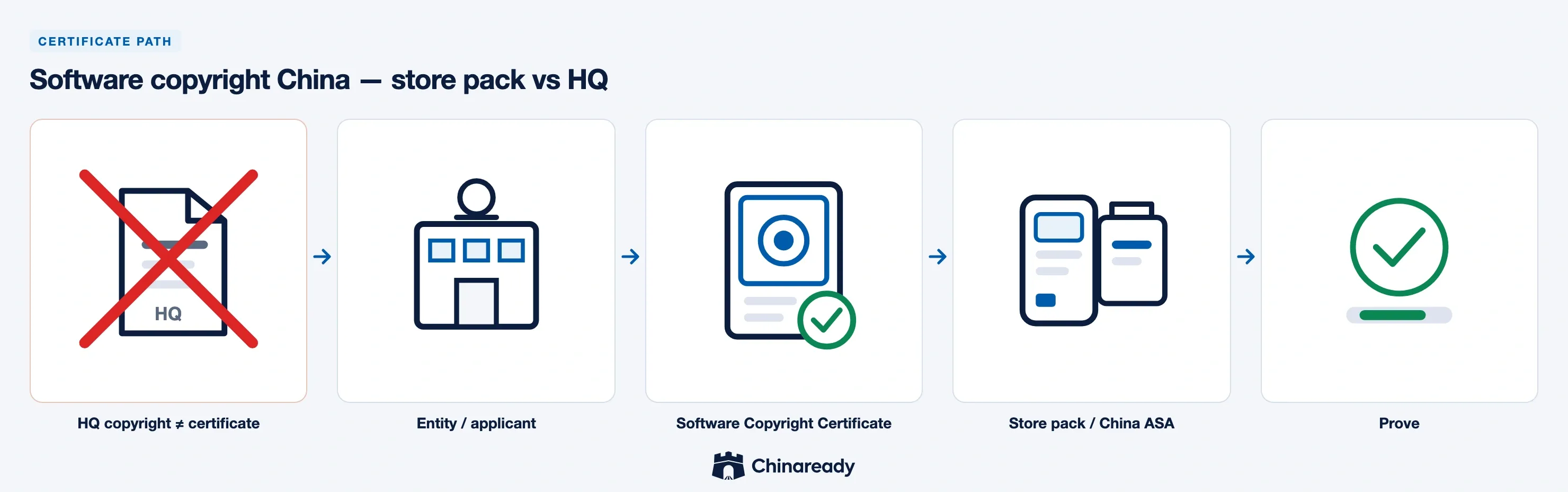
Software copyright China certificate — store pack vs HQ
Software copyright China is a certificate-vs-HQ decision. HQ copyright is not a Software Copyright Certificate. Need it for Mainland China Android packs and/or China ASA, or keep HQ only. Not MIIT App filing.
Software copyright China is a certificate-vs-HQ decision. HQ copyright exists when development is complete; a Software Copyright Certificate is the China registration proof that Mainland China Android store packs and China Apple Search Ads document review actually consume. Keep HQ copyright only, or lock an applicant entity and attach the certificate. The certificate is not MIIT App filing, not a trademark registration, and not a rewrite of Apple Search Ads. The store surfaces that ask for it are on the app stores in China map.
2026 policy update: CPCC registration has shifted from formality review to substantive integrity supervision — correction rates above 60%, AI-code review, a new application form, and a 4–5 month window. Full breakdown in China Software Copyright Registration 2026 — New Rules.
Video handbook
Short YouTube series on the software copyright certificate — what it is and is not, how to register under the 2026 rules, foreign-owner routes, and why store packs consume it. Full episode list and slide decks live on the handbooks hub.
- Full series on Chinaready handbooks — playlist, episode links, and PPT decks
Episodes:
| Ep | YouTube Title | Handbook |
|---|---|---|
| 1 | What a software copyright is | PPT |
| 2 | How to register it | PPT |
| 3 | Foreign owners and overseas entities | PPT |
| 4 | Why it matters in mainland China | PPT |
What a Software Copyright Certificate is (vs HQ copyright)
Hard names your pack will use:
- Software copyright China / Software Copyright Certificate — The registration certificate issued after a computer-software copyright recordal. Under the Regulations on Computer Software Protection (WIPO English, 2013 revision), a software copyright owner may register; the certificate is preliminary proof of the registered items, not the creation of the right. NCAC hosts an English text of the same Regulations.
- Copyright in China exists first — Article 14: software copyright exists from the date development is completed. Article 5: Chinese citizens, legal entities, and other organizations enjoy copyright whether or not the software is published; foreigners can enjoy copyright in China under first-publication or treaty rules. HQ copyright is real. It is still not the certificate a store pack asks to attach.
- China copyright ≠ trademark — This Guide is the certificate pack for software ownership proof. Name, logo, and brand clearance are a different registration. Do not staff trademark work as a substitute store pack.
- Registration agency — The National Copyright Administration designates the Copyright Protection Center of China (CPCC) as the software registration institution (NCAC Announcement No. 9). The Measures for the Registration of Computer Software Copyright (WIPO English) apply, including where an applicant is a foreign national (Article 5).
- What the pack contains (not a console tutorial) — The Measures ask for an application form, identifying materials of the program and files (typically the first and last thirty consecutive pages of source and documentation, with limited redaction options), and supporting identity / ownership documents.
- Certificate ≠ MIIT App filing — Filing is internet-information-service registration after an ICP-filed domain. The certificate is copyright registration proof. Publish an app in China treats both as common non-game gates. They are not interchangeable.
- Common myth — “We already have HQ copyright / a US Copyright Office record / Berne, so China stores and China ASA will accept that PDF.” Those proofs do not become a Software Copyright Certificate.
Vocabulary first. Next: what must exist before the certificate pack is real work.
What stops your product team before the certificate pack
Missing any of these stops your product team before a store upload or China ASA document drop is real work.
| Precondition | Why your process stalls |
|---|---|
| Job locked — Mainland China Android packages and/or China ASA vs HQ / export-only | A certificate program is staffed while HQ copyright was enough — or store/ASA dates are promised on HQ PDFs |
| Applicant entity named — who will appear as copyright owner on the certificate | Stores bounce packs when the holder does not match the Chinese organizing path |
| Software identity frozen — name, version, and identifying materials match the binary you will ship | Identifying pages and store metadata describe two different products |
| Ownership trail — employee-created, commissioned, or joint software documented | CPCC supporting documents and later store queries stall on “who wrote this” |
| Attach surface named — Android multi-store pack, China ASA Documents page, HarmonyOS store pack, or HQ-only | The certificate is issued and never attached to the channel that asked for it |
| Sister gates inventoried — MIIT App filing, security assessment, stay-up ops | The certificate is treated as a substitute for filing or security review |
Product teams usually cannot treat “export the HQ copyright PDF” as the Mainland China plan. Naming keep-HQ vs certificate-and-attach is the floor.
From applicant rail to store pack and China ASA
| Stage | Decision / outcome |
|---|---|
| 1. Name the job | Ordinary Mainland China Android distribution and/or China ASA, or HQ / export-only? |
| 2. If HQ / export-only | Keep HQ copyright. Do not market a Software Copyright Certificate as a China launch |
| 3. If stores or China ASA are the job | Rule HQ copyright out as the attachable proof. Lock the applicant entity |
| 4. Prepare identifying materials | Source/documentation pages and ownership papers that match the shippable software |
| 5. Register and obtain the certificate | Recordal through CPCC under the Measures; certificate is preliminary proof |
| 6. Attach to the pack that asked for it | Android store package, China ASA Documents (Industry Qualification / Entity as Apple labels them), HarmonyOS store pack if that OS is in scope |
| 7. Prove | Same software identity on certificate, filing, and store listing — then spend or submit |
Hard gate — applicant vs store entity
Necessity: wrong assumption here wastes the quarter — either registration starts under an HQ name the Android stores will not accept, or a partner holds a certificate your team cannot attach.
| Route | When it fits | What must already be true |
|---|---|---|
| HQ / export-only | No Mainland China Android package; no China ASA | China users are not the critical path; HQ copyright is named and capped |
| Certificate under the Chinese organizing entity | Domestic Android stores (and often HarmonyOS store packs) need a Chinese developer path | Applicant on the certificate matches the entity that will hold store accounts — see Publish an app in China |
| Foreign applicant recordal, then attach | Measures allow a foreign applicant; some iOS / ASA document packs can consume that proof | Confirm the live store or Apple Ads document menu before you freeze HQ as holder |
| China landing partner holds / operates the rail | No Mandarin CPCC ops, or no Chinese entity yet | Exit, ownership, and which entity’s name is on the certificate are agreed |
Hard gate — China ASA is spend after the pack
Apple Ads — Advertise in Mainland China: business and app must be approved; additional requirements also apply and may vary by placement; upload business licenses and other relevant documents from the Documents page (Entity vs Industry Qualification vs Creative Authorization). Campaigns will not run until app and business are approved. Set up an account notes the Documents page appears after Mainland China is added to a campaign. Apple’s help page does not name Software Copyright Certificate. Plan the certificate as the usual China software-ownership proof that Industry Qualification review consumes; confirm the live document menu with ops. Keyword spend after that pack is the Apple Search Ads in China Guide — not this one.
The Regulations say fees shall be paid for software registration; they do not publish a store-ready price list here. Do not freeze a vendor fee table. The 2002 Measures (WIPO English, Article 20) set a 60-day examination window from acceptance for a compliant application. Treat that as the legal text’s clock, not a store-deadline SLA — WIPO notes later amendments exist. Pack quality and applicant identity stall more often than the clock.
Why HQ copyright does not clear stores or ASA
HQ copyright → no attachable China certificate. Copyright in China can already exist. Android store packages and China ASA document review still ask for the registration proof.
Certificate without a matching applicant → store bounce. A foreign-holder certificate that cannot sit on the Chinese developer account fails the Android pack even when CPCC issued the PDF.
Certificate without attach → ASA hold. Apple’s Mainland China additional-requirements path is a go-live gate. A certificate in a legal folder is not a Documents-page approval.
Certificate treated as MIIT App filing → both gates slip. Filing is a different MIIT registration. Depth: China mobile app filing.
Certificate treated as a security assessment → stay-up risk. Assessment and takedown recovery are separate jobs: App security assessment in China, App removed from China stores.
HarmonyOS pack assumed covered by an Android-only certificate row → OS mismatch. If HarmonyOS NEXT is in the ship matrix, the store pack for that OS still needs the same identity proof — HarmonyOS NEXT in China.
Trademark work reported as software copyright China done → wrong IP rail. Name clearance does not prove software authorship for a store pack.
What blocks product teams on the certificate path
- HQ-PDF plans — Legal sends a US or EU copyright record and calls software copyright China finished.
- Applicant / store entity split — Certificate holder and Android developer entity are two companies with no assignment trail.
- Identifying materials from the wrong binary — First/last source pages describe a fork, SDK, or old version.
- Employee or vendor ownership undocumented — Commissioned or service-created software lacks the supporting contract the Measures expect.
- ASA locale-flip — Growth schedules China Search Ads before the Documents pack exists; remap spend to Apple Search Ads in China only after attach.
- Filing confusion — Teams wait on MIIT App filing and skip the certificate, or the reverse.
- Stay-up ignored — A listing that later fails identity or assessment review is a removal job, not a first-submit trophy.
- No Mandarin ops owner — CPCC correspondence, store questionnaires, and Apple Ads document follow-ups are not English-first.
What “fixed” means: the job is named (HQ-only vs store/ASA); the applicant matches the organizing path that will attach the file; a Software Copyright Certificate exists for the software you actually ship; it is on the Android / HarmonyOS store pack and/or China ASA Documents request; MIIT App filing is tracked as a separate gate. HQ copyright alone is not fixed.
China landing partner for the certificate pack
Most product teams exploring Mainland China entry need a China landing partner to lock the applicant entity, run CPCC recordal, match the certificate holder to Android or HarmonyOS store accounts, and attach the proof to China ASA document review — not another longer HQ copyright memo. Your team still owns which SKU ships, whether China ASA is in scope, and which residual HQ copyright line to keep; the partner path makes the Software Copyright Certificate an executable store/ASA pack when those rails are not already in-house.
What we can offer?
Software copyright China work is a certificate-vs-HQ decision before any store upload or China ASA keyword sprint. Chinaready helps your product team lock the applicant rail and attach a Software Copyright Certificate to the pack that actually asks for it:
- China Readiness Assessment — Map whether Mainland China Android packages and/or China ASA are the job, which entity should appear as applicant, and which filing, assessment, and stay-up gates sit beside the certificate before a store date.
- China Access Acceleration — Keep China-facing product and privacy pages reachable from Mainland China vantage so a store listing that now carries the certificate does not die on offshore-only destinations.
- China Product Hosting — Place China-critical APIs and pages where ICP adjacency and the filed app identity stay coherent with the software named on the certificate.
- Mobile App Distribution — Align the Software Copyright Certificate, MIIT App filing, Android / HarmonyOS store packs, and China ASA document attach so the certificate is not mistaken for a substitute launch.
Contact us when you need a Software Copyright Certificate store/ASA path before you staff an HQ-copyright PDF as the China pack.
Frequently asked questions
What is a Software Copyright Certificate?
A Software Copyright Certificate is the registration proof issued after a computer-software copyright recordal with the Copyright Protection Center of China, the agency designated by the National Copyright Administration. It is preliminary proof of the registered items — not the same thing as HQ copyright existing, and not MIIT App filing.
Does copyright in China exist without the certificate?
Yes. Under the Regulations on Computer Software Protection, software copyright exists from the date development is completed, and foreigners can enjoy copyright in China under treaty or first publication rules. The certificate is voluntary registration proof that store packs and China ASA document review actually consume.
Is China copyright the same as a Software Copyright Certificate?
No. China copyright is the legal right. A Software Copyright Certificate is the China registration document. HQ copyright, a US Copyright Office record, or a WIPO filing is not a substitute when a Mainland China Android store or China Apple Search Ads pack asks for the certificate.
Do we need a Software Copyright Certificate for Apple Search Ads in Mainland China?
Plan it as China ASA adjacency. Apple requires business and app approval plus additional documents that vary by placement, uploaded as Entity or Industry Qualification files. Apple’s help page does not name the certificate. Treat it as the usual China software-ownership proof that document review consumes, then run spend on the Apple Search Ads Guide.
Is the certificate the same as MIIT App filing?
No. MIIT App filing is internet-information-service registration after an ICP-filed domain. A Software Copyright Certificate is copyright registration proof. Stores often want both. Missing one does not clear the other. Depth on filing sits in the China mobile app filing Guide.
Can product teams finish the certificate without Mainland China ops?
Usually no. Applicant identity, identifying materials, Mandarin registration rails, and store or Apple Ads document attach sit on rails most global teams lack. That is when a China landing partner becomes the realistic path — especially when the Android developer entity must match the certificate holder.
Insights
Other similar insights
Part of the App distribution cluster — every guide in the cluster, one page.