
China app security assessment — when it blocks store launch
China app security assessment is the publisher pack that can block Mainland China store launch or stay-up. Fork whether this channel needs the pack now, or filing plus ordinary review is enough. Incomplete questionnaires bounce.
China app security assessment is the store / publisher pack that can block Mainland China launch or stay-up — not MIIT App filing, and not the PIPL cross-border data security assessment. Your product team forks whether this channel requires the assessment pack now, or filing plus ordinary store review is enough. Incomplete questionnaires are a common bounce. A missed or failed pack can pull a live listing.
What a China app security assessment pack is
Hard names your launch program will use:
- China app security assessment / app security assessment China — The publisher pack stores use to decide whether a build may list or stay listed: organizing-entity proof, security and privacy questionnaires, SDK and data-flow inventory, encryption and permission declarations, and the console’s china store security review (human review, automated scan, or both). It is paperwork plus scan — not a pentest you invent the night before submit.
- Not App filing — China mobile app filing is the MIIT registration for apps that provide internet information services. Stores usually want the filing number first. Filing does not fill the assessment pack.
- Not one CAC upload portal — The 2022 Provisions on the Administration of Mobile Internet Applications Information Services require distribution platforms to run listing review and ongoing management. Stores implement that as their forms and scanners. There is not one English national form you register once.
- Store scanners differ — Xiaomi GetApps documents automated compatibility and security testing in its review-stage FAQ; a failed automated security pass can reject before human review. Other OEM consoles run their own engines — variance lives on China Android app-store rejection.
- Not PIPL outbound assessment — PIPL product gates cover inventory, consent, processors, and the cross-border fork. That “security assessment” is a data-export path. Do not rewrite it as this store pack.
- Not MLPS — Graded cybersecurity for systems you operate after launch is a different program and clock (China MLPS). It does not replace the listing pack.
- Incomplete packs bounce — Form titles change. The failure mode does not. Publish an app in China already flags incomplete security / privacy questionnaires; this Guide owns the assessment pack.
Vocabulary first. Next: what must be true before the fork is real work.
What stops the pack before your team opens a console
Missing a named channel fork stops your product team before another “fill the security form during review” sprint is real work.
| Precondition | Why your process stalls |
|---|---|
| Channel named — which Mainland China stores (first-wave Android OEM / third-party, Apple China, or both) | A Xiaomi scan is staffed while the listing is OPPO-only — or the reverse |
| Fork locked — this path needs the assessment pack now, or filing plus ordinary store review is enough | Teams burn a quarter on a pack the console never gated — or submit with filing only and bounce |
| Chinese organizing entity (or contracted publish / landing path) that matches store accounts | Overseas HQ as sole publisher cannot complete legal-person and enterprise verification |
| Questionnaire owner who can answer in the console language from live product facts | English privacy PDFs and last year’s answers fail when SDKs or hosts changed |
| SDK and data-flow inventory frozen against the binary you will ship | Reviewers compare declarations to the APK/IPA; drift is a bounce |
| App filing identity aligned — package name, organizer, privacy URL | Store review treats filing mismatch as a security or identity fail — China mobile app filing |
| Stay-up owner for updates | A live app with a stale pack is a removal risk — app removed from China stores |
Mandarin consoles, enterprise / legal-person verification, and bilingual questionnaire owners are part of this floor. Product teams usually cannot clear app security China from an overseas Play Console or a global App Store Connect account alone.
Filing-only versus the assessment pack
| Stage | Decision / outcome |
|---|---|
| 1. Name the job | Which stores, which category, which build identity |
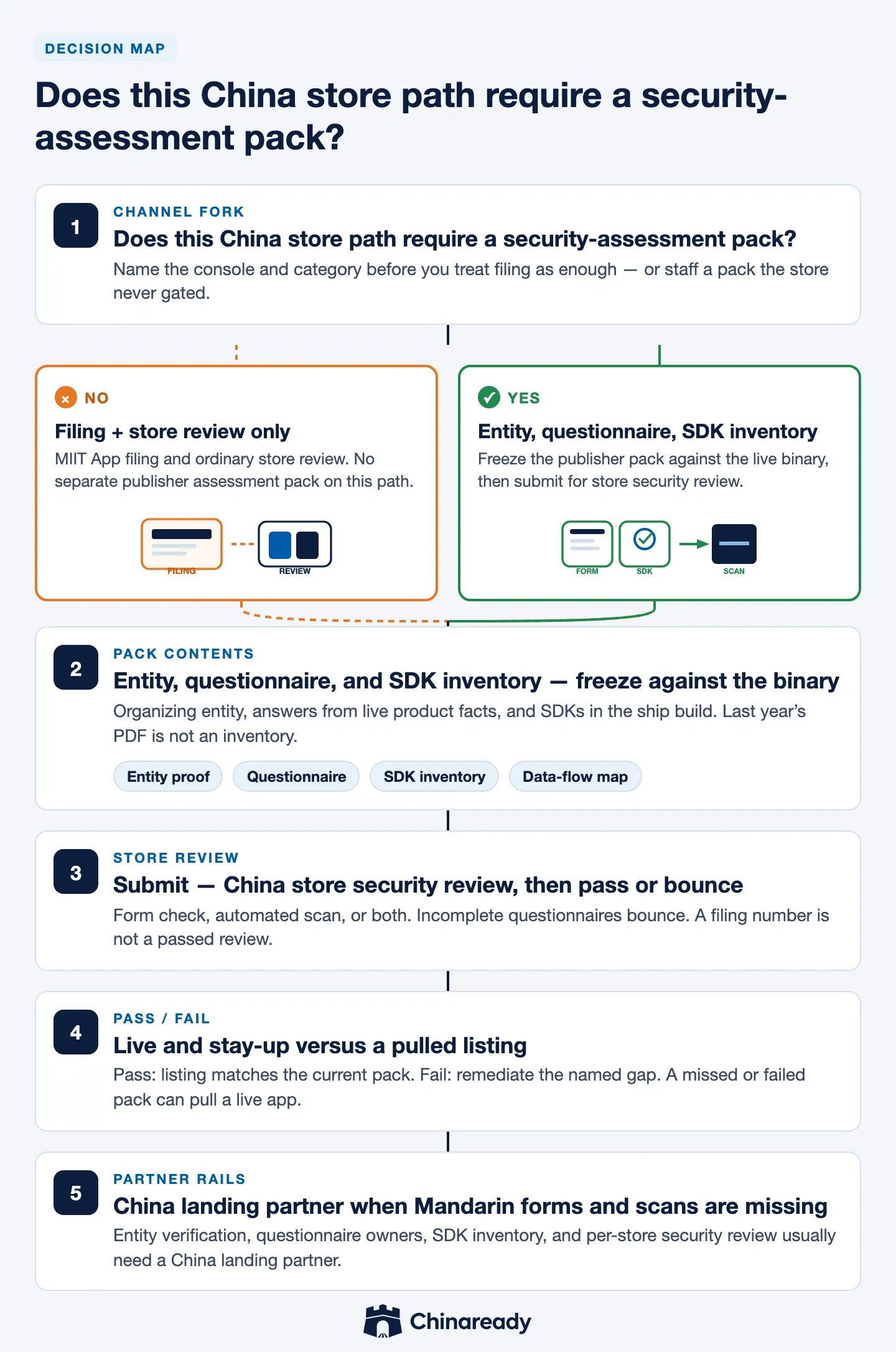
| 2. Fork | Does this China store path require a security-assessment pack now? |
| 3. If no | Complete mobile app filing and ordinary store review only. Still run Chinese metadata and a China-reachable product path — publish an app in China |
| 4. If yes | Freeze entity + questionnaire + SDK inventory against the live binary before you open the console |
| 5. Submit | Upload the pack and accept china store security review (form check, automated scan, or both) |
| 6. Pass or bounce | Pass → listing / stay-up. Bounce → remediate the named gap; incomplete questionnaires are the usual miss |
| 7. Operate | Keep the pack current on SDK, permission, and host changes so a live app is not pulled |
Hard gate — China store security review vs filing-only
Necessity: confusing these two jobs wastes the quarter — either you staff a pack the channel never gated, or you treat filing as enough and bounce on the first OEM console.
| Path | What must already be true | What “done” looks like |
|---|---|---|
| Filing + ordinary review | This console does not gate a separate assessment pack for this category | Filing number, store listing materials, review pass |
| Assessment pack required | This console / category asks for questionnaires, SDK inventory, and/or a security scan | Pack submitted, scan or review pass, listing allowed to stay up |
| Category extras | Social, education, health, finance, and similar verticals | Extra assessments or licenses on top of the base pack — still not a guess |
| Apple China | Privacy and review questionnaires under App Store Review Guidelines | A different rail from OEM Android assessment packs — do not clone one pack onto both |
Software copyright certificates often sit beside the pack as a store material, not inside it: software copyright China. Privacy enforcement campaigns are a sibling removal pattern, not this form: app privacy enforcement in China.
Why a bounce here blocks launch and stay-up
Engineering and ops constraints you must design around:
| Constraint | What breaks | What to do |
|---|---|---|
| Filing ≠ pack | The filing number is issued; the store still rejects an empty or stale questionnaire | Sequence filing first, then the pack on channels that require it |
| Incomplete questionnaire | Review never starts, or returns for “supplement materials” | Freeze answers from the live binary before submit — not during the review clock |
| SDK inventory disagrees with the APK/IPA | Scanner or reviewer flags undeclared analytics, login, or location SDKs | Inventory from the build, not from a marketing slide |
| Console-specific scanners | One OEM pass is treated as “China approved” | Grade per store — China Android app-store rejection |
| PIPL pack pasted as the store pack | Outbound-data analysis is done; the publisher form is still blank | Keep PIPL product gates on its own fork |
| Live listing, stale pack | An update or campaign scan pulls the app | Treat stay-up as the same pack — app removed from China stores |
A filing number ≠ a passed china store security review. MIIT registration is a different gate.
“We’ll fill it during review” → multi-week slip. Incomplete questionnaires are already the common bounce on the publish path; this pack is where that bounce lives.
One English PDF for every OEM → false confidence. Form titles and scan engines differ. Clone only the facts (entity, SDK list, data flows), not last quarter’s screenshot set.
HQ laptop QA → missed scan findings. Testers outside Mainland China never see a store-side security bounce, so the ticket never opens.
What stalls teams on app security China
- Yes/no SKU thinking — Product treats “do we need security assessment?” as a national toggle before the channel fork is named.
- Filing as the pack — App filing SDK fields are copied into a store questionnaire without a new inventory against the binary you will ship.
- PIPL or outbound assessment as this form — Counsel finishes a cross-border memo; the OEM console still wants the publisher pack.
- MLPS as launch paperwork — Graded cybersecurity for live systems is staffed as if it were a store form.
- English-only answers on Mandarin forms — Forms stay Mandarin-only on many consoles. Describe them in English for your team; do not ship untranslated guesses.
- No owner after listing — The pack is treated as a one-time upload. SDK and host drift then look like a surprise removal.
- Category honesty skipped — A “tools” label with social, health, or finance behavior invites extra assessment the team never budgeted.
What “fixed” means: the named stores either (a) listed on filing plus ordinary review because this path did not gate a pack, or (b) hold a current assessment pack that matches the live binary, with a stay-up owner. A filing number in a slide is not fixed. A privacy PDF in a shared drive is not fixed.
China landing partner for Mandarin assessment rails
Most product teams exploring Mainland China entry need a China landing partner to run entity verification, Mandarin questionnaires, SDK inventory against the ship binary, and per-store security review — and to keep that pack current after listing. Your team still owns product scope, category honesty, and which channels are in the first wave; the partner path makes the gates executable when those rails are not already in-house. Keeping an overseas Play listing does not remove the need for that China landing partner on the Mainland China store path.
What we can offer?
China app security assessment work is a channel fork before you treat filing as enough — or staff a pack the console never asked for. Chinaready helps your product team name the pack, complete it where it is required, and keep listings up after launch:
- China Readiness Assessment — Fork whether this product’s China store path needs the security-assessment pack now, or filing plus ordinary review is enough, including category extras that add questionnaires.
- China Access Acceleration — Keep privacy URLs, data-flow evidence hosts, and in-app journeys reachable from Mainland China so a passed pack still matches a real install-to-value path.
- China Product Hosting — Place backends and evidence sites on Mainland China termination when the questionnaire and filing story depend on in-country hosts — instead of declaring storage the binary does not use.
- Mobile App Distribution — Submit the pack with first-wave Android and Apple China review, then operate updates so a stale questionnaire does not pull a live app.
Contact us when a China store security-assessment form is blocking launch or stay-up — before you fill it during review.
Frequently asked questions
What is a China app security assessment?
It is the store / publisher pack — entity proof, questionnaires, SDK and data-flow inventory, plus the console’s security review or scan — that can block Mainland China listing or stay-up. It is not MIIT App filing, not MLPS for systems you operate, and not the PIPL cross-border data security assessment.
Is app security assessment China the same as App filing?
No. App filing is the MIIT registration that usually must exist before stores will take a new listing. The assessment pack is extra store-side paperwork and review. Filing done does not mean the pack is done. Pair the mobile app filing Guide.
When does China store security review require a dedicated pack?
When this product’s channel and category gate a questionnaire, SDK inventory, and/or automated security scan beyond ordinary store review. Some paths stay on filing plus review only. Inventory per console — do not assume one national English form.
Is this the PIPL or outbound-data security assessment?
No. PIPL product gates and cross-border data transfer assessment are a different fork. This Guide is the publisher forms and store scans that block launch or stay-up. Do not paste a privacy PDF and call the store pack complete.
What happens if the pack is incomplete or fails after launch?
Incomplete questionnaires are a common bounce before listing. A missed or failed assessment on a live app can pull the listing. Pair the app-removed Guide for stay-up. Keep the pack current when SDKs, hosts, or permissions change.
Can product teams finish app security China without a landing partner?
Usually no. Mandarin forms, entity verification, SDK inventory that matches the binary, and per-store scans sit on rails most global teams lack. That is when a China landing partner becomes the realistic path.
Insights
Other similar insights
Part of the App distribution cluster — every guide in the cluster, one page.