China Software Copyright Registration 2026 — New Rules
China software copyright registration (软著) turned substantive in 2026 — 60%+ correction rate, AI-code review, a new application form, and paperless e-certificates on a 4–5 month timeline.
This guide consolidates and de-duplicates three Chinese articles on the 2026 software copyright (“软著”) reform, reorganized as: what changed → what qualifies → what to submit → how to avoid pitfalls → the cost of non-compliance. Suitable for internal briefings and project planning. Policy information current as of August 2026. Always refer to the latest notices from the Copyright Protection Center of China (CPCC).
简体中文版:《软著申请 2026 年新政解读(开发者与产品团队版)》 — 本指南的中文原文。
Introduction: What Is a Software Copyright, and Where Is It Used?
In one sentence: a software copyright registration (计算机软件著作权) is the National Copyright Administration’s official confirmation of ownership over the “original expression” of your source code and documentation — essentially a “legal ID card” for your software, proving “you wrote this code.”
It doesn’t change the software itself, but it is indispensable currency in these 6 scenarios:
| Use Case | Details |
|---|---|
| App store listing | Major Chinese Android app stores (Huawei, Xiaomi, OPPO, vivo, Tencent MyApp, etc.) generally require a software copyright certificate before listing |
| IP enforcement | When facing code plagiarism or product piracy, the certificate serves as prima facie evidence of ownership in litigation |
| Qualifications & tax incentives | High-and-New-Tech Enterprise (HNTE) certification, “Double Soft” evaluation, and R&D super-deduction all score heavily on software copyright counts |
| Subsidies & government programs | Funding channels such as first-edition software and industrial software initiatives (e.g., Chongqing’s “All-Star” program) require the certificate as step one |
| Bidding & business development | Government and enterprise procurement often treats software copyrights as scoring bonuses or entry thresholds |
| Financing & personal growth | IP valuation in fundraising due diligence; for students, a common credential for graduate-school recommendation, scholarship reviews, and innovation competitions |
For how the certificate plugs into Mainland China Android store packs and China Apple Search Ads document review, see the companion guide Software copyright China certificate — store pack vs HQ.
1. The Numbers: Why the “Old Playbook” Is Dead
In 2026, software copyright registration shifted wholesale from “formality review” to “substantive integrity supervision” (some sources call it “limited substantive review”). The direct consequences:
| Metric | Change |
|---|---|
| Correction notice rate | Soared to over 60% |
| Rejection rate | Up 40%+ year-over-year |
| Standard processing time | Stretched from 3 months to 4–5 months |
| Abnormal applications | 3,200 cases nationwide in January–February alone |
Direct impact on project management: If the certificate is a prerequisite for app store listing, HNTE certification, project applications, or policy rewards (e.g., Chongqing’s “All-Star” program, with individual awards up to ¥20 million), you must build the 4–5 month processing window — plus possible correction rounds — into your critical path. File as soon as development completes; don’t wait until it’s “urgently needed.”
2. Three Core Changes in the 2026 Registration Rules
2.1 New Application Form (effective March 15, 2026; old form abolished)
- Feature description expanded from 100–200 characters to 500–1,300 characters. Applicants must fully cover R&D background, core architecture, functional modules, technical implementation, and use cases. Templated summaries are returned outright; insufficient length blocks submission entirely.
- Signature page adds a handwritten integrity pledge + agent’s ID number. The filing agent must hand-copy — in black gel pen — the pledge that “no AI was used to develop code, write documentation, or generate application materials” (checkboxes or printed text are invalid), then sign and provide their national ID number. False pledges carry consequences tied to the copyright registration dishonesty list + personal credit records.
2.2 The “Three Blades” of the New Review Mechanism
- Code similarity comparison system goes live: submitted source code is compared in full against the historical registration database and open-source projects across the web. Excessive similarity triggers automatic rejection with no correction opportunity. The “rename variables in open-source code and submit” route is completely closed.
- AI code review standards issued: code generated purely by one-click AI tools, with no human secondary development or core-logic optimization, is deemed “lacking originality” and rejected as an abnormal application. Note: AI is not banned — you must demonstrate substantive intellectual contribution: what you changed, why, and how the code logic changed as a result.
- Cross-departmental joint verification normalized: the CPCC cross-checks R&D super-deduction records with tax authorities and HNTE application materials with science & technology authorities. If your copyright filings show sloppy code while your tax filings claim millions in R&D spending, both sides will face problems.
2.3 Fully Paperless: No “Physical Software” Required
- Copyright protects the “expression” of code and documentation, not the physical medium. No installation packages, CDs, USB drives, or devices needed.
- Official application portal: CPCC website (https://www.ccopyright.com.cn/); direct software registration entry: https://register.ccopyright.com.cn/registration.html#/registerSoft . This is the only software registration body recognized by the National Copyright Administration — beware of fake agency websites.
- Fully online: account registration, real-name verification, form filling, and document upload in one flow.
- The signature page is generated online, printed, hand-signed (individual) or stamped (company), scanned, and re-uploaded as PDF.
- Upon approval, a PDF e-certificate with a digital anti-forgery seal is issued — legally equivalent to paper certificates, which are no longer provided.
3. What Qualifies — and What’s “Rejected on Sight”
Green Zone: All Registrable
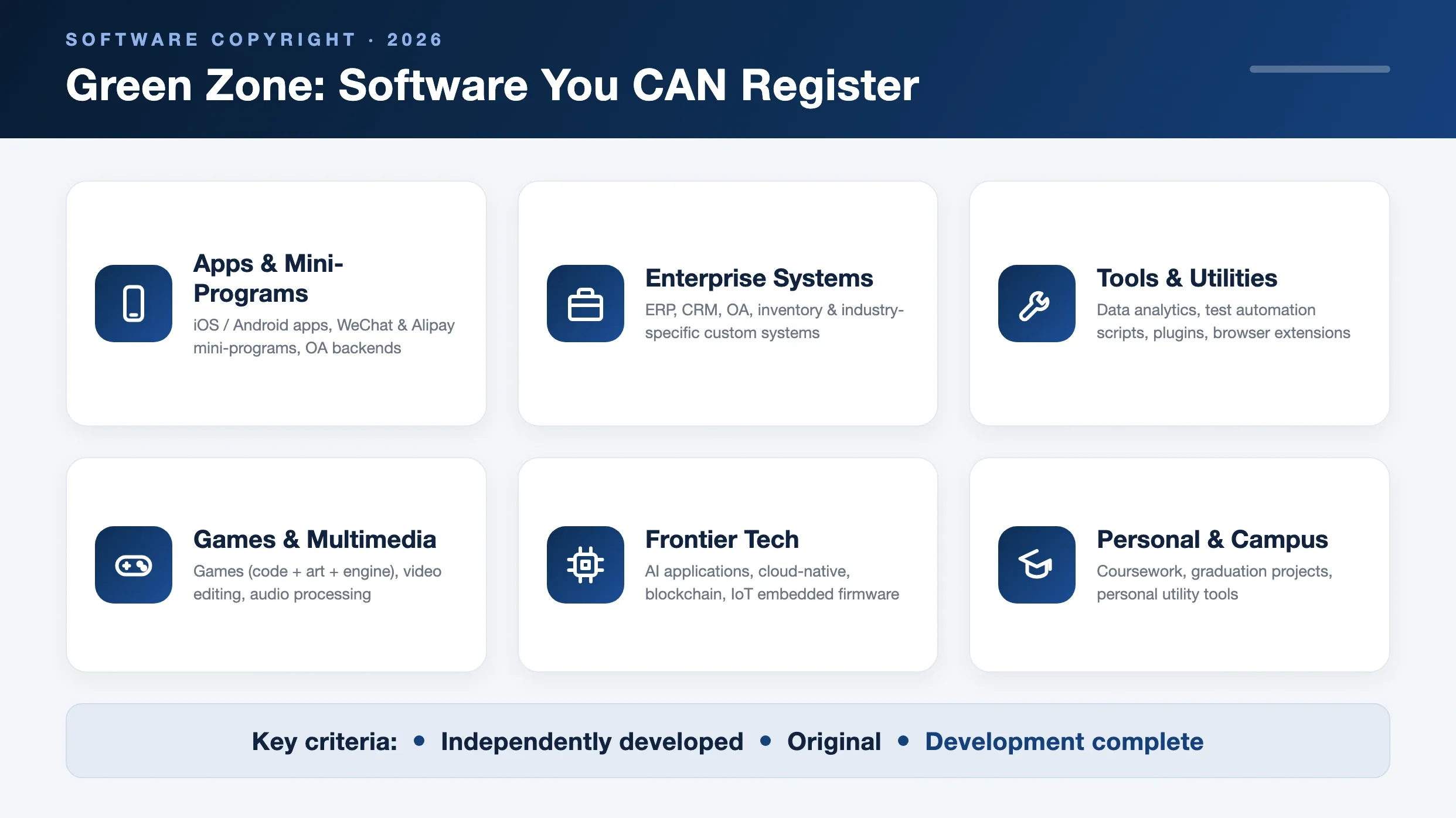
Coverage is broad. The core requirements are “originality + completed development” — even an automation script of a few dozen lines qualifies:
- Apps & mini-programs (iOS/Android apps, WeChat/Alipay mini-programs, official-account backends)
- Enterprise & office systems (ERP, CRM, OA, inventory, plus industry-specific systems for restaurants, healthcare, education)
- Tools & utilities (data analytics tools, test automation scripts, code review plugins, browser extensions)
- Games & multimedia (games including code, art assets, and engine architecture; video editing and audio processing software)
- Frontier tech (AI algorithm applications, cloud-native architecture, blockchain traceability, IoT embedded firmware)
- Personal & campus projects (coursework, graduation projects, personal utility tools)
Red Zone: Rejected on Submission — Don’t Waste Your Effort
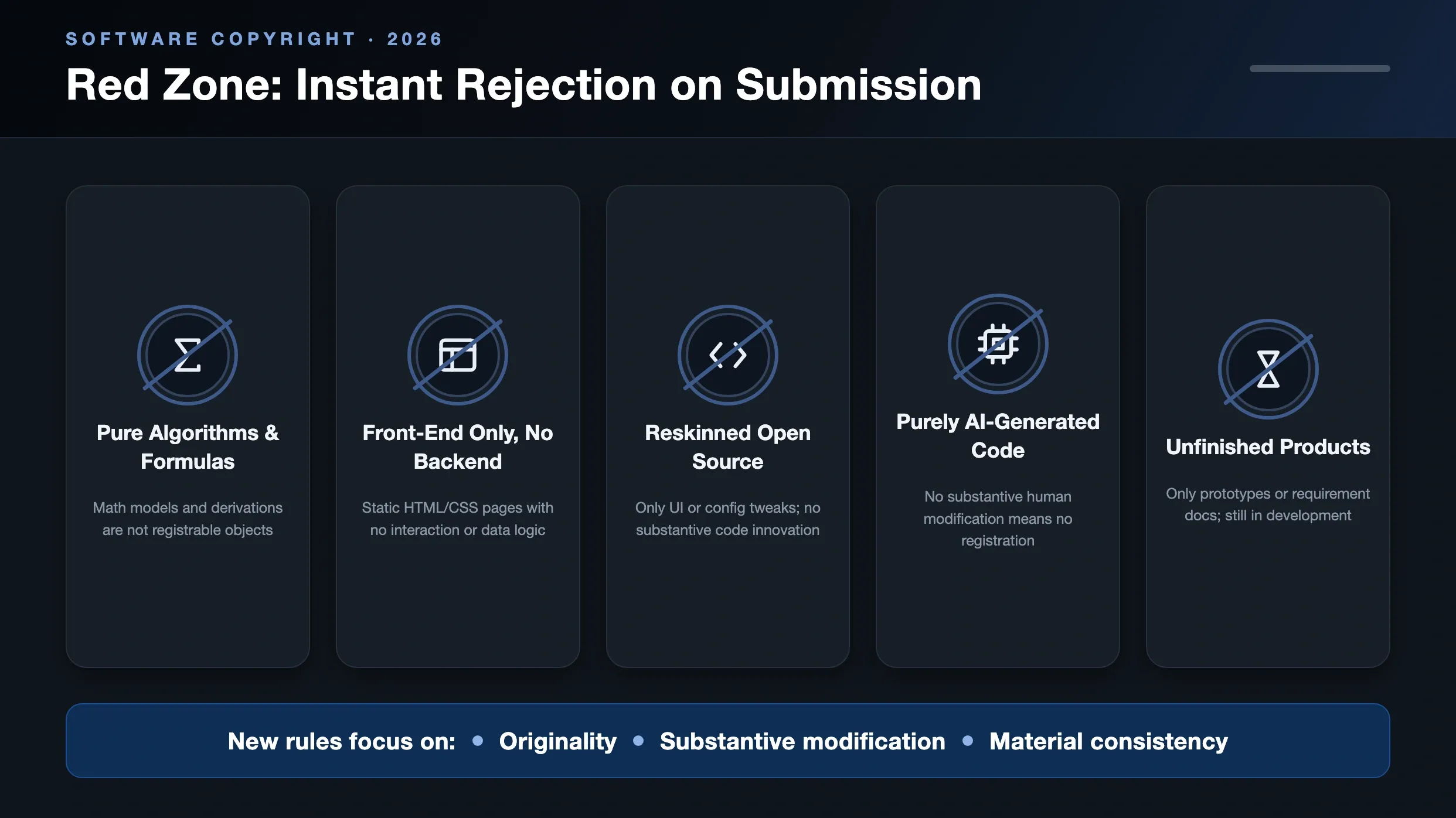
- Pure algorithms & mathematical formulas: math models, algorithm derivations, and rules of intellectual activity are not copyrightable objects
- Front-end without backend logic: static HTML/CSS/JS pages with no real interaction or data processing
- “Reskinned” open-source projects: repackaged code with only UI or configuration changes and no substantive innovation
- Purely AI-generated code: the key review target of 2026 — no substantive human modification means no registration, period
- Unfinished products: projects with only requirement docs or prototypes, still in development, not yet fixed in a tangible medium
4. Application Materials Checklist: The Electronic “Three-Piece Set”
| Material | Requirements |
|---|---|
| Source code (program identification material) | Submit the first 30 pages + last 30 pages (60 total); if under 60 pages, submit everything. At least 50 lines per page; the header must show “full software name + version + page number.” Code should be clean — no large blank sections or meaningless comments |
| Software manual (document identification material) | With a UI (apps/admin systems) → submit a user operation manual, illustrated with real interface screenshots and operation steps; software name and version in screenshots must match the filing. Pure backend logic/middleware/algorithms → submit a software design specification with architecture diagrams, flowcharts, and core module descriptions. Text-only manuals without screenshots are easily rejected |
| Identity proof + application form | Individuals: scanned ID card (front and back). Companies: scanned business license copy |
5. Pitfall Guide: Where Corrections Hit Hardest
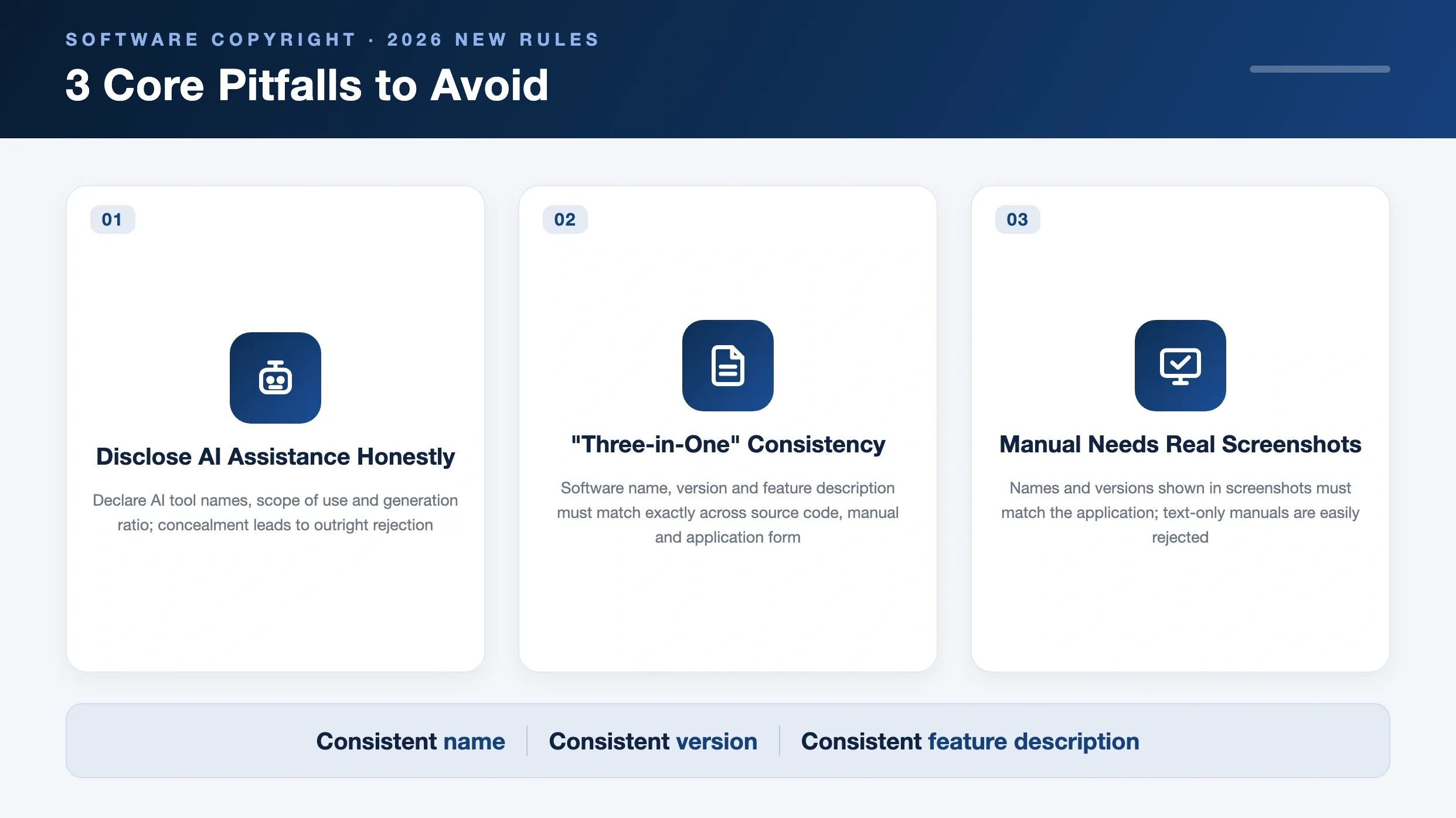
- “Three-in-one” consistency is the bottom line: software name, version number, and feature description must be identical across source code, manual, and application form — down to letter casing. “V1.0” on the form but “V1.0.1” in code headers is a classic correction trigger.
- AI assistance must be honestly disclosed: if you used AI tools (e.g., Copilot), you must declare the tool name, scope/stage of use, and generation ratio in the application. Concealment, once discovered, means outright rejection.
- Features must map to code: if the manual mentions a “data encryption module,” the submitted source code must contain the corresponding logic.
- Write the feature description in full: prepare 500–1,300 characters covering R&D background, architecture, modules, technical implementation, and use cases.
- Time your filing right: file as soon as development completes — don’t wait until your listing is blocked or you’ve been infringed.
- Use tooling to save effort: compiling 60 pages of code and an illustrated manual is heavy work; specialized material-generation tools (e.g., 语流软著宝) can auto-format code and generate manuals, saving hours of mechanical work.
6. Red Lines: Four Abnormal Application Types and the Penalty Chain
Four behaviors under targeted crackdown
- Bulk flooding applications: a single entity submitting large volumes of copyrights in a short time, spanning wildly unrelated domains, clearly detached from normal R&D cadence (e.g., an e-commerce SaaS company suddenly filing dozens of industrial-control software titles). More than 3 submissions per day by the same entity triggers automatic system alerts.
- AI-generated fake materials: the hallmark of low-cost agencies — mass-generating code and manuals with AI, disguising them as “original” through variable renaming and comment tweaks.
- Template ghostwriting & code plagiarism: generic templates with swapped project names; manuals so vague they only mention “user login” and “data query”; in worse cases, directly copying open-source code or others’ registered software.
- Duplicate registration & malicious hoarding: resubmitting the same software with a new name or version number, or splitting one complete system into multiple modules registered separately.
The penalty chain (far beyond mere “rejection”)
- Application rejected — correction within deadline (max 2 rounds; still non-compliant → rejection)
- 6–12 month filing ban for the company/agent
- Copyright dishonesty list (company + individual)
- Credit disclosure — synced to the National Enterprise Credit Information Publicity System and personal credit reporting system
- Legal liability where laws are violated
One abnormal application affects not just this one filing — it can compromise the company’s eligibility for all future IP-related business, and the filing agent’s personal credit.
7. Action Items by Role
Processing Timeline Reference (Under the 2026 New Rules)
Under the new policy, a smooth application takes about 35–60 working days (2–3 months); with corrections, it stretches to 4–5 months. Breakdown by stage:
| Stage | Duration | Notes |
|---|---|---|
| Registration + real-name verification | 1–3 working days | Includes facial verification |
| Acceptance notice | 5–7 working days | Only if materials are complete; otherwise a 30-day correction window applies |
| Examination | Within 60 working days of acceptance (statutory cap) | Per the Computer Software Copyright Registration Measures; under the stricter 2026 review, processing often runs close to this cap |
| Certificate issuance | Download the e-certificate from the official website after approval | Carries a digital anti-forgery seal; legally equivalent to a paper certificate |
Scheduling advice: Plan on two scenarios — “smooth: 2.5 months” and “conservative: 5 months.” If the software copyright is a hard prerequisite for app store listing or policy applications, back-plan your start date from the 5-month scenario. Passing on the first submission is the only real accelerator: keep name/version/feature description consistent across all materials, submit clean code, and include real screenshots in the manual — avoiding corrections locks in the smooth 35–60 working-day timeline.
Developers
- Preserve real R&D traces: design docs, commit history, iteration records — all evidence of “substantive intellectual contribution”
- If you used AI, disclose it honestly and perform substantive secondary development on AI output
- Stay away from reskinning open source and “rename-the-variables” pseudo-originality — the similarity system offers no second chances
Product teams
- Prepare the feature description to the new 500–1,300 character standard; align wording with engineering to ensure consistency across “application form — manual — code”
- Manuals must include real UI screenshots; names and versions shown in screenshots must match the filing
Project managers / company leadership
- Build the 4–5 month processing window + correction buffer into project schedules; kick off filing at development completion
- Control filing cadence: no more than 3 submissions per entity per day to avoid bulk-application alerts
- Copyright data is cross-checked against tax super-deduction and HNTE filings — keep all data streams consistent
- The certificate is step one for funding channels like first-edition software and industrial software programs; compliant, timely registration is how you catch the policy window
Sources
Official sources (Copyright Protection Center of China)
- CPCC official website (official software copyright portal) — direct online registration entry: https://register.ccopyright.com.cn/registration.html#/registerSoft
- Announcement: “Jointly Maintaining a Healthy Ecosystem for Computer Software Copyright Registration” (2026-03-15) — official text on the new application form, integrity system, and dishonesty penalties
- CPCC: “Research and Deployment on Governing Abnormal Software Copyright Registration Applications” (2026-02-14) — official deployment of the abnormal-application crackdown
Reference commentary
- 2026年软著申请大变化:补正率60%、AI生成被禁、经办人实名——旧模式彻底失效了 (Sohu, in Chinese)
Frequently asked questions
What changed for software copyright registration in China in 2026?
Registration shifted wholesale from formality review to substantive integrity supervision (limited substantive review). A new application form took effect on March 15, 2026, the correction notice rate passed 60%, rejections rose 40%+ year-over-year, and standard processing stretched from 3 months to 4–5 months.
Is AI-generated code banned from software copyright registration?
No — AI is not banned, but purely AI-generated code with no human secondary development is rejected as an abnormal application. You must disclose the tool name, scope of use, and generation ratio, and demonstrate substantive intellectual contribution.
What materials does a 2026 software copyright application need?
The electronic three-piece set — source code (first 30 + last 30 pages, at least 50 lines per page, header showing full software name + version + page number), a software manual (illustrated user operation manual for UI software, or a design specification for backend logic), and identity proof with the application form.
How long does software copyright registration take under the 2026 rules?
A smooth application takes about 35–60 working days (2–3 months); with corrections it stretches to 4–5 months. Examination is capped at 60 working days from acceptance by statute, and the stricter 2026 review often runs close to that cap.
What happens if an application is flagged as abnormal?
The penalty chain goes beyond rejection — correction within deadline (max 2 rounds), then a 6–12 month filing ban for the company or agent, the copyright dishonesty list, credit disclosure synced to national credit systems, and legal liability where laws are violated.
Where do you file a software copyright application in China?
Only the Copyright Protection Center of China (CPCC) portal — ccopyright.com.cn, with direct registration at register.ccopyright.com.cn. The process is fully paperless and ends with a PDF e-certificate carrying a digital anti-forgery seal, legally equivalent to the discontinued paper certificate.
Insights
Other similar insights
Part of the App distribution cluster — every guide in the cluster, one page.