
Publish an app in China — filings then multi-store launch
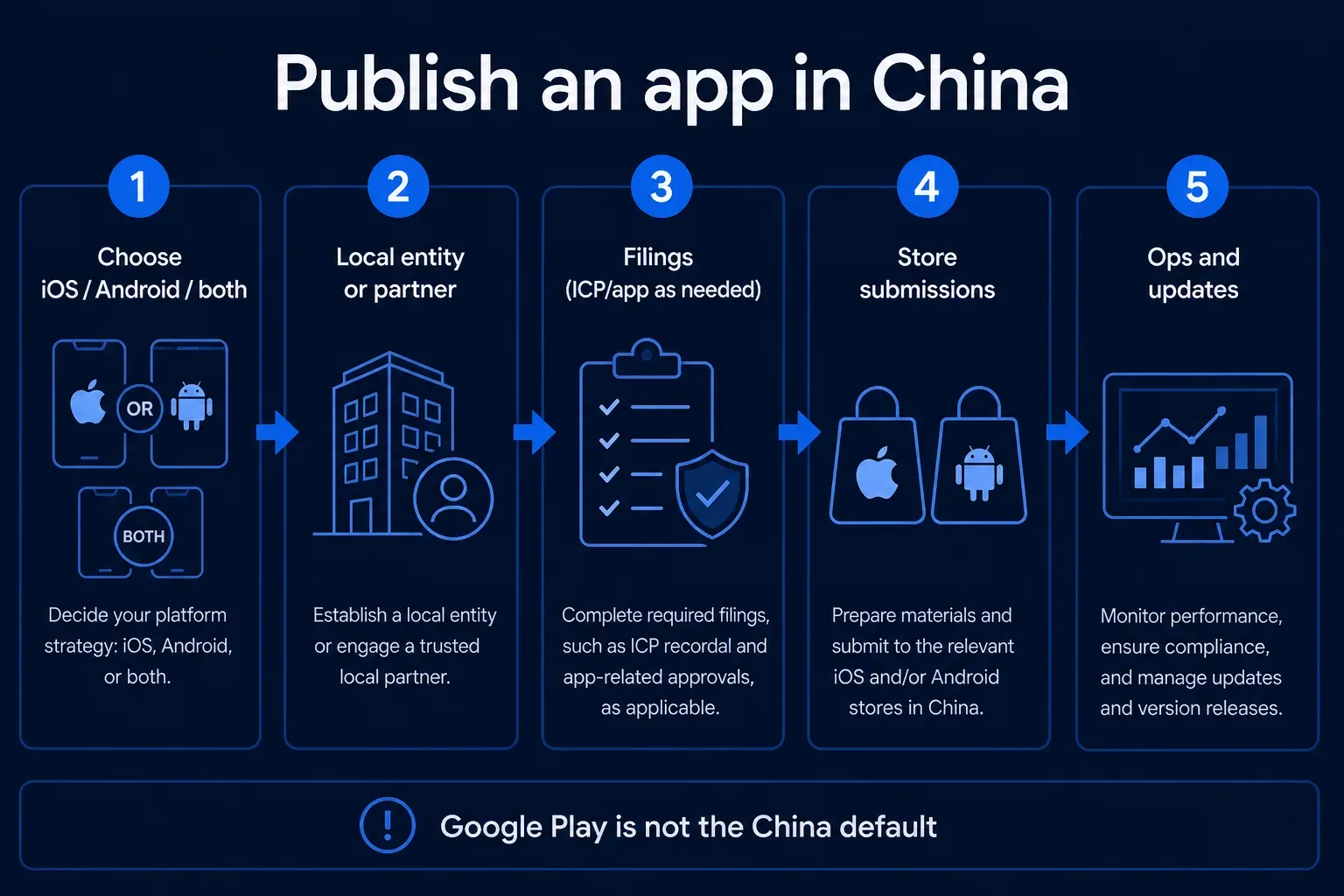
Publishing an app in Mainland China is a gate program — entity or partner, filings, then Apple and/or multi-store Android. Google Play is not the default channel.
Publishing an app in Mainland China is a multi-gate program, not a Play or App Store upload. Your product team chooses Apple and/or domestic Android, locks a Chinese entity or partner path, clears the filings and questionnaires that apply, then submits store-by-store with Chinese ops ready. Google Play is not the consumer default.
Video handbook
Short YouTube series on publishing mobile apps in Mainland China — readiness, privacy baselines, and store timelines. Full episode list and slide decks live on the handbooks hub.
- Full series on Chinaready handbooks — playlist, episode links, and PPT decks
Episodes:
| Ep | YouTube Title | Handbook |
|---|---|---|
| 1 | What publishing in Mainland China means | PPT |
| 2 | Product readiness and privacy baselines | PPT |
| 3 | Stores, timelines, and how launches fail | PPT |
What publishing an app in China means
Hard names your program will use (rewritten from how publish programs actually run — not a store tutorial):
- Organizing path — Domestic Android stores generally require a Chinese legal entity or a contracted local distribution / ops partner. A global developer account alone is not a Mainland China Android publish plan.
- Common non-game gates — Plan for ICP filing when a China domain / hosting story applies, mobile app filing (应用程序备案) after that, and a Software Copyright Certificate for many Android submissions, plus Chinese metadata and privacy materials reviewers can read. Category choice on app filing is a hard gate — use the full service-category table in China mobile app filing.
- Localization and data — Simplified Chinese UI and store copy; replace or gate blocked overseas services; keep personal data and core journeys on a Mainland China–reachable path when the product requires it.
- Channels — Android = multi-store (OEM + major third-party). Apple App Store China = separate regulated channel; global live ≠ China available.
- Timing (order of magnitude) — Non-game programs often land in roughly 1–3 months when entity/partner and materials are ready. Games run a different clock (ISBN / publishing approval — often much longer).
- Category extras — Social, education, health, finance, and similar verticals can add assessments or licenses. Incomplete security / privacy questionnaires are a common bounce.
Vocabulary first. Next: which decisions you lock, and where your process stalls.
Preconditions
Missing any of these stops your product team before the first honest store review.
| Precondition | Why your process stalls |
|---|---|
| Platform scope — iOS China, Android multi-store, or both — with success metrics | “Locale” launches fail later gates |
| Chinese entity or contracted distribution / ops partner | Filings and many store accounts need a Mainland China organizing path |
| Filing + questionnaire inventory started | Incomplete packages bounce; form names change, the failure mode does not |
| Chinese metadata, privacy policy, data-flow diagram | SDK and hostname changes invalidate last year’s answers |
| China-reachable product path for install → primary journey | A listing with overseas-only auth is not published |
| Release matrix + Chinese support coverage | Per-store package IDs and update owners prevent silent removals |
Chinese-language consoles, enterprise / legal-person verification, and bilingual questionnaire owners are part of this floor. Your team usually cannot clear the full path from an overseas App Store Connect account alone.
Core path
| Gate | Done when | Owner |
|---|---|---|
| 1. Scope | iOS China / Android multi-store / both locked with metrics | Product |
| 2. Organizing path | Entity or contracted partner that can hold filings and store accounts | Legal / BD |
| 3. Filings & questionnaires | Mobile app filing and related materials ready; security/privacy packs current | Compliance |
| 4. Channel packages | Chinese metadata, privacy URL, builds, screenshots per store | Eng + localization |
| 5. Operate | Update cadence, Chinese support, SDK allowlist, monitoring | Ops |
Decide platforms first
Apple App Store (Mainland China) — One primary iOS storefront, regulated. Global listing ≠ China availability. Category and game rules dominate. Detail: Apple App Store in China.
Android domestic stores — Multi-store by default. First wave is a selection decision, not a full store directory. For most product teams exploring entry, start with Huawei AppGallery, OPPO, vivo, Xiaomi, and Tencent MyApp; expand after you can ship a compliant update. Detail: China Android app stores. Upload matrix and unified package name: China Android app-store upload. Same-build review variance: China Android app-store rejection.
Web / Mini Program — Different filing surfaces. An APK/IPA plan does not cover WeChat.
Filings and assessment forms
Inventory questionnaires early (filing portals + each store). Assign bilingual owners. Keep SDK and data-flow diagrams current — reviewers ask. Do not reuse last year’s answers after you changed analytics or auth. Exact form titles change; incomplete packages still bounce.
For domain ICP vs app filing sequence, see ICP filing — domain DNS and China mobile app filing. If the product is a game, stop and open Publish a game in China — do not force a utility publish plan onto ISBN rules.
Soft-launch that reduces rework
- Clear filings for the builds you will actually ship.
- Submit first-wave Android stores + China App Store (if in scope).
- Fix review feedback on one channel before cloning metadata everywhere.
- Expand stores only after a compliant update path works.
Track per channel at minimum: package ID, version code, privacy URL, filing references, reviewer account, last approval date, next update owner. Without that matrix, “live in China” is not operable.
Linked reasoning
No organizing path → filings and store accounts never start. Portals that require Mainland China docs will not accept an overseas-only pack.
Filings incomplete → review stalls on questionnaires. “We’ll fill it during review” becomes a multi-week slip.
One binary, many stores, no release matrix → update drift and removals. Each Android store can demand different declarations.
Store live + overseas-only APIs → not published. Users must complete the primary journey from Mainland China networks; hotfixes must flow through the same channels.
Game mechanics under an “app” label → months burned. Monetize like a game → expect ISBN / publishing rules.
No owner for rule changes → last quarter’s approval becomes this quarter’s removal. Name a watcher for hostnames, SDKs, and listings.
Run Apple and Android as parallel workstreams with a shared compliance backbone (entity story, privacy policy, data-flow diagram, filing numbers, support contacts). Signing, consoles, screenshots, and commercial contracts stay distinct.
Difficulty and blockers
- China as another Play / App Store locale — budget compliance and ops, not only strings.
- Questionnaire debt — start when entity docs are ready; keep data-flow diagrams current.
- Overseas-only backends — pair publish with access and hosting decisions.
- Budgets that omit partner, support, and China-reachable engineering — submission labor is often the smallest line.
- Missing handoff artifacts — store account map, signing custody, filing numbers, questionnaire archive, release matrix, on-call. Missing artifacts make “live” apps unmaintainable.
China landing partner
Most product teams exploring Mainland China entry need a China landing partner to clear entity, verification, filings, Chinese-language store ops, and the multi-store release matrix Your team still owns product scope and category honesty; the partner path makes the gates executable when Mainland China ops rails are not already in-house.
What we can offer?
Publishing an app in Mainland China is a gate list — platforms, organizing path, filings and assessments, then a multi-store matrix. Chinaready helps your product team clear those gates in order and keep the product working after listing:
- China Readiness Assessment — Lock iOS/Android scope, entity or landing-partner path, and filing/assessment gates before China UA spend against empty listings.
- China Access Acceleration — Make auth, APIs, and critical deps reachable from Mainland China so “live in stores” matches a real install-to-value journey.
- China Product Hosting — Place backends and assets that must terminate in Mainland China when your publish plan depends on in-country reachability.
- Mobile App Distribution — Run submissions, Chinese metadata, and update ops across Apple’s China App Store and first-wave Android OEM/third-party channels.
Contact us when you need that matrix before the first store submission.
Frequently asked questions
How do I publish my app in China?
Lock platforms (Apple App Store China and/or domestic Android stores), arrange a Chinese entity or distribution partner as needed, complete the filings and questionnaires that apply, ship Chinese metadata and a China-reachable product path, then submit and operate each store channel.
Is Google Play enough for China?
No. Google Play is not a mainstream Mainland China consumer channel. Android reach usually requires OEM and major third-party domestic stores.
Do we need ICP filing, app filing, and a Software Copyright Certificate?
For many Android store paths, product teams plan for ICP filing (when a China domain/hosting story applies), mobile app filing after that, and a Software Copyright Certificate for store packages — plus Chinese privacy materials. Exact triggers depend on architecture and channel; treat them as gates, not optional paperwork.
How is publishing a game different?
Games usually need Chinese publishing approval (ISBN path) under a qualified publisher — often many more months than a typical utility or SaaS companion app. See the game and ISBN Guides.
Can our global Apple Developer account cover Mainland China?
Apple’s China App Store is a regulated channel, not a locale toggle. A global listing does not guarantee Mainland China availability. Plan category risk, filings, and ops separately — see the Apple App Store in China Guide.