App removed from China stores — restore or stay capped
An app removed from China stores is already live, then pulled. Name the deletion cause, then restore the listing or stay capped. Review fail and never-listed sit on other Guides.
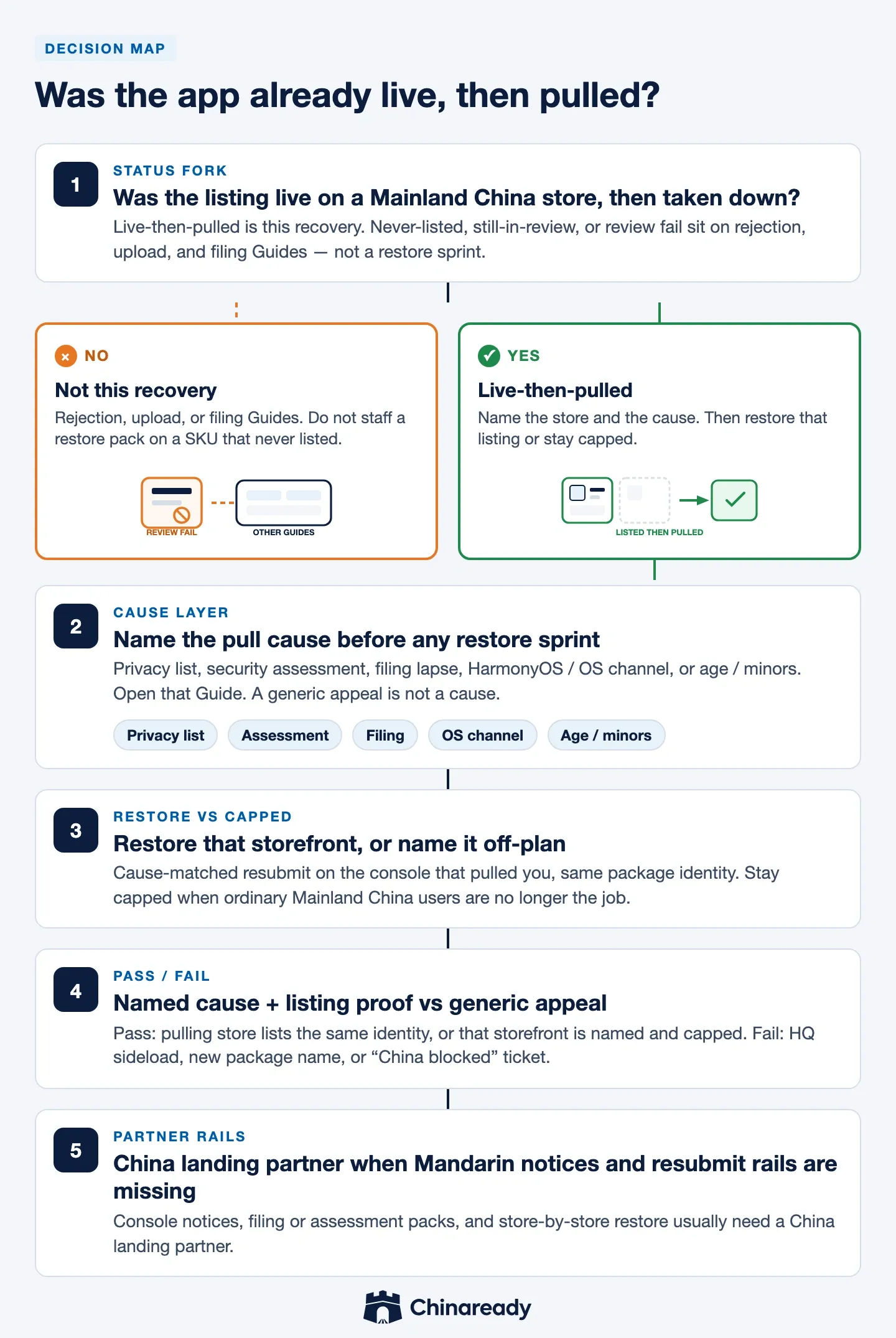
An app removed from China stores is a live-then-pulled recovery job — not a review bounce. If the package never listed, is still in review, or failed submit, use the rejection, upload, and filing Guides. If it was live and then pulled, name the deletion cause — privacy enforcement, security-assessment miss, filing lapse, HarmonyOS / OS channel, or age / minors — then restore the listing or stay capped.
What live-then-pulled actually means
Hard names your recovery plan will use:
- App removed from China stores — The SKU was searchable and installable on a Mainland China storefront, then disappeared. That is china app store deletion, not “we never got through review.” The storefront landscape sits on the app stores in China map.
- Live-then-pulled vs never-listed vs still-in-review — Never-listed and review-fail sit on China Android app-store rejection and China Android app-store upload. Still-in-review is a queue, not a takedown. This Guide starts only after a live listing is gone.
- Filing lapse can take a listed app down — MIIT’s app-filing notice and interpretation tell distribution platforms to process apps that skip filing. Xiaomi’s APP filing guide states the same stay-up rule for GetApps. Depth: China mobile app filing and Software Copyright.
- Privacy enforcement is a stay-up class — Store privacy scanners and ministry-style personal-information lists can delist a live SKU. Do not absorb that map here — app privacy enforcement and PIPL product gates.
- Security-assessment miss — A questionnaire or assessment that was skipped, expired, or no longer matches the live binary can pull a listing. Point to app security assessment — do not treat it as a store-appeal template.
- OS channel and age / minors — A Huawei path can drop when the job moved to HarmonyOS NEXT. Games and some apps stall on age verification. Neither is a generic “China blocked” ticket.
- Stay-up ops still matter — Consoles expect a current privacy pack, working support, and a release cadence. Stale binaries and unmoderated UGC are recovery debt, not a reason to rewrite the first publish Guide.
Vocabulary first. Next: what must be true before a restore sprint is real work.
What must be true before a restore sprint
Missing a clear live-then-pulled job stops your product team before another “appeal every console” week is real work.
| Precondition | Why your process stalls |
|---|---|
| Status locked — already live then pulled vs never-listed vs still-in-review | A restore sprint is staffed on a package that never listed — rejection was the job |
| Store named — which Mainland China console pulled the SKU | “China took us down” hides a one-store pull while siblings still list |
| Cause named — privacy list, assessment, filing, OS channel, or age / minors | A generic appeal lands on the wrong intra-cluster Guide |
| Same package identity — one applicationId / bundle ID across the first wave | Per-store package-name forks break update continuity — upload |
| Filing record current — mobile app filing number and related packs match the live binary | Stores process unfiled or drifted identity — mobile app filing |
| Restore vs stay-capped job — ordinary Mainland China users still need that storefront | Teams burn a quarter restoring a SKU that should stay capped for HQ / export-only |
| Mandarin console owner | English HQ paste cannot read the pull notice or resubmit pack |
Product teams usually cannot treat “the same global listing, plus a China appeal template” as the Mainland China plan. Status, store, and cause are the floor. First publish still lives on Publish an app in China.
Name the pull, then restore or stay capped
| Stage | Decision / outcome |
|---|---|
| 1. Name the status | Already live then pulled, never-listed / review fail, or still-in-review? |
| 2. If never-listed or still-in-review | Leave this Guide. Use rejection, upload, or filing |
| 3. If live-then-pulled | Name the store and the cause class — privacy, assessment, filing, OS, or age |
| 4. If the job is no longer that storefront | Stay capped. Do not market a pulled listing as a China launch |
| 5. If restore is the job | Fix the named rail, keep the same package identity, resubmit the console that pulled you |
| 6. Prove stay-up | Filing display, privacy pack, and binary match what reviewers will reopen |
| 7. Re-cut only what the cause demands | Do not clone a one-store privacy patch across healthy listings |
Hard gate — live-then-pulled vs review fail
Necessity: confusing these two jobs wastes the quarter — either you restore a SKU that never listed, or you rewrite the first-submit pack while a live listing is already gone.
| Status | This Guide? | Where the work sits |
|---|---|---|
| Already live, then pulled | Yes | Name cause → restore or stay capped |
| Review fail / never-listed | No | China Android app-store rejection |
| Still in review | No | Wait the console; upload for the matrix |
| Never published in Mainland China | No | Publish an app in China |
Hard gate — restore vs stay-capped
Restore is a cause-matched resubmit on the console that pulled you. Huawei AppGallery documents removing an app from sale and a later Draft → release path — useful when the SKU is already off AppGallery, not a promise that enforcement pulls reverse on a template appeal. Xiaomi GetApps (console), OPPO, and vivo are separate rails — one restore does not flip the others.
Stay capped is the honest job when ordinary Mainland China users are no longer on that storefront, or when the cause class (game ISBN, HarmonyOS-only, age / minors) is a different product. Capping is not “ignore the pull.” It is naming that storefront off-plan.
Why a wrong fork blocks restore
Engineering and ops constraints you must design around:
| Constraint | What breaks | What to do |
|---|---|---|
| Review fail treated as deletion | Restore tickets open on a package that never listed. | Grade status first — rejection vs this Guide. |
| Unnamed cause | Privacy, assessment, filing, OS, and age packs are mixed into one appeal. | Route to privacy enforcement, security assessment, filing, HarmonyOS NEXT, or age verification. |
| Filing number drifted | Stores process the SKU while the live binary no longer matches the filed identity. | Refresh mobile app filing and Software Copyright adjacency before resubmit. |
| One-store pull reported as “China down” | Healthy OEM listings get emergency forks. | Ledger the pulling console. Resubmit that rail first. |
| New package name to dodge the pull | Updates and filing rows multiply. | Keep one identity — upload. |
| Apple China treated as a locale toggle | Global live is cited while the China storefront is gone. | Treat Apple’s China storefront as a regulated channel — Apple App Store in China. |
| HarmonyOS gap called an Android rejection | AppGallery Android restore is staffed while the job moved to NEXT. | HarmonyOS NEXT is an OS publish gate, not a GetApps clone. |
Live listing gone ≠ review bounce. A console that once approved you can still pull you. The first-submit Guide does not reverse that.
HQ laptop “the app still installs” → false confidence. Sideloaded or overseas storefront builds are not proof the Mainland China listing is back.
Generic appeal → stay pulled. Stores reopen against a named cause pack, not against a translated complaint.
What stalls teams after a China store pull
- Status not locked — Product treats every missing tile as china app store deletion before live-then-pulled is proven.
- Cause shopping — Privacy, assessment, filing, OS, and age tickets open in parallel with no owner.
- First-publish rewrite — Teams reopen Publish an app in China instead of a restore pack.
- Package-name dodge — A new applicationId is invented to “look clean.” Filing and update rails break.
- One console, five-store fire drill — An OPPO pull is cloned onto Huawei and Xiaomi listings that still stand.
- Apple China assumed restored because US is live — Territory and filing are still the China storefront job.
- Stay-up ignored after relist — Privacy pack, filing display, and release cadence drift; the next pull is scheduled.
- No owner for Mandarin notices — The fork stalls because nobody can read the console or ministry notice — only “get us back in China stores.”
What “fixed” means: the pulling Mainland China storefront lists the same package identity again, or that storefront is named and capped; the cause class is closed on its own Guide; filing and privacy packs match the live binary; proof is the consumer listing from Mainland China — not an HQ sideload. A pulled SKU with a China marketing claim is not fixed.
China landing partner when the listing is already gone
Most product teams exploring Mainland China entry need a China landing partner once a live listing is pulled — to read Mandarin console and ministry notices, refresh filing or assessment packs, keep package identity coherent, and resubmit the console that actually took the SKU down. Your team still owns whether that storefront stays Plan A, which cause class is true, and which residual overseas listing to keep; the partner path makes restore-or-cap executable when those rails are not already in-house. Keeping a capped listing for outside-Mainland China viewers does not remove the need for that China landing partner on the primary China path.
What we can offer?
App-removed-from-China-stores work is a live-then-pulled recovery decision before another generic appeal sprint. Chinaready helps your product team name the pull, restore the listing, or stay capped on rails Mainland China consoles will actually reopen:
- China Readiness Assessment — Grade live-then-pulled versus review fail, name the cause class, and decide restore versus stay-capped before the next console week.
- China Access Acceleration — Keep the China-facing product reachable from Mainland China so a restored listing is not a dead shell on first open.
- China Product Hosting — Place China-critical services where filing adjacency and a reachable origin stay coherent after relist.
- Mobile App Distribution — Run the cause-matched resubmit on AppGallery, OEM stores, and Apple China without turning one pull into a five-store fire drill.
Contact us when you need a live-then-pulled restore-or-cap path before you staff another China-store appeal.
Frequently asked questions
What does app removed from China stores actually mean?
The listing was live on a Mainland China storefront — Apple App Store China and/or a domestic Android console — and then disappeared from search and browse. That is a recovery job. A review bounce before listing, or a package still sitting in review, is a different Guide.
How is china app store deletion different from review rejection?
China app store deletion is live-then-pulled. China Android app-store rejection is same-build review fail before or at submit — the listing never became the consumer SKU. Do not staff a restore sprint on a package that never listed. Pair the rejection Guide.
What does an app taken down China-side usually signal?
An app taken down China-side after listing usually names a stay-up cause — privacy enforcement, a missed security assessment, a filing lapse, an OS-channel gap, or age / minors gates — not a generic “China blocked” switch. One store can pull while another still lists the same identity.
How do we restore app China store listings after a pull?
Name the pull cause, fix that rail, then resubmit the same package identity on the console that pulled you. Huawei AppGallery documents a post-removal Draft path for a new release. A generic appeal without a named cause does not restore the listing.
Can product teams recover a pulled listing without Mainland China ops?
Usually no. Mandarin console notices, MIIT filing proof, privacy or assessment packs, and store-by-store resubmit sit on rails most global teams lack. That is when a China landing partner becomes the realistic path.
Insights
Other similar insights
Part of the App distribution cluster — every guide in the cluster, one page.