

China app privacy — MIIT lists can pull a live app
China app privacy is MIIT and store enforcement that can pull a live listing — SDK over-collection, missing policy, or disclosure mismatch. PIPL product gates and security-assessment forms are different tracks.
China app privacy is MIIT and store enforcement that can pull a live app — not a PIPL rewrite and not a security-assessment form. If the binary over-collects, ships without a usable privacy policy, or discloses SDKs that do not match what the APK actually loads, a listing that already passed review can still come down. Pair this Guide with app removed from China stores (this is a cause class). Contrast PIPL product gates and app security assessment as different clocks on the same inventory.
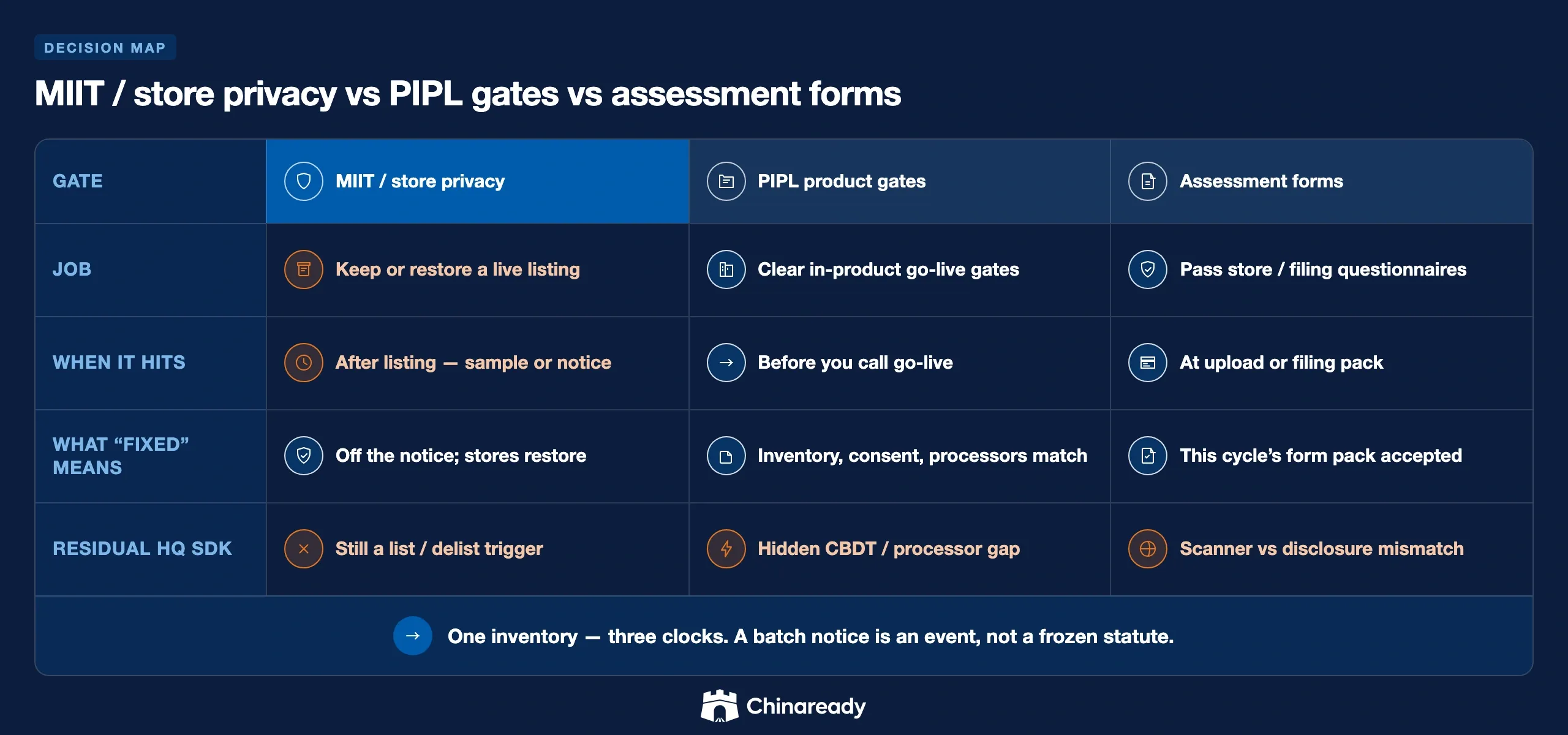
What MIIT app privacy actually enforces
Hard names your stay-up program will use:
- MIIT — Ministry of Industry and Information Technology. Telecom and internet user-rights supervision for apps and SDKs, including provisions on telecommunications and internet user personal information and recurring APP-infringement campaigns (2020 special-rectification notice).
- APP / SDK notices — Continuing public batches of apps and SDKs found to infringe user rights (for example a 2024 Information and Communications Administration notice). Each notice is an enforcement event with a rectify-or-further-dispose clock. Do not freeze any numbered batch as if it were current law.
- Identification classes — Joint CAC / MIIT / public-security / market-regulation methods for determining illegal collection and use of personal information by apps: no published collection rules; purpose/method/scope not stated; collection without consent; collection beyond necessity; providing personal information to others without consent; no deletion/correction or complaint channel. Product teams meet these as missing privacy policy, SDK over-collection, and SDK disclosure mismatch.
- Distribution-platform duty — App stores are not a passive pipe. CAC provisions on mobile internet application information services require providers and distribution platforms to keep personal-information processing lawful, necessary, and not a forced-consent wall. Stores execute takedowns when MIIT or their own scanners flag a live package.
- China app store privacy — The policy URL, SDK list, and permission story on Apple (App Privacy details) and domestic Android consoles such as Huawei AppGallery (release / privacy-statement configuration). Reviewers compare that story to the binary. A global English PDF is not the store artifact.
- Not this Guide — In-product PIPL gates live on PIPL product gates. Security-assessment forms live on app security assessment. Publish sequence lives on publish an app in China.
Vocabulary first. Next: what must exist before a notice response is real work.
What must exist before a privacy-list response is real
Missing any of these stops your product team before a restore ticket or a “we uploaded a new policy” sprint is honest.
| Precondition | Why your process stalls |
|---|---|
| Job locked — stay-up / restore a live listing vs go-live design vs form pack | PIPL gates or assessment forms are staffed while the listing is already on a notice |
| China-facing binary inventory — iOS China, each Android store flavor, Mini Program if in scope | HQ APK is audited while the China channel still ships a different SDK set |
| SDK allowlist with purpose — analytics, crash, ads, push, maps, login | Hidden HQ SDKs recreate over-collection the week after a policy rewrite |
| Privacy policy and in-app rules that match the binary | Store URL and consent copy describe a product the APK does not run |
| Owner for Mandarin notices and store consoles | English legal memos never reach Huawei AppGallery, Xiaomi GetApps, OPPO, vivo, or Apple China |
| Mainland China entity or landing-partner path | Restore, re-cut, and appeals need a China organizing path most HQ teams lack |
A listing that already passed China Android app-store rejection can still be pulled later. Rejection is review-time; this Guide is live-then-pulled.
How a store privacy finding moves from notice to delist
Stages are decisions, not console click-paths.
| Stage | Decision / outcome |
|---|---|
| 1. Name the clock | MIIT / store privacy list, PIPL go-live gates, or security-assessment forms — pick one primary job this sprint |
| 2. Freeze the China binary | Version, channel flavors, and the SDK graph that actually ships in Mainland China |
| 3. Map findings to classes | Missing policy, over-collection, disclosure mismatch, forced consent, third-party sharing — not a news headline |
| 4. Fix the binary, then the story | Drop or gate HQ SDKs; rewrite policy and store privacy answers to match; do not invert that order |
| 5. Re-cut store packages | Apple China App Privacy details and each Android console’s privacy URL / SDK list — same inventory |
| 6. Prove stay-up | Notice closed or stores restore; residual HQ SDKs named and capped. If the listing is already gone, run app removed from China stores |
| 7. Only then resume UA | Paid acquisition on a listing still in dispute funds a second removal |
Hard gate — three clocks, one inventory
Necessity: confusing these three jobs wastes the quarter — you rewrite PIPL copy while stores pull the APK, or you pass a form while the SDK graph still matches a notice class.
| Clock | Job | What must already be true |
|---|---|---|
| MIIT / store privacy | Keep or restore a live listing | Binary matches disclosed purpose; SDKs named; policy reachable in-app and on the store |
| PIPL product gates | Honest go-live | Inventory, basis, processors, security, CBDT fork — PIPL product gates |
| Security-assessment forms | Upload / filing pack accepted | Questionnaire matches this cycle’s binary — app security assessment |
What “fixed” means on this Guide: the app is off the notice (or never sampled into one), domestic stores and Apple China still list the current package, and residual HQ SDKs are gated or honestly disclosed. A longer privacy PDF with the same SDK graph is not fixed.
Why a PIPL PDF does not clear china app store privacy
No published rules → the first identification class. A privacy policy that is missing, unreachable from first launch, or English-only when the store requires a China-readable URL fails before consent UX is even discussed.
Policy rewrite without a binary change → mismatch. Stores and MIIT sample the APK. If crash, ads, or analytics SDKs still collect device, location, or clipboard data the policy denies, the finding is disclosure mismatch, not a copy ticket.
SDK over-collection → necessity fail. Collecting contacts, precise location, or identity “for growth” after a minimised launch is the same class as “collection unrelated to the stated service.” Purpose creep on an already-listed app is how live products enter a batch.
HQ SDK left on the China flavor → third-party sharing. Overseas analytics and attribution often move personal information without a matching disclosure or processor story. That is both a store privacy fail and a PIPL processor / CBDT gap — sequence PIPL on the sibling Guide; do not treat the store list as the statute.
Assessment form accepted → listing not immunized. A security questionnaire is a pack. MIIT notices and store scanners re-read the live binary. Passing app security assessment does not retire a later privacy list.
Rejection cleared ≠ stay-up. China Android app-store rejection is one console’s review rail. A later MIIT or platform notice is a different clock on the same package.
Named-app news ≠ your program. Public batches name other operators. Your team staffs the classes (policy, over-collection, SDK mismatch), not a memorized roster.
Where app privacy china programs stall product teams
- Statute reading without a clock — PIPL, MIIT notices, and store forms are collapsed into “privacy.” The decision is which clock stops this listing.
- News-dump operating model — Leadership tracks a headline batch instead of SDK allowlists and restore owners.
- Global privacy PDF as the only artifact — Apple App Privacy details and Android console fields ask for SDK lists and purposes, not a blog-length policy.
- HQ SDK residual — “We will gate analytics after launch” is how the next sample hits over-collection.
- One-store proof — Huawei AppGallery restored while OPPO still shows the old privacy URL. Multi-store is the publish an app matrix, not a single screenshot.
- Forced-consent walls — Refusing basic functions unless the user accepts unrelated collection is an identification class, not a growth experiment.
- No owner for restore — Legal writes a memo; engineering still ships the flagged SDK; stores never see a new package.
When you need a China landing partner for MIIT lists
Most product teams exploring Mainland China entry need a China landing partner once a live listing is in scope for MIIT or store privacy enforcement — to read Mandarin notices, re-cut channel packages, align SDK allowlists with store privacy fields, and run restore tickets across Apple China and domestic Android consoles. Your team still owns which HQ SDKs stay, which purposes are real, and whether PIPL gates or assessment forms are a separate sprint; the partner path makes the Mainland China stay-up clock executable when those rails are not already in-house. Passing a global privacy review does not remove the need for that China landing partner on the listing you intend to keep.
What we can offer?
China app privacy work for a live Mainland China listing is a MIIT / store enforcement clock — SDK over-collection, missing policy, and disclosure mismatch — not a longer PIPL reading list. Chinaready helps your product team keep the listing up beside publish, rejection, and assessment rails:
- China Readiness Assessment — Name whether the blocking clock is a privacy list, PIPL product gates, or a security-assessment form, and which HQ SDKs would still trigger a sample.
- China Access Acceleration — Keep in-app privacy rules, consent, and policy URLs reachable from Mainland China so the store story matches the path users actually hit.
- China Product Hosting — Place China-critical collection and processor endpoints where the inventory you disclose to stores still describes one stack.
- Mobile App Distribution — Re-cut Apple China and Android store privacy fields, SDK lists, and restore packages so a notice does not become a silent delist across the matrix.
Contact us when you need a stay-up path for china app privacy before the next sample — sequenced with PIPL gates and assessment forms, not as a named-app news brief.
Frequently asked questions
What is china app privacy enforcement for product teams?
China app privacy here is MIIT and store enforcement against a live listing — missing or mismatched privacy rules, over-collection, and SDK disclosure gaps. It is not the PIPL product-gate map and not a security-assessment form pack. A notice can pull the app even after go-live.
How is MIIT app privacy different from PIPL product gates?
PIPL product gates are in-product design before you call go-live — inventory, purpose, consent, processors, security, then a cross-border fork. MIIT app privacy is a telecom-and-store clock that samples live APKs and SDKs. Clearing PIPL gates does not retire a store privacy list; see the PIPL product-gates Guide.
What is china app store privacy versus a security-assessment form?
China app store privacy is the policy URL, SDK list, and permission story Apple, Huawei AppGallery, and peer Android consoles show users and reviewers. A security-assessment form is a filing/upload questionnaire. Passing the form does not prove the binary matches the notice; failing a privacy list can still remove a live listing.
Can an HQ SDK still pull the listing after we rewrite the privacy policy?
Yes. Residual HQ analytics, crash, ads, or push SDKs that collect beyond the disclosed purpose still match over-collection and third-party sharing findings. Policy text that does not match the binary is itself a mismatch. Treat HQ SDKs as in-scope until they are gated, replaced, or honestly disclosed.
Is one MIIT batch of named apps the current law?
No. MIIT publishes continuing APP and SDK notices. Each notice is an enforcement event with a rectify-or-dispose clock. Do not freeze a numbered “crackdown list” as if it were the statute. The pattern — sample, notify, rectify, then store disposal — is what product teams staff.
Can product teams finish MIIT and store privacy work without Mainland China ops?
Usually no. Mandarin notices, store consoles, SDK allowlists, and restore tickets sit on rails most global teams lack. That is when a China landing partner becomes the realistic path. Your team still owns which HQ SDKs stay.
Insights
Other similar insights
Part of the App distribution cluster — every guide in the cluster, one page.