

SaaS in China — filing, hosting, payments, speed
Selling SaaS in China is a publish-and-operate program — ICP filing and possible B25 analysis, China-reachable hosting, local login and payments, and a fast China path. A global stack alone serves none of it.
Selling SaaS in China is a publish-and-operate program, not a region toggle. Your product team decides which surfaces serve Mainland China users, clears ICP filing for the China-terminated path (and the commercial B25 analysis when you charge for access), places hosting that users can actually reach, wires local login and payments, and keeps the journey fast enough to retain. A global stack with Chinese users is not a China SaaS business — it is a slow demo.
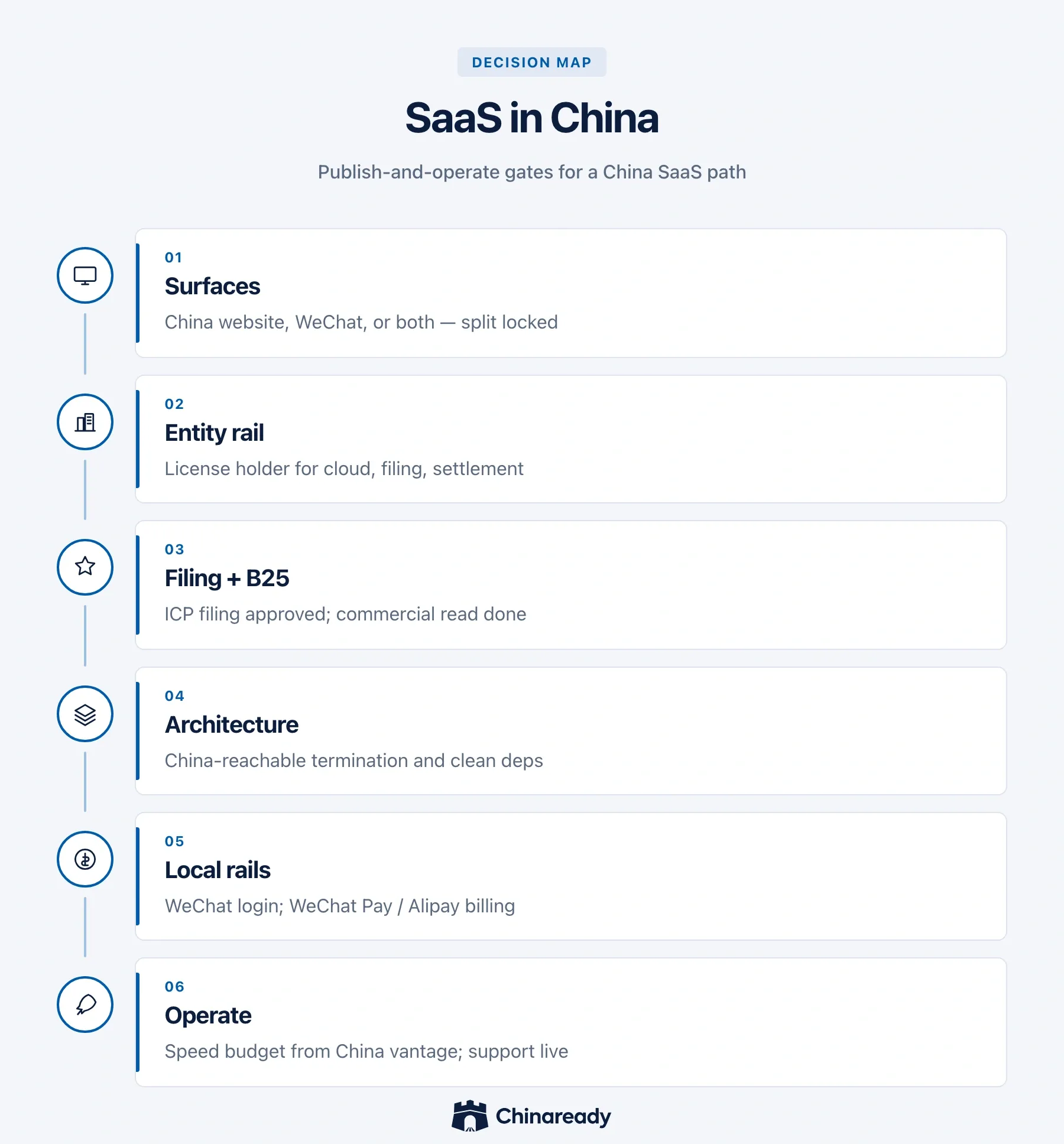
What SaaS in China means
Hard names your program will use (rewritten from how SaaS China entries actually run — not a market-entry primer):
- Surface split — B2B SaaS usually ships a China-reachable website; consumer tools often add WeChat surfaces (Mini Program / Official Account) on top. Each surface has its own filing and review path. The split decision: Website vs WeChat in China.
- ICP filing for the China path — When the product terminates on Mainland China hosting, ICP filing comes before go-live. The chain from domain to PSB: Publish a website in China; the filing itself: China ICP registration.
- B25 commercial fork — Paid information access, subscriptions, and ad inventory are commercial information-service patterns that can pull the commercial ICP license (B25) analysis. Depth: China ICP license (B25).
- Data and PIPL gates — Personal-information product gates and cross-border transfer rules shape where user data may live and how it moves. Depth: PIPL product gates and Cross border data transfer.
- Partition reality — AWS China and Azure China (21Vianet) are separate clouds with entity expectations and service gaps; Alibaba and Tencent are the domestic defaults. Depth: AWS China, Azure China, Alibaba Cloud China.
- Login and payments — WeChat login and phone-first real-name flows replace assumed OAuth; WeChat Pay / Alipay replace card-first billing. Depth: App login and payments in China.
- Speed floor — Cross-border latency on every click is the default failure. The performance program: SaaS performance in China; APIs specifically: API China path.
- Common myth — “Chinese users tolerate our slow global product.” They switch. Speed, local login, and working payment are retention features, not localizations.
Vocabulary first. Next: what must be locked before the China path is real work.
Preconditions
Missing any of these stops your product team before an honest SaaS China launch.
| Precondition | Why your process stalls |
|---|---|
| Surface decision — China website, WeChat surfaces, or both; B2B vs consumer split | Wrong surface ships the wrong filing and review path |
| Entity or landing-partner rail for filing, cloud accounts, and settlement | Partitions and provider accounts expect a Chinese business-license holder |
| Filing and B25 read for what you charge and where you terminate | Paid access on a China-terminated path can pull commercial-license analysis |
| China-reachable architecture — termination, CDN, clean dependencies | Blocked fonts, tags, auth, and APIs break the journey after everything else clears |
| Local login + payments design — WeChat login, WeChat Pay / Alipay | Card-first and Google-first assumptions fail at the first real user |
| Data placement plan under PIPL and transfer rules | Wrong data geography blocks enterprise deals and invites takedowns |
Core path
| Gate | Done when | Owner |
|---|---|---|
| 1. Surfaces | China website / WeChat split locked with success metrics | Product |
| 2. Organizing rail | Entity or partner holds cloud accounts, filings, settlement | Legal / BD |
| 3. Filing | ICP filing approved for the China path; B25 read done | Compliance |
| 4. Architecture | Termination, CDN, and dependency allowlist China-reachable | Eng |
| 5. Local rails | WeChat login live; WeChat Pay / Alipay or invoice path live | Eng / finance |
| 6. Operate | Speed budget held from China vantage; support and updates running | Ops |
Decide the surfaces and the filing read together
A China website pulls the website publish chain — domain, ICP filing, hosting termination, DNS. WeChat Mini Program surfaces pull their own filing and review path. Running both means one compliance backbone, two channel tracks — the same pattern as app-plus-website programs.
Place the product where users are
Overseas-only termination is a valid early probe with known limits. A durable SaaS China path usually means China-reachable termination — a filed front door, onshore cache for the slow hop, and dependencies that do not call blocked overseas hosts. The speed program is its own gate: SaaS performance in China.
Local login, payments, and support are the retention layer
WeChat login and phone-number flows, WeChat Pay / Alipay billing, Mandarin support coverage — these decide whether the second month of usage exists. Depth: App login and payments in China. Measurement that still works after GTM-style stacks fail: Analytics China; forms and bot checks: reCAPTCHA & forms in China.
Soft-launch checks that reduce rework
- Prove the journey from Mainland China vantage before campaigns — test website blocked in China.
- Onboard a design partner on local login and payment before scaling spend.
- Hold a speed budget (load and primary API) from China broadband and mobile.
- Keep the filing, IP list, and dependency allowlist current as the stack changes.
Linked reasoning
No organizing rail → cloud accounts, filings, and settlement never start. China partitions and providers expect a Chinese business-license holder.
Paid access, no B25 read → pricing page outruns compliance. Commercial information-service patterns can pull the license analysis after filing — do it before the launch date, not after the invoice.
Overseas-only stack, China marketing → traffic onto a slow demo. Every click pays cross-border latency; blocked dependencies fail silently.
Card-first billing → checkout abandonment by design. Mainland China users pay through WeChat Pay / Alipay or enterprise invoice paths.
Data geography ignored → enterprise deals stall at security review. PIPL gates and transfer rules decide where user data may live.
No speed owner → “performance issues” tickets replace a program. Assign the China speed budget like any other SLO.
Publishing an app or a website-only property instead? Those gate lists are mapped in Publish an app in China and Publish a website in China.
Difficulty and blockers
- Treating China as a traffic problem — the gate list is filing, architecture, payments, speed; acquisition is last.
- Global-stack fundamentalism — refusing a China-reachable path caps retention no matter the ad budget.
- Login assumptions — Google OAuth and email-first flows underperform or fail in Mainland China journeys.
- Measurement blindness — GTM-style stacks do not report from China; decisions go blind at the exact market they target.
- Missing handoff artifacts — filing numbers, partition account map, payment reconciliation owner, dependency allowlist.
China landing partner
Most product teams exploring Mainland China entry need a China landing partner to make SaaS China executable — entity and filing rails, partition accounts, local payment and login integration, Chinese-language support, and a speed program measured from China. Your team still owns product and pricing; the partner path supplies the rails when they are not already in-house.
What we can offer?
SaaS in China is a gate list — surfaces, filing read, architecture, local rails, speed. Chinaready helps your product team clear those gates in order and keep the product working after launch:
- China Readiness Assessment — Map the surface split, filing and B25 exposure, and the gates on the critical path before a launch date.
- China Access Acceleration — Keep APIs, auth, and critical dependencies reachable from Mainland China so the journey survives contact with real networks.
- China Product Hosting — Place the SaaS front door and API tier where China users get a fast, filed, operable path.
- Mobile App Distribution — Align app or WeChat surfaces with the same entity, filing, and compliance backbone when the SaaS ships beyond the browser.
Contact us when you need the SaaS China gate list mapped before the first design partner onboards.
Frequently asked questions
Can I sell my SaaS in China from overseas?
You can serve Mainland China users from an overseas stack, but every layer underperforms — latency and blocked dependencies degrade the product, ICP filing is unavailable for a China-terminated path, and enterprise buyers ask for local rails. Durable SaaS in China usually runs a China-reachable path with local login, payments, and support.
Does SaaS need an ICP filing or an ICP license in China?
If the product terminates on Mainland China hosting for public internet information services, ICP filing comes first. Selling paid access, subscriptions, or advertising inventory is commercial information-service activity that can pull the commercial ICP license (B25) analysis after filing — check the B25 Guide before you price a China launch.
Why is our SaaS slow in China?
Usually geography pretending to be front-end work — HTML, APIs, auth, and third parties living overseas make every click pay cross-border latency, and blocked dependencies fail silently. Fix the path — China-reachable termination, clean dependencies, onshore cache for the slow hop — then measure from Mainland China, not US synthetic checks.
Can SaaS run on AWS or Azure in China?
Yes, but on the China partitions — AWS China and Azure China (21Vianet) are separate clouds with separate accounts, entity expectations, and service gaps versus global regions. Alibaba Cloud and Tencent Cloud are the domestic defaults. Decide the partition with the entity and filing plan together.
How do SaaS users in China log in and pay?
Plan WeChat login (and phone-number real-name flows) instead of assuming Google or email-first OAuth works, and WeChat Pay / Alipay instead of card-first billing — see the app login and payments in China Guide. Enterprise contracts may still settle by invoice through a China entity or partner.
Should SaaS in China be a website, an app, or WeChat?
B2B SaaS usually ships a China-reachable website with local login and payments; consumer-facing tools often need WeChat surfaces on top. Each surface has its own filing and review path — map the split before building. See Website vs WeChat in China for the surface decision.
Insights
Other similar insights
Part of the Website & SaaS readiness cluster — every guide in the cluster, one page.