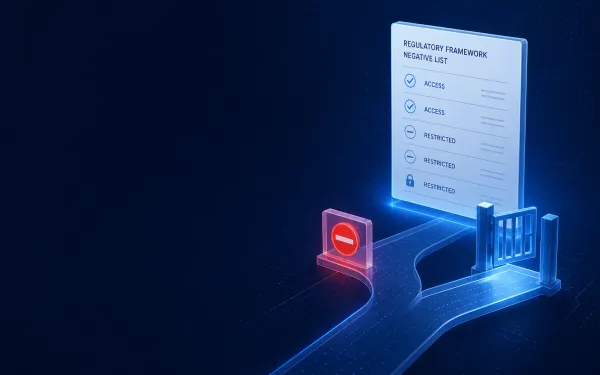

China ICP license (B25) — when you need commercial, not filing alone
B25 is the commercial ICP / information-services VATS license — not basic ICP filing. Use this decision map when “do I need an ICP license?” really means commercial vs filing-only; most product teams publish via a licensed Chinese partner.
“Do I need an ICP license?” almost always means: filing, commercial B25, or neither — depending on Mainland China hosting and what your product sells. China’s commercial ICP license (B25) is the Value-Added Telecommunications Services (VATS) permit for commercial information services — the license product teams usually mean when they say “ICP license.” It is not basic Internet Content Provider (ICP) filing. Your team needs a trigger map: when offshore avoids both, when filing is enough, when B25 appears, and whether your path is a licensed Chinese partner or a rare pilot-region WFOE application.
Video handbook
Short YouTube series on ICP license vocabulary (filing vs commercial). Full episode list and slide decks live on the handbooks hub.
- Full series on Chinaready handbooks — playlist, episode links, and PPT decks
Episodes:
What commercial ICP (B25) means
Hard names for the “do I need a license?” decision:
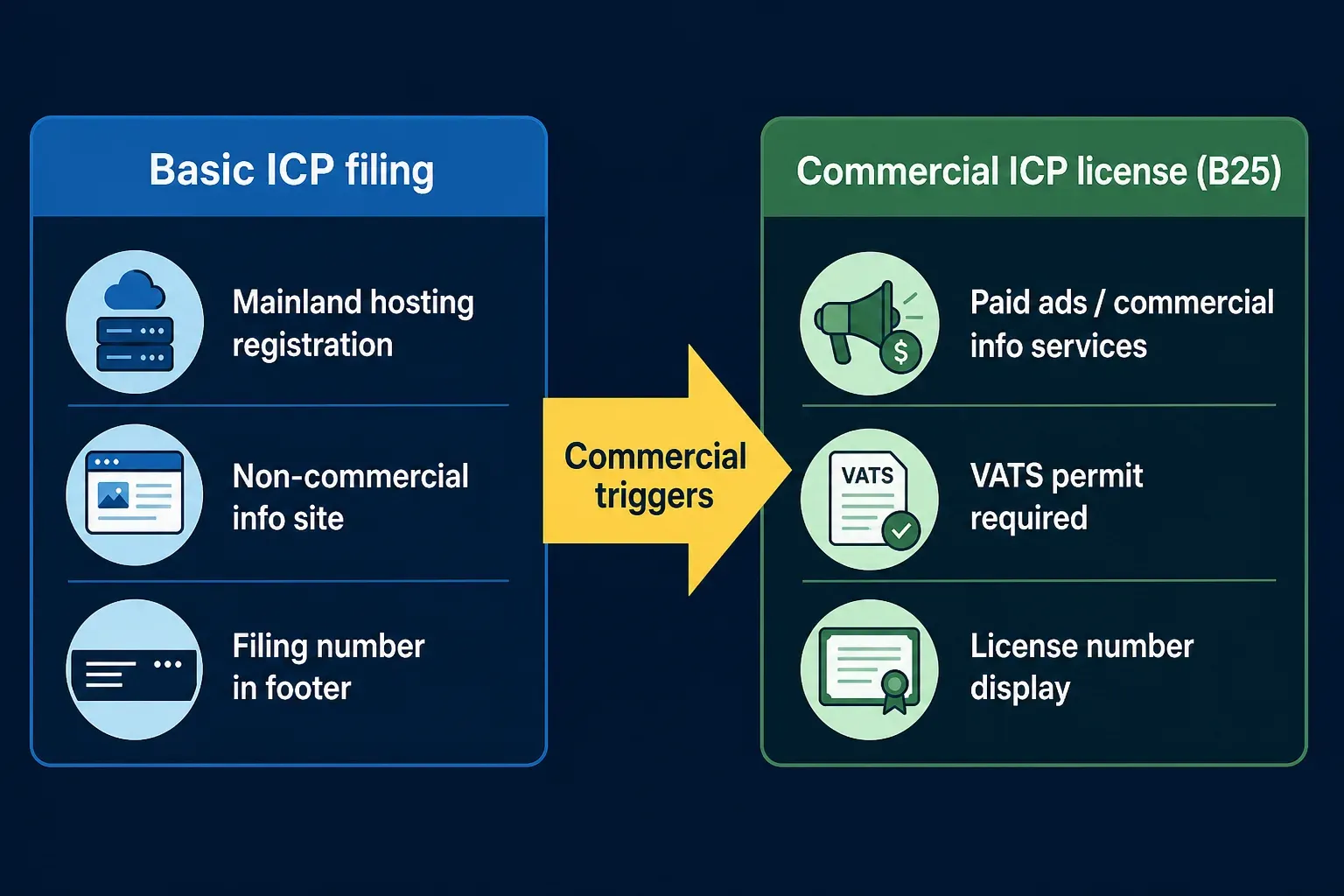
- Two products, one casual label — English “ICP license” often conflates basic ICP filing (备案 / non-commercial registration) with the commercial ICP license (经营性 ICP / B25). Footers that show a filing number are not proof of commercial authorization.
- Host trigger — Basic filing and commercial B25 attach when your site or app is hosted (or DNS-resolves) on Mainland China infrastructure. Offshore-only stacks usually avoid both filing and B25; they do not automatically deliver Mainland China performance or unblock third-party resources.
- Commercial vs non-commercial split — Non-compensatory public information services sit on the filing track. Compensatory / commercial information services sit on the license track. B25 is that commercial track for information services under Category II VATS.
- Typical commercial patterns — Advertising inventory, paid / gated information, many e-commerce information layers, and other compensated online information services pull toward B25 analysis after filing — not “any website that loads in China.”
- Filing first, license on top — On Mainland China hosting, commercial properties usually need filing for the host path and B25 for the commercial information-service layer. B25 is not a substitute for filing.
- Not a speed product — A license (or filing) meets regulatory and host-enforcement gates. It does not by itself fix cross-border latency, packet loss, or blocked global CDNs and embeds.
- Sibling Guides — Domain / DNS / service-IP filing rules: ICP filing in China — domain DNS to Mainland China IPs. Sequence with PSB: ICP and PSB filing sequence. Wider B25/B21 catalogue: China VATS licenses for digital products.
Vocabulary first. Next: what must exist before any B25 pack is realistic.
What must be true before a B25 path is real
Missing any of these stops your product team before a commercial-license calendar is honest — whether you aim at partner publish or a provincial application.
| Precondition | Why your process stalls |
|---|---|
| Clear commercial model — paid content, ad inventory, compensated information features, or marketplace patterns named | You cannot choose filing-only vs B25 (and B21) from a vague “we sell in China” slide |
| Mainland China host / resolve decision | Offshore-only usually avoids filing + B25; onshore creates the filing duty before license talk |
| Organizing entity or licensed Chinese partner | B25 packs and MIIT opinion letters need a China-operable applicant or contracted scope |
| Domain + ICP filing posture that matches the applicant | Beijing-style packs expect company-owned domain, completed filing, entity match, remaining validity |
| Staff / capital / business-scope floor (if self-applying) | Capital, social insurance paid by the applicant, and Category II / internet information-services scope are hard gates |
| Live commercial surfaces that match the model | Reviewers check registration, membership, paid information / advertising patterns — brochure-only sites fail commercial packs |
Chinese-language consoles, MIIT / provincial channels, and social-insurance evidence are part of this floor. Product teams usually cannot finish a Beijing (or other provincial) B25 pack from an overseas-only checklist.
Critical path: filing vs B25
Start from behavior on the Mainland China property, not from collecting every telecom code. For domain DNS and service-IP filing rules, see ICP filing in China — domain DNS to Mainland China IPs and ICP and PSB filing sequence. For the wider B25/B21 catalogue map, see China VATS licenses for digital products.
Numbers and process steps below use a Beijing provincial B25 package as the worked example (information-services / internet information services under Category II VATS). Other provinces can differ on capital, staff months, and foreign routing — confirm with the local communications administration before you file.
| Your China property does… | Usual first gate | B25? |
|---|---|---|
| Informational / corporate site, no commercial information-service model | Basic ICP filing (+ PSB after launch) | Often no |
| Sells advertising inventory, runs paid content platforms, or commercial information services | ICP filing first | Yes — analyze B25 |
| Marketplace / transaction processing between buyers and sellers | ICP filing + platform controls | B25 may still apply; also check B21 |
| Typical single-store self-operated ordering mini program | ICP / App filing as applicable | Usually no B25 |
| You only consume Alibaba Cloud / Tencent Cloud / AWS China / Azure China | Vendor holds infrastructure VATS | Your service layer still needs its own analysis |
Filing vs license (keep these distinct)
| Basic ICP filing (备案) | Commercial ICP license (B25) | |
|---|---|---|
| What it is | Registration for non-commercial internet information services on Mainland China hosting | VATS permit for commercial information services |
| Cost / bar | Filing process via host / MIIT systems; no “license fee” in the commercial sense | Qualification pack, review, multi-year certificate, ongoing display / renewal |
| Typical use | Corporate sites, blogs, product showcases without paid information services | Paid content, ad-funded platforms, many SaaS / app information services sold for compensation |
| Relationship | Often required first when you host in Mainland China | Usually sits on top of filing when commerce begins — not a substitute for it |
Many commercial properties need both: filing for the Mainland China host path, B25 for the commercial information-service layer.
What B25 actually authorizes
- Catalogue home: Information services under the Telecommunications Services Classification Catalogue (电信业务分类目录) — commercial track. Product language usually groups release / search / community / messaging / protection-style services when they are offered for compensation.
- Legal split (plain English): China’s internet information-service rules treat commercial (compensatory) information services under a license system and non-commercial (non-compensatory, public information) services under a filing system. B25 is the commercial track product teams mean by “ICP license.”
- Display: Approved operators show the license number on the website or platform where required. Validity is five years; plan renewal about 90 days before expiry.
This guide stops at B25 (+ a pointer to B21). Call-center, IDC, CDN, and VPN codes matter for specialized operators; they are not the default shortlist for a SaaS or content app.
Trigger examples (yes / no)
Usually pull toward B25 analysis
- B2B SaaS that charges for information access — e.g. HR or ops tooling where companies pay monthly so employees can view payroll, benefits, or operational records through a web/app information layer.
- Paid content / education platforms — subscriptions or one-time fees for courses, reports, or gated media delivered as an internet information service.
- Ad-funded or premium apps — free companion apps that later sell analytics packs, premium feeds, or paid information features still enter commercial territory for those layers.
- E-commerce product information + accounts — catalogs, user accounts, and commercial information layers often sit in B25 analysis; multi-seller / third-party transaction platforms also need B21 (EDI) in parallel.
Usually stay filing-only (if the model stays non-commercial)
- Corporate brochure site — company story, product specs, contact forms, no paid information services and no ad inventory sales as a commercial platform.
- Fully free utility app — device companion or status views with no subscriptions, premium content, or paid information features (and no ad-sales platform model).
- Single-store self-operated ordering mini program — usually outside B25; third-party marketplace mechanics are the B21 trigger.
B2B vs B2C does not remove B25. “We only charge enterprises” is still compensation for information services when that is what you sell.
How product teams clear B25 in practice
| Path | When it is realistic | Trade-off |
|---|---|---|
| Chinese partner operate / publish model | Most commercial apps and sites entering Mainland China | Partner holds B25; your product rides under contracted scope |
| WFOE in MIIT pilot regions (Beijing and other designated scopes) | Long-term local entity + approval budget | Policy eligibility ≠ easy approval |
| Stay filing-only / offshore | No commercial information-service model in Mainland China | Avoids B25 — and avoids the commerce model you may have assumed |
Since October 2024, Beijing as a pilot region has removed the foreign-equity cap for listed VATS — a wholly foreign-owned enterprise may apply for B25 (Beijing Free Trade Zone entities may hold 100% foreign equity). Non-pilot regions still require foreign ownership ≤ 50%. Treat that as eligibility, not a launch forecast: successful foreign licensees remain few, and foreign-invested applicants still follow the two-step path below. Most product teams should assume a licensed Chinese partner unless they have a dedicated WFOE program.
Qualification shape — Beijing worked example
For a Beijing B25 (information services — internet information services) package, core bars are:
| Area | Beijing requirement |
|---|---|
| Registered capital | ≥ RMB 1 million |
| Domestic entity | Pure domestic company; foreign share ≤ 10% is treated as domestic |
| Foreign entity | Pilot policy allows up to 100% foreign equity in Beijing; non-pilot regions remain ≤ 50% |
| Business scope | Business license must include Category II value-added telecommunications services or internet information services |
| Staff / social insurance | ≥ 3 full-time employees with social insurance paid by the applicant for at least one continuous month (some regions require three months); one needs a computer-related background. Third-party payroll SI is not accepted |
| Domain | Company-owned domain, ICP filing complete, filing entity matches the applicant, remaining validity ≥ 6 months |
| Servers | Hosted in Mainland China; hosting agreement plus IDC provider qualifications |
| Website | Live commercial functions that match the model — user registration, membership management, and paid information / advertising / membership-fee patterns as applicable |
Pre-work pack typically includes business license, legal-representative and shareholder IDs, the three employees’ social-insurance records, domain certificate, and server hosting agreement.
Application shape — Beijing path
Who submits
- Domestic enterprises — apply directly to the Beijing Communications Administration.
- Foreign-invested enterprises — (1) obtain an MIIT Foreign-Invested Telecommunications Business Opinion Letter, then (2) apply to the Beijing Communications Administration with that opinion letter.
Flow
- Prepare — confirm entity bars, stand up a compliant commercial site, finish domain ICP filing, assemble the pack above.
- File online — submit via the MIIT government-services platform (dxzhgl.miit.gov.cn).
- Formal review — correction feedback within five business days.
- Substantive review — about 20–40 business days; possible on-site check of premises.
- License — download the electronic license or collect a paper certificate from the Beijing Communications Administration; show the license number on the property.
- Maintain — validity five years; start renewal about 90 days out; file the annual report each January–March (late filing can put the entity on the abnormal business list).
End-to-end timing with a complete Beijing pack is about 30–60 business days, plus prep.
Operating without B25 when you need it
Risks include correction orders, fines, confiscation of illegal income, suspension, and permit problems under telecommunications rules. Hosting partners, payment rails, and enterprise buyers also enforce commercial-license evidence in practice — often before a formal enforcement action.
Why filing-only calendars break when commerce starts
Offshore assumption → wrong license calendar. Teams plan “ICP license for speed,” then discover the real fork is host location + commercial model — not a single permit that makes the site fast.
Filing complete → commerce features ship → wrong posture. A valid filing footer does not authorize paid information platforms or ad-inventory sales. Feature creep after a filing-only launch creates a silent B25 gap.
Cloud vendor VATS → product-layer gap. Infrastructure licenses cover the host / CDN operator. They do not authorize your commercial information service.
B25 labeled as “the marketplace license” → B21 miss. Multi-vendor checkout and third-party transaction patterns need B21 analyzed in parallel; wrong code means wrong partner scope and a restart.
Pilot WFOE eligibility → launch forecast. Equity-cap removal is real in designated scopes; scarce approvals still leave most launches on a licensed Chinese partner path while the MIIT opinion + provincial cycle runs — if it runs at all.
China-specific failure points
Saying “we have ICP” when you only have filing
Footer filing numbers satisfy basic registration. Commercial features, ad sales, or paid information platforms can still sit outside that posture. Stores, payment partners, and enterprise buyers increasingly distinguish filing from commercial licenses.
Assuming the cloud vendor’s VATS covers your product
Your CDN or IDC provider’s licenses cover their infrastructure. They do not authorize your commercial information service. Product-layer B25 analysis still belongs to the organizing operator of the app or site.
Feature creep after a filing-only launch
Brochure site → later sprint enables ad inventory, paid content marketplace, or commercial information feeds. The filing number still looks valid while the commercial posture has changed. Schedule a license re-check when those features land.
Social insurance not paid by the applicant
Beijing packages reject packs where the three named staff are covered through a third-party payroll agent, or where the computer-related background requirement is missing. SI employer must match the applicant entity.
Website out of scope or missing compliance surfaces
Content in news, healthcare, or other pre-approval domains without the prior permits — or a commercial site missing privacy policy and complaint channels — is a common reject reason even when capital and staff look fine.
Incomplete foreign-equity disclosure
Foreign structures must be disclosed through to the ultimate shareholders. Hiding or truncating the ownership chain is a reject risk under Beijing review.
Treating pilot WFOE as the default path for teams outside Mainland China ops norms
Pilot opening is real (including Beijing’s equity-cap removal); successful foreign licensees remain few. For most launches, a licensed Chinese partner is the operational path while you decide whether the MIIT opinion + provincial license cycle is worth it.
Confusing B25 with B21
Multi-vendor checkout, escrow-like flows, or “platform takes a cut” patterns pull toward B21. Mislabeling marketplace mechanics as “just B25 content” creates the wrong application and the wrong partner scope.
Display, renewal, and annual-report hygiene
Missing license display, stale footers after entity changes, a lapsed five-year certificate, or skipping the January–March annual report creates avoidable enforcement and diligence failures — even when the original approval was clean.
Diligence questions from China buyers and stores
Enterprise customers and distribution partners ask for commercial license evidence during onboarding. Being able to show B25 — or explain why the model is filing-only — is go-to-market work, not only regulatory defense.
When a China landing partner is the realistic B25 path
Most product teams need a China landing partner to clear entity, verification, partner-publish scope, and provincial / MIIT rails for commercial ICP Self-application remains possible for teams with a funded WFOE program and a complete Beijing-style pack; it is not the default launch path for a first Mainland China commerce calendar.
What we can offer?
B25 is a product trigger, not a telecom catalogue: basic ICP filing versus commercial information-service licensing, partner publish versus a rare pilot WFOE path (including a Beijing pack when that is your province), and license display that matches what you actually sell. Chinaready’s four services map onto that line:
- China Readiness Assessment — Name whether your China property is filing-only or needs B25 (and B21 if marketplace patterns appear), and which operating model (partner vs Beijing / pilot WFOE) is realistic before you promise commerce dates.
- China Access Acceleration — Keep Mainland China user journeys reachable once commercial features and license gates are in scope — so “licensed” and “customers can open the site” stay aligned.
- China Product Hosting — Place the right components on Mainland China termination paths that support ICP filing, domain/host evidence for a B25 pack, and the commercial posture you chose.
- Mobile App Distribution — Sequence store launch with the same commercial-license evidence buyers and stores ask for, so App filing and B25 triggers do not collide at submission.
Contact us when you need that trigger map before you open a Mainland China commerce calendar.
Frequently asked questions
Do I need an ICP license for my website?
Only if you host (or resolve) on Mainland China infrastructure — and “license” usually means two different products. Informational / corporate sites often need basic ICP filing only. Commercial information-service patterns (paid content, ad inventory platforms, many compensated information apps) pull you toward the commercial ICP license (B25) after filing. Offshore-only hosting usually avoids both filing and B25, but does not by itself fix Mainland China performance or blocked third-party resources.
Do I need B25 or only basic ICP filing?
Informational / corporate sites on Mainland China hosting often need basic ICP filing only. Commercial information-service patterns — including many advertising and paid information platforms — pull you toward B25 after filing.
What capital and staff bar does a Beijing B25 package require?
For a Beijing information-services (B25) application, registered capital must be at least RMB 1 million, and you need at least three full-time employees with social insurance paid by the applicant for at least one continuous month (some regions require three months), including one with a computer-related background.
Is B25 the same as an EDI / B21 license?
No. B25 covers commercial information services. B21 (online data processing / transaction processing) is the marketplace / transaction-platform license. Third-party transaction platforms usually need B21 analyzed in parallel; typical single-store self-operated ordering mini programs usually do not need B25.
Can a company without a Mainland China entity hold a B25 license in Beijing?
Policy in Beijing (pilot since October 2024) removed the foreign-equity cap for listed VATS, so a wholly foreign-owned enterprise may apply. Applicants still obtain an MIIT foreign-invested telecom opinion letter first, then apply to the Beijing Communications Administration. Approvals remain scarce in practice; most product teams still use a licensed Chinese partner.
How long does a Beijing B25 application take?
With a complete pack, end-to-end timing is about 30–60 business days — formal feedback within five business days, then substantive review over roughly 20–40 business days (possible on-site check). Partner publish models can be faster to launch if the partner already holds the license.