

SaaS performance in China — put a China path on the journey
Slow SaaS in China is usually geography. Speed up SaaS performance with a China termination path, local static assets, and reachable APIs — not only a global CDN toggle.
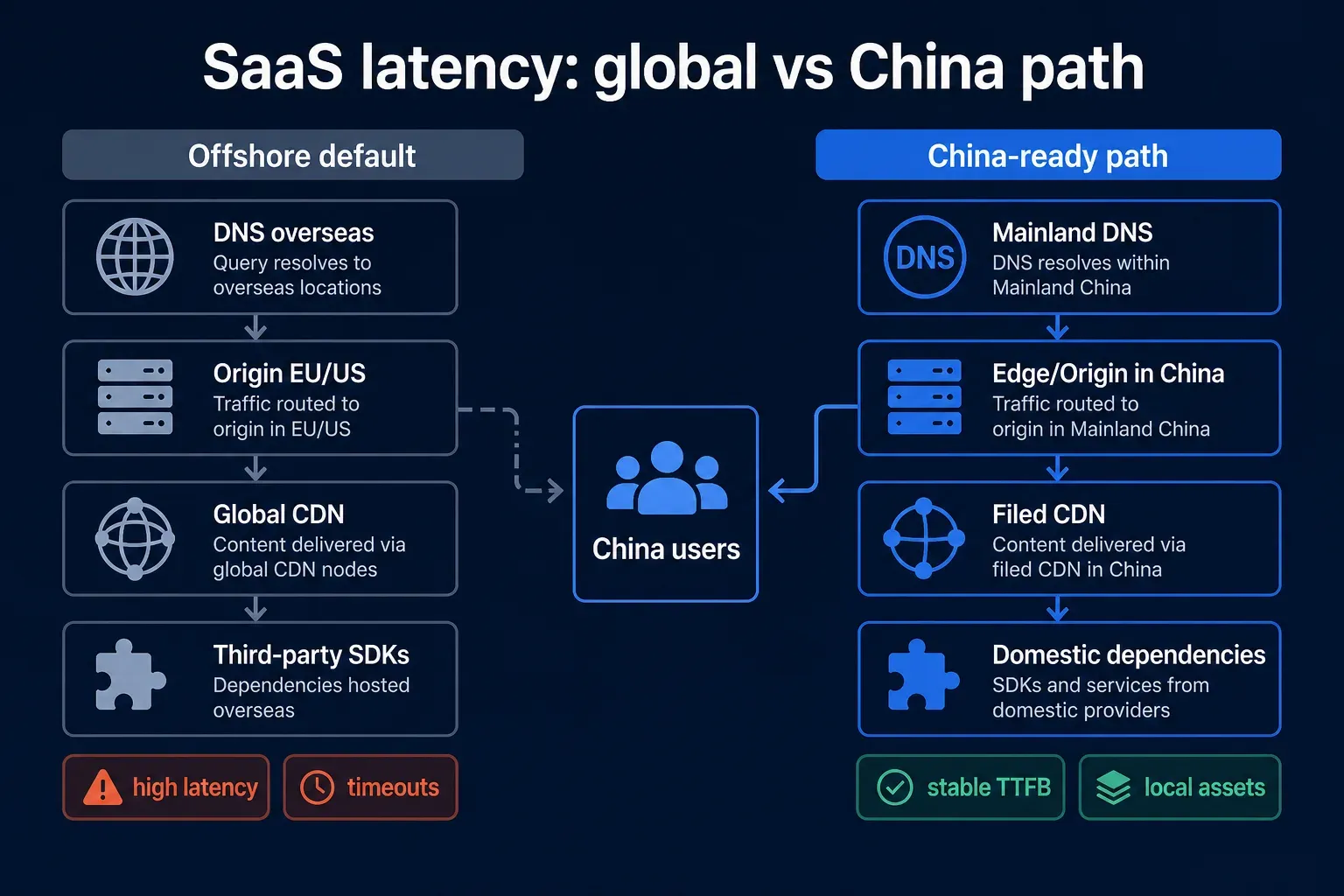
Slow SaaS in China is usually a geography problem pretending to be a front-end problem. If HTML, APIs, auth, and third parties all live overseas, every click pays cross-border latency. To speed up SaaS performance in China, a global CDN toggle is not enough: put a real China path on the journey, localize static weight, keep APIs reachable, and measure from Mainland China — not from US synthetic checks alone. The filing-and-hosting chain behind a China path: Publish a website in China. The full SaaS program — surfaces, filing read, local payments, and this speed gate: SaaS in China.
Preconditions
Before you buy another “China acceleration” SKU, lock these facts. Missing any of them turns performance work into theater.
| Precondition | Why DIY stalls |
|---|---|
| Journey map — login, home dashboard, top three workflows; every hostname each step calls | Optimizing CSS while auth sits on a blocked IdP wastes the quarter |
| Mainland China vantage for TTFB, waterfall, API p95, websocket success | US/EU APM proves overseas SLOs only |
| Clarity on intended China termination (edge-only vs selective API locality vs full region) | Asia PoP outside Mainland China is not an in-country region |
| Inventory of third parties on the critical path (auth, CAPTCHA, analytics, fonts, session replay) | One blocked widget makes “the app is down” |
| If you claim an in-country site or shell: ICP / host path alongside latency work | A fast unfiled deploy is still a business risk — see ICP domain-DNS |
| China-segmented SLOs (or instrumentation that can create them) | Global averages hide China churn |
If customers report “site down” rather than “slow,” triage access first with Website not working in China. Designing a filed, loadable China front door is covered in Website accessible in China.
Core path
| Layer | Offshore default | China-ready move |
|---|---|---|
| DNS | Single global answers | China-appropriate answers for China hostnames |
| Static shell | US/EU object storage + global CDN | Mainland China CDN/host for China hostname assets |
| App HTML | SSR/edge outside China | China edge or in-country origin for China entry |
| APIs | One global API hostname | China-reachable API path or regional deploy |
| Auth | Overseas IdP + blocked widgets | IdP/paths tested from Mainland China |
| Realtime | Global websocket fan-in | Regional gateway or degraded mode |
| Third parties | Global tag soup | Allowlisted, China-safe dependencies |
| Data | Single region abroad | Residency/architecture per product and law |
Optimization sequence (decisions, not console clicks)
- Map the journey — Login, dashboard, top workflows; list every hostname.
- Measure from Mainland China — TTFB, waterfall, API p95, websocket connect success.
- Kill blocked or huge overseas static weight — Fonts, unsplit bundles, session replay.
- Decide the China termination story — Edge-only vs partial stack vs full region.
- Implement one hostname strategy — Dedicated China entry beats magic geo on a single global host when paths diverge.
- Re-measure and budget — Set SLOs for China separately from global.
Pattern choice (keep it boring)
Edge + overseas origin — Improves static; APIs still cross the border. Good first mile, incomplete for chatty SaaS.
China front door + selective API locality — Shell and read-heavy APIs in Mainland China; heavy compute stays global with explicit UX limits.
Full China deploy — Highest performance and highest ops/compliance cost. Use when China is a primary revenue region.
Spend money where the pie chart is largest: DNS, TLS, static, document, API, or third party. Static acceleration without API locality is how you get a fast spinner over a slow truth.
Linked reasoning
Global APM green → false confidence. Cross-border RTT and blocked third parties do not appear in US/EU averages. “Fine globally” and “usable in China” are different facts.
Static CDN without API locality → fast shell, slow product. Chatty SPAs multiply RTT; BFF aggregation and fewer round trips matter more in China than micro-optimizing CSS.
Auth on frozen hosts → dashboard work never matters. IdP, CAPTCHA, and bot scripts on blocked or distant domains make login the slowest — or failed — step. Fix auth and bootstrap locality before polishing widgets.
Singapore / Tokyo “multi-region” → still not Mainland China. Nearby overseas regions help some Asia users; many China ISP paths still pay the border penalty.
Realtime that hairpins overseas → collaborative features stall. Plan regional gateway or degraded polling before sales promises live collaboration.
Performance without filing / data rules → business risk. A fast illegal or unfiled in-country deploy is still a risk. Latency design sits next to ICP/traffic and data rules — it does not replace them. Sequence context: China ICP and PSB filing.
Difficulty and blockers
- Optimizing Lighthouse on a US laptop — Lab scores abroad omit the Mainland China boundary. Tie budgets to China RUM or synthetic nodes.
- Chatty SPA patterns — Hundreds of small API calls multiply RTT. Consolidation pays off faster than CSS shaving.
- Websocket and SSE assumptions — Plan fallback or regional gateway before promising collaboration.
- Ignoring mobile China networks — Test 4G/5G Mainland China paths, not only office fiber.
- API design that hurts more in China — Fewer round trips, payload diet, real caching headers, idempotent retries, region-aware config that disables doomed integrations early.
- People and process — Marketing adds tags without a China check; “global SRE” has no China vantage. Add China performance review to the same change management that already covers privacy and security.
- Vendor “China acceleration” slides without numbers — Ask where TCP terminates, whether Mainland China is in-country or nearby overseas, what filing/onboarding is required, and what p95 looked like from Beijing/Shanghai/Guangzhou broadband last quarter.
- Organizational anti-patterns — Platform measured only on US/EU SLOs; China sales selling realtime without a China path; budgets that exclude third parties; “temporary” overrides that disable China CDN caching forever.
Example shape that feels “down” while status pages are green: overseas DNS/TLS → HTML OK → auth redirect to overseas IdP (+1–2s or fail) → cross-border token and bootstrap APIs → widget fan-out (many calls) → session-replay third party blocked or slow. Fix auth and bootstrap locality before CSS.
SLO sketch: pick three China journeys; define availability, API p95 for the critical endpoint, and a UX time budget. Alert on China segment regressions separately from global. If APM cannot segment Mainland China, fix instrumentation before arguing about CDN brands. Consider read-only caches, longer timeouts with progress UI, and feature flags that disable collaborative realtime when the China path is unhealthy.
China landing partner
Most product teams need a China landing partner to stand up Mainland China measurement, choose an honest termination pattern, and align filing with the latency path — not another longer front-end checklist. Your team still owns product architecture; the partner path makes China-side edges, hosting, and ops rails executable when those prerequisites are not already in-house.
What we can offer?
When SaaS feels slow in Mainland China, Chinaready helps you put a China path on the real click journey — which hostnames dominate latency, where they must terminate, and what China SLOs you will hold — instead of another global CDN toggle:
- China Readiness Assessment — Map session, static, API, and third-party hosts on the critical path; choose edge-only versus selective locality versus fuller China deploy; set China-segmented evidence before the next vendor SKU.
- China Access Acceleration — Attack the proven bottleneck layer (static, document, API, or third party) so Mainland China p95 moves for customers, not only for global APM dashboards.
- China Product Hosting — Host the China entry shell and the APIs that must be local on Mainland China termination when that is the honest latency fix.
- Mobile App Distribution — Align mobile clients and API hosts with the same China path so web performance work does not leave the app slow or broken.
Contact us when global p95 looks fine but China customers still churn on “slow.”
Frequently asked questions
Why is my SaaS slow in China but fine in the US and EU?
Most SaaS architectures terminate sessions, APIs, and static assets outside Mainland China. Cross-border RTT, loss, and blocked third parties compound on every navigation — global APM stays green while China users wait. Improving SaaS performance in China means putting a China path on that journey, not only shaving front-end bytes.
How do you speed up SaaS performance in China?
Map the click journey, measure from Mainland China, kill blocked or huge overseas static weight, then choose edge-only versus selective API locality versus a fuller China deploy. A global CDN alone rarely fixes chatty APIs and auth that still cross the border.
Will a global CDN fix China SaaS latency?
It can help static assets at overseas edges, but dynamic API calls and websockets still pay the cross-border penalty. Meaningful speed usually needs Mainland China edge/origin for the China path or a localized deployment.
Should we deploy a full China region copy of the product?
Sometimes yes for data-heavy or real-time products; sometimes a China edge + selective API locality is enough. Choose based on which calls dominate the user journey, plus filing and data rules.
Do third-party scripts affect SaaS performance in China?
Yes. Auth widgets, analytics, session replay, and font hosts that are slow or blocked in Mainland China inflate Time to Interactive even when your primary API is optimized.
Can we tune this from US synthetic checks alone?
No. Lab scores abroad omit the Mainland China boundary. Prove improvement with China-segmented TTFB, LCP/INP, API p95, and error rate — and often a China landing partner — before choosing edge-only versus fuller locality.
Insights
Other similar insights
Part of the Website & SaaS readiness cluster — every guide in the cluster, one page.