
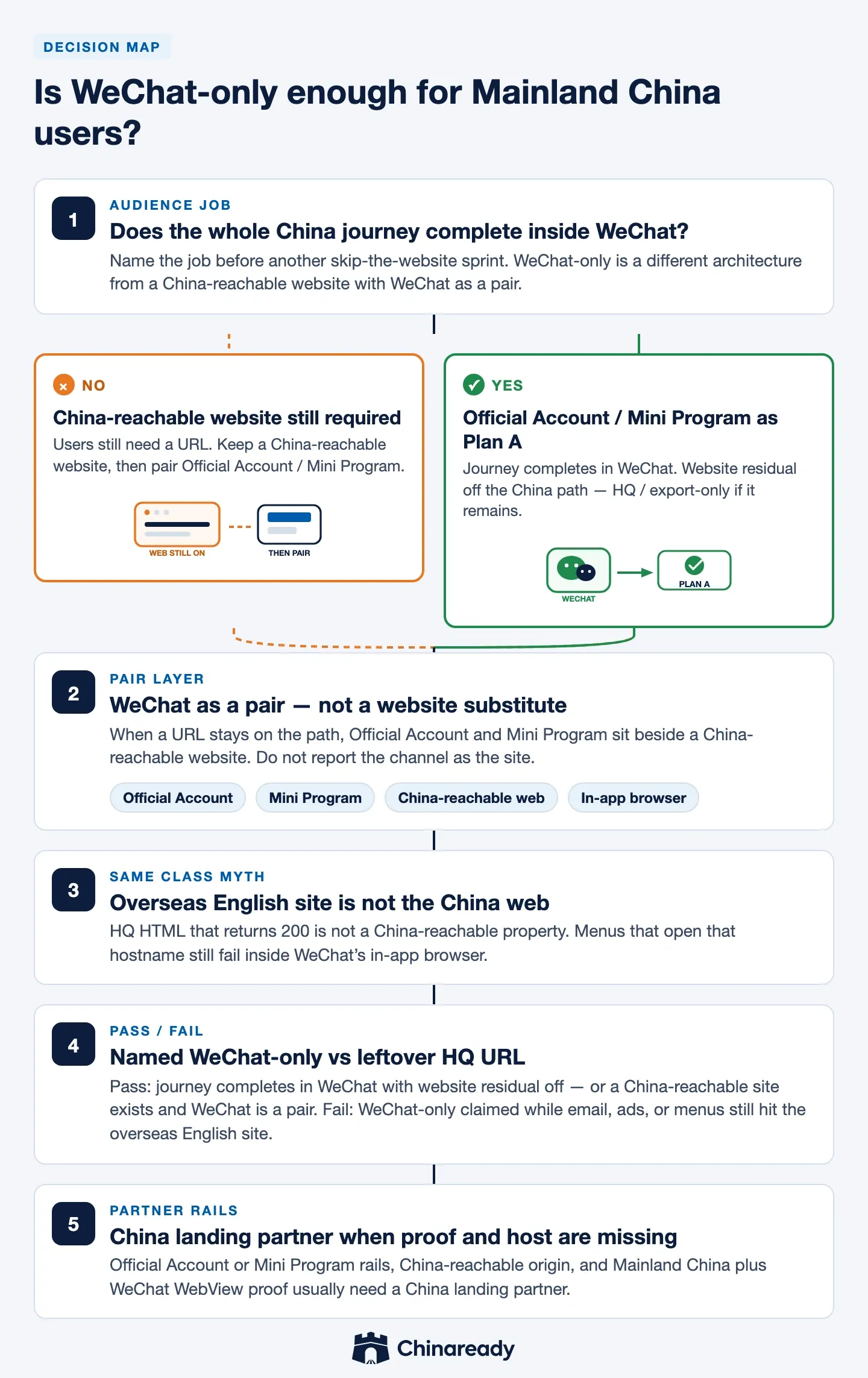
Website vs WeChat China is a surface fork, not a channel how-to. WeChat-only — a verified Official Account and, when conversion must live inside WeChat, a Mini Program — can be Plan A when the entire Mainland China journey completes in WeChat. If users still need a URL they can open from search, email, ads, partner pages, or Official Account menus, a China-reachable website is still required, then WeChat as a pair. An overseas English site is not the China web. For SaaS products deciding this fork: SaaS in China.
What WeChat-only and a China website actually are
Hard names your distribution decision will use:
- WeChat — Tencent’s super-app for chat, content, and lightweight apps (WeChat). Here it is the in-app China surface, not a rename of your global website.
- WeChat-only China — Official Account and/or Mini Program as the China property. No China-reachable website on the critical path. Website residual is off, or capped for HQ / export-only.
- WeChat Official Account vs website — A followable channel (broadcasts, menus, messaging) vs a URL your team controls (Official Account / service guide). Menus can open a page; they do not become the page. Verification lives on the Official Account Guide.
- WeChat Mini Program — A lightweight product inside WeChat without a store install (introduction). Filing is a different map: Mini Program Guide.
- China-reachable website — A hostname Mainland China users can resolve, complete TLS on, and finish journeys on — including inside WeChat’s in-app browser. Architecture: website accessible in China.
- Overseas English site ≠ China web — HQ
.comthat works from London is not proof. Cross-border TTFB, blocked tags, and in-WeChat stalls are the usual failure class. - Not the WeChat marketing order — Official Account, Mini Program, then ads is a spend sequence: WeChat marketing in China. This Guide is whether you still need a web property at all.
Vocabulary first. Next: what must be true before WeChat-only is honest Plan A.
What must be true before WeChat-only is Plan A
Missing a locked job stops your product team before another “we will just do WeChat” sprint is real work.
| Precondition | Why your process stalls |
|---|---|
| Job locked — entire Mainland China journey inside WeChat vs any open-web URL still on the path | WeChat-only is staffed while search, email, or partner links still need a site — or a full China site is built when WeChat-only was enough |
| Surfaces named — Official Account vs Mini Program vs both | Channel work is reported as the product, or a Mini Program is promised as “the website” |
| Landing inventory — menus, QR, ads, email, partner pages, consumer-platform rails | A follow exists; the click-through dies on an overseas English URL |
| WeChat in-app browser in scope when any menu or article opens HTML | HQ Chrome passes; WeChat WebView fails |
| China-reachable website scoped only if the fork says the URL is still required — not copied from the global site | ICP and host start on a US origin as a ritual, or the HQ site is labeled “launched in China” |
| Name / trademark path if you will publish a China-facing brand on web or WeChat | Spend and follows ship under a name you cannot hold — trademark in China |
Product teams usually cannot treat “open WeChat, skip the website” as the Mainland China plan. Naming WeChat-only vs still-need-web is the floor. Consumer rails such as Taobao, Douyin, or Xiaohongshu still often need a web landing even when WeChat is the chat layer — China consumer platform map.
Keep WeChat-only or keep a China-reachable website
| Stage | Decision / outcome |
|---|---|
| 1. Name the job | Does every Mainland China user complete the journey inside WeChat, or does any critical path still need a URL? |
| 2. If WeChat-only is honest | Official Account and/or Mini Program as Plan A. Website residual off the China path (HQ / export-only if it remains) |
| 3. If a URL is still on the path | A China-reachable website is still required. Then WeChat as a pair, not a substitute |
| 4. Inventory landings | Official Account menus, ads, QR, email, partner pages, consumer-platform hops. One leftover overseas English URL still fails the journey |
| 5. Do not freeze HQ HTML as the China web | Prove from Mainland China broadband, mobile, and WeChat’s in-app browser — website accessible in China |
| 6. If you terminate in Mainland China | Entity, host, and ICP move as one chain — host in Mainland China. Do not absorb that Guide here |
| 7. Cut over, then re-test | China hostname (or honest WeChat-only with no leftover web hop). Keep overseas English residual off that path |
Hard gate — WeChat-only vs still-need-web
Necessity: confusing these two jobs wastes the quarter — either you underfund a China-reachable site, or you staff ICP and host when WeChat-only was the honest architecture.
| Job | Website role | What must already be true |
|---|---|---|
| Journey completes in WeChat | Residual / off | Verified Official Account and/or Mini Program named; no open-web URL on the critical path |
| Users still need a URL | Plan A (China-reachable) | Hostname, deps, and in-WeChat browser proof; WeChat is a pair |
| HQ / export-only English site | Capped | Not marketed as the China web |
| “Menus are the website” | Myth as Mainland China plan | A menu click is still a landing. If that landing is HTML, accessibility still applies |
Hard gate — overseas English site is not the China web
A US/EU marketing site with a China campaign URL is still a capped overseas architecture. Hong Kong / Singapore ≠ Mainland China. A .cn on an overseas origin does not move termination onshore.
Why WeChat-only still leaves web jobs broken
Engineering and distribution constraints you must design around:
| Constraint | What breaks | What to do |
|---|---|---|
| Closed-ecosystem discoverability | Official Account content is not a substitute for an open-web URL users type, search, or receive in email | Keep WeChat-only only when those hops are truly off the path. Otherwise fund a China-reachable site |
| Menu / article click → HTML | Follow works; WeChat in-app browser loads an overseas English page slowly or not at all | Treat linked pages as part of website accessible in China |
| Official Account vs website collapsed | Channel sprints are reported as “we have a China website” | Split the jobs. Pair Official Account for the channel; keep the URL if the URL is still required |
| Mini Program counted as the website | Wrong console, filing, and payment rails | Mini Program is an in-WeChat product — Mini Program Guide. It does not retire every web landing |
| Consumer-platform ads with no web landing | Douyin / Xiaohongshu / Taobao hops still dump users on HQ HTML | Map those rails first — consumer platform map — then decide China website or WeChat for each hop |
| ICP started because “we have a website” | Filing on an overseas origin, or filing when WeChat-only was honest | Host and ICP only when Mainland China termination is the chosen architecture — host in Mainland China |
A 200 on the HQ site ≠ China-reachable web. Testers outside Mainland China never see the WeChat WebView stall.
WeChat marketing order pasted onto this fork → wrong program. Destinations-before-ads is a spend sequence (WeChat marketing). It does not answer whether you still need a website.
Trademark skipped because “it is only WeChat” → name risk. A followable account still publishes a brand. Naming rails sit on trademark in China.
What stalls teams that skip the China website
- WeChat-only as a cost shortcut — Product treats “skip the website” as savings before the journey is named. WeChat-only China is a job, not a budget line.
- Overseas English site as the China website — HQ HTML is announced as launched in China.
- Official Account how-to instead of the fork — Teams staff Service vs Subscription while the URL job is still open.
- Mini Program wrap of an H5 — The wrap is reported as retiring the website; leftover landings stay overseas.
- WeChat marketing order confused with this fork — Ads sequence starts before anyone decides whether a China-reachable site exists.
- Consumer rails without a landing — Platform work ships; the click still hits HQ.
- ICP ritual on the wrong architecture — Filing starts because a website exists globally, not because Mainland China termination was chosen.
- HQ laptop QA — Green screenshots from outside Mainland China, never inside WeChat’s in-app browser.
- No owner for leftover URLs — Email, QR, and partner PDFs still point at the overseas English site after WeChat-only is declared.
What “fixed” means: Mainland China users can complete the journeys you claim — either entirely inside Official Account / Mini Program with no leftover web hop, or on a China-reachable website with WeChat as a pair. The overseas English site is named and capped if it remains. Proof includes Mainland China broadband, mobile, and WeChat in-app browser. WeChat with a China marketing claim and an HQ URL is not fixed.
China landing partner when the fork is still open
Most product teams exploring Mainland China entry need a China landing partner once they stop treating WeChat-only as a slogan — to stand up Official Account or Mini Program rails when that is Plan A, or to place a China-reachable website (entity, host, ICP when termination is in-country) and prove the journey from Mainland China broadband, mobile, and WeChat’s in-app browser. Your team still owns whether WeChat-only is honest, which leftover URLs to kill, and which HQ English line to keep; the partner path makes that fork executable when those rails are not already in-house. Keeping a capped overseas site for outside-Mainland China viewers does not remove the need for that China landing partner on the primary China path.
What we can offer?
Website vs WeChat China work for Mainland China is a WeChat-only vs still-need-web decision before any “skip the website” or “copy the HQ site into WeChat” sprint. Chinaready helps your product team cap WeChat-only where it is honest — or keep a China-reachable website and pair WeChat:
- China Readiness Assessment — Decide whether WeChat-only is Plan A, which Official Account vs Mini Program vs website hops sit on the critical path, and whether leftover HQ URLs must die before a launch date.
- China Access Acceleration — Keep China-facing pages reachable from Mainland China vantage and inside WeChat’s in-app browser so Official Account menus, ads, and partner links do not die on an overseas English site.
- China Product Hosting — When the fork says the website is still required, place the China-critical origin where entity consistency and a China-reachable hostname stay coherent — not an HQ origin with a China campaign URL.
- Mobile App Distribution — Align any China app or Mini Program wrap with the same fork — not mistake an in-WeChat shell for a China-reachable website, or the reverse.
Contact us when you need a Website vs WeChat China fork named before you staff another WeChat-only or HQ-site-in-China sprint.