

Cross border data transfer China — when assessment blocks launch
Cross border data transfer China is a go-live fork — keep personal info in Mainland China, or clear CBDT security assessment, standard contract, or certification before export rails ship.
Cross border data transfer China is a go-live fork before it is a statute reading. If personal information collected or generated in Mainland China operations must leave the border, your product team clears a China CBDT mechanism — security assessment, standard contract, or certification — before export rails ship. If data can stay in Mainland China, keep residency and treat hosting / ICP as the peer program. Unresolved data export China is how launch decks slip while HQ sync and global tooling stay wired open. The SaaS program this fork gates: SaaS in China.
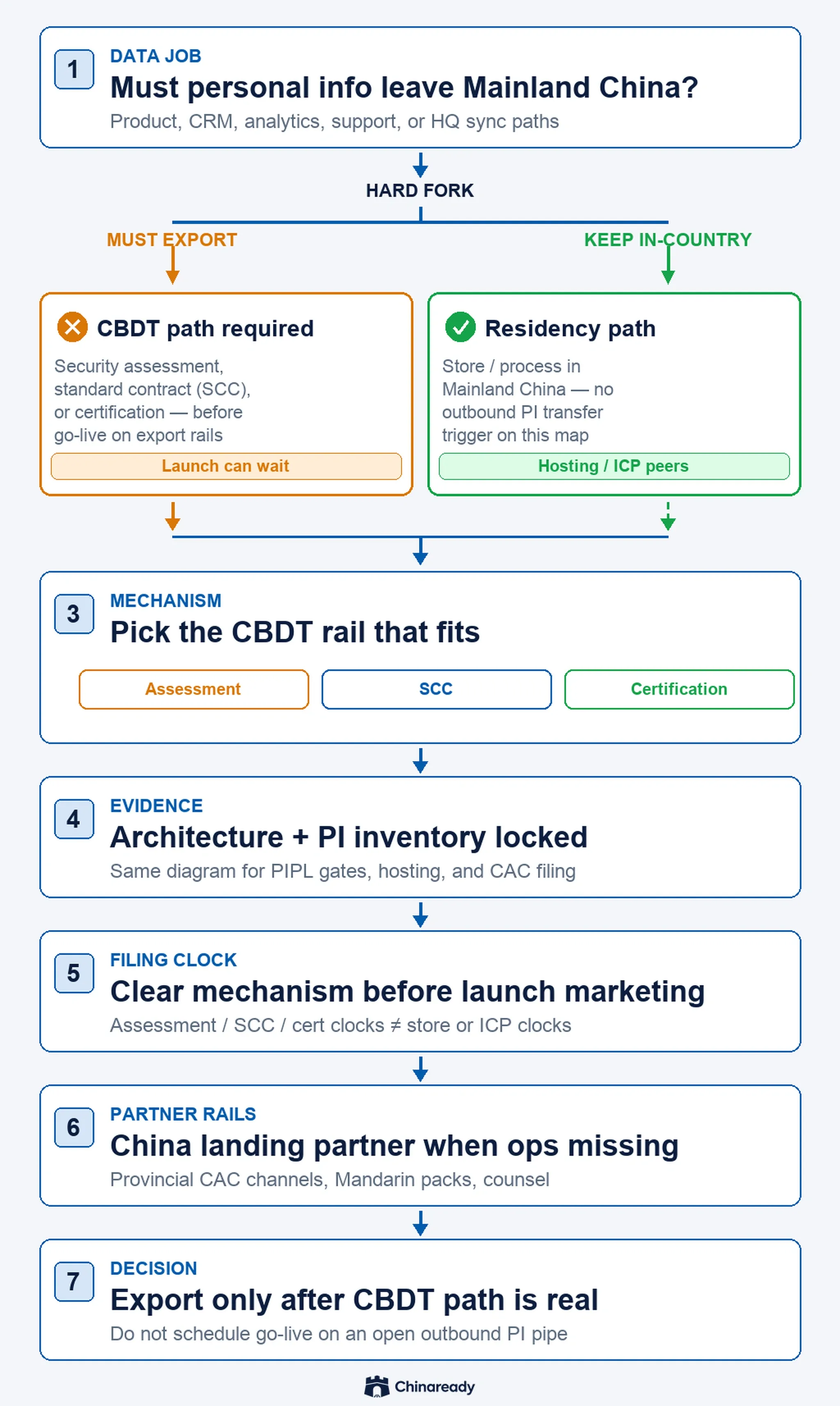
What China CBDT means for product launch
Hard names this Decision Map uses — sibling to PIPL product gates for the export / launch block only:
- Cross-border data transfer / China CBDT — Providing personal information (and, where rules apply, important data) from Mainland China operations to an overseas recipient. Product language: data export China that can block go-live when the product depends on that pipe.
- PIPL cross border baseline — The Personal Information Protection Law (个人信息保护法) requires a lawful condition before providing personal information abroad, including CAC security assessment, standard contract, or certification among the statutory paths (NPC text).
- Security assessment — CAC Measures for Security Assessment of Outbound Data Transfers (数据出境安全评估办法) (CAC; gov.cn). When this path applies, assessment incomplete = outbound launch blocked.
- Standard contract (SCC) — Measures for the Standard Contract for Outbound Transfer of Personal Information (个人信息出境标准合同办法) (CAC). Contract + impact assessment + provincial filing — not a silent HQ DPA paste.
- Certification — Personal information protection certification as an alternative outbound path under PIPL / CAC rules when it fits the scenario.
- 2024 implementing overlay — Provisions on Promoting and Regulating Cross-border Data Flows (促进和规范数据跨境流动规定) (CAC) adjust when assessment / SCC / certification apply, and when certain scenarios are eased. Where earlier Measures conflict, these Provisions control.
- Filing surface — CAC data-outbound declaration system (sjcj.cac.gov.cn) for assessment / SCC workflows teams actually open.
- Common myth — “Privacy policy updated = data export China cleared.” Notices help PIPL hygiene; they do not replace the CBDT mechanism when outbound transfer is required.
Vocabulary first. Next: what must be true before an export-dependent launch is real work.
What stops your product team before CBDT work starts
Missing any of these stops your product team before a CAC assessment, SCC filing, or certification path is executable — not after marketing locks a HQ-sync go-live date.
| Precondition | Why your process stalls |
|---|---|
| Honest export map — which personal info leaves Mainland China (CRM, analytics, support, identity, payments metadata) | Teams argue “only logs” while production pipes already sync abroad |
| Keep-vs-export decision locked | Half the stack “temporary overseas” forever; CBDT never owns a calendar |
| PI / important-data inventory tied to systems and regions | Assessment and SCC packs need named datasets, not slide arrows |
| Mainland China entity or organizing path for provincial CAC / filing | Overseas-only applicants cannot drive Mandarin portals alone |
| Architecture diagram shared with hosting / PIPL owners | Contradictory residency stories fail assessment and PIPL product gates together |
| Timeline that separates CBDT from ICP / store clocks | Store live ≠ outbound pipe approved |
Product teams without Mainland China ops rails usually cannot treat CBDT as an English questionnaire finished from HQ.
From residency fork to a launchable CBDT path
| Stage | Decision / outcome |
|---|---|
| 1. Name the data job | Must personal information leave Mainland China for the product to work? |
| 2. Hard fork | Keep in-country → residency / host in Mainland China + ICP peers · Must export → open CBDT mechanism selection |
| 3. Classify the outbound path | Security assessment vs standard contract vs certification under current CAC measures |
| 4. Lock evidence | PI inventory, recipient list, purpose, retention, security measures, legal documents |
| 5. Run the mechanism | Assessment through provincial CAC → national CAC; SCC execute + file; or certification track |
| 6. Gate go-live | Do not schedule launch marketing on an open outbound personal-info pipe |
| 7. Operate | Re-assess when purpose, volume, recipient, or architecture changes |
Hard gate — keep vs export
Necessity: confusing these two jobs burns the quarter — either you underfund Mainland China residency, or you ship on an illegal / unfinished outbound pipe.
| Job | CBDT role | What must already be true |
|---|---|---|
| Personal info stays in Mainland China | Export fork closed on this map | China-region storage / processing; no HQ sync of in-scope PI; hosting / ICP path coherent |
| Must provide PI abroad | Mechanism required before export rails are “launch ready” | Assessment, SCC, or certification path funded and owned |
| Important data outbound | Assessment path is the usual hard gate | Sector / CAC classification ownership — not a product guess |
Why residency and CBDT clocks block each other
Global SaaS default → silent data export China. Identity, ticketing, CRM, and analytics that terminate overseas turn every China user event into a potential outbound transfer.
“We’ll localize later” after launch → enforcement and relaunch risk. Marketing go-live on an open pipe makes CBDT a crisis project instead of a stage gate.
PIPL notices done, CBDT ignored → false green. The PIPL product-gates Guide covers lawful processing and product privacy gates; outbound transfer is a separate launch blocker when export is required.
Hosting in China, admin and backups abroad → half residency. Operators, support tooling, and backups that pull PI offshore reopen the export fork — align with China Product Hosting and ICP filing.
Cloud “China region” SKU ≠ CBDT cleared. Partition Guides (Alibaba Cloud China, Tencent Cloud China, Huawei Cloud China) place workloads; they do not replace CAC mechanisms when PI still leaves.
SCC template pasted from EU SCCs → filing reject. China standard contract is a CAC form + impact assessment + provincial filing, not a renamed GDPR exhibit.
Assessment assumed “too slow so skip” → launch on the wrong mechanism. Volume, CIIO status, and important-data flags decide the rail — counsel and current CAC measures set the threshold call.
What blocks product teams on China CBDT
- Treating CBDT as post-launch paperwork — Export-dependent features need the mechanism before those features are customer-ready.
- No single owner for the export map — Engineering, legal, and China ops each hold a different diagram.
- HQ analytics non-negotiable without a CBDT budget — Product insists on global tools while compliance has no assessment / SCC line.
- Ignoring important-data and CIIO questions — Teams that only count “user rows” miss assessment triggers.
- Free-trade-zone or exemption myths without counsel — Scenario easements exist in the 2024 Provisions; they are not a blanket launch waiver.
- Store / ICP success reported as “China compliant” — Channel and hosting gates do not clear outbound personal-information transfer.
- No China landing partner when portals and Mandarin packs are missing — Overseas-only teams stall at provincial CAC queues.
China landing partner when export rails are unfinished
Most product teams exploring Mainland China entry need a China landing partner (beside counsel) once the hard fork says personal information must leave Mainland China — or when residency requires China-region hosting and ICP ops the team does not have in-house. The partner path makes provincial CAC filing, Mandarin evidence packs, SCC filing, and coherent hosting / PIPL diagrams executable. Your team still owns product architecture and the keep-vs-export decision; the partner does not invent a mechanism that the law does not allow.
What we can offer?
Cross border data transfer China is a keep-vs-export launch decision before any CAC form. Chinaready helps your product team see whether China CBDT blocks go-live and which residency or mechanism path fits:
- China Readiness Assessment — Map which China features force data export China, whether security assessment / SCC / certification is plausible, and which launch date is fake until the fork is locked.
- China Access Acceleration — Keep China-facing admin and critical deps reachable while residency or CBDT evidence is built — without silently reopening outbound PI pipes.
- China Product Hosting — Place China-critical workloads so “keep in Mainland China” is an architecture fact, not a slide — aligned with ICP and later CBDT answers.
- Mobile App Distribution — Ship store launches on their own gates while privacy and outbound-transfer stories match the live app backends reviewers and CAC would test.
Contact us when your China launch depends on HQ sync, global CRM, or overseas analytics — and you need the CBDT fork decided before marketing owns the date.
Frequently asked questions
What is cross-border data transfer (CBDT) in China?
China CBDT (cross-border data transfer) means providing personal information or important data collected or generated in Mainland China operations to a recipient outside Mainland China. Product teams treat it as an export / launch fork — keep processing in-country, or clear a lawful outbound mechanism before go-live on export rails.
When does a CAC security assessment block launch?
When your architecture must export personal information or important data outside Mainland China and the applicable path is a CAC-organized data export security assessment, launch marketing that depends on that outbound pipe should wait until the assessment path is real. Assessment clocks are separate from ICP, store, and app-filing clocks.
What are the main China CBDT mechanisms under PIPL?
PIPL cross border rules point to three primary mechanisms for providing personal information abroad — CAC security assessment, the personal information outbound standard contract (SCC), and personal information protection certification — plus other conditions the law allows. Current volume and scenario rules live in CAC implementing measures; confirm current thresholds with counsel / current CAC measures.
Can we avoid CBDT by hosting in Mainland China?
Often yes for the outbound-transfer gate — if personal information stays stored and processed in Mainland China and is not provided abroad, this Decision Map’s export fork may not open. You still need hosting, ICP, and product rails — see host in Mainland China and ICP peers — and PIPL product gates still apply in-country.
Is data export China the same as PIPL compliance?
No. PIPL covers lawful basis, notices, rights, and processors for personal information in scope. Data export China / CBDT is the outbound transfer layer that can freeze go-live when HQ sync, global CRM, or overseas analytics must leave Mainland China. Use the PIPL product-gates Guide for the broader privacy map; use this article for the export block.
Can product teams finish CBDT without Mainland China ops?
Usually no. Provincial CAC channels, Mandarin filing packs, standard-contract filing, certification bodies, and architecture evidence need Mainland China ops or a China landing partner beside counsel.
Insights
Other similar insights
Part of the Website & SaaS readiness cluster — every guide in the cluster, one page.