

Publish a website in China — domain, filing, hosting, reach
Publishing a website in China is a filing-led chain — entity, domain, ICP filing via a Mainland China access provider, hosting and DNS cutover, then reachable dependencies. Hong Kong is not a shortcut.
Publishing a website in China is a filing-led chain, not a deploy step. Your product team decides which hostnames need Mainland China delivery, locks a Chinese entity or landing-partner rail, aligns the domain, buys hosting from the access provider that will forward the ICP filing pack, then cuts DNS to the filed IPs and keeps dependencies China-reachable. An overseas-only site is a different architecture with different limits — and Hong Kong hosting is not the shortcut it is sold as.
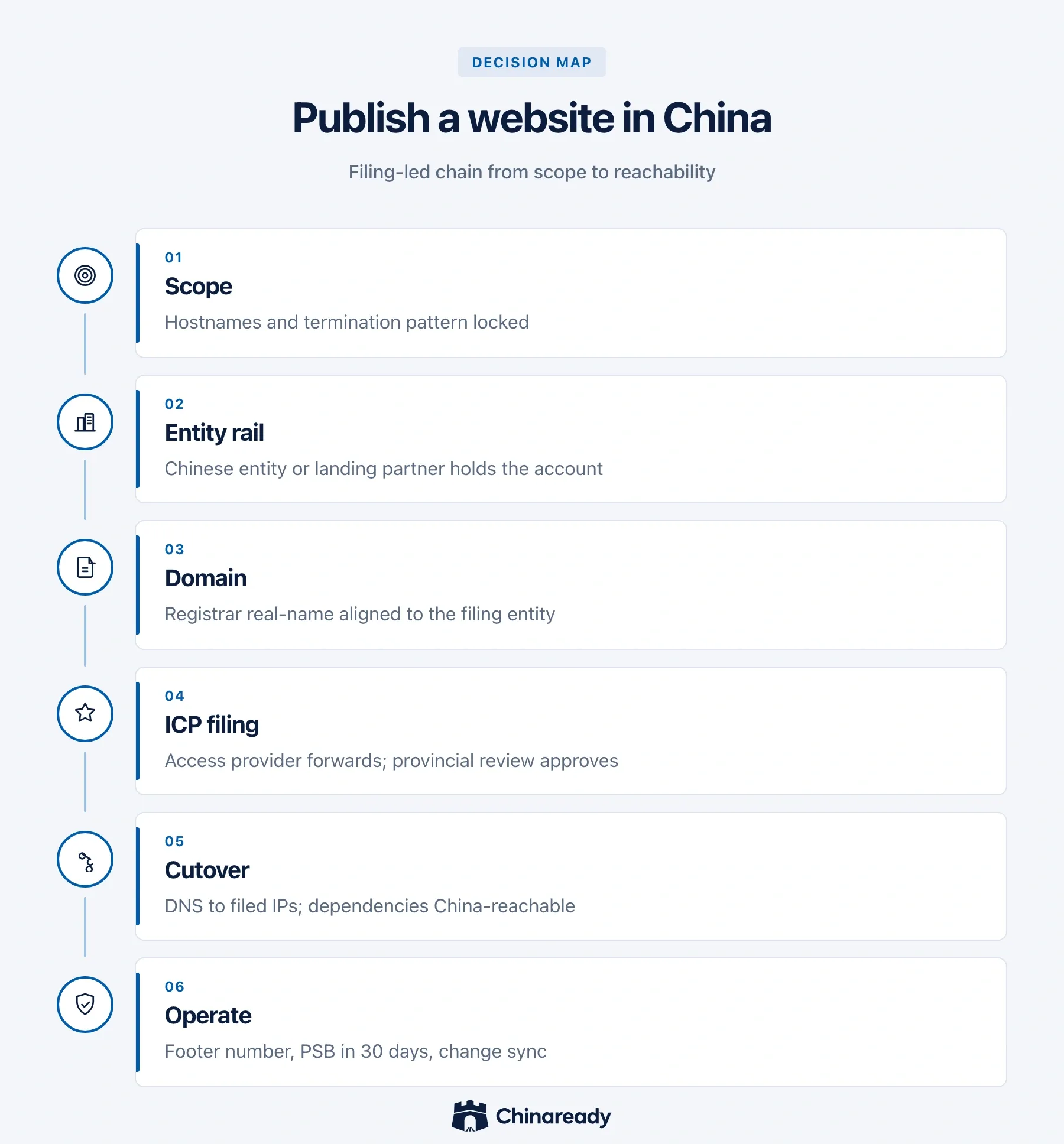
What publishing a website in China means
Hard names your program will use (rewritten from how website publish programs actually run — not a hosting tutorial):
- Termination decision — Whether HTML and critical APIs resolve and serve from inside Mainland China. That single decision pulls ICP filing, entity alignment, and DNS control into scope. Depth: Host in Mainland China.
- ICP filing (ICP备案) — Base MIIT registration tied to the domain and its Mainland China service IPs. You buy hosting first; the same access provider opens the filing order. The full sequence, timeline, and display rules: China ICP filing.
- PSB filing — Public-security registration for the same property within 30 days of launch, after ICP approval. Depth: China PSB filing.
- B25 commercial fork — Paid information services, ad inventory, or monetized platform patterns can pull the commercial ICP license (B25) analysis after filing is on the path. Depth: China ICP license (B25); content-publishing products: Web Publishing Service License.
- DNS bind — Production records must send China-facing traffic to the filed endpoints. A filing number in the footer with leftover overseas A records is not an in-country site.
- Reachability floor — Fonts, tags, auth, and object stores that call blocked overseas hosts fail China users even when HTML terminates locally. Depth: Website accessible in China; CDN gate: China CDN.
- Common myth — “Host in China and the site works.” Termination without filing, DNS sync, or clean dependencies still fails users and compliance checks.
Vocabulary first. Next: what must be locked before a filing order is real work.
Preconditions
Missing any of these stops your product team before the first honest filing submission.
| Precondition | Why your process stalls |
|---|---|
| Publish intent — which hostnames claim Mainland China delivery (marketing site, product app, or both) | Wrong scope buys the wrong host and filing path |
| Chinese entity or landing-partner rail | Provider accounts and ICP submissions expect a Chinese business-license holder |
| Domain and registrar readiness — real-name match, usable TLD, entity-aligned owner | Unapproved registrar or identity mismatch blocks the ICP order; see CN domain |
| Termination decision made on purpose — full Mainland China, front-door pattern, or overseas-only | ”Asia CDN in front of overseas origin” is not in-country hosting |
| Dependency inventory owner — fonts, tags, auth, APIs, object stores | Blocked third parties break the journey after every other gate clears |
| Chinese-language ops capacity for consoles, questionnaires, and provincial notices | Filing portals and provider tickets are not English-first |
Core path
| Gate | Done when | Owner |
|---|---|---|
| 1. Scope | Hostnames and termination pattern locked with success metrics | Product |
| 2. Organizing rail | Entity or partner that can hold the provider account and filing subject | Legal / BD |
| 3. Domain | Registrar real-name aligned to the filing entity; TLD usable for filing | Eng / legal |
| 4. Hosting + ICP filing | Access provider chosen; filing pack submitted and approved | Compliance |
| 5. Cutover | DNS points China traffic at filed IPs; dependencies clean or replaced | Eng |
| 6. Operate | Footer number live; PSB filed within 30 days; IP-change workflow running | Ops |
Decide termination first
Full Mainland China site — origin (and usually CDN) in Mainland China under the filing provider. Strongest when China is a primary market and you accept local ops.
China front door + global product — a filed, localized hostname terminates in-country while the global app stays offshore with explicit limits for Mainland China users.
Overseas-only — no Mainland China hosting, no automatic ICP duty, managed expectations on speed and dependencies. Valid early probe — weak as a filed in-country launch story. Hong Kong sits here, not in a fourth bucket: Hong Kong hosting China.
The filing chain runs through the access provider
Provider pre-review often takes 1–2 business days; provincial review commonly about 20 business days after a complete pack forwards. A clean complete submission often finishes in about 3–4 weeks end-to-end; from prep and host setup through approval, plan 6–8 weeks calendar time. The government fee is free — hosting, domain, and partner time are the real costs. Step-by-step flow and display rules: China ICP filing; the domain-and-DNS mechanics: ICP filing — domain DNS path.
Reachability after the DNS cutover
Filing clears the compliance path; it does not make the site work. After cutover: strip or replace blocked overseas dependencies, prove the journey from a Mainland China vantage (test website blocked in China), and expect that an onshore origin alone may still need CDN and tuning for real speed (onshore hosting still slow, Website accessible in China).
Soft-launch checks that reduce rework
- File for the hostnames and content you will actually serve — content mismatch is a frequent rejection reason.
- Cut DNS per hostname after approval; retire overseas answers for that hostname.
- Verify footer number, PSB clock, and reachability before campaigns send traffic.
- Keep an IP-change workflow: filing updates commonly take 3–20 business days via the access provider.
Linked reasoning
No organizing rail → provider account and filing never start. Portals that require Chinese business-license identity will not accept an overseas-only pack.
Domain misaligned → filing order blocked before review. Registrar real-name, TLD, and owner must match the filing entity.
Filing approved, DNS still overseas → paperwork and packets disagree. Authorities and buyers care about the live resolution path.
In-country origin, blocked dependencies → shell still breaks. Local HTML with overseas auth, fonts, or object stores fails real users.
Launch marketing before cutover and PSB → compliance exposure on day one. Campaigns hit unfilled paths while the 30-day PSB clock runs.
Provider migration without re-bind → restart feeling. Moving hosting products or accounts often restarts access-provider and ICP change workflows.
Publishing an app alongside the website? That is a different gate list — MIIT app filing, Software Copyright Certificate, multi-store review — run as one program with two channel tracks: Publish an app in China. Running a SaaS on that website? Filing read, local payments, and the speed program are mapped in SaaS in China.
Difficulty and blockers
- Treating hosting as a SKU — the program is entity + domain + filing + host + DNS + dependencies, not the cheapest China VM.
- Broker promises of “host tomorrow, file later” — public publish on unfiled Mainland China IPs is the failure mode the chain exists to prevent.
- English-only ops — tickets, questionnaires, and provincial notices need Mainland China owners.
- Content drift after approval — live site text that stops matching the filing invites review trouble.
- Silent infrastructure drift — autoscaling or standby IPs outside the filed list recreate shell-filing risk.
- Missing handoff artifacts — filing numbers, registrar access, provider console ownership, DNS change control, dependency allowlist.
China landing partner
Most product teams exploring Mainland China entry need a China landing partner to make website publish executable — entity alignment, access-provider account, ICP host bind, DNS cutover, and Chinese-language filing ops — not another longer hosting catalog. Your team still owns hostname intent and architecture; the partner path supplies the Mainland China rails when they are not already in-house.
What we can offer?
Publishing a website in Mainland China is a gate list — scope, organizing rail, domain, filing, cutover, operate. Chinaready helps your product team clear those gates in order and keep the site working after launch:
- China Readiness Assessment — Decide which hostnames need Mainland China termination versus an overseas-only or front-door pattern the board can fund.
- China Access Acceleration — Keep auth, APIs, and critical dependencies reachable while the China hostname goes through filing.
- China Product Hosting — Place origins on Mainland China termination paths with an access provider that submits and updates ICP when IPs change, then cut DNS to match.
- Mobile App Distribution — Align the app-side filing and store tracks with the same entity and compliance backbone when the website is one surface of the product.
Contact us when you need the domain-to-PSB chain mapped before the first filing order opens.
Frequently asked questions
How do I publish a website in China?
Lock which hostnames need Mainland China delivery, secure a Chinese entity or landing-partner rail, align the domain and registrar, buy Mainland China hosting from the access provider that will forward the ICP filing pack, cut DNS to the filed IPs, clear blocked dependencies, and complete PSB filing within 30 days of launch — then keep filing records in sync as IPs and content change.
Can I publish a website in China without ICP filing?
Only by keeping all termination outside Mainland China. Public internet information services served from Mainland China IPs need ICP filing before they may go live — providers block unfiled hosts. An overseas-only path is a valid early probe with known latency and dependency limits; Hong Kong hosting does not clear the Mainland China duty.
How long does it take to publish a website in China?
A clean complete ICP submission often finishes in about 3–4 weeks end-to-end — provider pre-review 1–2 business days, provincial review commonly about 20 business days. From entity and host setup through approval, plan 6–8 weeks calendar time. The government filing fee itself is free; hosting, domain, and ops time are the real costs.
Does Hong Kong hosting count as publishing in China?
No. Hong Kong is a separate region with no Mainland China ICP duty — and no Mainland China filing benefit. It buys proximity, not compliance or in-country speed guarantees. Treat "host in Hong Kong" as an overseas-only pattern with its own latency profile.
What must happen after the website goes live in China?
Display the ICP filing number in the footer, complete PSB filing within 30 days of launch, keep the filing in sync when service IPs change, and keep dependencies China-reachable — fonts, tags, auth, and object stores that call blocked overseas hosts break the journey even when HTML terminates in-country.
How is publishing a website different from publishing an app?
Websites gate on ICP filing, hosting termination, and DNS; apps gate on MIIT app filing, Software Copyright Certificate packs, and multi-store review. The entity and compliance rails overlap — run them as one program with two channel tracks. See Publish an app in China for the app-side gate list.
Insights
Other similar insights
Part of the Website & SaaS readiness cluster — every guide in the cluster, one page.