

An API China plan that still terminates every call overseas is usually the wrong primary path for ordinary Mainland China users. China API latency is geography plus host reach — not a JSON prettier. To optimize APIs China, put an API China path on the slow hop: China-reachable endpoint, reachable auth, and no blocked third-party API hosts. HTML 200 with hung fetch is a failed journey. Keep overseas APIs for residual HQ / Hong Kong / Taiwan / export only. The full SaaS program this sits inside: SaaS in China.
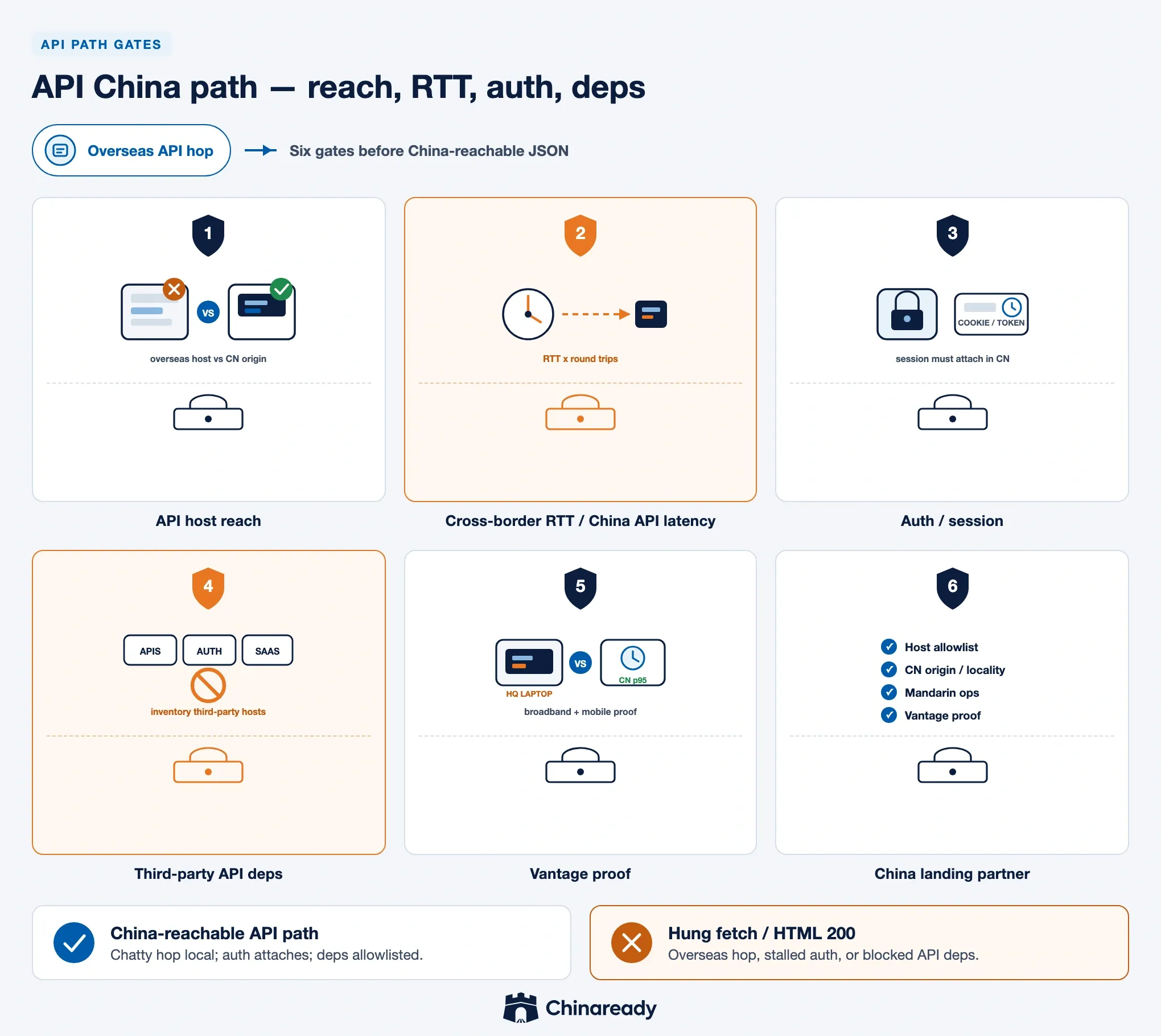
What an API China path actually is
Hard names this API-path decision will use:
- API China — The hostname the China client actually calls for JSON, GraphQL, or BFF traffic. It is not “we have an API,” and it is not the HTML document host. HTML 200 with hung
fetchis a failed journey — same class as website accessible in China. - China API latency — Geography plus host reach. Chatty round trips multiply cross-border RTT. A JSON prettier or gzip toggle does not move p95 if every call still leaves Mainland China.
- API China path — A China-reachable endpoint (or selective locality) for the slow hop, plus reachable auth, plus no blocked third-party API hosts on the critical path. SaaS performance in China is the product-journey map (edge vs API locality vs fuller deploy). This Guide is the API hop.
- CDN does not cache the chatty hop — A China CDN / edge can help static. Dynamic JSON still pays the border if the API origin stays overseas. Filed HTML that is still slow is onshore hosting China; chatty APIs are this remap.
- Third-party API hosts —
googleapis, overseas auth, US-only SaaS APIs. Inventory hosts. Tags and widgets that call those hosts are deps — Google Tag Manager in China and captcha forms in China — not this API-path map. Static type and CSS hosts are a different hop: Google Fonts China. - Auth / session — Cookies and tokens that only work on overseas domains stall the China path even when the JSON host answers.
- Common myth — “The page returns 200, so APIs are fine.” Prove from Mainland China broadband and mobile. An HQ laptop is not proof.
Vocabulary first. Next: what must already be true before you optimize APIs China.
What must be true before you optimize APIs China
Missing a named API hop stops your product team before another “make the JSON faster” sprint is real work.
| Precondition | Why your process stalls |
|---|---|
| Job locked — ordinary Mainland China users vs residual HQ / Hong Kong / Taiwan / export | Wrong job keeps every call overseas while China-reachable endpoints never start |
API host named — the hostname fetch / XHR actually hits, not “the backend” | HTML 200 is reported as API China working |
| Chatty vs cacheable named — dynamic JSON vs static the CDN can hold | Teams buy edge cache while every dashboard call still crosses the border |
| Auth / session domain named — cookies and tokens on the China path | Login succeeds overseas and the China client never attaches a session |
| Third-party API inventory — googleapis, overseas auth, US-only SaaS APIs on the critical path | One blocked dep host hangs a “local” product |
| Mainland China vantage proof — broadband + mobile p95; HQ laptop is not proof | Overseas QA “passes” while China users wait — lab context only: which parts of your stack break first |
Product teams usually cannot treat “one global API hostname” as the Mainland China plan. Host reach and the slow hop are the floor.
From an overseas hop to an API China path
| Stage | Decision / outcome |
|---|---|
| 1. API host reach | Does the China client’s API hostname answer from Mainland China? If no, remap the origin — selective China locality or in-country termination for the chatty calls |
| 2. Cross-border RTT / China API latency | Count round trips on the top journeys. Chatty fan-out multiplies the border. Consolidate or move the hop; do not prettier the JSON first |
| 3. Auth / session | Cookies and tokens must work on the China-facing domain. Overseas-only IdP or cookie domain stalls the path after HTML 200 |
| 4. Third-party API deps | Inventory hosts. Remap or drop blocked googleapis / overseas auth / US-only SaaS APIs from the China client. Tags that load those hosts: Google Tag Manager in China, captcha forms in China |
| 5. Vantage proof | Mainland China broadband and mobile p95 on the API hop — not HQ, not VPN, not Hong Kong residual |
| 6. China landing partner | Host allowlist, in-country termination, Mandarin ops, and proof usually need a landing partner |
Hard gate — one API path class
Necessity: confusing these jobs wastes the quarter — either you cache static while JSON still crosses the border, or you staff a full-region copy when the stall is one blocked dep host.
| What you see | Usual class | Where the remap lives |
|---|---|---|
HTML 200, fetch hung | API host reach / RTT / deps | This Guide — API China path |
| Page hangs on fonts or CSS | Static type/CSS hosts | Pair hop — not this API path |
| Filed origin, page still slow | Leftover overseas deps or DNS on HTML | Onshore hosting China |
| Whole product journey (shell + API + realtime) | Edge vs selective locality vs fuller deploy | SaaS performance in China |
| Cacheable static only | Onshore cache vs origin | China CDN / edge |
Why HTML 200 still leaves fetch hung
Engineering and ops constraints you must design around:
| Constraint | What breaks | What to do |
|---|---|---|
| First-party API still overseas | Every chatty call pays the border. CDN cache does not fix dynamic JSON. | Selective China locality or in-country origin for the chatty calls. Journey context: SaaS performance in China. |
| Cross-border RTT × round trips | Dashboards that fire dozens of small APIs feel “down.” | Fewer round trips, payload diet, real caching headers — after the host is reachable. |
| Auth / session bound overseas | Token and cookie domains that only work on overseas hosts stall login and bootstrap. | Prove auth from Mainland China. Widgets that wrap auth: Google Tag Manager in China, captcha forms in China. |
| Third-party API hosts | googleapis, overseas auth, US-only SaaS APIs hang independently of your origin. | Inventory hosts. Remap or drop from the China client. |
| HQ laptop QA | Testers outside Mainland China never see the stall. | Broadband and mobile from Mainland China. If you terminate or collect in Mainland China, that hop can stall on entity rails — this Guide is still reach / RTT / deps, not a data-law map. |
| Residual overseas APIs reported as China working | Hong Kong / Taiwan / HQ traffic is not ordinary Mainland China. | Cap residual APIs off the China hostname critical path. |
Overseas APIs are not “illegal” as a class. Failure here is reach / RTT / deps. Do not staff a legal memo when the hostname never answers.
HTML 200 ≠ API 200. The document host can succeed while fetch hangs. Same split as website accessible in China.
CDN without API locality → fast shell, slow truth. Cacheable static is not the chatty hop — China CDN / edge.
Auth on an overseas domain → dashboard work never starts. Fix session locality before consolidating JSON.
HQ / Hong Kong residual as Mainland China p95 → wrong stack. Those paths are not ordinary Mainland China users.
What stalls teams that keep every API overseas
- JSON-prettier as the plan — Product treats latency as payload cosmetics before the API host is China-reachable.
- One global API hostname — Geo DNS theater without a China-reachable origin still pays the border.
- CDN-as-API — An onshore cache in front of overseas JSON is staffed as if p95 will recover. It will not, if the hop stays dynamic and offshore.
- Auth left overseas — Cookies and tokens never attach on the China-facing domain.
- Third-party APIs left on the critical path — googleapis, overseas IdP, and US-only SaaS APIs restore the stall after “our API is local.”
- HQ laptop QA — Testers outside Mainland China never open the ticket.
- Hong Kong conflated with Mainland China — Residual traffic is reported as API China working.
- No owner for the host inventory — The remap stalls because nobody owns which API hosts the China client may call.
What “fixed” means: Ordinary Mainland China users complete the journeys you claim on a China-reachable API path; chatty first-party calls terminate on a reachable endpoint or selective locality; auth/session works on that path; blocked third-party API hosts are remapped or dropped; proof is Mainland China broadband and mobile p95. HTML 200 with a hung spinner is not fixed.
China landing partner when the API hop is the product
Most product teams exploring Mainland China entry need a China landing partner once every call still terminates overseas — to inventory API hosts, place China-reachable endpoints on the chatty hop, keep auth and third-party deps on an allowlist, run Mandarin ops, and prove p95 from Mainland China broadband and mobile. Your team still owns which journeys are China-facing and which hop is actually slow; the partner path makes that API China path executable when those rails are not already in-house. Keeping overseas APIs for HQ / Hong Kong / Taiwan / export does not remove the need for that China landing partner on the primary China path.
What we can offer?
API China work for Mainland China is an API-path decision before any “prettier the JSON” sprint. Chinaready helps your product team put an API China path on the slow hop — host reach, RTT, auth, and deps — not another global CDN toggle:
- China Readiness Assessment — Name the API hosts on the critical path, whether chatty calls still terminate overseas, and which auth and third-party API gates stall Mainland China p95 before a remap date.
- China Access Acceleration — Attack the proven API hop (reach, RTT, or deps) so China API latency moves for users, not only for an HQ laptop. Acceleration does not make overseas JSON local by itself.
- China Product Hosting — Place China-critical API origins (or selective locality) on Mainland China termination when that is the honest latency fix, with auth that matches the China-facing domain.
- Mobile App Distribution — Align any China app that still calls the same API hosts with the same reach, auth, and dep gates — not mistake a global API hostname inside an app for an API China path.
Contact us when HTML 200 looks fine but Mainland China users still wait on fetch — before you staff another JSON-prettier sprint.