

Host in Mainland China — when ICP forces in-country
When ICP and public publish force Mainland China hosting, product teams decide entity, filing, host, and DNS together — not as a global CDN checkbox.
Host in Mainland China when public publish needs in-country termination — then ICP filing, entity path, host choice, and DNS must move as one chain. Overseas-only sites are a different architecture with different limits. Buying a China VM or flipping a global CDN checkbox is not the decision.
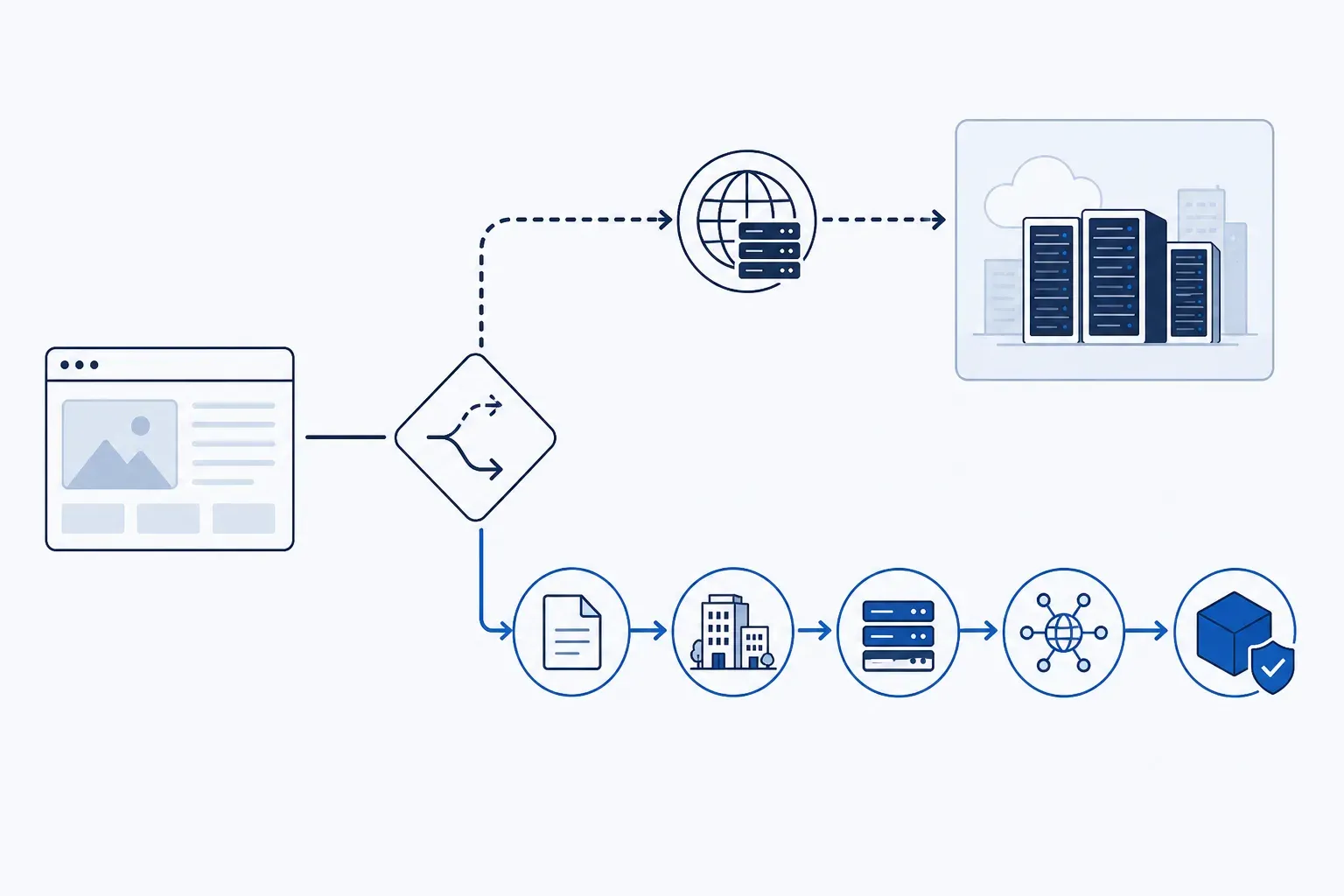
What Mainland China hosting means for product teams
Hard names for this decision:
- Mainland China hosting / termination — HTML and critical APIs resolve and serve from infrastructure inside Mainland China (origin, filed edge, or other service IPs the access provider binds). That is what pulls ICP filing into scope for public internet information services.
- ICP filing (ICP备案) — Base MIIT registration tied to the domain and the Mainland China service IPs that host it. Product teams often say “ICP license” when they mean this filing number. Depth: ICP filing — domain DNS path.
- Access provider — The Mainland China cloud or hosting merchant that sells the resource and forwards the filing pack. You typically buy hosting first; the same provider console opens the filing order.
- DNS bind — Production records must send China-facing traffic to the filed endpoints. A filing number in the footer with leftover overseas A records is not an in-country site.
- Overseas-only path — Keep termination outside Mainland China. No automatic ICP duty from “having users in China,” but you accept cross-border latency, dependency risk, and a weaker “we launched in China” story. Accessibility design: Website accessible in China.
- Hong Kong ≠ Mainland China — Regional hosting in Hong Kong does not clear Mainland China ICP / public-publish hosting rules.
- Common myth — “Host in China and the site works.” Termination without filing, DNS sync, or clean China-reachable dependencies still fails users and compliance checks.
Vocabulary first. Next: what must exist before your team purchases in-country hosting.
What must exist before you buy in-country hosting
Missing any of these stops your product team before a Mainland China server SKU is useful.
| Precondition | Why your process stalls |
|---|---|
| Publish intent — China marketing site, product app, or both; which hostnames claim in-country delivery | Wrong scope buys the wrong host and filing path |
| Organizing entity or China landing partner path | Provider accounts and ICP submissions expect a Chinese business-license holder (or equivalent organizing rail) |
| Decision that termination is Mainland China — not “Asia CDN in front of overseas origin” | Global acceleration is not in-country hosting |
| Chinese-language ops capacity (or a partner who has it) | Onboarding, content questionnaires, and tickets are not English-first |
| Domain / registrar readiness for the filing entity | Unapproved registrar, real-name mismatch, or wrong TLD blocks the later ICP order |
| Owner for DNS cutover and IP inventory | Filing lists every live Mainland China service IP; drift after go-live creates shell-filing risk |
If you are still mapping how to obtain filing once DNS aims at Mainland China IPs, use the ICP filing Guide. If the question is full accessibility (deps + vantage proof), use Website accessible in China. This Decision Map stays on when ICP forces in-country host termination.
Host choice and DNS decisions when ICP is in scope
Stages are product decisions — not console click-paths.
| Stage | Decision / outcome |
|---|---|
| 1. Confirm the trigger | You need public publish with Mainland China termination (not an overseas probe) |
| 2. Lock entity / partner rail | Who holds the cloud account and filing subject before any SKU purchase |
| 3. Choose access provider + region | Same merchant will host and usually forward ICP; region/province must stay consistent with the pack |
| 4. Place origins (and filed edges) | HTML and critical APIs terminate on approved Mainland China infra under that provider |
| 5. Open ICP on the host path | Filing lists every real Mainland China service IP for the domain — see ICP filing |
| 6. Cut DNS for China users | Production records point at filed endpoints; retire leftover overseas answers for that hostname |
| 7. Prove and operate | China vantage checks; change control when IPs or providers move |
Honest patterns (not a brochure):
- Full Mainland China site — Origin (and usually CDN) in Mainland China under the filing provider. Strongest when China is a primary market and you accept local ops.
- China front door + global product — Filed
cn.or localized hostname terminates in-country; global app stays offshore with explicit limits for users in Mainland China. - Overseas-only — No Mainland China hosting; manage expectations on speed and dependencies. Valid early probe — weak as a filed in-country launch story.
Commercial information-service patterns on the China property may later pull B25 analysis — after filing is on the path, not instead of it: China ICP license (B25).
Why host, filing, and DNS fail as a chain
Server purchased, entity unclear → console opens, filing cannot forward. Access providers will not push an inconsistent organizing-entity pack to provincial review.
ICP approved, DNS still overseas → paperwork and packets disagree. Authorities and buyers care about the live resolution path. A beian number without Mainland China answers is not in-country hosting.
Mainland China origin, unfiled standby or LB IPs → shell-filing risk. The record must list every real service IP. Silent autoscaling without a change workflow recreates the stall.
Hong Kong or “Asia” region sold as China hosting → wrong duty map. Teams discover late that ICP and public-publish rules still treat the path as non–Mainland China termination.
In-country host + blocked third parties → shell still breaks. Fonts, tags, auth, and object stores that call overseas-blocked hosts fail China users even when HTML terminates locally — continue in Website accessible in China.
Provider migration without re-bind → restart feeling. Moving Mainland China hosting products or accounts often restarts access-provider and ICP change workflows.
Where in-country hosting programs stall
- Treating hosting as a SKU — the decision is entity + ICP + host + DNS, not the cheapest China VM.
- Confusing ICP filing with a commercial license — filing clears the host path; B25 is a separate commercial fork.
- Launch marketing before DNS cutover — campaigns hit leftover overseas records while the footer shows a filing number.
- English-only ops — tickets, questionnaires, and provincial notices need Mainland China ops owners.
- Broker promises of “host tomorrow, file later” — public publish on unfiled Mainland China IPs is the failure mode the chain exists to prevent.
- Ignoring PSB after go-live — sequence context: ICP and PSB filing.
When you need a China landing partner for host termination
Most product teams exploring Mainland China entry need a China landing partner to make in-country termination executable — entity alignment, access-provider account, ICP host bind, and DNS cutover — not another longer hosting catalog. Your team still owns hostname intent and architecture patterns; the partner path supplies the Mainland China ops rails when they are not already in-house. For how Chinaready runs that hosting line as a service, see China Product Hosting — this Insights piece stays the Decision Map.
What we can offer?
In-country hosting is a termination decision that forces ICP, entity, host, and DNS to move together. Chinaready maps that chain for product teams for the next program gates:
- China Readiness Assessment — Decide whether your hostnames truly need Mainland China termination, or an overseas-only / front-door pattern with explicit limits the board can fund.
- China Access Acceleration — Keep admin, auth, and review paths reachable while you stage the China hostname — without pretending global CDN alone is filed in-country hosting.
- China Product Hosting — Place origins on Mainland China termination paths with an access provider that can submit and update ICP when IPs change, then cut DNS to match.
- Mobile App Distribution — Align app backends and store packs with the same China-reachable host story when the website is only one surface of the product.
Contact us when you need a host-termination Decision Map for the property you plan to publish for users in Mainland China — without treating a server SKU as the whole plan.
Frequently asked questions
When does ICP force Mainland China hosting?
When your public property terminates on Mainland China infrastructure — origins, filed CDN edges, or other service IPs that DNS resolves to inside Mainland China — Internet Content Provider (ICP) filing is generally required before honest public publish. Overseas-only termination is a different architecture and does not automatically create that filing duty.
Is Hong Kong hosting the same as Mainland China hosting?
No. Hong Kong infrastructure is not Mainland China termination for ICP and public-publish purposes. Treat it as an overseas / regional path with its own latency and access trade-offs, not a substitute for a filed in-country host.
Does buying a Mainland China server finish accessibility?
No. Filing must list the real service IPs; DNS must send production traffic to those filed endpoints; blocked third-party dependencies can still break the shell. Host purchase is one gate in a chain — see the accessibility Guide for clean deps and China vantage proof.
How is this different from the ICP filing Guide?
The ICP filing Guide is how you obtain filing once domain DNS aims at Mainland China IPs. This Guide is the earlier Decision Map — when public publish forces in-country termination, and how entity, host choice, and DNS must align before that filing path is useful.
Can our product team finish in-country hosting from an overseas console alone?
Usually no. Organizing-entity path, Chinese-language provider consoles, ICP host bind, and DNS cutover are Mainland China ops rails most teams lack in-house.