
ICP filing in China — obtain via domain DNS path
To obtain ICP filing, lock domain DNS to filed Mainland China IPs. CDN myths do not clear the duty. Registrar, real-name match, and complete service IPs come first; B25 is a later fork.
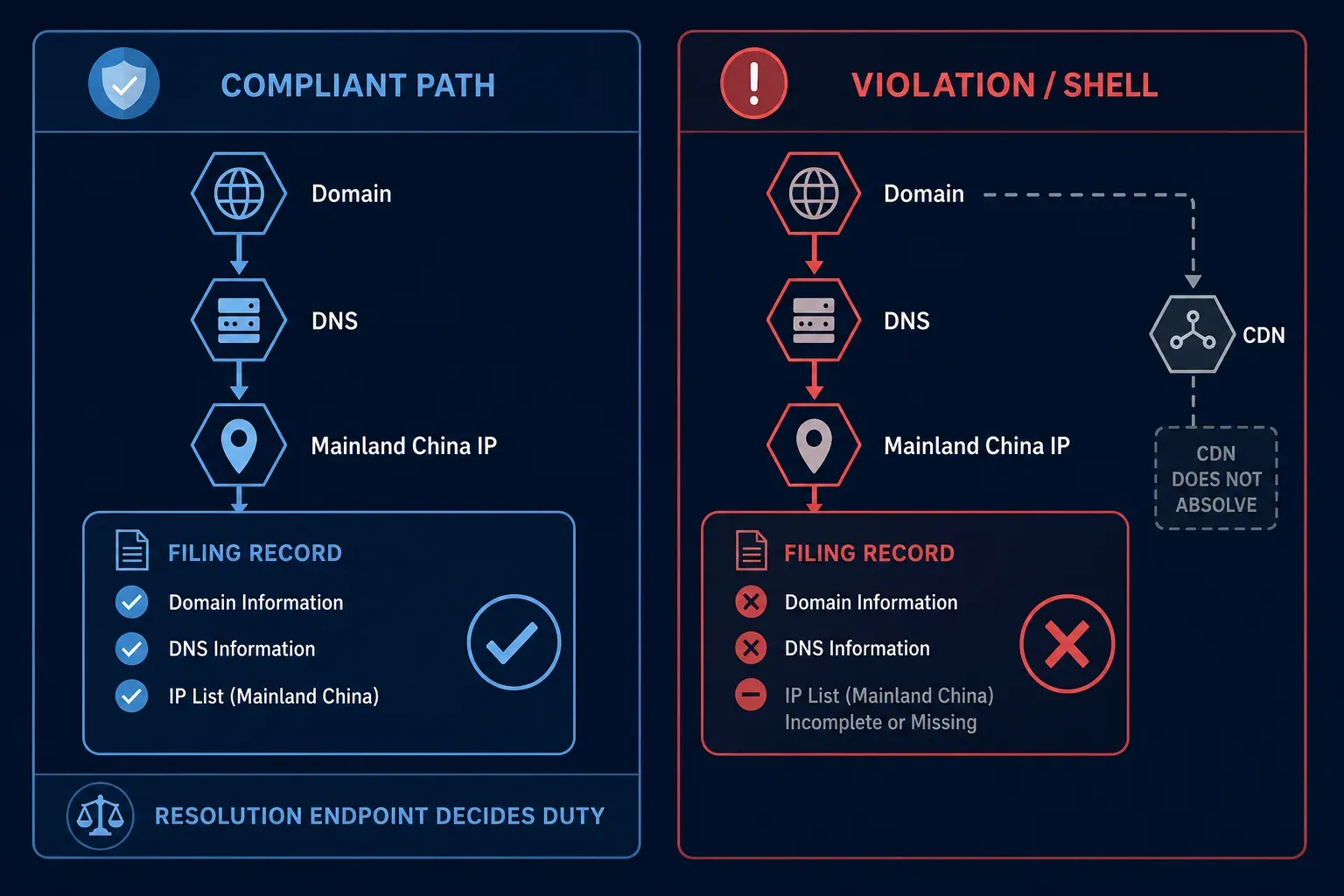
To obtain Internet Content Provider (ICP) filing in China, treat domain → DNS → Mainland China IPs as the critical path — not a CDN myth or a “license” shopping list. Filing attaches to the domain. If that domain’s DNS finally resolves to Mainland China IP addresses, filing is mandatory — whether or not traffic passed a proxy or accelerator. The domain must come from an MIIT-approved registrar, real-name identity must match the filing entity, and the record must list every real Mainland China service IP and stay in sync when IPs change. Resolve to Mainland China without that complete, consistent filing and you are in illegal / shell filing territory: blocking, cancellation, shutdown, and fines. Chinese entity or partner rails, provider consoles, and provincial review are part of how you actually get the number.
For the filing and PSB sequence, see China ICP filing — app filing and B25 license. For when the commercial ICP license (B25) fork starts, see China ICP license (B25) — when filing is not enough. This Guide is the how you get there map: domain + DNS + IP → filing path.
What ICP filing is — and what “obtain” means
Hard names for this decision:
- ICP filing (ICP备案) — Base MIIT registration for internet information services on Mainland China hosting. Product teams often hear “ICP license” when they mean this filing number.
- Filing object = domain — You file per domain (and related properties as the provider checklist requires). The record still lists every real Mainland China service IP.
- DNS resolution trigger — Communications authorities monitor DNS answers. An A or CNAME path that ends on a Mainland China IP for an unfiled domain can trigger blocking — regardless of the physical hop path users took.
- Organizing entity — Filing runs under a Chinese business-license holder (or an equivalent organizing path via a China landing partner). Overseas company registration alone usually cannot open the provider filing console.
- Access provider — Major Mainland China cloud / hosting merchants forward the pack into MIIT / provincial systems. You file through the provider that actually hosts.
- Commercial ICP license (B25) — Separate VATS permit for commercial information services. It is not a substitute for filing. When revenue / commercial-information patterns appear, analyze B25 after (or with) filing — details live in the B25 Guide.
- PSB filing — Public Security Bureau network-security registration after ICP approval / launch — see the ICP and PSB sequence Guide.
Vocabulary first. Next: what must exist before your product team can open a real filing order.
What must exist before you open a filing order
Missing any of these stops your product team before the provider console is useful.
| Precondition | Why your process stalls |
|---|---|
| Organizing entity or China landing partner path | Mainland China cloud accounts and ICP submissions expect a Chinese business-license holder |
| MIIT-approved registrar + approved TLD | Unapproved registrar or suffix → cannot submit filing |
| Real-name identity = filing entity | Personal registrant vs company subject (or license-name drift) → reject or later false-information risk |
| Mainland China access provider that will host and forward the pack | Filing is tied to the host that actually serves the domain |
| Inventory of every Mainland China service IP (primary, standby, LB, API hosts) | Partial list = incomplete / shell filing risk |
| Honest DNS plan — when you will resolve to Mainland China IPs | Pointing production DNS before filing is a block path |
Chinese-language provider consoles, enterprise / legal-person verification, and provincial review norms sit on this floor. Your team usually cannot finish “obtain ICP filing” without Mainland China ops.
Critical path: domain → resolution → complete IPs
Core rule: Resolution creates the duty. Communications authorities monitor DNS answers. An A or CNAME path that ends on a Mainland China IP for an unfiled domain can trigger blocking — regardless of the physical hop path users took.
| Gate | Requirement | Failure mode |
|---|---|---|
| Domain registrar | Registered via an MIIT-approved registration service organization (for example major China cloud registrars or approved China branches of international registrars — confirm the current MIIT list) | Unapproved registrar → cannot submit filing |
| TLD | MIIT-approved suffix only — see shortlist below; confirm the latest MIIT list before you buy | Unapproved TLD → cannot file |
| Real-name match | Domain real-name subject = filing entity (personal ID or business license fields match) | Mismatch → reject or post-approval violation |
| Resolution trigger | Final DNS to Mainland China IP → must file | Unfiled + Mainland China resolution → blocking |
| Full service IPs | All real Mainland China service IPs on the record (primary, standby, load balancer, other live service addresses) | Partial list = false / shell filing risk |
| Change sync | Update filing immediately on IP add / remove / replace (commonly 3–20 business days via the access provider) | Record ≠ production → cancel / block / fine |
| Access provider | File through the provider that actually hosts; complete access-filing change when you switch providers | Unchanged access after a move → block |
| DNS endpoint | Filing? |
|---|---|
| Domain resolves to Mainland China IPs | Required — even if traffic previously touched overseas edges |
| Domain resolves only outside Mainland China (for example Hong Kong SAR or US hosts, with no Mainland China answer) | Usually not triggered by this rule |
Domain compliance (before you open a filing order)
- Approved registrar — Domains from registrars outside the MIIT-approved list cannot enter the filing pipeline, even if the brand is well known overseas.
- Allowed TLD — Only MIIT-approved suffixes can be filed. Common ccTLD / China options include
.cn,.中国,.公司,.网络. Widely used gTLDs include.com,.net,.org. Additional approved or commonly filed new gTLDs include:.top,.xyz,.vip,.club,.shop,.online,.site,.tech,.icu,.co,.store,.fun,.work,.ltd,.group,.world,.press,.video,.app,.blog,.news,.wiki,.art,.music,.game,.live,.cloud,.ai,.io. Unapproved industry or novelty suffixes still fail at submit — confirm the current MIIT list before you register. - Real-name consistency — Individual filings must match the registrant’s identity; enterprise filings must match the business license. Name, ID type, and number must align with the filing subject.
Service IP integrity and change control
When you submit ICP filing, list every Mainland China IP that actually serves the domain. Omitting standby, load-balancer, or API host IPs is treated as incomplete / false information and can lead to cancellation or blocking.
If production IPs change:
- Sign in to the original access-provider filing console (for example Alibaba Cloud or Tencent Cloud).
- Submit an IP change — add new addresses, remove retired ones.
- Wait for provincial review (commonly about 3–20 business days).
Switching the server provider requires an access filing change as well. Serving from a new access merchant while the old filing still points elsewhere is a block risk.
CDN and path myths (hard correction)
ICP filing duty does not depend on whether packets traversed a CDN, overseas POP, or “acceleration” product. It depends on the DNS resolution endpoint.
- Mainland China DNS answer → file, with complete service IPs.
- Overseas-only DNS answer → this trigger usually does not apply.
- Hairpinning traffic through overseas edges while DNS still answers Mainland China IPs does not remove the duty.
- DNS tricks aimed at evading detection are not a compliance strategy.
The same rule applies to non-80/443 ports and to API-only hostnames: if the name resolves to Mainland China IPs and offers a service, filing applies.
Consequences of unfiled or shell filing
Under current practice tied to the internet information-services rules (including the Administrative Measures for Internet Information Services, as published in the State Council Gazette at gov.cn):
- Unfiled domains resolving to Mainland China hosts can be automatically blocked (interstitial or connection refusal).
- Incomplete or false IP / entity data can lead to filing cancellation and service interruption.
- Sites can be shut down; enterprises face fines up to about RMB 10,000, and refusal to correct can escalate to shutdown and dishonest-list style outcomes.
Shell filing — a number in the footer while DNS, IPs, or entity facts do not match — is treated as illegal filing, not a paperwork formality.
How you obtain ICP filing (stages, not console clicks)
These stages are the decisions your product team locks — not a click-path through one cloud UI.
| Stage | Decision / outcome |
|---|---|
| 1. Entity / partner | Chinese business-license holder or China landing partner path that can organize the filing |
| 2. Domain readiness | MIIT-approved registrar, approved TLD, real-name match to filing subject |
| 3. Mainland China host | Access provider account and service IPs that will actually answer DNS |
| 4. Submit filing pack | Provider console → provincial / MIIT review; list every Mainland China service IP |
| 5. Receive filing number | Display in footer (and in-app where required); verify in the MIIT public database |
| 6. After approval | PSB filing within 30 days of launch; keep IP / access changes in sync |
| 7. License fork (if triggered) | If the property runs commercial information services → analyze commercial ICP license (B25) — separate process |
Typical timing once a complete pack is in review is on the order of about 20 business days provincial review (provider pre-check often 1–2 business days). End-to-end from prep through approval commonly lands nearer 3–4 weeks when clean, or about 6–8 weeks when entity and host setup are still open — see the ICP and PSB sequence Guide. The government filing fee itself is free; hosting, domain, and partner time are the real costs.
Why domain mistakes block filing — and when the license path starts
Wrong registrar or TLD → no submit. The filing console will not accept the name. Rebuild the domain path before you promise a launch date.
Real-name ≠ filing entity → reject or later cancel. Align domain real-name with the entity that will hold the filing before you submit.
DNS to Mainland China before filing → block risk. Resolution creates the duty. Production A records without a complete filing are the classic shell.
Partial service IPs → false / shell filing. Brochure host filed; API, standby, or load-balancer omitted. Inventory every Mainland China address users or apps actually hit.
CDN / overseas acceleration myths → false confidence. Duty follows the DNS endpoint, not the packet hop path.
Filing complete ≠ commercial license complete. Informational / corporate properties on Mainland China hosting often need ICP filing only (plus PSB after launch). Payments, advertising inventory, paid information platforms, and similar commercial patterns pull you toward B25 analysis — after filing is on the path, not instead of it. Depth for that fork: China ICP license (B25).
IP or access-provider change without update → overnight block. Treat filing change control like a production failover with a compliance owner on the ticket.
China-specific failure points
Believing CDN or overseas acceleration removes filing duty
Global CDN brands do not rewrite the DNS trigger. If the domain answers on Mainland China IPs, file — then keep those IPs complete on the record.
Domain from an unapproved registrar or TLD
Marketing buys a domain from a registrar that never entered the MIIT-approved list, or a suffix that was never approved for filing. The filing console will not accept the name; rebuild the domain path before you promise a launch date.
Real-name identity ≠ filing entity
Personal registrant vs company filing subject, or license name drift after a rebrand, creates rejects and later “false information” exposure. Align domain real-name with the entity that will hold the filing before you submit.
DNS already to Mainland China with no filing
The classic shell: production A records in Mainland China, no ICP number (or a borrowed number). Monitoring can block without a polite warning letter first.
Filing only a subset of service IPs
Brochure host filed; API, standby, or load-balancer IPs omitted. Partial records are false records. Inventory every Mainland China address users or apps actually hit.
Changing IPs or access provider without change filing
Failover DNS to a new Mainland China VIP “for an hour” without updating the filing is how compliant launches become overnight blocks. Treat IP and access-provider changes like production database failovers — with a compliance owner on the ticket.
Assuming non-80/443 or API hostnames are exempt
Port 8080 APIs and internal-sounding hostnames still need filing when they resolve to Mainland China IPs and serve the public internet.
Treating “ICP license” shopping as a substitute for domain readiness
Buying a commercial license narrative while the domain is on an unapproved registrar, real-name is mismatched, or DNS already answers Mainland China IPs without a complete filing does not clear the block path. Obtain filing on the domain/DNS/IP line first; open the B25 analysis when commercial patterns appear.
Skipping the entity / partner rail
Overseas-only company registration usually cannot open Mainland China cloud filing consoles. Without a Chinese business-license holder or a China landing partner path, the “how do I get ICP filing” ticket stalls before stage 1.
When you need a China landing partner for ICP filing
Most product teams need a China landing partner to clear entity / organizing path, MIIT-approved domain real-name alignment, access-provider filing consoles, and IP change control Your team still owns the DNS and architecture decision (when to resolve to Mainland China IPs); the partner path makes the filing pack and provincial rails executable when those rails are not already in-house.
What we can offer?
ICP filing for product teams is a domain DNS + complete IP obtain path: approved registrar and real-name match, resolution that honestly reflects Mainland China hosts, change control when IPs move — and a clear fork to commercial license analysis when commerce begins. Chinaready’s four services map onto that line:
- China Readiness Assessment — Map which hostnames resolve to Mainland China, whether registrar / real-name / entity line up, which service IPs must appear on the filing, and whether a B25 fork is in scope before you promise a launch date.
- China Access Acceleration — Keep Mainland China user journeys reachable on a filed DNS and IP posture — acceleration that does not pretend to bypass filing.
- China Product Hosting — Place origins on Mainland China termination paths with an access provider that can submit and update your ICP record when IPs change.
- Mobile App Distribution — Keep app-related domains and backends on the same filing identity story stores and diligence teams will check.
Contact us when you need that domain → DNS → IP → filing map before you point production records at Mainland China.
Frequently asked questions
How do I obtain ICP filing for China?
Lock an organizing entity or China landing partner path, register the domain through an MIIT-approved registrar with real-name match, place the property on Mainland China hosting through an access provider, then submit the ICP filing pack listing every Mainland China service IP. Approval yields an ICP filing number you display and can verify in the MIIT public database.
When is ICP filing required?
When a domain’s DNS finally resolves to a Mainland China IP address. That resolution endpoint — not whether traffic passed a CDN or proxy — is the trigger for Internet Content Provider (ICP) filing.
Does a CDN or overseas proxy remove the filing duty?
No. Filing duty follows the DNS endpoint. If the domain resolves to Mainland China IPs, you must file even when packets traverse overseas edges. Offshore-only DNS usually does not trigger filing.
Is the filing object the domain or the server?
The filing object is the domain. The record must still list every real Mainland China service IP that hosts the domain — primary, standby, load-balancer, and other live service addresses.
What registrar and real-name rules apply?
The domain must be registered through an MIIT-approved registration service organization, use an approved TLD, and complete real-name verification that matches the filing entity (individual ID or business license) exactly.
When does the commercial ICP license (B25) path start?
After (or alongside) basic ICP filing when the Mainland China property runs commercial information-service patterns — paid information access, advertising inventory, monetized platforms, and similar models. Filing is how you get onto Mainland China hosting; B25 is a separate VATS license fork. See the commercial ICP license (B25) Guide for that depth. Unfiled or shell filing still risks blocking, cancellation, shutdown, and fines up to about RMB 10,000 under current practice.