

Hong Kong hosting China — not Mainland China origin
Hong Kong hosting China is not Mainland China hosting. Hong Kong vs China hosting is a jurisdiction split, not a latency tweak. Keep Hong Kong hosting residual; remap ordinary users in-country.
Hong Kong hosting China is not Mainland China hosting. Hong Kong vs China hosting is a jurisdiction and termination split, not a latency tweak. Being “close” does not create ICP duty or a Mainland China origin. Keep Hong Kong hosting for residual HQ / Hong Kong-local / Taiwan / export jobs. Ordinary Mainland China users remap via Host in Mainland China — then know an ICP’d origin can still be slow (Onshore hosting China). The full filed-publish chain: Publish a website in China.
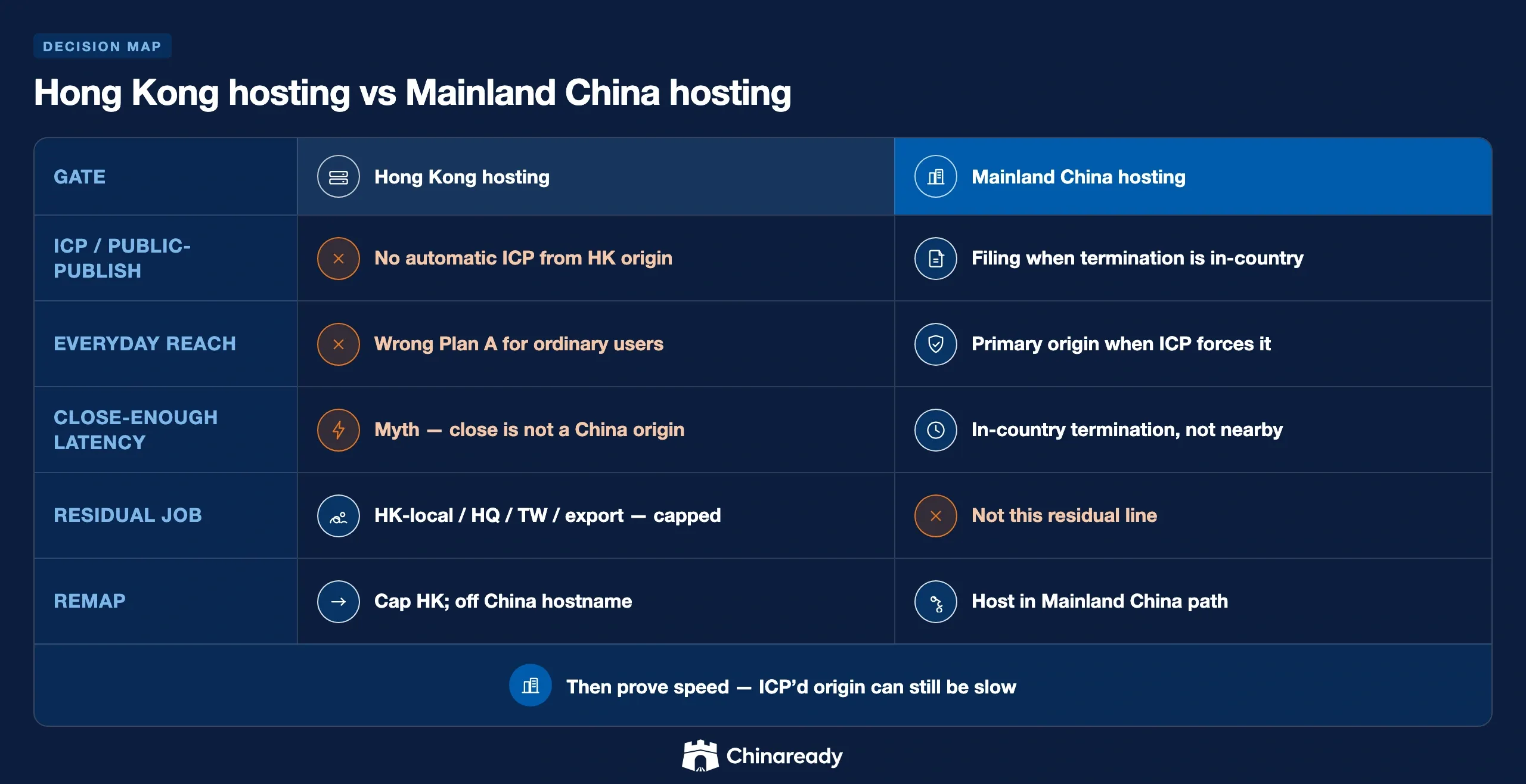
What Hong Kong hosting China actually is
Hard names this origin decision will use:
- Hong Kong hosting China — A regional origin that sits in Hong Kong infrastructure. It is not Mainland China hosting. Teams buy it hoping “Asia” equals China. It does not.
- Hong Kong vs China hosting — A jurisdiction and termination split. Where the hostname terminates decides ICP / public-publish duty and everyday Mainland China reach. Distance is not that gate.
- Mainland China hosting — HTML and critical APIs resolve and serve from infrastructure inside Mainland China. That is what pulls ICP filing into scope for public internet information services. Depth: Host in Mainland China.
- ICP filing — Base registration tied to the domain and the Mainland China service IPs that host it. Hong Kong termination does not create that duty the way in-country termination does. How you obtain filing once DNS aims at Mainland China IPs: ICP filing — domain DNS.
- CDN with Hong Kong PoPs — Hong Kong / Japan / Singapore edges are not onshore Mainland China nodes. A China CDN / edge in front of a Hong Kong origin is still an overseas / regional architecture with known limits.
- Shared overseas hosts in Hong Kong or Singapore — Same reach class as SiteGround in China. This Guide is the HK ≠ Mainland China myth, not a shared-host rewrite.
- Failure class is wrong termination, not a ban — Hong Kong hosting China failure for ordinary Mainland China users is jurisdiction, ICP myth, and reach. It is not a claim that Hong Kong hosting is illegal.
- Common myth — “Host in Hong Kong and it is the same as China.” Close is not origin identity. Do not report Hong Kong TTFB as Mainland China hosting working.
Vocabulary first. Next: what must be true before Hong Kong hosting stays in scope at all.
What must be true before Hong Kong hosting stays in scope
Missing a clear origin job stops your product team before a “Hong Kong is close enough” sprint is real work.
| Precondition | Why your process stalls |
|---|---|
| Origin job locked — ordinary Mainland China users vs HQ / Hong Kong-local / Taiwan / export residual | Wrong job keeps Hong Kong hosting as Plan A while Mainland China hosting never starts |
| Termination named — Hong Kong regional origin vs Mainland China hosting | “Asia hosting” is staffed as if ICP and public-publish duty had already moved in-country |
| Honest latency assumption — do not treat Hong Kong TTFB as Mainland China origin proof | Plans built on HQ or Hong Kong probes invent a journey that is not there |
| CDN scoped as edge, not origin — Hong Kong / Japan / Singapore PoPs are not onshore Mainland China nodes | A CDN checkbox is funded as if the origin class had changed |
| ICP scoped only when you terminate in Mainland China — not claimed as a Hong Kong overseas ban | Filing starts too late on a real in-country origin, or is demanded on an overseas-only architecture |
| Mainland China vantage proof on origin and dep hosts — broadband + mobile; a Hong Kong laptop is not proof | Overseas QA “passes” while China users wait — same class as website accessible in China |
| Supplementary budget / scope cap if Hong Kong hosting stays for residual jobs | Unlimited “Hong Kong hosting China” on the existing plan crowds out origin, filing, and DNS work |
Product teams usually cannot treat “ship the same Hong Kong site globally” as the Mainland China plan. Job clarity and remapping are the floor. Cloud-family SKU lookups belong on Landscape when you need a partition label — AWS is one Limited pointer. That is not a Hong Kong hosting China origin.
Hong Kong vs China hosting — origin jobs
Stages are product decisions — not console click-paths.
| Stage | Decision / outcome |
|---|---|
| 1. Name the origin job | Ordinary Mainland China users at scale, or a residual HQ / Hong Kong-local / Taiwan / export audience? |
| 2. If Mainland China ordinary reach | Rule Hong Kong hosting out as primary; open Mainland China hosting when public publish needs in-country termination |
| 3. Pick the in-country path | Entity, access provider, ICP, and DNS move together — Host in Mainland China then ICP filing — domain DNS |
| 4. If a residual Hong Kong job remains | Keep Hong Kong hosting as a capped supplementary line — Hong Kong-local / HQ / Taiwan / export only — off the China hostname critical path |
| 5. Prove hosts from Mainland China | DNS / TLS / waterfall (or China Network Diagnostics) on the Hong Kong origin, leftover deps, and on the chosen Mainland China origin — not only Hong Kong TTFB |
| 6. Cut over the China journey, then re-test | Mainland China hosting on the China-facing hostname; do not leave Hong Kong hosting on the critical path. A later “Asia CDN” toggle can restore the stall |
Hard gate — primary vs residual
Necessity: confusing these two jobs wastes the quarter — either you underfund Mainland China hosting, or you keep optimizing Hong Kong hosting China that never becomes a Mainland China user journey.
| Job | Hong Kong hosting role | What must already be true |
|---|---|---|
| Ordinary Mainland China origin (HTML, APIs, public hostname) | Not primary — remap | Mainland China hosting named; ICP in motion if you terminate in-country |
| HQ / Hong Kong-local / Taiwan / export residual | May remain supplementary | Geo and measurement match that residual audience; Mainland China Plan A is still in-country termination when publish needs it |
| “Hong Kong hosting China” via proximity, CDN PoP, or ICP on the Hong Kong origin only | Myth as Mainland China plan | Termination and filing duty — not a nearby rack |
Hard gate — not a CDN hope, not a shared-host rewrite
Hong Kong vs China hosting is regional termination versus Mainland China hosting. A China CDN with Hong Kong PoPs is not in-country termination. SiteGround in China covers overseas shared-host class (US/EU/SG PoPs). This Guide does not reprint those maps.
After an ICP’d in-country origin exists, speed can still fail — that pair lives on Onshore hosting China. Do not treat that as permission to stay on Hong Kong hosting.
Why close enough fails as a Mainland China origin
Hong Kong hosting ≠ Mainland China hosting. Jurisdiction and termination are the gate. A regional rack does not inherit in-country public-publish duty, and it does not become a China origin by being close.
Close TTFB ≠ in-country origin. Hong Kong probes and HQ laptops measure a residual vantage. Ordinary Mainland China users on local networks still cross a boundary the rack does not erase. Do not report Hong Kong TTFB as Mainland China hosting working.
Hong Kong PoPs ≠ onshore Mainland China nodes. CDN or edge locations in Hong Kong, Japan, or Singapore stay overseas / regional. Dynamic HTML and origin fetch still pay the border if the origin stays in Hong Kong — China CDN / edge.
ICP on a Hong Kong origin ≠ China switch. Filing does not move Hong Kong infrastructure into Mainland China. Treat ICP as a stall only on remapped in-country termination — Host in Mainland China + ICP filing.
Shared-host SKU in Hong Kong or Singapore ≠ this Decision Map. If the product is an overseas managed / shared host, use SiteGround in China. Do not shop Hong Kong colo SKUs as a substitute for that class decision.
Stalled Hong Kong origin ≠ legal ban. Hong Kong hosting China failure for ordinary Mainland China users is wrong termination, ICP myth, and reach — not a claim that Hong Kong hosting is prohibited.
Reporting residual Hong Kong traffic as China origin working → wrong stack. Hong Kong-local, Taiwan, or VPN-using testers are not ordinary Mainland China users at scale.
What stalls teams that treat Hong Kong as China
- Proximity thinking — Product treats “close to China” as Mainland China hosting before in-country termination exists.
- Jurisdiction ignored — Teams shop Hong Kong racks instead of naming Hong Kong vs China hosting as a termination split.
- HQ / Hong Kong laptop QA — Testers outside ordinary Mainland China networks never see the stall, so the ticket never opens.
- Hong Kong / Taiwan conflated with Mainland China — Performance from outside Mainland China is reported as “Hong Kong hosting China working.”
- CDN-as-origin — Hong Kong / Japan / Singapore PoPs are staffed as if they were onshore Mainland China nodes. They are not.
- ICP as a Hong Kong fix — Filing is treated as the switch that makes the regional origin a China origin. It does not.
- Shared-host class mixed in — SiteGround-class plans in Singapore or Hong Kong are rewritten as this myth instead of the shared-host Guide.
- No owner for the remap — The fork stalls because nobody owns Mainland China hosting, only “make Hong Kong work in China.”
What “fixed” means: ordinary Mainland China users complete the journeys you claim on Mainland China hosting when public publish needs in-country termination; Hong Kong hosting is gone from that client path or capped as residual; leftover overseas deps are gone; ICP filing is done when termination is in-country; residual Hong Kong jobs are named and capped. Overseas-only Hong Kong hosting with a China origin claim is not fixed. An ICP’d origin that is still slow is a different Decision Map — Onshore hosting China.
China landing partner for the origin remap
Most product teams exploring Mainland China entry need a China landing partner once they stop treating Hong Kong hosting as Plan A — to place the site on Mainland China hosting, bind ICP filing when termination is in-country, keep a dependency allowlist, run Mandarin consoles, and prove the journey from Mainland China broadband and mobile. Your team still owns which hostname is China-facing and which residual Hong Kong line to keep; the partner path makes that remapped origin executable when those rails are not already in-house. Keeping a capped Hong Kong hosting line for HQ / Hong Kong-local / Taiwan / export does not remove the need for that China landing partner on the primary China path.
What we can offer?
Hong Kong hosting China work is a primary-vs-residual origin decision before any “Hong Kong is close enough” sprint. Chinaready helps your product team remap the China hostname to Mainland China hosting when public publish needs in-country termination — not a nearby-rack hope:
- China Readiness Assessment — Decide whether Hong Kong hosting is residual only, which journeys must complete in Mainland China, and which origin, ICP, and DNS gates sit on the critical path before a remap date.
- China Access Acceleration — Keep China-facing pages reachable from Mainland China vantage so the remapped origin does not die on leftover overseas deps. Acceleration does not turn Hong Kong PoPs into onshore Mainland China nodes.
- China Product Hosting — Place China-critical pages on Mainland China hosting with an access provider that can submit and update ICP when IPs change, then cut DNS to match.
- Mobile App Distribution — Align any China app that still wraps the marketing site in a WebView with the same origin gates — not mistake a Hong Kong URL inside an app for a Mainland China origin plan.
Contact us when you need a Hong Kong vs China hosting remap before you staff another nearby-rack sprint.
Frequently asked questions
Is Hong Kong hosting China the same as Mainland China hosting?
No. Hong Kong hosting China is a regional / overseas origin. Hong Kong vs China hosting is a jurisdiction and termination split, not a latency tweak. Hong Kong infrastructure does not create ICP duty the way Mainland China termination does, and it does not become a China origin by being close.
Should ordinary Mainland China users use Hong Kong hosting as Plan A?
Usually no. For ordinary Mainland China users, Hong Kong hosting is the wrong primary origin. Remap to Mainland China hosting when public publish needs in-country termination — then ICP, entity, host, and DNS move together. Keep Hong Kong hosting for residual HQ, Hong Kong-local, Taiwan, or export jobs, and do not report Hong Kong TTFB as Mainland China hosting working.
Does Hong Kong vs China hosting still matter if the PoP is “close”?
Yes. Close is not origin identity. Hong Kong vs China hosting is about where the hostname terminates and which public-publish duty applies. A nearby regional rack does not become Mainland China hosting. CDN edges in Hong Kong, Japan, or Singapore are still overseas / regional PoPs — not onshore Mainland China nodes.
Is Hong Kong hosting illegal for a China site?
No. The failure class is wrong termination, an ICP myth, and reach — not a prohibition. Overseas-only Hong Kong hosting does not automatically create an ICP duty, and it does not become a filed in-country launch. If you need in-country termination, remap the origin; do not treat a Hong Kong plan as a China switch.
How is this different from SiteGround or a China CDN?
SiteGround-class shared hosts (including plans that sit in Singapore or similar overseas PoPs) are a sibling origin-class decision. A China CDN with Hong Kong PoPs is still an overseas / regional edge, not a Mainland China origin. This Guide is the Hong Kong ≠ Mainland China hosting myth — not a shared-host rewrite and not a CDN SKU list.
Can product teams finish a Hong Kong-to-China remap without Mainland China ops?
Usually no. In-country origin, ICP filing when you terminate in Mainland China, dependency cleanup, and Mainland China vantage proof sit on Mandarin ops most global teams lack. That is when a China landing partner becomes the realistic path.
Insights
Other similar insights
Part of the Website & SaaS readiness cluster — every guide in the cluster, one page.