
Publish a game in China — ISBN path before store UA
Publishing a game in Mainland China needs a licensed publisher path and ISBN lead time before durable store listings. Soft-launching without approvals risks mass removal.
Publishing a game in Mainland China is not “publish an app, but funnier.” Monetized titles generally need a licensed Chinese publisher path and ISBN / approval lead time before durable store presence. Soft-launching globally and “adding China later” is how teams walk into takedown waves.
Video handbook
Short YouTube series on publishing mobile games in Mainland China — publisher vs operator, ISBN path, filings and technical readiness, foreign routes, and store distribution. Full episode list and slide decks live on the handbooks hub.
- Full series on Chinaready handbooks — playlist, episode links, and PPT decks
Episodes:
| Ep | YouTube Title | Handbook |
|---|---|---|
| 1 | What China game publishing is | PPT |
| 2 | Filings, content, and technical readiness | PPT |
| 3 | Routes, commercials, and distribution | PPT |
What publishing a game in China means
Hard names your program will use (rewritten from how game publish programs actually run):
- Dual publishing structure — Monetized games typically need a licensed Chinese operator path and a licensed Chinese publisher that can file for approval. A global studio account alone is not a Mainland China game publish plan.
- ISBN / publishing approval — The game approval number (版号 / ISBN path) is the hard gate before durable paid or IAP listings. Spine: China game ISBN.
- Filings that still apply — Often rides with the license path: ICP license (B25) when required, ICP filing, mobile app filing, Software Copyright Certificate, plus Chinese privacy materials. Wrong class (game vs utility) burns months — see Publish an app in China if you are not shipping a game.
- Player-protection rails — Real-name / anti-addiction and ongoing content duties are operating requirements, not launch-week paperwork.
- Localization and reach — Simplified Chinese product and store copy; China-reachable payments and services; journeys reviewers and players can complete from Mainland China.
- Timing — ISBN / publishing approval often sits on a ~12-month class of clock (genre and materials vary). Store enablement after approval is a second program — multi-store Android + Apple China.
- Channels after license — Apple China App Store, OEM Android stores, and game-centric channels (e.g. TapTap). Approval does not install itself.
Vocabulary first. Next: which decisions you lock, and where your process stalls.
Preconditions
Missing any of these stops your product team before the first honest store review.
| Precondition | Why your process stalls |
|---|---|
| Commercial model locked — free, IAP, ads, boards | Monetization drives license expectations and review depth |
| Publishing vehicle — licensed Chinese publisher / entity | Most product teams cannot hold approvals alone |
| China build candidate frozen — version, content, monetization tables | Mid-review creative or economy changes reset clocks |
| Studio–publisher RACI written — submission, ops, appeals, IP, revenue | Verbal “we’ll figure it later” fails during removals |
| Timeline tolerance — months, not a fixed calendar week | Boards that need China revenue next month will pressure false dates |
| Live-ops willingness — anti-addiction, content, localization depth | Literal string translation is not a China track |
Chinese-language publisher workflows, authority correspondence, and store relationships sit outside a global soft-launch checklist. If progression, gacha-like monetization, or marketing presents the product as a game, reviewers treat it as a game even when the global SKU says “app.”
Core path
| Stage | Decision / outcome |
|---|---|
| 1. Classify the product | App-like utility vs game (mislabeling lengthens rejection) |
| 2. Lock commercial model | What must be licensed and what stores will expect |
| 3. Select publishing model | Which Chinese publisher / entity holds approvals |
| 4. Freeze China package | Build, metadata, age inputs, privacy answers aligned |
| 5. Run ISBN / approval | See the ISBN Guide for the spine |
| 6. Enable stores | Apple China App Store + Android/game channel matrix |
| 7. Operate | Anti-addiction, content calendar, update coordination, appeals |
App vs game — the decision teams miss
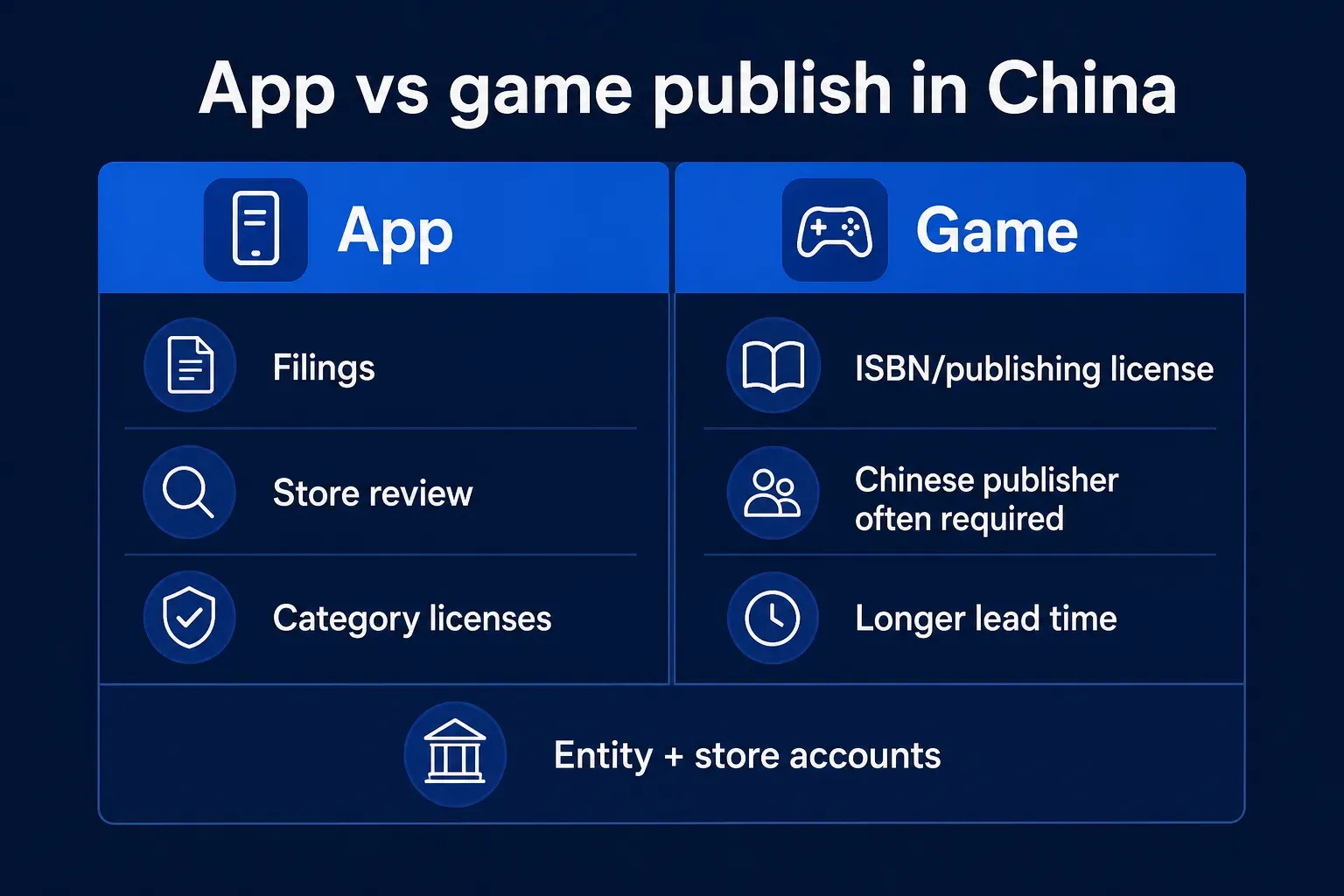
Wrong class is a hard gate: you pick the wrong track and burn the quarter. Use this comparison before you promise a China date.
| Gate | App-like product | Game (typical monetized) |
|---|---|---|
| Entity | Local entity or ops partner | Often licensed Chinese publisher |
| License | App filing / category docs | ISBN / game publishing approval |
| Timeline | Weeks to a few months | Often many months (ISBN-class) |
| Stores | App Store + Android OEM set | Same plus game channels (e.g. TapTap) |
| Content ops | Privacy + updates | Ongoing content & anti-addiction duties |
| Go-to-market | Soft-launch carefully | Soft-launch without license is fragile |
Stage-gate the commercial promise: license confidence → approval confidence → listing confidence → UA confidence. Skipping gates for a sales slide is how China becomes a write-off.
Channel notes (high level)
- Apple China App Store — critical for iOS spenders; license expectations still apply for monetized games. Detail: Apple App Store in China.
- OEM Android stores — required for device reach; publisher often drives relationships. Detail: China Android app stores.
- TapTap / community — powerful for certain genres; still not a license substitute.
- Hardcore PC/console paths — separate tracks; do not assume mobile ISBN covers them.
Linked reasoning
No publishing vehicle → no valid applicant. Store consoles cannot invent a qualified Chinese publishing entity for you.
Unfrozen scope → endless review cycles. Changing loops, IAP tables, or content mid-process turns “two months” into a year.
Approval without store matrix → license with no installs. ISBN progress does not replace Android multi-channel package ops or Apple China enablement.
UA before listing durability → burned budget. Paid acquisition ahead of approval and stable listings funds removal waves.
Global soft launch ≠ China license readiness. TestFlight or soft Android abroad proves little about Mainland China publishing approval.
Verbal publisher terms → lost control at crisis. Territories, revenue share, store account ownership, update SLAs, and exit must be written before review pressure hits.
Hit-title headlines ≠ process. Survivorship samples share a dedicated China track, ops-capable publishers, and willingness to change monetization — not only art style.
Difficulty and blockers
- Publisher shopping mid-review — switching entities resets clocks; align creative, build, and legal early.
- Live-ops re-triggers — seasonal content, UGC, and voice chat can re-open compliance; keep a China content calendar with checkpoints.
- Android multi-channel reality — even with ISBN progress, each store needs packages, metadata, and relationships.
- Underbuilt localization — payment UX, community, event cadence, and CS must feel local; battle-pass calendars do not translate themselves.
- Opaque “guaranteed ISBN” brokers — if entity, timeline assumptions, and rejection handling are unclear, you are buying hope.
- Metrics blindness — global DAU hides China pain; track listing uptime, China-device crash-free sessions, payment success, CS volume, and policy flags.
- No China operating model — producer, compliance liaison, localization, and live-ops need a written RACI; China cannot be “whoever answered WeChat last.”
When not to publish yet
- You cannot accept multi-month uncertainty on approval timing
- You lack budget for a real publisher/ops relationship
- The game depends on UGC or voice features you will not adapt
- Leadership wants China revenue next month without a China team
In those cases, keep building the global hit — and revisit when the operating model exists.
Contracting tips with publishers
Define territories, revenue share, marketing rights, IP ownership, update SLAs, audit rights, store-account control, and exit. Run a pre-mortem before any China date: license slips two quarters; publisher relationship sours; major update rejected; soft-launch metrics look good abroad but China still fails commercially. Write answers early.
China landing partner
Most product teams exploring Mainland China entry need a China landing partner to clear publishing entity selection, ISBN sequencing, store enablement, and live-ops ownership Your studio still owns the product and IP decisions; the partner path makes the Mainland China publish gates executable when those rails are not already in-house.
What we can offer?
Publishing a game in Mainland China is ISBN-first: publishing vehicle, frozen package, approval, then stores and UA — not a mirrored global soft launch. Chinaready helps your product team sequence that path so license risk is not discovered after ads spend:
- China Readiness Assessment — Classify app vs game, map publisher/ISBN readiness, and name which gate is blocking a durable China launch date the board can trust.
- China Access Acceleration — Keep China builds, auth, and APIs reachable for reviewers and players once the license path is real — not only a store listing screenshot.
- China Product Hosting — Place China-critical game services where Mainland China players and review environments can complete journeys.
- Mobile App Distribution — Sequence Apple China and Android/game channels after approval confidence, with package ops that survive updates and appeals.
Contact us when you need that sequence before you promise a China season.
Frequently asked questions
How do I publish my game in China?
Lock a licensed Chinese publisher (or equivalent publishing vehicle), freeze the China build and commercial model, run ISBN / game publishing approval, complete the filings that still apply, then enable Apple’s China App Store and selected Android/game channels — and keep anti-addiction and live-ops running after listing.
How is publishing a game different from publishing an app?
Monetized games usually need a licensed Chinese publisher and ISBN / publishing approval — often many more months than a utility app. App filing and stores still matter, but they do not replace the game license path. See the app publish Guide for the non-game track.
Can we list first and get the ISBN later?
That pattern is how removal waves start. Major stores expect required game approvals for paid/IAP titles. Market first only when the license path is secured or you accept delist risk.
What can product teams learn from successful China titles?
They treat China as a separate product track — licensed publisher, localized ops, compliant monetization, and patient timelines — not a mirrored global soft launch.
Which stores matter for games?
Apple’s China App Store for iOS; on Android, OEM stores plus game-centric channels such as TapTap — chosen with your publisher, not copied from a global Play console.