
Network Culture Business License — when content products need it
The Network Culture Business License gates for-profit internet culture products in Mainland China — not ISBN, VATS, or publishing credentials. Map product behavior first; most teams need a China landing partner.
The Network Culture Business License (网络文化经营许可证) is a provincial culture-administration gate for for-profit internet culture products — not a universal “content app” stamp, and not a substitute for game ISBN, VATS, or publishing credentials. Your product team maps product behavior and operating model first, then decides whether this license is on the critical path or a sibling gate is.
What the Network Culture Business License covers
Hard names your Mainland China content plan will use:
- Network Culture Business License (网络文化经营许可证) — The permit provincial culture administrations issue when they approve for-profit internet culture activities under the Interim Provisions on the Administration of Internet Culture (2017 revision) published by the Ministry of Culture and Tourism (文化和旅游部).
- Internet culture products — The same Provisions define products produced, transmitted, or circulated via the internet — including online music entertainment, online games, online performance programs, online performances, online artworks, and online animation (and cultural products moved online by technical means).
- For-profit vs non-profit split — For-profit internet culture activity means providing those products/services to gain benefit through user charges, ecommerce, advertising, sponsorship, or similar. Non-profit activity follows a filing (备案) path with the provincial culture administration — not the same as holding the operating license.
- Who approves — Provincial-level culture administrations approve for-profit applications and issue the license; they also handle non-profit filing. Ministry-level culture authorities set national policy and supervise.
- Clock and display — Approval decision after acceptance is commonly cited as within 20 days; license validity is three years, with renewal applied for at least 30 days before expiry. Internet culture units must show the culture license/filing number (and telecom license/filing numbers) in a prominent place on the website homepage.
- Not the whole stack — Telecom / commercial ICP (VATS), game publishing ISBN, publication credentials, app filing, and store rails are sibling programs. AV / streaming / IPTV-style models may also need the Broadcast and Television License (NRTA) path. Content self-review duties for network culture operators sit on top of the permit — see the Ministry notice implementing the Measures for the Administration of Content Self-Review by Network Culture Business Units.
Vocabulary first. Next: what must exist before an NCBL path is real work.
What must exist before an NCBL path is real
Missing any of these stops your product team before a provincial culture filing is honest work — not before a feature roadmap slide.
| Precondition | Why your process stalls |
|---|---|
| Product class named — internet culture product vs ordinary SaaS / brochure | Wrong class wastes entity work; remap to VATS-only or “no culture license” early |
| For-profit operating model locked — fees, ads, sponsorship, ecommerce monetization of culture content | Non-profit filing vs for-profit license is a different provincial path |
| Chinese organizing entity that can apply where it is located | Provincial culture admins approve the local operating unit — not a global HQ brand alone |
| Domain and business-scope pack ready (domain registration proof, business license, scope description, personnel / premises / technical measures materials) | Incomplete packs bounce before substantive review |
| Sibling license map — ISBN / publisher for games; VATS when commercial telecom patterns apply; publication credentials when publishing is the real job | Clearing NCBL alone does not unlock stores or telecom commerce |
| Homepage / client display plan for license or filing numbers | Missing display fails diligence and ongoing supervision |
| Mandarin ops contact reachable during provincial review and content self-review duties | Silent stalls when reviewers cannot reach anyone |
Product teams usually cannot treat “ship a content feature → paste a license number later” as the Mainland China plan.
From product behavior to license or sibling gate
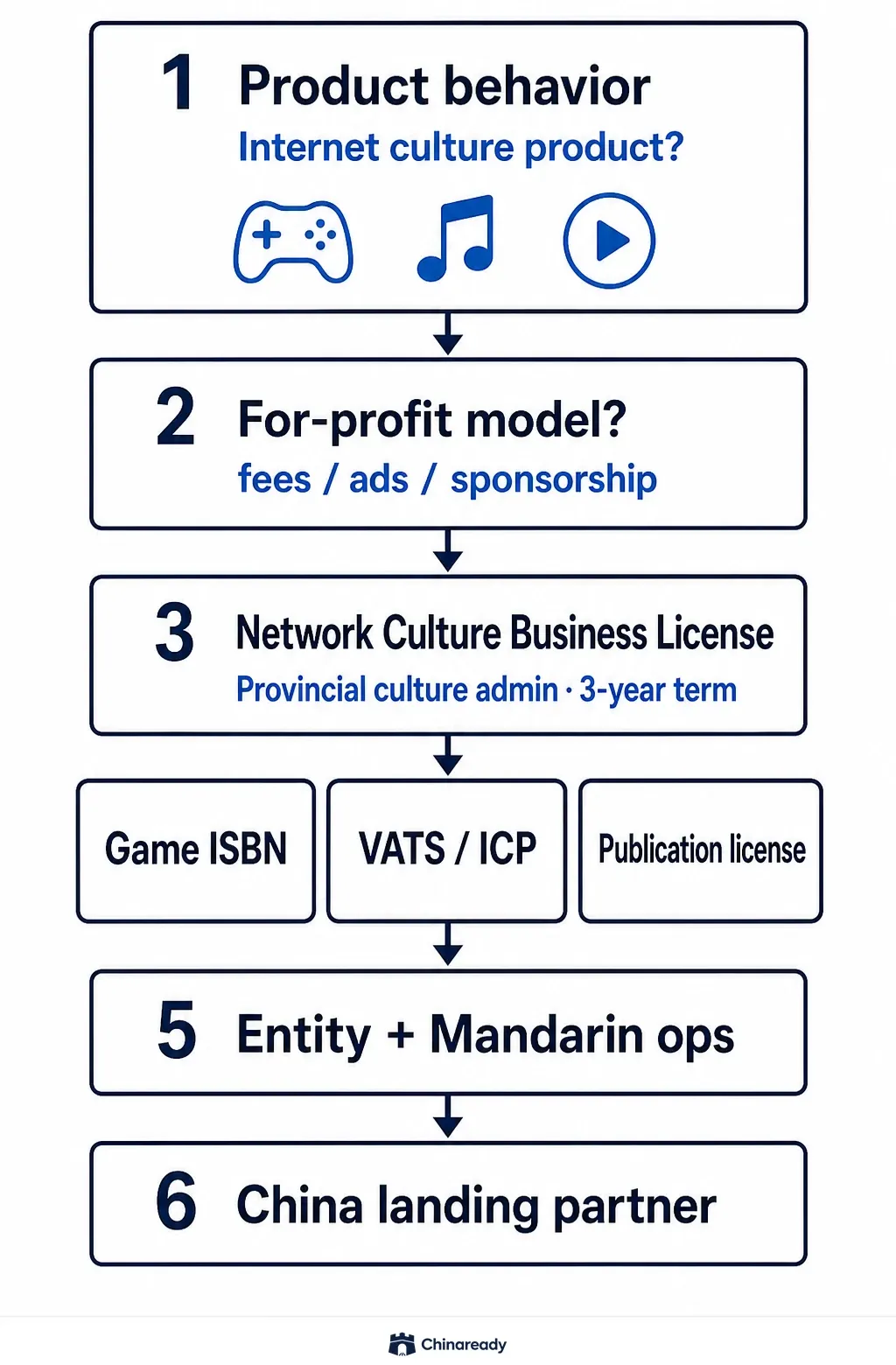
| Stage | Decision / outcome |
|---|---|
| 1. Name the product behavior | Is the Mainland China property providing internet culture products/services as defined above — or a non-culture SaaS / informational site? |
| 2. Lock the operating model | For-profit culture activity → license path; non-profit culture activity → provincial filing path; neither → do not force an NCBL story |
| 3. Check sibling hard gates | Games / durable paid listings → game ISBN and publish a game in China; commercial information / marketplace telecom patterns → VATS for digital products; publishing-entity credentials → China Publication License |
| 4. Choose the applying entity | Provincial culture path under a Chinese operating company or contracted landing-partner structure |
| 5. Submit and clear provincial review | Application materials per the Interim Provisions; decision window after acceptance; license issuance or written refusal |
| 6. Complete adjacent telecom procedures | After culture approval, handle related telecom/internet information procedures required for the operating model |
| 7. Display, renew, and operate | Homepage numbers, three-year renewal clock, content self-review, and change filings when entity / domain / scope shifts |
This sequence is phase decisions, not a console click-path. Import of internet culture products and domestic product filing after launch have additional content-review and marking duties under the same Provisions — schedule them with counsel when import or catalog launch is in scope.
Why NCBL, ISBN, and VATS are not interchangeable
Culture product without for-profit clarity → wrong provincial path. The Interim Provisions split for-profit licensing from non-profit filing. Shipping ads or paid downloads while claiming a “non-profit filing story” is how diligence and enforcement diverge from the product board’s slides.
NCBL cleared, game ISBN ignored → store durability still fails. For monetized games, major Mainland China listings usually hinge on the publishing approval (ISBN) path under a qualified publisher. The Network Culture Business License does not replace that program. Spine: China game ISBN and Publish a game in China.
NCBL treated as VATS → wrong ministry, wrong evidence pack. Commercial ICP license (B25) and related VATS codes are MIIT telecom gates for commercial information services and similar patterns. Culture licensing answers a different question. Map both when the product is a commercial culture platform — see China VATS licenses for digital products.
Publication credentials skipped when publishing is the job → entity mismatch. When the real activity is publishing (not only operating an internet culture platform), publication-side credentials matter. Pair this Guide with China Publication License instead of stuffing every content product into NCBL.
License number without display / renewal → operational failure after approval. Homepage marking and the three-year renewal clock are part of staying authorized. Letting the certificate lapse, or changing domain / legal person without provincial change filings, recreates the stall after you thought you were done.
Global feature rename → false “we’re not culture.” Live streaming performances, UGC music, anime distribution, or game-adjacent virtual goods can pull the product into internet culture territory even when the global brand calls the SKU “community” or “engagement.” Name behavior, not marketing labels.
What blocks product teams on this license map
- Assuming every content app needs NCBL — Ordinary productivity SaaS and corporate sites are a different map; force-fitting wastes months.
- Assuming no culture license because HQ is overseas — The Provisions apply to internet culture activities in Mainland China; entity structure does not erase the product trigger.
- Confusing non-profit filing with a for-profit license — Monetization mode chooses the path.
- Using NCBL as a game-store shortcut — ISBN / publisher rails remain the durability gate for many monetized titles.
- Ignoring VATS / ICP commercial when the platform sells information or transactions — Culture permit ≠ telecom commercial authorization.
- No Chinese entity or Mandarin ops rail — Provincial applications and ongoing self-review expect a local operating posture.
- Missing homepage display and renewal owners — Approval without ops hygiene fails the next diligence cycle.
- Importing culture content without the import / content-review track — Import activities have additional approval and marking duties under the Interim Provisions.
When you need a China landing partner for content licenses
Most product teams exploring Mainland China entry need a China landing partner to classify product behavior against internet culture rules, choose for-profit license vs filing vs “not in scope,” sequence sibling ISBN / VATS / publication gates, and execute provincial applications under a Chinese organizing entity. Your team still owns product scope and monetization decisions; the partner path makes culture-admin rails executable when they are not already in-house.
What we can offer?
The Network Culture Business License is a product-behavior gate for for-profit internet culture activities — decided beside ISBN, VATS, and publication credentials, not instead of them. Chinaready helps your product team name the trigger and the executable path:
- China Readiness Assessment — Map whether your Mainland China property is an internet culture product, whether the operating model is for-profit, and which sibling licenses (ISBN, VATS, publication) sit on the critical path before you promise a content launch date.
- China Access Acceleration — Keep admin, partner, and user journeys reachable while culture-license evidence and live product rails stay aligned.
- China Product Hosting — Place China-critical content properties on Mainland China–operable hosting and domain postures that can support the license/filing display and telecom adjacency you actually need.
- Mobile App Distribution — Sequence app or game channel launches with the same license evidence stores and partners ask for — especially when game ISBN and culture operating permits both appear.
Contact us when you need an NCBL vs ISBN vs VATS decision for a content or games-adjacent product — without treating one permit as a universal content stamp.
References
- Interim Provisions on the Administration of Internet Culture (2017 revision) — Ministry of Culture and Tourism; Network Culture Business License approval, validity, display, and internet culture product scope
- Measures for the Administration of Content Self-Review by Network Culture Business Units (notice) — Ministry open-government page; content self-review duties for network culture operators
- Ministry of Culture and Tourism — ministry portal
- National Press and Publication Administration — publishing / game-approval adjacency (pair with ISBN Guides)
- Ministry of Industry and Information Technology — telecom / VATS adjacency
- China game ISBN — Chinaready guide
- Publish a game in China — Chinaready guide
- China VATS licenses for digital products — Chinaready guide
- China Publication License — Chinaready guide
Frequently asked questions
What is China’s Network Culture Business License?
The Network Culture Business License (网络文化经营许可证) is the provincial culture-administration permit for for-profit internet culture activities under the Interim Provisions on the Administration of Internet Culture. It covers operating models that provide internet culture products and services for profit — not every SaaS or brochure site.
Which products usually trigger this license?
Product teams should start from internet culture product classes named in the Interim Provisions — such as online music entertainment, online games, online performances, online artworks, and online animation — when the Mainland China operating model is for-profit (user fees, ecommerce, advertising, sponsorship, and similar). Confirm scope with counsel and your operating entity; do not invent a category from a global feature list alone.
Is the Network Culture Business License the same as a game ISBN?
No. The Network Culture Business License is a culture-admin operating permit for internet culture activities. Monetized game store durability in Mainland China typically also depends on the game publishing approval (ISBN) path under a qualified publisher. See the China game ISBN and publish-a-game Guides — do not treat one license as a substitute for the other.
How is this different from VATS or a commercial ICP license?
Value-Added Telecommunications Services (VATS) licenses are MIIT telecom/internet service permits (for example commercial information services B25). The Network Culture Business License sits under culture administration for internet culture operating activities. A commercial app can need VATS analysis, culture licensing, both, or neither — depending on behavior, not brand category labels.
Can our global company apply alone?
Applications for for-profit internet culture activities go to the provincial culture administration where the operating unit is located, and require a qualified Chinese organizing entity, domain evidence, and related materials. Most product teams outside Mainland China ops norms execute through a Chinese operating company or China landing partner — not without Mainland China ops.
How long is the license valid?
Under the Interim Provisions, the Network Culture Business License is valid for three years; renewal must be applied for at least thirty days before expiry if operations continue. Display of the license (or filing) number on the website homepage is also required for internet culture units.