
China Publication License — digital publishing product gate
Publication License talk mixes distribution permits and internet publishing permits. Classify activity first — then ISBN, VATS, and partner rails.
“Publication License” is not one checkbox for every product that ships text or media in Mainland China. Product teams usually mix two National Press and Publication Administration (NPPA; 国家新闻出版署) tracks: the Publication Business License (出版物经营许可证) for commercial distribution of publications, and the Internet Publishing Service License (网络出版服务许可证) for internet publishing services. Games still run a separate ISBN / publishing approval path under a licensed publisher. Content hosting and commerce still pull ICP / VATS analysis. Classify the activity first — then pick the gate. Most global teams need a China landing partner.
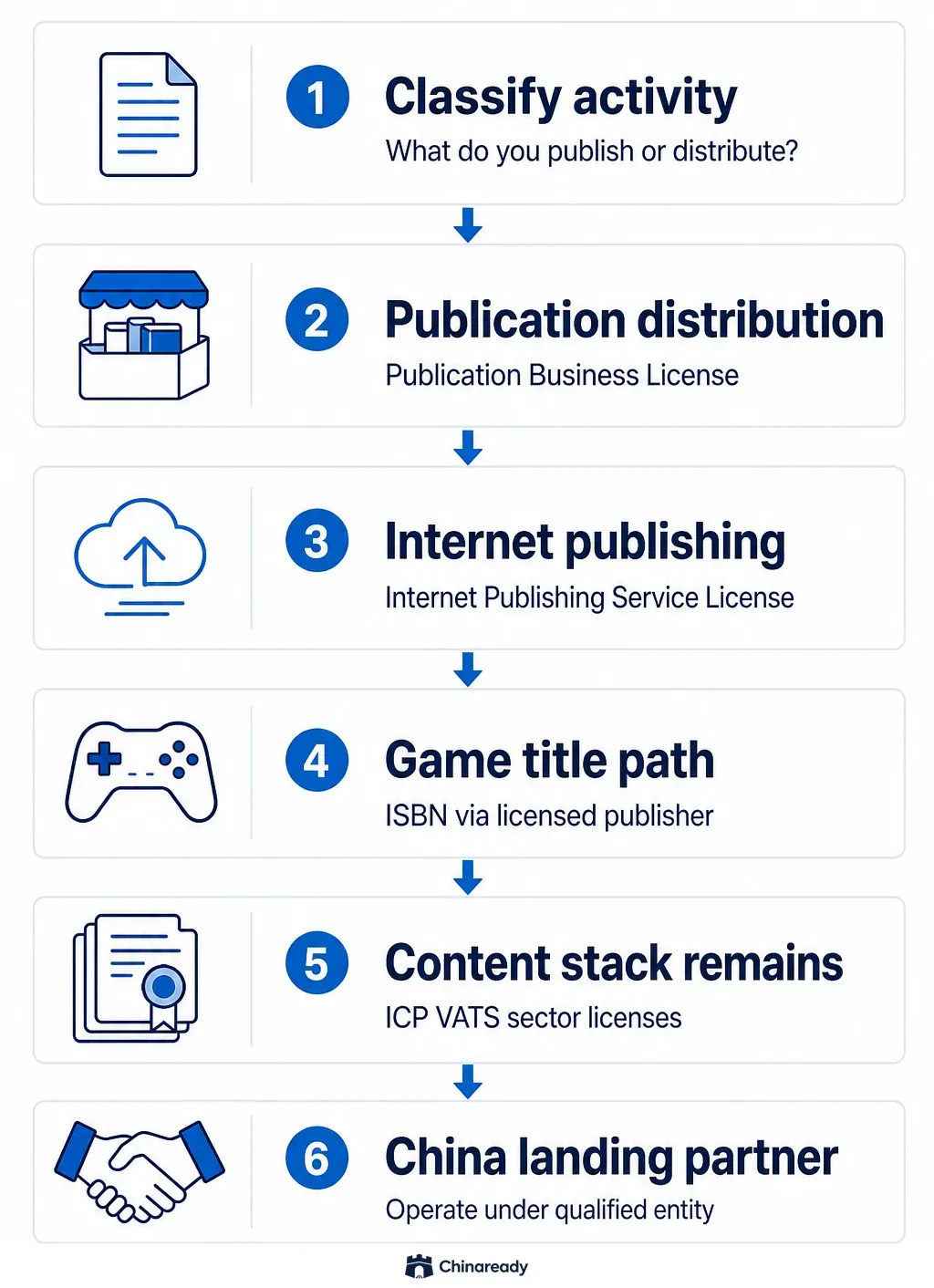
What publication and internet publishing permits cover
Hard names your digital publishing plan will use:
- Publication Business License (出版物经营许可证) — The permit to engage in publication wholesale / retail (and related distribution) of books, newspapers, periodicals, audio-visual products, and electronic publications. Online distribution of those publications still sits on this track under the publications market rules (Publications Market Administration Provisions; Regulation on the Administration of Publishing).
- Internet Publishing Service License (网络出版服务许可证) — The permit to engage in internet publishing services after publishing-authority approval. For the operator-track deep dive, see the Web Publishing Service License Guide. Primary rule text: Regulations on the Administration of Internet Publishing Services; NPPA approval item: establishment of an internet publishing service unit.
- NPPA is the publishing authority — Policy and approval sit with NPPA and provincial publishing administrations — not with a cloud vendor’s ICP footer (nppa.gov.cn).
- Not a game ISBN — Monetized games need Chinese publishing approval (版号) on the ISBN path under a qualified publisher. That is title-level authorization, not proof that your company holds a Publication Business License. Spine: China game ISBN and Publish a game in China.
- Not a substitute for content / telecom licenses — ICP filing, commercial VATS (for example B25), and sector overlays remain on the stack when hosting or commercial information services apply — see China VATS licenses and ICP license (B25). Interactive / culture-platform models may also need the sibling Network Culture Business License analysis.
- Foreign equity is a hard wall — Direct foreign ownership of publication distribution and internet publishing is tightly restricted. Product teams that need these activities almost always publish or distribute through a qualified Chinese entity, not a WFOE self-application fantasy.
Vocabulary first. Next: which decisions lock before any filing talk.
What must be locked before you chase a publishing permit
Missing any of these stops your product team before a realistic license or partner path.
| Precondition | Why your process stalls |
|---|---|
| Activity class named — distribution of publications vs internet publishing services vs game title vs ordinary SaaS / info site | Wrong permit chase; months spent on a track that never applied |
| Content objects named — books / periodicals / e-publications vs UGC platform vs game build vs utility SaaS | Reviewers and partners cannot map scope; counsel cannot pick the gate |
| Operating entity model — Chinese licensee / publisher / distributor vs “global HQ alone” | Foreign-equity limits make solo WFOE paths unavailable for these permits |
| China-reachable legal & ops owners — Mandarin-capable contacts for provincial packs | Silent stalls when authorities or partners cannot reach anyone |
| Parallel stack inventory — ICP / VATS / app filing / sector licenses already listed | Publishing permit work without hosting / telecom gates creates launch collisions |
| Partner RACI — who holds the license, who owns content review, who answers takedowns | Verbal “we have a publisher” fails on the first removal event |
Replace “we need a Publication License in Q3” with “activity class locked; entity model named; ISBN vs operator license vs content stack assigned.”
From activity class to the right publishing gate
| Step | Outcome | Failure if skipped |
|---|---|---|
| 1. Classify activity | Distribution vs internet publishing vs game title vs out-of-scope utility | Wrong permit narrative |
| 2. Map publication distribution | Publication Business License path under a Chinese distributor when you wholesale / retail publications (including online) | Unlicensed distribution exposure |
| 3. Map internet publishing | Internet Publishing Service License path when you operate internet publishing services | Platform launch without publishing authority approval |
| 4. Map games separately | ISBN / approval via licensed Chinese publisher — ISBN Guide | Soft-launch then removal waves |
| 5. Keep content stack honest | ICP / VATS / app filing / sector licenses on the same plan | “We got a publishing partner” with nowhere to host |
| 6. Lock China landing partner | Contracted entity that already holds or can pursue the needed permit | Paper plan with no applicant |
Quick forks product teams misuse
- Utility SaaS with help docs — Usually not a Publication Business License trigger. Still check hosting / ICP / commercial VATS.
- Selling e-books or periodical packs as a retailer / wholesaler — Plan the Publication Business License distribution track (online distribution still requires it under the market rules).
- Operating an online publishing platform — Plan the Internet Publishing Service License track; servers and storage for that service must sit in Mainland China per NPPA approval conditions.
- Monetized game — Do not substitute “Publication License” language for the ISBN path. The publisher’s network publishing credentials matter; your title approval is still a separate clock.
Why the wrong permit blocks the next gate
Mis-classifying a game as “publication distribution” → ISBN clock never starts. Stores and channels care about the game approval record under a publisher, not a retail publication license story your ops wiki invented. Fix the class before you fund UA — Publish a game in China.
Internet publishing without a licensed operator → platform features cannot stay live. Search, store, and hosting partners increasingly expect to see the internet publishing permit number when the product is in that category. Partnering after launch means rewriting commercial contracts mid-crisis.
Publication distribution without the Publication Business License → inventory and settlement freeze. Online bookstore / periodical commerce that is actually distribution cannot hide behind a generic ICP footer.
Publishing permit secured, content stack ignored → host and telecom gates still fail. ICP filing, commercial B25 / other VATS, and app filing are not optional because you named NPPA once — see VATS for digital products.
Foreign HQ as applicant → no valid filing vehicle. These categories sit behind foreign-investment and publishing-authority walls. Most product teams need a China landing partner that already holds (or can lawfully pursue) the right permit and content-review ops.
Difficulty and blockers that are China-specific
- Restricted industry, low private success rate — Publication distribution and internet publishing remain tightly controlled. Treat “we will apply ourselves” as an exception narrative, not the default plan.
- Provincial intake, central approval clocks — Internet publishing establishment applications go through provincial publishing administrations before NPPA decision windows (policy text cites a sixty-day class of central decision clock after acceptance — not a launch-week form).
- Personnel and infrastructure bars — Internet publishing applicants that are not existing publishing units face Chinese legal-representative rules, qualified editing headcount, content review systems, and Mainland China server / storage placement (NPPA approval conditions).
- License display and transfer bans — Internet publishing units must show the license number on the site homepage; licenses cannot be rented or informally transferred. Ops must match the named entity.
- Parallel enforcement — Unlicensed publishing / distribution can trigger cessation orders, confiscation of illegal income, and further liability under publishing regulations — separate from store removal waves on the game track.
- Copy alone cannot finish it — Entity design, Mandarin packs, and partner commercial terms require Mainland China counsel and a landing partner; this Guide stops at the decision map.
What we can offer?
Publication and internet publishing permits are an activity-classification problem: distribution license vs internet publishing permit vs game ISBN vs ordinary content / VATS stack — then a Chinese operating vehicle. Chinaready maps that line before your team promises a digital publishing date:
- China Readiness Assessment — Name whether your China product is publication distribution, internet publishing, a game ISBN program, or outside those NPPA tracks — and which foreign-equity / partner model is realistic.
- China Access Acceleration — Sequence partner selection, publishing-authority packs, and parallel ICP / VATS / sector work so license clocks match a shippable product scope.
- China Product Hosting — Place publishing-relevant services on Mainland China termination paths that support ICP filing and NPPA server-location expectations, instead of assuming a global CDN covers publishing permits.
- Mobile App Distribution — Align store enablement with the same publishing / ISBN evidence channels ask for, so app filing and NPPA gates do not collide at submission.
Contact us when you need the activity class and partner path named before you market a Mainland China digital publishing launch.
Frequently asked questions
What is China’s Publication License?
In product planning, “Publication License” usually points to the Publication Business License (出版物经营许可证) for wholesale or retail distribution of publications — including online distribution of books, newspapers, periodicals, audio-visual, and electronic publications under the publications market rules. It is not the same permit as the Internet Publishing Service License (网络出版服务许可证), and it is not a game ISBN.
Do SaaS or utility apps need a Publication License?
Usually no, if you are not commercially distributing publications or operating internet publishing services. Classify the activity first. Many digital products still need ICP filing, commercial VATS analysis, app filing, or sector overlays — those are separate gates from publication permits.
What is the Internet Publishing Service License?
The Internet Publishing Service License (网络出版服务许可证) is the NPPA permit to engage in internet publishing services under the Regulations on the Administration of Internet Publishing Services (网络出版服务管理规定). Online publishing platforms and digital publication operators that fall in that definition plan this track — not every website that hosts text.
How does this relate to China game ISBN?
Game ISBN / publishing approval is a title-level gate for monetized games. Submissions typically run through a qualified Chinese publisher that already holds the required network publishing credentials. Your studio usually buys a publish vehicle — you do not treat ISBN as a substitute for holding the Publication Business License yourself. See the China game ISBN Guide.
Can a foreign-owned company hold these licenses?
Publication and internet publishing are among Mainland China’s most restricted media categories. Wholly foreign-owned enterprises generally cannot hold these permits directly. Most global product teams operate through a China landing partner or licensed Chinese publishing / distribution entity.
Can product teams finish this without Mainland China ops?
No. Activity classification, foreign-investment limits, provincial-to-central approval clocks, and parallel content licenses (ICP / VATS / sector) stall teams without Mainland China counsel and a landing partner.