
China VATS licenses — which apps and sites need them
VATS licenses matter when your China website or app is commercial — B25 ICP license, B21 EDI for marketplaces, and partner or pilot-WFOE paths. This is a product trigger map, not a full license encyclopedia.
Value-Added Telecommunications Services (VATS) licenses (增值电信业务经营许可证) are Ministry of Industry and Information Technology (MIIT) permits for specific commercial telecom and internet service categories. For foreign apps and websites, you rarely need the full catalogue memorized. You need a trigger map: when basic Internet Content Provider (ICP) filing is enough, when a commercial ICP license (B25) or EDI license (B21) appears, and whether your path is a Chinese partner or a rare pilot-region WFOE application.
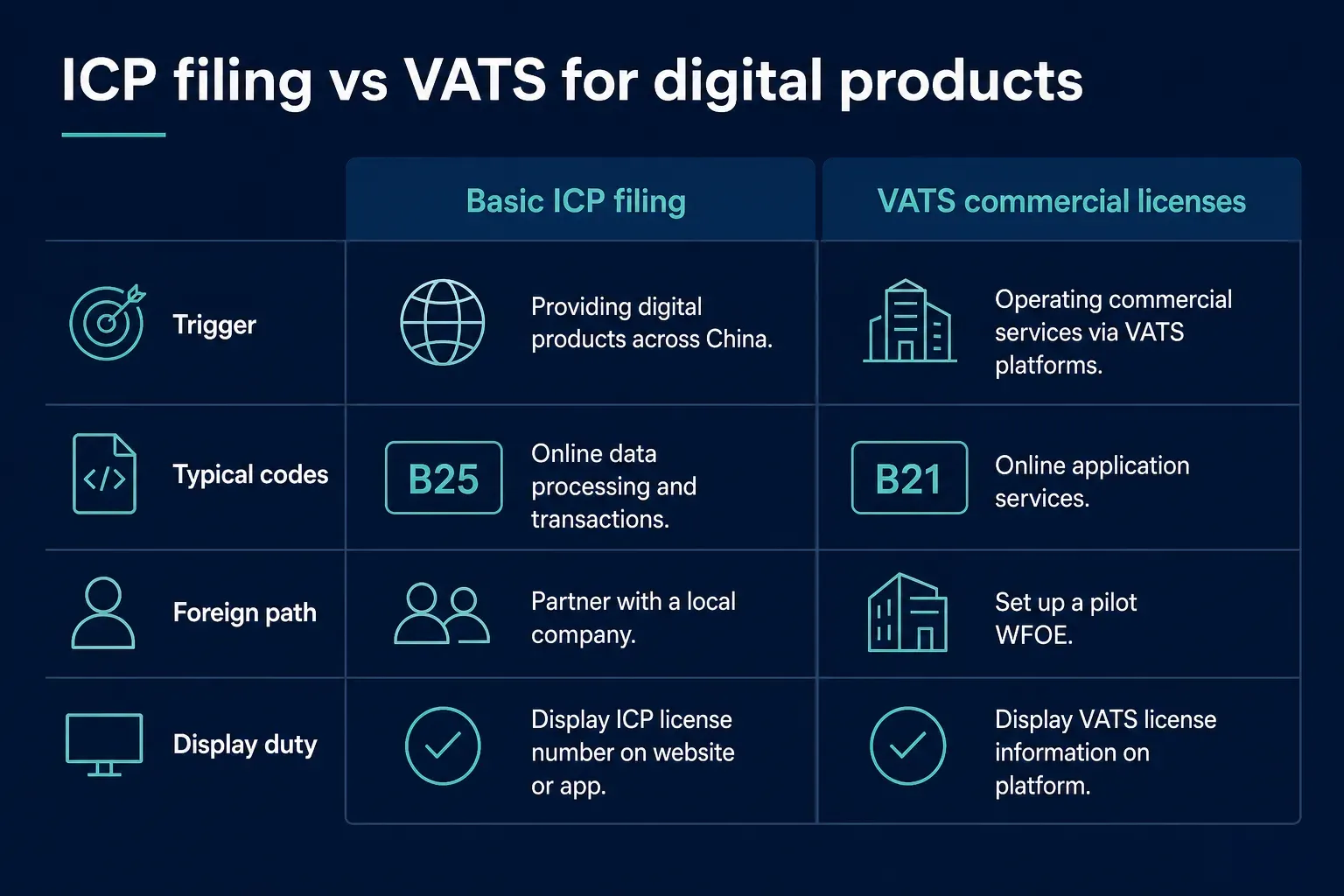
Critical path: filing vs commercial VATS
China’s telecom rules split basic telecommunications from value-added services. Most software products live in VATS territory when they operate commercially on the Mainland China internet. The Telecommunications Services Classification Catalogue (电信业务分类目录) defines codes; product teams should start from behavior, not from collecting every code.
| Your China property does… | Usual first gate | Commercial VATS to check |
|---|---|---|
| Informational / corporate site on Mainland China hosting, no payments or ads sales | Basic ICP filing (+ PSB after launch) | Often none |
| App or site that sells advertising, runs paid content platforms, or commercial information services | ICP filing first | B25 commercial ICP license |
| Marketplace / transaction processing between buyers and sellers | ICP filing + platform controls | B21 EDI license |
| You operate IDC / CDN / VPN as a service to others | Provider licensing | B11 / B12 / B13 (usually the cloud vendor’s problem if you only consume) |
Product-shaped reading of common codes
- B25 — Information services (commercial ICP license): The VATS most product teams mean when they say “ICP license.” Triggered by commercial information-service patterns on websites and apps — not by every marketing page.
- B21 — Online data processing and transaction processing (EDI): The marketplace / transaction-platform license. Third-party e-commerce patterns are the classic trigger.
- B11 IDC / B12 CDN / B13 VPN: Infrastructure-operator licenses. If you buy Alibaba Cloud, Tencent Cloud, AWS China, or Azure China, the vendor holds these for the infrastructure layer; your job is still ICP / B25 / B21 for your service layer when those apply.
This guide stops there on purpose. Call-center, ISP, and other codes matter for specialized operators; they are not the default shortlist for a SaaS or content app launch. Internet culture operating models (games, music, performances, and related for-profit culture products) also need a separate Network Culture Business License analysis — culture-admin, not MIIT.
How foreign teams actually clear the gate
| Path | When it is realistic | What it means |
|---|---|---|
| Chinese partner publish / operate model | Most foreign apps and sites | Partner entity holds required VATS; your product rides under a contracted compliance structure |
| WFOE in MIIT pilot regions (Beijing, Shanghai, Shenzhen, Hainan — designated scopes) | You will invest in a local entity and long approval cycle | Direct application for listed VATS categories with no foreign-equity cap in policy — approvals remain scarce in practice |
| Stay offshore only | No Mainland China commercial operation / hosting that triggers the licenses | Avoids VATS, but also avoids the in-China commercial model you may have assumed |
Public reporting around the 2024–2026 pilot opening showed only a small number of foreign-invested entities successfully obtaining VATS licenses in the first waves. Treat “WFOEs can apply” as eligibility, not as a forecast of easy approval. Name B25 / B21 (if any) on the same plan as ICP filing — not as a surprise after store submission — and assign footer / in-app license display plus renewal owners early.
Application shape (when you or your partner apply)
- Qualification and document pack (corporate, personnel, business plan, security plans)
- Submit via MIIT’s telecommunications business management system
- Formal then substantive review; possible on-site checks
- Approval, certificate (often 5-year validity), and display of license number on the property
- Renewal planning well before expiry (commonly start ~90 days out)
End-to-end timing is often cited around 40–60 business days for a clean package — longer when supplementation or inspection applies.
Document packs typically group into corporate qualifications (business license, articles, shareholders), personnel evidence (technical staff credentials and social-insurance records where required), business materials (feasibility and development plans), and security/compliance plans (information security and emergency response). On-site verification — when used — can cover office premises, staff interviews, live platforms, and technical facilities. Plan as if someone will ask to see the operation you described on paper.
Who is in scope for digital products
If users in Mainland China can use your commercial website, app, content platform, or transaction service under a China operating model, VATS analysis belongs on the checklist. The deciding factor is service activity and operating structure, not whether the brand HQ sits in San Francisco or Singapore. Offshore-only products that never take on Mainland China commercial operation may avoid these licenses — and should not pretend they have “China commerce” either. If your team cannot yet say whether B25 or B21 applies, pause feature scope — that ambiguity is the compliance risk.
China-specific failure points
Confusing ICP filing with B25
Teams say “we have ICP” when they only completed basic filing. Commercial features then ship into a filing-only posture. Stores, payment partners, and enterprise buyers increasingly distinguish filing numbers from commercial licenses.
Assuming the cloud vendor’s VATS covers your product
Your CDN or IDC provider’s licenses cover their infrastructure service. They do not automatically authorize your commercial app or marketplace. Product-layer B25/B21 analysis still belongs to the organizing operator of the app or site.
Building marketplace mechanics without B21 on the roadmap
Multi-vendor checkout, escrow-like flows, or “platform takes a cut” patterns pull you toward B21 territory. Redesigning commerce after rejection is more expensive than naming the license early.
Treating pilot WFOE as the default foreign path
Pilot opening is real; successful foreign licensees remain few and resource-heavy. For most launches, a licensed Chinese partner is the operational path while you decide whether a long-term WFOE application is worth it.
Display and renewal hygiene
License numbers must be shown on the website or platform where required. Letting a five-year license lapse, or leaving a stale footer after entity changes, creates avoidable enforcement and customer-diligence failures.
Operating commercially without the permit
Telecommunications Regulations allow warnings, correction orders, confiscation of illegal income, fines, suspension, and — for serious cases — heavier liability. In practice, hosting and distribution partners also choke unlicensed commercial services before a court ever appears.
Feature creep after a “filing-only” launch
A common sequence: team ships a brochure site under basic ICP filing, then enables checkout, advertising inventory, or a multi-seller catalog in a later sprint. The hosting filing number still looks valid in the footer while the commercial posture has changed. Schedule a license re-check whenever you add payments, ads sales, marketplace roles, or paid information services on the China property.
Diligence questions from China buyers and stores
Enterprise customers, payment partners, and app stores increasingly ask for commercial license evidence during onboarding. Being able to show the correct B25/B21 number — or explain why your model is filing-only — is part of go-to-market, not only regulatory defense. Keep certificate scans, scope descriptions, and footer display aligned with what sales promises.
What we can offer?
VATS for apps and websites is a product trigger problem: basic ICP filing versus commercial B25/B21, partner publish versus a rare pilot WFOE path, and license display that matches what you actually sell. Chinaready’s four services map onto that line:
- China Readiness Assessment — Name whether your China property is filing-only or needs commercial VATS (B25/B21), and which operating model (partner vs pilot WFOE) is realistic before you promise commerce dates.
- China Access Acceleration — Keep Mainland China user journeys reachable once commercial features and license gates are in scope — so “licensed” and “customers can open the site” stay aligned.
- China Product Hosting — Place the right components on Mainland China termination paths that support ICP filing and the commercial posture you chose, instead of assuming a global CDN alone covers VATS.
- Mobile App Distribution — Sequence store launch with the same commercial-license evidence buyers and stores ask for, so App filing and VATS triggers do not collide at submission.
Contact us when you need that trigger map before you open a Mainland China commerce calendar.
Frequently asked questions
What is a VATS license in China?
A Value-Added Telecommunications Services (VATS) license is an MIIT permit to operate specific internet telecom service categories. For many digital products the practical trigger is commercial information services (B25) or transaction platforms (B21), not every telecom subcategory.
Is basic ICP filing the same as a commercial ICP license?
No. Basic ICP filing is registration for non-commercial internet information services on Mainland China hosting. The commercial ICP license (B25) is a VATS authorization for commercial information services — separate process and higher bar.
Can a foreign company hold a VATS license?
In limited pilot regions, wholly foreign-owned enterprises may apply for listed VATS categories, but approvals remain rare. Most foreign product teams publish through a Chinese partner that already holds the needed licenses.
Which VATS codes matter most for apps and websites?
For product planning, start with B25 (commercial information services) and B21 (online data processing / transaction processing for marketplaces). IDC, CDN, and VPN codes matter when you operate infrastructure, not when you only consume a cloud vendor.
What happens if you operate without required VATS licenses?
Risks include correction orders, fines, suspension, confiscation of illegal income, and permit problems. Access providers and app stores also enforce commercial licensing gates in practice.