

China advertising law — gates for product teams
Mainland China advertising law gates stop product launches when claims, endorsements, or special categories fail review — map those gates before you buy media.
China advertising law is a launch gate for product and marketing teams — not a platform tip sheet. Before you buy media in Mainland China, map three hard stops: claims (truthfulness and banned absolute language), endorsements (spokesperson and influencer rules), and special categories (prior review and sector bans). The Advertising Law and the internet advertising measures apply across WeChat, Douyin, Xiaohongshu, Baidu, and other China-facing channels.
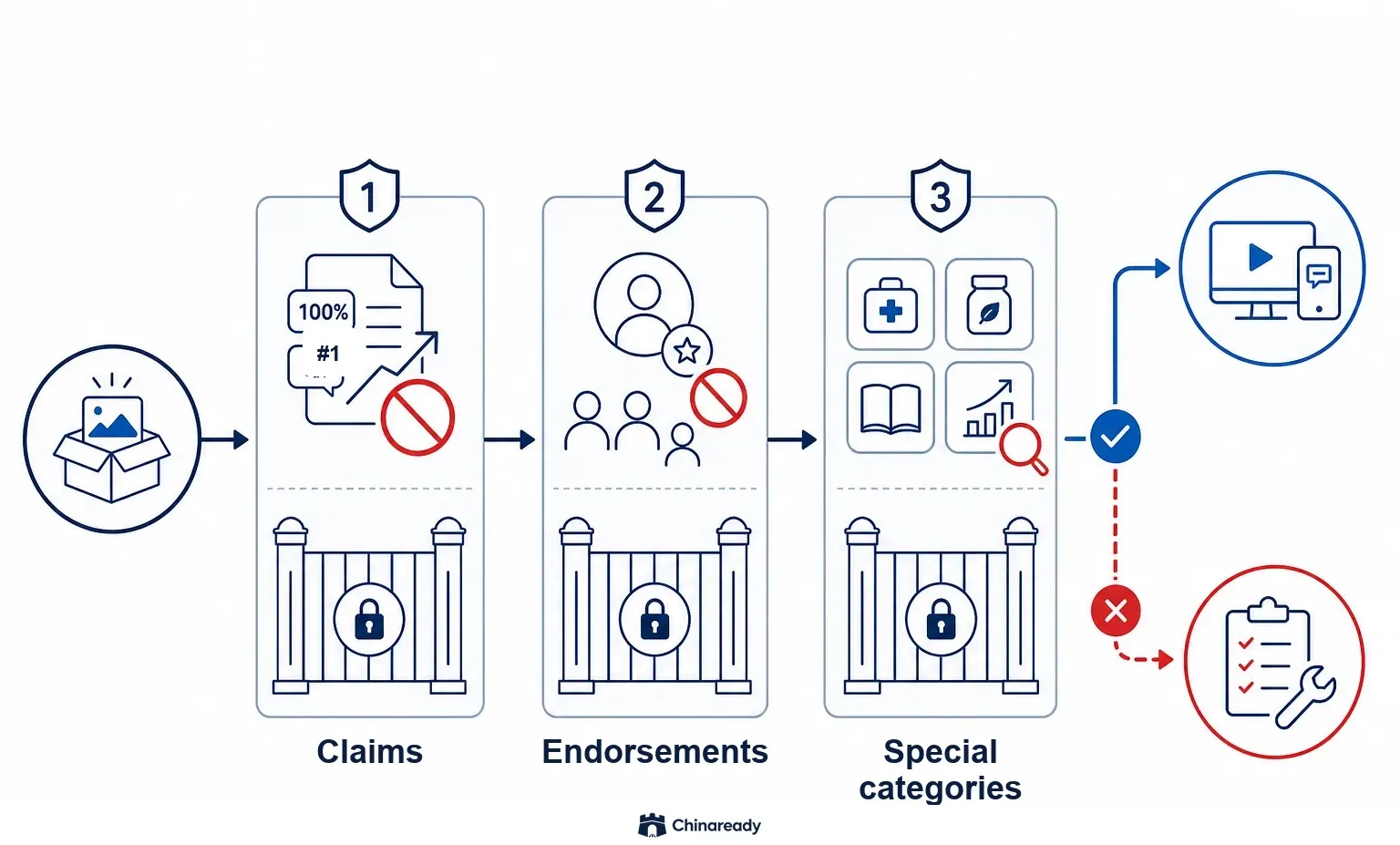
What China advertising law means for launches
Hard names your launch program will use:
- Advertising Law of the PRC (广告法) — Baseline statute for advertising activities in Mainland China (2021 amendment text hosted by market-regulation channels: SAMR law PDF; provincial republication: Shanghai AMR).
- Administrative Measures for Internet Advertising (互联网广告管理办法) — SAMR rules for commercial ads on websites, apps, feeds, search, livestreams, and related internet media (SAMR text; State Council Gazette republication: gov.cn).
- Truthful, lawful, identifiable — Ads must not mislead; paid content must be recognisable as advertising (commonly labelled 广告 online).
- Claim control — Absolute superlatives, guarantees, and unsupported figures are high-risk; every remaining claim needs evidence.
- Special-category prior review — Medical treatment, medicines, medical devices, pesticides, veterinary medicines, health foods, and other legally listed categories need review before publication.
- Platform layer on top — Tencent Ads, Ocean Engine, and others add review and industry quals; clearing platform policy does not replace the statute.
- Common myth — “Global English creative is fine if we translate literally.” Localisation is a legal claim rewrite, not only a language pass.
Vocabulary first. Next: what must exist before media spend is executable.
What must exist before you buy China media
Missing any of these stops your product team before a real campaign review — not after creatives are already in the platform queue.
| Precondition | Why your process stalls |
|---|---|
| China product + landing surfaces — site, app, Mini Program, store, checkout | Ad → landing claim mismatch fails review and enforcement together |
| Mainland China entity or agency buying path | Contracting, settlement, and industry qualifications usually need a China applicant |
| Category map — ordinary goods vs medical / health food / education / investment | Wrong map → skipped prior review or banned endorsement formats |
| Claim inventory with evidence — stats, rankings, efficacy, comparisons | Unsupported claims fail statute and platform review |
| Endorsement pack — who appears, usage proof, age / category fitness | KOLs and testimonials are advertising content, not informal social posts |
| China-ready access for landings — ICP / reachability where the ad sends traffic | Paid traffic to a blocked or non-China-ready landing wastes the buy — see China ads goal–channel map |
Product teams without Mainland China ops rails usually cannot assemble prior-review packs and Chinese substantiation without Mainland China ops.
Gate map: claims, endorsements, special categories
Use this as a launch gate map. Stages are decisions, not console click-paths.
| Stage | Decision / outcome |
|---|---|
| 1. Lock goal → channel layer | Exposure, acquisition, conversion, or app monetization — then platform shortlist (ads goal–channel map) |
| 2. Classify the product category | Ordinary goods/services vs prior-review / high-restriction sectors |
| 3. Run the claims gate | Remove absolute / guarantee language; keep only substantiated facts; localise Chinese claims, do not literal-translate English promo |
| 4. Run the endorsement gate | Confirm spokesperson / influencer use is lawful for the category; minors under 18 cannot be advertising spokespersons; medical and health-food testimonials are usually off-limits |
| 5. Clear identification and format | Paid placements labelled as ads; pop-ups / open-screen formats with real one-click close |
| 6. Align ad + landing + product story | Same claims across creative, landing, store pack, and in-app copy |
| 7. Only then submit platform review | Platform reject is a symptom; unfinished statute gates are the cause |
Channel execution (account verification, creative formats, bidding) sits beside this law map — see WeChat advertising for Tencent Ads account and creative gates after the category and claim gates are clear.
Why one advertising-law fail blocks the launch
Unclassified category → skipped prior review. Medical, device, and health-food campaigns that treat review as “platform will catch it” get takedowns, refunded media, and restart clocks.
Global superlatives → Chinese claim failure. “Best,” “#1,” “guaranteed,” and weak “90% success” lines that survive Western brand decks often fail Mainland China claim control even when the product is ordinary goods.
KOL post treated as organic → endorsement and disclosure gaps. Sponsored Moments, livestreams, and review-style content with purchase paths are advertising when commercial. Missing 广告 identification or unlawful testimonials kills the flight mid-spend.
Landing page ≠ ad claim → double fail. Platform review and market-regulation enforcement both look at the journey. An ICP-weak or blocked landing also breaks the buy — hosting and access belong in the same launch plan (China Product Hosting, website accessible in China).
Education or investment guarantee language → sector block. Pass-rate, admission, and “no risk / guaranteed return” framing is a hard gate, not a copy preference.
Documents after go-live → cannot remediate fast. Licences, test reports, likeness authorisations, and prior-review approvals must exist before submission — not after a takedown notice.
Where advertising-law programs stall product teams
- Statute reading without a gate map — the decision is which of claims / endorsements / category review stops this launch, not whether you can recite article numbers.
- Platform-only compliance — clearing Tencent Ads or Ocean Engine review does not prove Advertising Law fitness for a regulated category.
- Literal translation of global creatives — English promo tone becomes Chinese absolute claims.
- Influencer campaigns without category counsel — medical and health-food endorsements are the classic launch killer.
- Media booked before landings and ICP readiness — paid traffic amplifies access and claim mismatches.
- Broker promises of “approved creatives in days” — diligence who holds prior-review approvals, which evidence pack, and what happens on reject.
When you need a China landing partner for ad-law gates
Most product teams exploring Mainland China entry need a China landing partner to turn advertising-law gates into an executable launch sequence — category classification, Chinese claim rewrite, endorsement fitness, prior-review packs, and platform submission beside entity and landing rails — not a longer statute reading list. Your team still owns product truth and brand voice; the partner path makes review, evidence, and China media ops workable when they are not already in-house.
What we can offer?
Advertising-law work is a gate map across claims, endorsements, and special categories — not one creative proofread. Chinaready helps your product team see which gates block the launch and run the Mainland China path beside channel and hosting readiness:
- China Readiness Assessment — Inventory China-facing landings and campaign surfaces, flag advertising-law category and claim risk, and sequence them with ICP / access gates the board can fund before media spend.
- China Access Acceleration — Keep review test paths and paid-traffic landings reachable from Mainland China so platform and statute checks match the journey users actually hit.
- China Product Hosting — Place China-critical landings and conversion stacks where ICP, access, and ad-claim evidence describe one coherent path.
- Mobile App Distribution — Align app store packs, in-app claims, and paid acquisition creatives so distribution and advertising-law stories do not diverge after launch.
Contact us when you need an advertising-law gate map for the Mainland China launch you plan to fund —.
Frequently asked questions
What is China’s Advertising Law for product teams?
The Advertising Law of the People’s Republic of China sets the baseline for truthful, lawful, identifiable advertising in Mainland China. Online placements also follow the Administrative Measures for Internet Advertising. Product teams treat both as launch gates — claims, endorsements, and special categories — not as optional platform policy.
Do China ads rules apply if we buy media from overseas?
Usually yes when the campaign targets users in Mainland China or runs on China-facing platforms and media. Overseas creative teams, offshore entities, or global ad accounts do not remove the Advertising Law baseline.
Which claims are highest risk under China advertising law?
Absolute superlatives (“best,” “number one”), guarantee-style outcomes, unsupported statistics, and health or efficacy assertions that cannot be substantiated. Regulated categories add stricter bans and often prior review before publication.
Can influencers endorse medical or health-food products?
For medical treatment, medicines, medical devices, and health foods, spokesperson recommendations and testimonials are tightly restricted or prohibited under the Advertising Law. Treat KOL / KOC and livestream scripts as advertising when the brand sponsors or controls the commercial content.
Which categories need prior ad review?
Advertisements for medical treatment, medicines, medical apparatuses, pesticides, veterinary medicines, and health foods — plus other ads that law or regulation requires — must be reviewed before publication. Online rules also call out special medical-purpose foods in the prior-review set.
Can we finish advertising-law compliance without Mainland China ops?
Usually no. Claim localisation, category qualifications, prior-review packs, Chinese-language substantiation, and platform review all need Mainland China ops rails.