

China ads map — match goal, channel, and user
China ads work when goal, channel, and user match — exposure, acquisition, conversion, or App monetization — not when you buy every platform at the lowest CPM.
China ads succeed when goal → channel → user match — not when you stack every platform or chase the lowest CPM. Pick the objective layer first (brand exposure, precision acquisition, instant conversion, or App monetization), then shortlist platforms in that layer. Prefer closed-loop measurement and channel-combo ROI over raw impressions; keep compliance as the floor. Foreign teams still need entity / agency, China-ready landings, and measurement that works in Mainland China. Google Ads and Meta Ads are not a Mainland China primary plan.
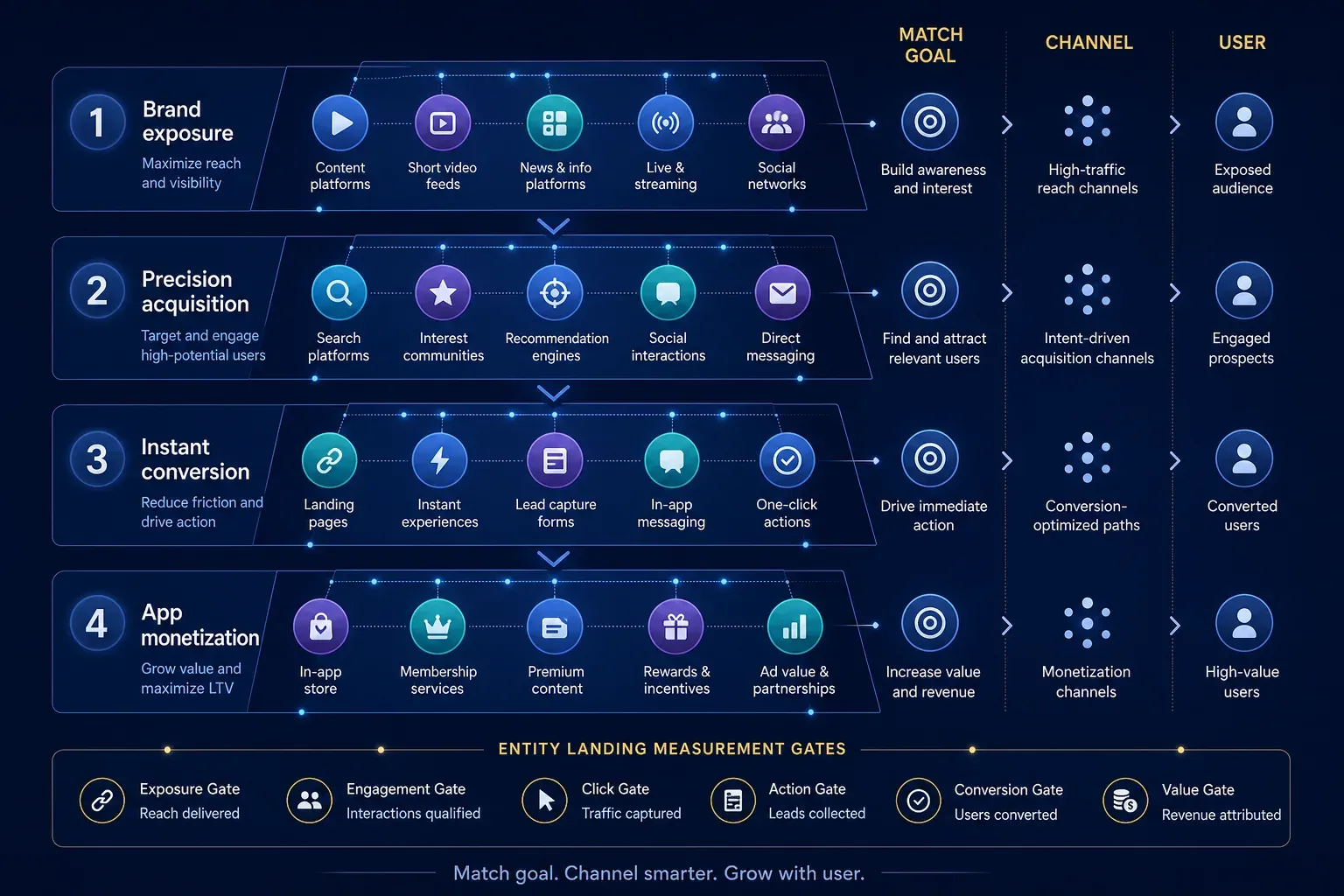
Critical path: pick the layer, then the platforms
| Goal stage | Indicative layer mix | What to avoid |
|---|---|---|
| Brand building | ~60% state media + portals; ~30% vertical media | Treating local-media price as a cheaper substitute for state-media trust |
| Acquisition / conversion | ~70% feed ads; ~20% closed-loop / measurement tooling | Scaling placements you cannot attribute |
| Long-term ops | Shift budget toward higher LTV via cross-channel attribution | Single-platform spray with no cohort view |
Figures above are indicative planning shapes, not universal SLAs.
Google Ads and Meta Ads — not the Mainland China primary plan
Google Ads and Meta Ads (Facebook / Instagram) are not reliable primary channels for ordinary Mainland China user reach — inventory, measurement, and payment paths do not replace a China platform stack. Keep them for audiences outside Mainland China or limited cross-border cases. For China acquisition, pick a layer below (Ocean Engine, Tencent Advertising, Xiaohongshu, Baidu, e-commerce media, and so on). If your global stack still names Google or Meta as the “China plan,” remap via the Landscape alternatives index and the layers in this Guide — then see Google Ads China decision and Blocked Meta surfaces. Deeper platform playbooks (WeChat, Douyin, Xiaohongshu, and others) can follow once the layer choice is locked.
Brand exposure — trust and search occupancy
Use when you need authority, financing or government-adjacent signaling, or durable search occupancy for brand terms.
- State / authoritative media examples: People’s Daily Online (人民网), Xinhua Net (新华网), CCTV.com (央视网), Guangming Online (光明网)
- Portals: Sina (新浪), NetEase (网易), Tencent (腾讯新闻等门户语境), Sohu (搜狐), ifeng (凤凰网)
One strong state-media placement often outweighs a pile of thin syndication for finance, health, and B2B trust jobs. Match portal placements to industry channels — generic homepage spray is weak SEO occupancy.
Precision acquisition — decision-makers and feed systems
Use when you need qualified leads or efficient paid reach with measurable outcomes.
- Vertical media: 36Kr (36氪), DXY / Dingxiangyuan (丁香园), Autohome (汽车之家), ebrun (亿邦动力)
- Feed / closed-loop platforms: Ocean Engine (巨量引擎 — Douyin / Toutiao ecosystem), Tencent Ads (腾讯广告 — WeChat / QQ ecosystem), Umeng+ U-AddWin (友盟+ U-AddWin)
Verticals often convert better than generic portals for SaaS and niche B2B. Prefer outlets with real editorial process over AI-batch syndication when trust matters. Ocean Engine is strong for short-video and live scenes; Tencent Ads for social graph and private-domain adjacency; closed-loop tools matter when you need placement- and cohort-level optimization — evaluate vendors on reporting depth, not logo alone.
Instant conversion — short-path sales
Use when the next event is purchase, form, or private-domain handoff with a short path.
- Live commerce media: Douyin Qianchuan (抖音千川), Kuaishou CiLi Jinniu (快手磁力金牛)
- Social seeding: Xiaohongshu (小红书) — paid discovery often runs through Juguang (聚光) for feed and search-style placements; Zhihu (知乎); WeChat Official Accounts (微信公众号)
Indicative live-commerce hygiene: cold start often runs a high paid share (commonly cited ~60–70%) toward room-view or learning goals; a healthier mature mix often keeps organic contribution above half of traffic — treat as planning guidance, not a guarantee. On seeding platforms, combine head creators for momentum with mid-tier volume; follower count alone is a weak proxy for conversion. Xiaohongshu / JuGuang bidding detail belongs in the Xiaohongshu ads Guide — this map only places the channel.
App growth & monetization — Mainland China networks
Plan Mainland China App user acquisition and ad monetization on Mainland China advertiser platforms and publisher networks. Global mediation / UA stacks usually cannot deliver reliable fill, auction access, or compliant data paths for China-facing apps. There is usually no SDK drop-in from a global stack; expect separate UA and monetization routes.
If you already run global ad platforms, use the Chinaready Landscape alternatives index to look up that product and see its mapped Mainland China alternatives.
Four China-ready candidates for paid App growth (advertiser / UA side):
| Platform | Ecosystem | China job |
|---|---|---|
| Tencent Advertising (腾讯广告 / TMS) | WeChat, QQ, Tencent traffic | Primary Tencent-ecosystem route for app installs and performance campaigns — especially gaming and social. Distinct from Youlianghui (优量汇), Tencent’s publisher monetization network. |
| Ocean Engine (巨量引擎) | Douyin, Toutiao | Default ByteDance advertiser stack for Mainland China app installs, gaming UA, and conversion optimization. Distinct from Pangle (穿山甲), ByteDance’s publisher monetization network. |
| Kuaishou Ads (快手磁力引擎) | Kuaishou short video | Performance UA and conversion through Kuaishou inventory; often strong in lower-tier city short-video funnels. Distinct from Kuaishou Union (快手联盟), the publisher monetization network. |
| Huawei Ads (鲸鸿动能 / Petal Ads) | Huawei / AppGallery / HarmonyOS | Dual role: app promotion into Huawei ecosystem and publisher monetization on Huawei inventory — important when AppGallery reach matters. |
Confirm SDK access, China settlement entity, and PIPL-aligned data paths before production. Prefer Tencent Advertising for WeChat/QQ growth, Ocean Engine for Douyin/Toutiao campaigns, Kuaishou Ads for Kuaishou short-video acquisition, and Huawei Ads when Huawei devices / AppGallery are in scope.
Publisher-side monetization networks (developer inventory — not the same console as the UA platforms above):
- Pangle (穿山甲) — ByteDance publisher network; large video inventory; pair with Ocean Engine only as adjacent ecosystem knowledge, not as one product.
- Youlianghui / YLH (优量汇) — Tencent publisher network; strong social-graph inventory; pair with Tencent Advertising the same way.
- Umeng+ U-AppWin (友盟+ U-AppWin) — cross-platform monetization tooling often evaluated alongside analytics / closed-loop ops.
Indicative publisher ops checks often cited in market practice: fill rate for quality inventory commonly targeted above ~85% (investigate hard if below ~70%); news/content Apps often aim for higher eCPM bands than tools. Always ship frequency caps and skip controls — over-pushing ads burns retention faster than it lifts eCPM.
Later-wave platforms (name them, then specialize)
After one primary and one secondary channel are stable, teams often expand into these Mainland China surfaces. This Guide names them for stack completeness and search clarity; placement mechanics and bidding belong in later focused Insights (same pattern as WeChat / Douyin / Xiaohongshu playbooks).
| Cluster | Platforms to know | Typical job |
|---|---|---|
| Search intent | Baidu ads (百度推广 / search ads) | Query demand and brand-term defense when awareness exists |
| Social / community | Weibo ads, Bilibili ads, Zhihu ads (also in seeding above), Maimai (脉脉) | Topic communities, B2B/professional adjacency, long-form or fan communities |
| Short video (beyond first wave) | Kuaishou ads (also CiLi Jinniu above), additional Douyin placements | Scale creative tests once ops capacity exists |
| E-commerce media | Taobao ads, Tmall ads, JD ads | On-platform GMV when store ops already exist — not a website-traffic substitute |
| Gaming / app discovery | TapTap ads | Game and app audiences adjacent to TapTap distribution |
Do not open all of these in week one. Keyword presence here supports “China ads channels” discovery; execution depth comes in dedicated articles.
Three selection principles
- Closed-loop capability > single-impression volume — Prefer stacks that can break out outcomes by date, placement, and audience, and that can relate to retention when the product is an App or private-domain funnel.
- Channel-combo ROI > single-platform spray — Mix precision placements with scaled distribution; do not grade state media and local media on the same CPM yardstick — they buy different jobs (trust vs regional penetration).
- Compliance is the floor — China advertising sits under the Advertising Law of the People’s Republic of China and internet-advertising rules, plus platform review. Prefer platforms with clear privacy and advertising-compliance posture; keep claims truthful and distinguishable from non-ad content. Avoid “zombie” aggregators with no real news provenance and weak indexing — long-term brand search weight suffers. For claim and creative gates, see China Advertising Law.
Scenario quick picks
| Scenario | Layer emphasis | Notes |
|---|---|---|
| Website / B2B demand | Portals + verticals + SEO occupancy; later Baidu ads | Plant brand and long-tail terms; accelerate indexing where you publish |
| App user growth then monetize | UA: Ocean Engine / Tencent Advertising / Kuaishou Ads / Huawei Ads; then publisher networks (Pangle, Youlianghui, U-AppWin) | Keep UA consoles distinct from publisher networks; confirm China settlement and SDK access before production |
| E-commerce | Qianchuan / CiLi Jinniu + Xiaohongshu (Juguang) for FMCG; Taobao / Tmall / JD ads when stores exist; state media + Zhihu for high AOV trust | Creative must clear platform review; on-platform media assumes listings and fulfillment |
Readiness gates (foreign teams)
| Gate | Why spend stalls without it |
|---|---|
| Chinese contracting entity or authorized agency | Platforms and payment rails expect local counterparties |
| Landing compliance (ICP / access where required) | Rejected or unreachable destinations kill learning budgets |
| Industry qualifications | Finance, health, education, and similar verticals need permits |
| Creative localization | Translated global assets often fail review or underperform |
| Measurement path in Mainland China | Broken attribution becomes a false “ads don’t work” story |
China-specific failure points
Channel-count planning
Opening twelve accounts before one clean creative test ships burns quarters. Pick a layer, then one primary and one secondary platform.
Grading state media on local CPM
State media buy trust and search occupancy. Local or cheap syndication buys a different job. Comparing them as interchangeable inventory is a planning error.
Scaling without a closed loop
If you cannot attribute conversions by placement and date, you are buying hope. Fix measurement before you raise budgets.
Global stack assumptions
EU/US pixels, consent patterns, and analytics often mis-measure or break in Mainland China. Design the China measurement path explicitly.
Landings that are not China-ready
Traffic to a site that only terminates outside Mainland China — with intermittent access, missing filing, or English-only checkout — wastes approved ads.
WeChat ads without WeChat operations
Paid traffic into an empty Official Account or broken Mini Program wastes premium inventory. Ads and private-domain ops are one system.
App ads without hygiene — or zombie aggregators
Missing frequency caps and skip controls churn users. Thin aggregators with no real provenance can drag brand search quality over time.
What we can offer?
China ads for foreign teams is a goal–channel–user problem plus readiness: which layer you can convert, which platforms in that layer fit, and whether entity, landing, and measurement will survive first spend. Chinaready’s four services map onto that line:
- China Readiness Assessment — Name your objective layer, entity/agency path, and landing readiness before you open platform accounts.
- China Access Acceleration — Keep Mainland China user journeys reachable so paid traffic can actually convert.
- China Product Hosting — Place landings on Mainland China paths that support filing and stable review.
- Mobile App Distribution — Align App install or store paths with the same acquisition or monetization story you buy media against.
Contact us when you need that layer map before you fund the first China auction.
Frequently asked questions
How do I choose the first China ads layer?
Name the job first — brand exposure, precision acquisition, instant conversion, or App monetization — then shortlist platforms inside that layer. Channel count and lowest CPM are secondary.
Can Google Ads or Meta Ads be the Mainland China primary plan?
No. They are not reliable primary channels for ordinary Mainland China user reach. Keep them for audiences outside Mainland China; plan Mainland China platform layers for in-China acquisition.
Brand building vs conversion — which platform types?
Brand building leans on state media and portals for trust and search occupancy, plus vertical media for professional proof. Conversion leans on feed ads, live-commerce tools, and social seeding platforms with closed-loop measurement.
Why emphasize a data closed loop?
Impressions without attributable conversions waste learning budget. Prefer stacks that can report revenue or outcomes by date, placement, and audience — and that can connect to retention where App or private-domain goals matter.
What blocks foreign brands from buying China ads?
Missing Chinese contracting entity or agency path, incomplete industry qualifications, landings that fail ICP or access checks, creative that fails review, and payment settlement in China.
Is this a full Ocean Engine or WeChat ads manual?
No. This is a goal–channel–user map for route selection — including later-wave names (Baidu, Weibo, Bilibili, Taobao/Tmall/JD, and others) for stack completeness. Bidding and product-console detail belong in focused platform Guides after you choose a layer and clear entity and landing readiness.