
WeChat Mini Program filing — Chinese entity path before launch
WeChat Mini Program filing is mandatory for Mini Programs in Mainland China. Chinese entity, Chinese admin verification, MIIT SMS in 24 hours, then provincial approval — foreign teams usually need a local partner path.
WeChat Mini Program filing (微信小程序备案) is the mandatory registration for Mini Programs that operate in Mainland China. You submit through the WeChat developer console; Tencent pre-reviews; the Ministry of Industry and Information Technology (MIIT) sends SMS verification; then the provincial communications administration issues a filing number. Foreign brands almost always need a Chinese organizing entity and a Chinese national administrator — not an overseas-only team.
Technical overview: architecture and ecosystem scale
From a technical standpoint, a WeChat Mini Program is not a traditional H5 page. It is a hybrid application built on a dual-thread model — a render layer separated from a logic layer — running on WeChat’s self-developed MWEB kernel. That design keeps much of the agility of web development while using native components to close performance gaps, so the experience can feel close to a native app. Instant launch without a separate install is what lets Mini Programs run inside WeChat’s super-app surface (on the order of 1.432 billion monthly active users).
By the first quarter of 2026, Mini Program monthly active users had passed 973 million, with more than 8 million active merchants, supporting a commercial ecosystem whose annual transaction scale is described in the RMB 12 trillion class. For developers, the practical upside is one codebase reaching the bulk of Mainland China mobile internet users — without maintaining separate Android and iOS app shells for first contact.
Business value: low-cost connection for enterprises
For enterprises, the core advantage is low-cost connection. Compared with full native app build and user-acquisition cost, Mini Programs ride WeChat’s social graph and compress traffic → service → payment into a short path. Technically, UnionID and open APIs make it straightforward to connect Official Accounts, WeCom (企业微信), and WeChat Pay into a private-domain data loop. As WeChat Cloud Development (云开发) / serverless patterns mature, backend operations overhead drops, so teams can validate a business model at a low marginal cost.
In that multi-trillion-yuan transaction ecosystem, a Mini Program is not only a front-end showcase — it is infrastructure for commerce, retention, and digital assets. Chinaready provides custom WeChat Mini Program development for foreign teams that need a Tencent-ecosystem build path alongside filing and China readiness.
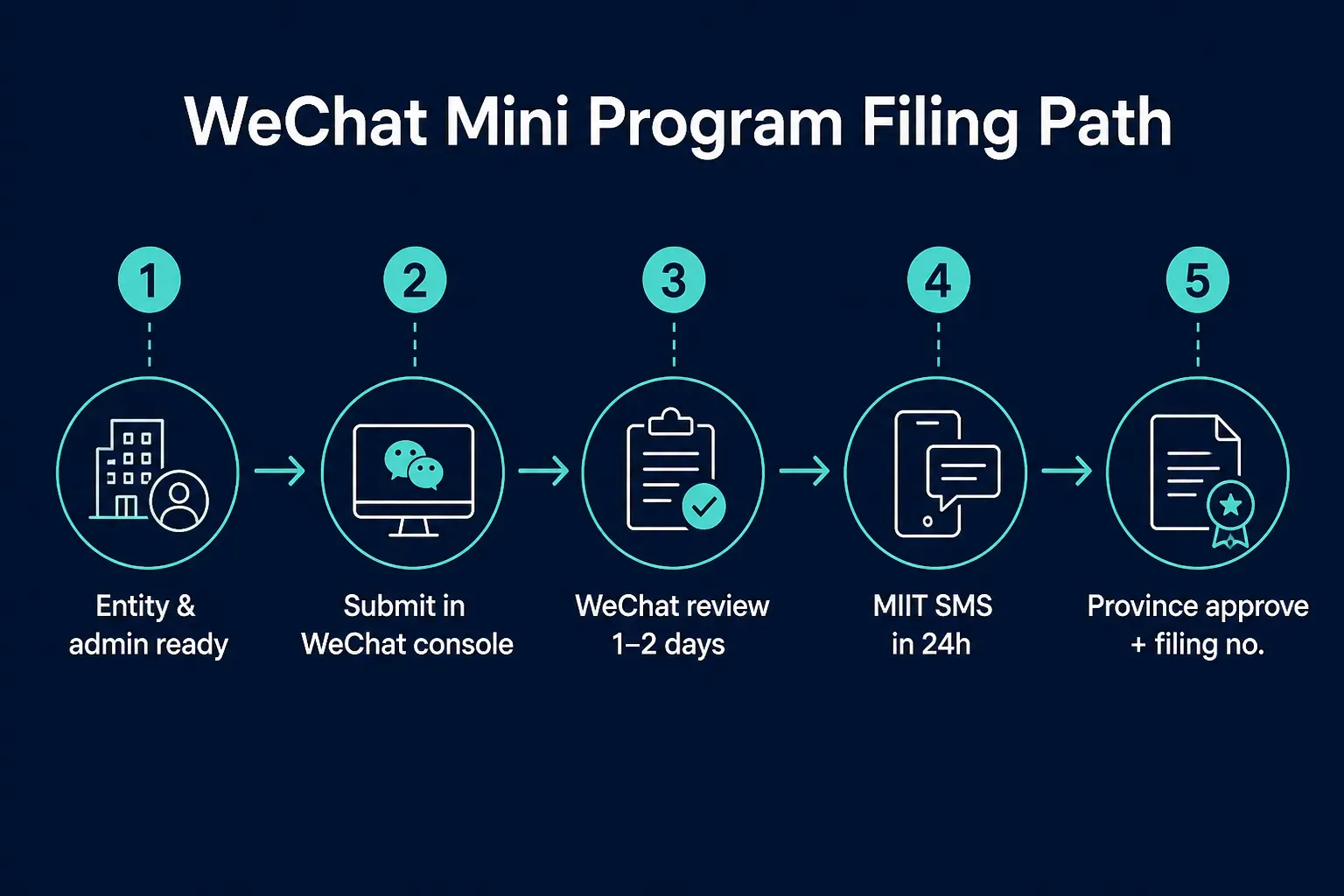
Critical path (five stages)
Treat filing as a launch gate, not a post-ship form. A typical path:
- Entity and administrator ready — Chinese business license (or accepted entity certificate), Chinese mobile numbers, and a Chinese national who can pass facial verification as Mini Program administrator.
- Submit in the WeChat console — Entity details, entity contact, Mini Program name/category/description, administrator materials, and any industry pre-approvals.
- WeChat initial review (about 1–2 business days) — Platform checks document quality, consistency, and category fit; may ask for clarifications.
- MIIT SMS verification (24-hour window) — Designated contact receives SMS (commonly from 12381), completes verification on the MIIT site within 24 hours, or the order fails and you resubmit.
- Provincial review and filing number (about 1–20 business days) — Provincial communications administration decides; approved Mini Programs receive a filing number that displays in Mini Program information.
| Stage | What “done” looks like | Typical timing |
|---|---|---|
| Prep | Entity, admin, category, and pre-approvals aligned | Days to weeks |
| WeChat review | Console status advances; no open document defects | ~1–2 business days |
| MIIT SMS | Verification completed inside 24 hours | Same day |
| Province | Filing number issued | ~1–20 business days |
Documents you should expect
Exact fields vary by entity type and category, but foreign teams usually prepare:
- Entity certification (Mainland China business license or equivalent accepted certificate)
- Entity contact identification and Chinese mobile number
- Mini Program administrator identification (Chinese national ID path for facial verification)
- Mini Program name, description, content category, and service explanation
- Pre-approval licenses for regulated categories (news, healthcare, finance, education, publishing, and similar)
- Authorization letters when the submitter is not the legal representative
- High-quality scans/photos — blurry certificates are a common hard reject
WeChat filing itself usually has no MIIT filing fee. Teams still budget for entity or partner setup, verified-account maintenance, translation, and any sector licenses. From a complete package, expect one to several weeks; category complexity, province backlog, or one missed SMS can still blow a marketing date.
China-specific failure points
These are the stalls that show up repeatedly for overseas product teams — not generic “missing paperwork” advice.
Chinese administrator is not optional in practice
Facial verification for the Mini Program administrator currently expects a Chinese national with a Chinese ID and a reachable Chinese mobile number. Putting a foreign product owner as administrator “because they own the roadmap” is a frequent false start. Resolve who can verify before you open the order.
Entity path is the real first decision
Overseas companies generally cannot complete Mini Program filing under a foreign parent alone. Practical options:
| Path | When teams use it | Trade-off |
|---|---|---|
| Chinese subsidiary | Long-term China ops planned | Full control; entity setup cost |
| Landing / publish partner | Compliant publish without a company first | Faster start; define admin phones, credentials, and exit |
| Hybrid | Brand stays global; China Mini Program is a local shell | Engineering and compliance scopes must stay identical |
Write down before kickoff: organizing entity on the forms; who holds the WeChat developer account; whose Chinese mobiles receive MIIT SMS; who can re-run facial verification in 24–48 hours; what happens to the Mini Program if the partnership ends. Unclear answers look like “MIIT is slow” but are credential gaps.
A Mini Program that “works” without filing is not the same as a Mini Program that is fully compliant. Treat discoverability in testing as a product milestone, not a compliance green light.
Category and pre-approvals block late
If the Mini Program touches regulated content or commercial patterns that need sector permits, Tencent will ask for those materials. Filing as a generic utility while the live experience is education, medical advice, news, or payments creates rejection or later enforcement. Map features to category before submission.
MIIT SMS is a hard clock
Missing the 24-hour SMS window is not a soft delay — it typically forces full resubmission. Designate a Mainland China business-hours owner for the contact phone during review weeks.
Mini Program filing ≠ backend ICP filing
Mini Program filing covers the property inside WeChat. If your Mini Program loads Mainland China–hosted APIs, webviews, or domains, those surfaces can still need Internet Content Provider (ICP) filing, and sometimes Public Security Bureau (PSB) filing after launch. Commercial models may also trigger a commercial ICP license (B25) or other Value-Added Telecommunications Services (VATS) licenses — separate from Mini Program filing.
Build a simple inventory before you file: Mini Program AppID, primary name, content category, payment features, webview domains, API hostnames, and where those hosts live (Mainland China vs offshore). Filing only the Mini Program while leaving an unfilled Mainland China API host is a classic “console green, production red” failure.
Document consistency across systems
Mismatches between business license address, filing jurisdiction, Mini Program name, and live screenshots cause WeChat or provincial bounce-backs. Keep one source of truth for legal name, domain/API scope, and category text.
Appeal loops burn calendar time
After rejection, WeChat’s appeal path usually expects you to fix every cited defect, resubmit with the original application context, and wait again for platform plus province clocks. Teams that “fix one field” while leaving low-quality scans or an unreachable contact phone often bounce twice. Budget a clean resubmission package, not a hopeful tweak.
Chinaready difference
Chinaready treats WeChat Mini Program filing as part of China readiness, not a console checklist. We start from whether your Mini Program, backend hosting, and commercial features should file on this path; then we map organizing entity, administrator verification, category risk, and any ICP/VATS follow-ons so launch dates match real review clocks. Contact Chinaready when you need that map before you open a WeChat filing order.
Frequently asked questions
Is WeChat Mini Program filing required?
Yes. Since 2023, Mini Programs operating in Mainland China generally need WeChat Mini Program filing before they can be fully compliant for publish and ongoing operation.
Can a foreign company complete Mini Program filing alone?
Usually no. Filing is completed under a Chinese legal entity with a Chinese administrator and Chinese mobile number for identity and SMS verification.
Is Mini Program filing the same as ICP filing?
No. Mini Program filing covers the Mini Program inside WeChat. ICP filing covers Mainland China–hosted websites, domains, APIs, and related internet information services. Many launches need both.
How long does WeChat Mini Program filing take?
Plan several business days to several weeks. WeChat pre-review is often 1–2 business days; MIIT SMS must be completed within 24 hours; provincial review can take about 1–20 business days.
Why was my Mini Program filing rejected?
Common causes include inconsistent documents, low-quality scans, wrong category or missing pre-approvals, unreachable Chinese contacts, failed facial verification, or missed MIIT SMS verification.