

Volcengine Cloud China — the ByteDance AI rail
Volcengine is ByteDance's AI-native China cloud — Ark and Doubao lead Mainland model-API traffic. For global teams the rail forks hard — the China site needs a Mainland entity, and BytePlus sells no Mainland regions.
Volcengine Cloud China is ByteDance’s AI-native China-site rail — not a region toggle on any global account, and not reachable through BytePlus, which sells no Mainland China regions at all. Your product team must clear the entity fork (Mainland entity for the China site, or BytePlus without Mainland regions), real-name authentication built around Mainland registration codes, a three-region Mainland map, and ICP adjacency before public workloads are real. When the thing your stack actually misses in China is the model layer — Claude-class APIs that do not answer from Mainland networks — Ark and the Doubao family are the reason this rail exists.
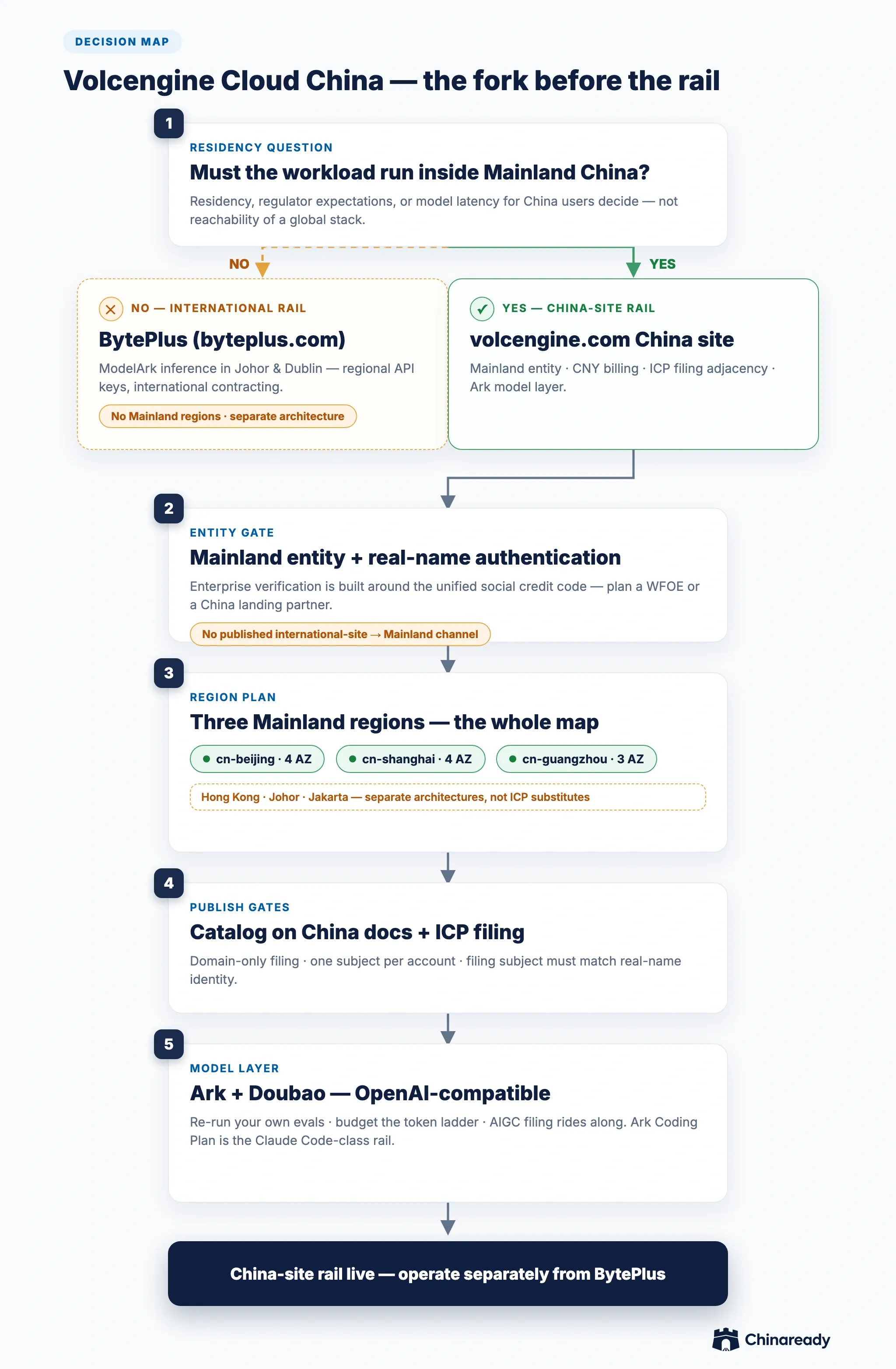
What Volcengine Cloud China is for product teams
Hard names your stack decision will use:
- ByteDance’s cloud, young and AI-first — Volcengine brands itself ByteDance’s cloud and AI service platform. The brand went live in June 2020 and the full cloud suite — 78 services across cloud base, video and content delivery, data, development, and AI — only shipped in December 2021 (volcengine.com; launch coverage by 36kr). The operating entity is Beijing Volcano Engine Technology Co., Ltd.; the international brand BytePlus is a separate Singapore company.
- A layered market story, not one number — On overall public-cloud IaaS revenue, Volcengine sits outside the top five (Alibaba, Huawei, China Telecom, China Mobile, Tencent per IDC data reported by STCN). On AI infrastructure it is third with 9% AI IaaS revenue share (Eastmoney relaying IDC). On model APIs it is the leader — 46.4% of Mainland public large-model token traffic in 2024, 49.2% in the first half of 2025 (IDC via STCN; IDC via Yicai). Which layer you are buying decides which Volcengine you meet.
- Three Mainland regions, full stop — The official regions documentation lists three commercial Mainland regions:
cn-beijing(four zones),cn-shanghai(four zones),cn-guangzhou(three zones), plus Hong Kong, Johor (ap-southeast-1), and Jakarta. That is AWS-China-thin — far behind Alibaba, Tencent, and Huawei — and it constrains in-country DR topologies. - A real migration stack, not just AI — ECS including GPU families (
ecs.gni3with 24 GB GPUs; eight-way A800 NVLink machines per the GPU product pages), TOS object storage with intelligent tiering, veDB and RDS MySQL/PostgreSQL plus Redis, VKE Kubernetes with GPU scheduling, veFaaS, EMR and Flink, CLB/ALB, and CDN (service catalog). ByteDance externalizes Douyin-proven video-on-demand (VOD — “aligned with Douyin” per the product page) and the recommendation platform behind Toutiao (Volcengine recommendation). - Ark — the model layer other China clouds buy from — Ark is the one-stop model platform carrying the Doubao family. The data-plane API is
https://ark.cn-beijing.volces.com/api/v3, OpenAI-SDK compatible, with endpoint IDs likeep-…and API keys per the Ark base URL and authentication doc and quick start. Volcengine opened 2024’s model price war at 0.8 CNY per million input tokens (Wallstreetcn); flagship Doubao tiers now list around 6 CNY input / 30 CNY output per million tokens, with mid tiers near 1.2 CNY in (Doubao product page; STCN). - Ark Coding Plan — the Claude Code-class rail — For coding agents specifically, Volcengine sells an Ark Coding Plan subscription in the Claude Code mold, with a new-user free quota and a reported 28% trial-to-paid conversion (Volcengine article; free inference quota doc). If your China blocker is “Claude does not answer from Shanghai,” this product family is the intended on-ramp.
- The entity fork is binary — China-site enterprise real-name authentication offers legal-representative face scan (Mainland-registered companies with Mainland-ID legal reps), bank-account verification, or certificate verification that submits enterprise documents, the unified social credit code, and a Mainland registration address (real-name method chooser; certificate authentication). There is no published “international site buys Mainland regions” channel comparable to Aliyun or Tencent.
- BytePlus is a different door, to different rooms — BytePlus Pte Ltd (byteplus.com) sells ModelArk, GPU compute, CDN, and the Seed video/image generation models internationally — but its ModelArk regions are Johor and Dublin only (ModelArk endpoints doc), with regional API keys that do not interoperate with the Beijing Ark endpoint. Buying BytePlus does not buy Mainland residency.
- Partition peers, familiar shape — Same decision class as AWS China, Azure China, Alibaba Cloud China, Tencent Cloud China, and Huawei Cloud China — a Mainland-operable stack with filing adjacency, plus one variable no peer has: the model layer is the vendor’s flagship product.
Vocabulary first. Next: what must be true before China-site console work is useful.
What must be true before Volcengine console work
Missing any of these stops your product team before a stable China reference architecture — often before a usable China-site payer account.
| Precondition | Why your process stalls |
|---|---|
| Fork verdict: China site vs BytePlus | BytePlus sells no Mainland regions; Mainland residency requires the volcengine.com China site — the two do not merge |
| Mainland entity path for the China site | Enterprise real-name is built around Mainland registration and the unified social credit code; teams without a PRC entity need a WFOE or China landing partner |
| Real-name authentication finished | Purchase and use sit behind identity verification; later ICP filing needs the filing subject to match the verified account |
| Three-region plan, honestly stress-tested | cn-beijing / cn-shanghai / cn-guangzhou is the whole Mainland map — DR and residency layouts must fit it; Hong Kong is not a filing substitute |
| Service bill of materials checked on China-site docs | Docs are Chinese-first; English coverage exists (?lang=en) but is uneven by product — International feature pages are not sign-off |
| ICP / public-publish plan for customer-facing domains | Volcengine filing is domain-only, one subject per account; unfiled public resolve on Mainland hosting is not publish clearance |
| Model-layer migration named as its own workstream | OpenAI-compatible plumbing is not model parity — evals, prompts, guardrails, and generative-AI filing obligations need owners |
Chinese-language consoles, CNY settlement patterns, and filing rails are part of this floor. Product teams usually cannot finish Volcengine onboarding from an overseas laptop alone.
From global ByteDance assumption to China-ready rail
| Stage | Decision / outcome |
|---|---|
| 1. Residency verdict | Confirm the workload must run inside Mainland China (residency, regulator, model latency for China users) — not “reach China users” from outside |
| 2. Fork decision | Mainland required → volcengine.com China site; Mainland not required → evaluate BytePlus (ModelArk Johor/Dublin, no Mainland regions, international contracting) |
| 3. Entity + real-name | Clear a Mainland entity path (own WFOE or landing partner) and finish China-site identity verification before SKU shopping |
| 4. Region plan | Fit DR and residency into the three Mainland regions; treat Hong Kong / Johor / Jakarta as separate architectures |
| 5. Catalog trim | Diff required services against China-site docs; replace global-console assumptions early — Terraform sits in the community tier with two parallel providers, so IaC plans need that tolerance |
| 6. Model-layer migration | If AI is the workload: stand up Ark endpoints, re-run evals against Doubao tiers, budget the token ladder, and schedule generative-AI filing |
| 7. Filing adjacency | Align domain, DNS, and public publish with ICP / PSB on the Volcengine filing rail — domain-only, one subject per account |
| 8. Operate | Keep BytePlus and China-site stacks explicitly separate; support, billing, and SDK trust follow the China site |
Provider-neutral hosting context: Host in Mainland China.
Why the fork, entity, ICP, and model assumptions cascade
BytePlus treated as the international door to Mainland regions → no such door. The two brands are separate companies, consoles, and accounts, and BytePlus’s own docs list ModelArk regions as Johor and Dublin. Architecture reviews that assume “start on BytePlus, add Mainland later” discover there is no later — Mainland means the China site, with its entity and real-name gates.
A Claude-shaped stack assumed portable → the model layer is the actual blocker. Our China reachability benchmark keeps measuring frontier-model API hosts as unreachable from Mainland probe nodes, and which parts of your stack break first puts the model layer high on that list. Ark’s OpenAI-compatible surface rescues your plumbing, not your evals — plan a real migration, and note that generative-AI features bring AIGC filing obligations of their own.
China site without a Mainland entity → purchase never opens. Real-name paths are documented around Mainland registration codes. Teams outside Mainland operating norms stall at authentication unless a WFOE or landing partner supplies the rail.
“Cloud-scale” region assumptions → three-region reality. Multi-AZ is fine inside Beijing or Shanghai; multi-region DR inside Mainland has exactly three building blocks, fewer than every domestic peer. Data-residency programs that assume province-level region choice need redesign.
Cloud before ICP → blocked publish. Volcengine’s filing center processes domain filings only, one subject per account, with the filing subject matching account real-name identity. Buying ECS does not authorize public DNS cutover — deepen with ICP filing and domain/DNS.
Global IaC pointed at Volcengine → community-tier friction. Official Terraform providers exist (volcengine/volcengine, plus the newer volcengine/volcenginecc), but Registry tiers them as community, two providers run in parallel, and downloads need mirroring from inside China. Budget for that in the platform plan.
Control plane — volcengine.com vs BytePlus
| Dimension | volcengine.com (China site) | BytePlus (international) |
|---|---|---|
| Operating entity | Beijing Volcano Engine Technology Co., Ltd. | BytePlus Pte Ltd, Singapore |
| Audience | China market and Chinese companies going global | Buyers outside China |
| Mainland China regions | cn-beijing, cn-shanghai, cn-guangzhou | None |
| Model platform | Ark — ark.cn-beijing.volces.com/api/v3, Doubao family | ModelArk — Johor and Dublin endpoints, regional keys |
| Account interop | Separate console, CNY billing | Separate console; endpoints and keys do not interoperate with Ark Beijing |
| Real-name gate | Enterprise paths built around Mainland registration and unified social credit code | International contracting |
| Public websites in China | ICP filing center — domain-only, one subject per account | Not a Mainland hosting rail |
Migration means a China-site account and ops model, redeployed stacks, and a deliberate model-layer plan — not adding ByteDance gravity to a global Org.
The model layer: Ark as the domestic answer to “Claude does not answer”
This is the blank Volcengine fills that no peer in this series fills the same way. When a global team’s China post-mortem reads “our coding agents, our copilots, our RAG stack all call US model APIs that Mainland networks do not reach,” the question stops being IaaS and becomes: whose model rail do we run on inside China?
Volcengine’s answer is the strongest single claim in this space:
- Scale: roughly half of Mainland public model-API token traffic runs on Ark (IDC data reported by STCN and Yicai) — the demand-side signal that the rail is production-grade for Chinese workloads.
- Cost: Volcengine started the 2024 price war at 0.8 CNY per million input tokens (Wallstreetcn) and today’s ladder runs from ~1.2 CNY mid tiers to 6 CNY in / 30 CNY out flagship tiers per the Doubao product page — an order of magnitude below pre-war frontier pricing, with reserved “model unit” capacity for committed inference.
- Plumbing: OpenAI-compatible API surface and per-endpoint keys per the authentication doc — clients built for OpenAI-shaped APIs usually reconnect without protocol work.
- Agents: the Ark Coding Plan is the Claude Code-class subscription for coding agents (Volcengine article), with new-user inference quotas (quota doc).
- A non-China pressure valve: ModelArk on BytePlus runs the same model family from Johor and Dublin for the parts of your system that stay outside China (ModelArk docs) — one model family, two operating jurisdictions, no endpoint interop.
Honesty section: token-share leadership is a MaaS metric, not an IaaS-revenue ranking — the two get conflated in vendor marketing. Model quality against your evals is yours to measure before commit. And generative-AI features served to China users ride AIGC filing and cross-border data obligations that the model API does not absorb for you.
What blocks product teams on Volcengine
- Treating BytePlus as a Mainland on-ramp — no Mainland regions, no endpoint interop, separate accounts.
- No Mainland entity / real-name rail — China-site purchase and later ICP name-match stall without it.
- Assuming the model layer ports itself — OpenAI-compatible wire format is not model parity; evals and guardrails need re-running.
- Region-count optimism — three Mainland regions is the whole map; DR plans must fit.
- Buying cloud before ICP — domain-only filing, one subject per account; public DNS cutover waits.
- Catalog sign-off from translated assumptions — docs are Chinese-first; verify each required service on China-site docs.
- IaC maturity assumptions — community-tier Terraform with two parallel providers; mirror downloads from inside China.
- Confusing ByteDance name recognition with enterprise depth — the stack is young (full suite December 2021) and thin in regulated industries versus the domestic big three.
When Volcengine Cloud China fits
Choose Volcengine when the China workload is AI-shaped — model inference for China users, coding agents, content and recommendation stacks that benefit from Douyin-proven VOD/CDN tech — and you can sustain a China-site operating model: Mainland entity, real-name authentication, a three-region plan, filing adjacency, and a deliberate model-layer migration.
It is usually the wrong first answer when you need the widest IaaS map (regions, managed databases, enterprise channels — Alibaba, Tencent, or Huawei fit better), when your workload has no AI core, or when the problem is only reachability of a global footprint rather than residency inside China. For peer partition reads, see Alibaba Cloud China, Tencent Cloud China, Huawei Cloud China, AWS China, and Azure China. For provider-neutral route selection, see How we choose providers without selling them or start a China Readiness Assessment.
Minimum diligence before sign-off: name the fork (Mainland residency or not); verify the entity and real-name path; fit DR into three regions; scope the model migration with your own evals; align ICP before public DNS cutover.
When you need a China landing partner for Volcengine
Most product teams exploring Mainland China entry need a China landing partner to open or operate the China-site account rail, finish real-name and entity paths, trim architecture to China-site reality, run the Ark eval-and-migrate loop, and align ICP / hosting. Your team still owns product and architecture decisions; the partner path makes the entity, filing, and model-layer rails executable when they are not already in-house.
What we can offer?
Volcengine Cloud China is a China-site rail with an unusual payload — account isolation, real-name and entity paths, three Mainland regions, ICP adjacency, and a model layer that leads domestic demand. Chinaready helps your product team decide whether that rail fits and what must be true before public go-live:
- China Readiness Assessment — Map whether residency forces a China-site stack, whether your AI workload makes Volcengine the right rail, and which entity path you can actually execute.
- China Access Acceleration — Keep admin paths, dependencies, and hybrid links workable while global and China-site stacks stay separate.
- China Product Hosting — Place China-critical workloads on a Mainland-operable stack where ICP and China-site endpoints describe one coherent publish path.
- Mobile App Distribution — Ship channel launches on their own gates while backend residency and model-rail choices stay consistent with the live product boundary.
Contact us when you need a Volcengine vs BytePlus vs peer-cloud decision — fork, entity, filing adjacency, and the model-layer migration — without treating China as a region checkbox.
References
- Volcengine — regions documentation — commercial regions and zones, Mainland and international
- Volcengine — Ark base URL and authentication — OpenAI-compatible Ark API endpoint and API-key model
- Volcengine — Doubao model family and pricing — model tiers and token pricing
- Volcengine — enterprise real-name authentication methods — Mainland-entity-centered verification paths
- Volcengine — ICP filing limitations — domain-only filing, one subject per account
- BytePlus — ModelArk endpoints — Johor and Dublin regions, regional API keys
- Volcengine — Ark Coding Plan — Claude Code-class subscription, trial-to-paid conversion
- Wallstreetcn — Doubao price war — 0.8 CNY per million tokens launch pricing
- STCN — IDC China public cloud tracking — IaaS top five and 46.4% MaaS token share
- Yicai — IDC 2025H1 MaaS data — 49.2% token share
- Terraform Registry — volcengine/volcengine — community-tier provider
- AWS China — partition decision map — Chinaready guide
- Azure China — partition decision map — Chinaready guide
- Alibaba Cloud China — Chinaready guide
- Tencent Cloud China — Chinaready guide
- Huawei Cloud China — Chinaready guide
- ICP and PSB filing for foreign companies — Chinaready guide
Frequently asked questions
Is Volcengine the same cloud as BytePlus?
No. They are separate brands, companies, consoles, and accounts. Volcengine (volcengine.com, Beijing Volcano Engine Technology) serves China and Chinese companies going global; BytePlus (byteplus.com, BytePlus Pte Ltd in Singapore) serves buyers outside China. The split is load-bearing for architecture — BytePlus sells no Mainland China regions, and the Ark model endpoint in Beijing and the ModelArk endpoints in Johor and Dublin do not interoperate, with API keys issued per region.
Can we buy Volcengine Mainland regions from outside China the way Aliyun and Tencent international sites sell Mainland regions?
Volcengine publishes no equivalent public channel. China-site enterprise real-name authentication is built around Mainland entities — the certificate path asks for enterprise documents, a unified social credit code, and a Mainland registration address. The realistic paths for a foreign team are a Mainland China entity such as a WFOE on the China site, or an in-country operating partner; if Mainland residency is not actually required, BytePlus is the international rail.
We ship Claude and OpenAI-shaped stacks. Can Ark replace that model layer in China?
Partly, and only as a deliberate migration. Anthropic and OpenAI API hosts are among the endpoints our China reachability benchmark measures as unreachable from Mainland probe nodes. Ark exposes an OpenAI-compatible API surface, so client plumbing often survives — but model behavior, evals, prompts, and guardrails need re-running against the Doubao family, and generative-AI services in China carry their own filing obligations. Treat the model layer as a migration project, not a base-URL swap.
Which Mainland regions does Volcengine actually offer?
Three commercial Mainland regions — cn-beijing (four zones), cn-shanghai (four zones), and cn-guangzhou (three zones) per the official region documentation. That is far fewer than Alibaba Cloud, Tencent Cloud, or Huawei Cloud, and it constrains multi-region DR and data-residency layouts inside China. Hong Kong, Johor, and Jakarta regions exist but are separate architectures — Hong Kong is not Mainland termination for ICP purposes.
Does buying Volcengine finish public website go-live in China?
No. Volcengine runs an ICP filing center, and public websites on Mainland hosting need ICP filing before honest public publish. Volcengine's documented limits are strict — domain-based filing only (no bare-IP filing), one filing subject per account, and the filing subject must match the account's real-name identity. Multi-brand portfolios need multiple accounts or a different hosting topology.
Is Volcengine a general-purpose replacement for the bigger China clouds?
Layered answer. Overall public-cloud IaaS revenue share sits outside the top five, the full cloud suite only shipped in December 2021, and enterprise or government depth trails Alibaba Cloud, Tencent Cloud, and Huawei Cloud. But AI is the counterweight — third-place AI IaaS revenue share, and the largest share of Mainland public model-API token traffic on IDC data reported by Chinese financial media. Volcengine is the strongest fit when the China workload is AI-shaped, not when you need the widest IaaS map.
Insights
Other similar insights
Part of the China cloud cluster — every guide in the cluster, one page.