

PIPIA — when Important Data assessment is the gate
PIPIA is the processor impact assessment for high-risk personal information, not a CAC license. Important Data China is a DSL class that usually forces CAC security assessment, not SCC. SPI is not Important Data.
PIPIA is the Personal Information Protection Impact Assessment — an internal processor assessment before specified high-risk processing, not a CAC PIPIA license. If the dataset is Important Data China, outbound usually means a CAC security assessment or keep-in-country processing; the standard contract is a personal-information path, not a substitute. Sensitive personal information China often triggers PIPIA. It is not Important Data. A GDPR DPIA clears neither gate.
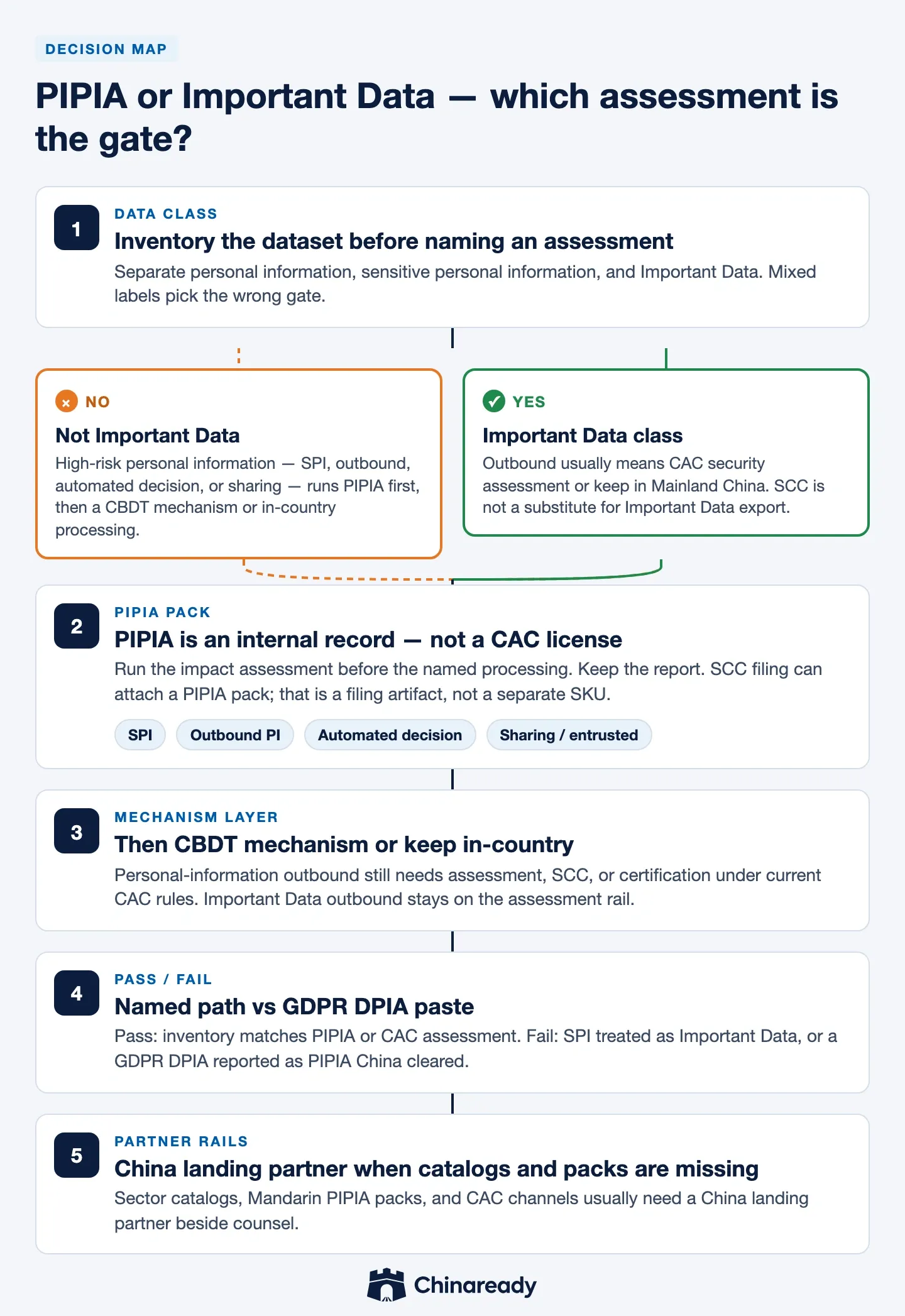
What PIPIA and Important Data actually are
Hard names this Decision Map uses — sibling to PIPL product gates and cross-border data transfer:
- PIPIA — Personal Information Protection Impact Assessment. PIPL requires an assessment before specified high-risk processing (SPI; automated decision-making; providing personal information to others or abroad; other high-impact cases) and records kept (CAC PIPL text).
- PIPIA China is that internal pack, not a CAC license. An SCC filing can attach it — a filing artifact, not a SKU (SCC measures).
- Important Data China is a Data Security Law catalog class — not a synonym for SPI (CAC DSL; English). Statute map: CSL / DSL product gates.
- Sensitive personal information China — PIPL category (biometrics, medical, financial accounts, location traces, minors). Separate consent + often PIPIA. Not Important Data.
- Fork — Important Data outbound usually means CAC security assessment or keep in Mainland China (outbound assessment measures). Personal information (including SPI) going abroad under thresholds needs PIPIA + SCC or assessment or certification.
- Common myth — “We ran a GDPR DPIA, so PIPIA and Important Data are cleared.” DPIA ≠ PIPIA; SPI ≠ Important Data.
Vocabulary first. Next: what must exist before an assessment sprint is real work.
What must exist before an assessment sprint is real
Missing any of these stops your product team before a PIPIA pack or Important Data call is executable — not after legal pastes a European DPIA into a China folder.
| Precondition | Why your process stalls |
|---|---|
| Named datasets — fields, systems, regions, and whether the job is personal information, SPI, Important Data, or mixed | Teams argue “privacy review done” while catalogs and PIPIA templates still have no object |
| Inventory frozen with PIPL product gates | Purpose, consent, and processor lists contradict the assessment later |
| Keep-vs-export decision locked | Half the stack “temporary overseas” forever; PIPIA and CBDT never own a calendar |
| Catalog / notice check for Important Data — not a product nickname | Self-labeling everything as Important Data, or nothing as Important Data, both fail CAC questionnaires (2024 cross-border provisions) |
| Owner for the PIPIA report and a retention path | SCC filing and diligence ask for the report, not a slide titled “impact assessed” |
| Mainland China entity or landing-partner path | Mandarin packs, provincial CAC, and sector catalogs are not an English questionnaire finished from HQ |
Product teams without those rails usually cannot treat “run PIPIA this sprint” as a console task.
From inventory to PIPIA or Important Data fork
Use this as an assessment-class map. Stages are decisions, not a form click-path. Mechanism selection stays on cross-border data transfer.
| Stage | Decision / outcome |
|---|---|
| 1. Freeze the inventory | Every China-facing field, SDK, log sink, and HQ sync named; class as personal information, SPI, Important Data, or mixed |
| 2. Hard fork | Important Data? → CAC security assessment or keep in Mainland China. High-risk personal information? → PIPIA first |
| 3. Run PIPIA when PIPL says so | Before SPI, automated decision-making, sharing / entrusted processing, or outbound personal information; keep the report |
| 4. Pick the outbound rail only after the class is honest | PI under thresholds → PIPIA + SCC, certification, or assessment. Important Data outbound → assessment, not SCC as a workaround |
| 5. Gate go-live | Do not ship export-dependent features on an unnamed assessment |
| 6. Re-open on change | Purpose, volume, recipient, or architecture change restarts PIPIA and, where required, the CBDT mechanism |
CAC is the regulator umbrella for personal-information and outbound-data tracks. Hosting locality belongs beside this map: China Product Hosting.
Why SPI is not Important Data
Mixing these three labels is how teams file SCC for Important Data, or skip PIPIA because they “already classified.”
| Class | Regime | What it is | Typical next gate |
|---|---|---|---|
| PIPIA | PIPL | Internal processor impact assessment + records | Required before named high-risk PI processing; SCC filing may attach the report |
| Sensitive personal information | PIPL | Biometrics, medical, financial accounts, location traces, minors’ PI, and similar | Stricter basis / separate consent and often PIPIA — still personal information |
| Important Data | DSL | Catalog / notice class tied to national security, economy, or public interest | Outbound usually CAC security assessment or keep in-country — not SCC as a substitute |
SPI treated as Important Data → wrong rail. You may still need PIPIA and a PI outbound mechanism. You have not proved a DSL catalog listing.
Important Data treated as SPI → SCC used as a workaround. The personal-information standard contract does not replace Important Data export assessment.
No inventory → both assessments lie. A PIPIA report and a CAC pack cannot describe a product the team has not mapped — the same failure PIPL product gates names when consent copy has no object.
GDPR DPIA pasted as PIPIA China → filing reject. China PIPIA asks whether this processing is lawful, necessary, and matched to risk under PIPL — not whether an EU DPIA exists.
PIPIA treated as the outbound license → launch contradiction. PIPIA is the processor’s assessment. Providing personal information abroad still needs a CBDT mechanism when export is required. Providing Important Data abroad is a different assessment.
Where assessment work stalls
- Calling every China dataset Important Data — Catalogs and notices identify the class. A product nickname is not a listing.
- Calling nothing Important Data because “we only have users” — Sector data (industrial, telecom, health, transport, and similar catalogs) can sit beside consumer PI. Check; do not guess.
- Waiting for SCC to invent PIPIA — PIPIA is due before the high-risk processing, including many in-country SPI and automated-decision jobs. Outbound filing is one attachment, not the first time the assessment exists.
- HQ analytics non-negotiable without a class decision — Global tools can force outbound PI (PIPIA + CBDT) or reopen Important Data questions. Pick the fork before the tool.
- Store / ICP success reported as “China assessed” — Channel and hosting gates do not clear PIPIA or Important Data export.
- No China landing partner when catalogs and Mandarin packs are missing — Overseas-only teams stall at provincial CAC and sector lists.
When a China landing partner runs the assessment pack
Most product teams exploring Mainland China entry need a China landing partner (beside counsel) once inventory shows high-risk personal information or a possible Important Data class — Mandarin PIPIA reports, sector catalog checks, SCC filing packs, and CAC assessment channels are not an English questionnaire finished from HQ. Your team still owns product purpose, architecture, and the keep-vs-export decision; the partner path makes the named assessment executable. The partner does not turn a GDPR DPIA into PIPIA, and does not turn SCC into Important Data export.
What we can offer?
PIPIA versus Important Data is a class-and-assessment fork before any CAC form. Chinaready helps your product team see which assessment blocks the Mainland China launch and which pack is actually due:
- China Readiness Assessment — Map which China features force PIPIA, Important Data questions, or both, and which go-live date is fake until the fork is locked.
- China Access Acceleration — Keep China-facing admin and critical deps reachable while PIPIA evidence and residency answers are built — without silently reopening outbound personal-information pipes.
- China Product Hosting — Place China-critical workloads so “keep in Mainland China” is an architecture fact when that is the honest alternative to CAC assessment.
- Mobile App Distribution — Ship store launches on their own gates while privacy questionnaires and outbound-transfer stories match the same PIPIA / Important Data diagram.
Contact us when your China launch depends on SPI, HQ sync, or a possible Important Data class — and you need the assessment fork decided before marketing owns the date.
Frequently asked questions
What is PIPIA, and is PIPIA China a CAC license?
PIPIA is the Personal Information Protection Impact Assessment. PIPL requires the processor to run it before specified high-risk processing — including sensitive personal information, automated decision-making used to make significant decisions, providing personal information to others, and providing personal information abroad — and to keep records. PIPIA China is that internal assessment pack, not a CAC “PIPIA license.” An SCC filing can attach a PIPIA report; that is a filing artifact, not a separate SKU.
What is Important Data China, and how is it different from PIPIA?
Important Data China is a Data Security Law class — data that, if altered, destroyed, leaked, or illegally used, could harm national security, the economy, or the public interest — identified through national and sector catalogs, not a product-team nickname. PIPIA does not classify Important Data. Outbound Important Data usually means a CAC security assessment or keep-in-country processing; the personal-information standard contract is not a substitute.
Is sensitive personal information China the same as Important Data?
No. Sensitive personal information China is a PIPL category (biometrics, medical, financial accounts, location traces in many product reads, and personal information of minors under fourteen). It needs a stricter legal basis, usually separate consent, and often PIPIA. Important Data is a DSL class. Mixing the two labels picks the wrong assessment.
Does a GDPR DPIA clear PIPIA and Important Data China?
No. A GDPR DPIA is a different regime. It does not become PIPIA, and it does not identify Important Data China. Reusing a European impact assessment as the China pack is how SCC filings and CAC questionnaires fail.
When does PIPIA still apply if personal information stays in Mainland China?
PIPIA is not only an export form. High-risk in-country processing — sensitive personal information, automated decision-making, entrusted processing, or sharing with another processor — still needs the assessment before that processing starts. Outbound personal information adds a CBDT mechanism on top; see the Cross-border data transfer Guide.
Can product teams finish PIPIA China without Mainland China ops?
Usually no. Sector catalogs for Important Data, Mandarin PIPIA reports, SCC filing packs, and CAC channels sit on rails most global teams lack. That is when a China landing partner, beside counsel, becomes the realistic path.
Insights
Other similar insights
Part of the Website & SaaS readiness cluster — every guide in the cluster, one page.