

SiteGround in China — when shared hosting stalls
SiteGround in China is usually the wrong primary origin for ordinary Mainland China users. Shared hosting China stalls on latency, deps, and missing in-country termination — remap to a China-reachable origin, not a CDN checkbox.
SiteGround in China is usually the wrong primary origin for ordinary Mainland China users. SiteGround hosting China sits in one overseas shared hosting China class (US/EU/SG PoPs). HTML can return 200 from HQ while Mainland China journeys stall on latency, deps, and missing in-country termination. Remap to a China-reachable origin — and ICP if you terminate in Mainland China — not a CDN checkbox. Keep SiteGround only for residual HQ / Hong Kong / Taiwan / export sites.
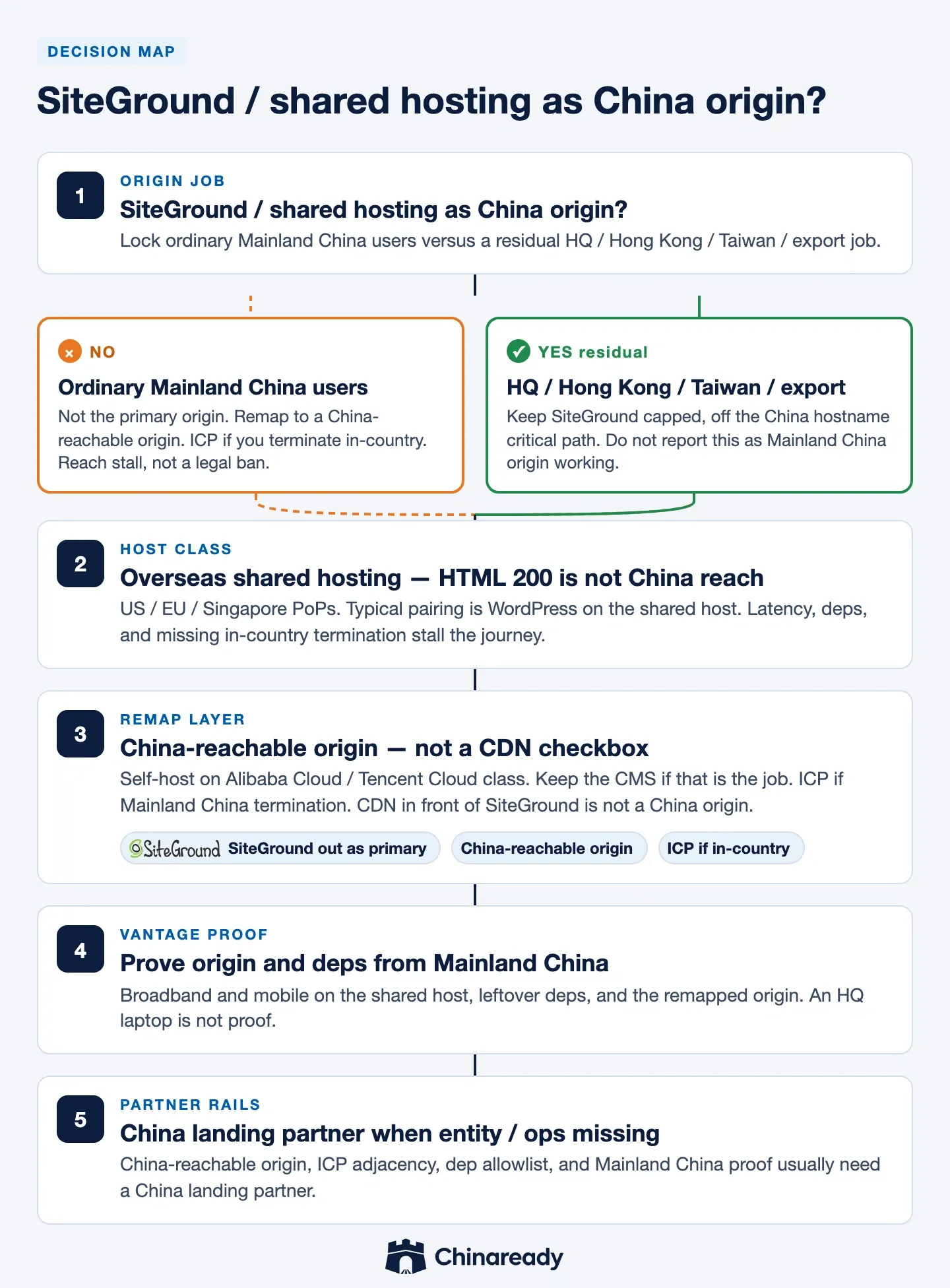
What SiteGround China means as an origin class
Hard names your host decision will use:
- SiteGround — Overseas managed / shared hosting, including typical WordPress hosting. Origin: SiteGround. Published datacenters are Council Bluffs (Iowa), London, Frankfurt, and Singapore — not Mainland China termination.
- Shared hosting China — One overseas shared-host class (managed / shared WordPress hosts with US/EU/SG PoPs). SiteGround is the named stem for the class, not a brand-by-brand catalog.
- WordPress hosting China — Typical CMS pairing on this class. Keep WordPress when that is the job; change the origin. CMS, plugin CDNs, and replace-CMS forks live on WordPress in China. Landscape labels WordPress Limited for the usual WordPress.com / overseas plugin-CDN setup — that is the CMS SKU, not this host class.
- HTML 200 ≠ China reach — The HTML host can return 200 from HQ while Mainland China users stall on latency, fonts, plugin CDNs, or forms. Same class as website accessible in China.
- Failure class is reach, not a ban — SiteGround China failure for ordinary Mainland China users is latency, PoP, and deps. It is not a claim that SiteGround is legally prohibited. Overseas-only SiteGround does not automatically create an ICP duty — and does not become a China launch.
- ICP filing is a stall on in-country termination — Filing applies when you choose Mainland China termination, not because you “cannot use SiteGround overseas.” Depth: host in Mainland China and ICP filing — domain DNS. Hong Kong ≠ Mainland China — see the host Guide.
- CDN in front of SiteGround is not a China origin — SiteGround’s own CDN is documented on Google Cloud edges (Tokyo, Singapore, Sydney, US, EU, and peers — not Mainland China termination). A China CDN / edge in front of an overseas shared host is a different architecture with known limits. Dynamic HTML and origin fetch still pay the border.
- Usual remap — China-reachable self-host (Alibaba Cloud / Tencent Cloud class, as already mapped on the WordPress Guide). Then ICP if Mainland China termination. Keep SiteGround residual for HQ / Hong Kong / Taiwan / export, off the China hostname critical path. Replace WordPress only when the job is not keep WordPress — that fork stays on the WordPress Guide.
Vocabulary first. Next: what must be true before SiteGround stays in scope at all.
What must be true before SiteGround stays in scope
Missing a clear origin job stops your product team before a “keep SiteGround, add China” sprint is real work.
| Precondition | Why your process stalls |
|---|---|
| Origin job locked — ordinary Mainland China users vs HQ / Hong Kong / Taiwan / export residual | Wrong job keeps SiteGround as Plan A while the China-reachable origin never starts |
| Host class named — overseas shared hosting China (SiteGround stem), not a geo setting on the existing plan | A “SiteGround China” SKU is staffed as if PoPs had moved |
| Honest PoP assumption — do not assume Iowa / London / Frankfurt / Singapore behaves like other markets for Mainland China users on local networks | Plans built on everyday shared-host usage invent a journey that is not there |
| CMS vs origin named — WordPress hosting China on SiteGround is the pairing; this Guide decides the host | Plugin/CDN cleanup is skipped, or CMS work is confused with the host decision |
| ICP scoped only when you terminate in Mainland China — not claimed as a SiteGround overseas ban | Filing starts too late on a real in-country origin, or is demanded on an overseas-only architecture |
| Mainland China vantage proof on origin and dep hosts — broadband + mobile; HQ laptop is not proof | Overseas QA “passes” while China users wait on the shared host — same class as website not working in China |
| Supplementary budget / scope cap if SiteGround stays for residual jobs | Unlimited “SiteGround hosting China” on the existing plan crowds out origin, deps, and ICP work |
Product teams usually cannot treat “ship the same SiteGround site globally” as the Mainland China plan. Job clarity and remapping are the floor. CMS SKU orientation lives on WordPress alternatives.
SiteGround hosting China — remap origin or residual
| Stage | Decision / outcome |
|---|---|
| 1. Name the origin job | Ordinary Mainland China users at scale, or a residual HQ / Hong Kong / Taiwan / export audience? |
| 2. If Mainland China ordinary reach | Rule SiteGround / shared hosting out as primary; open the China-reachable origin path |
| 3. Pick the China-reachable origin | Self-host on Alibaba Cloud / Tencent Cloud class (as mapped on WordPress in China). Keep the CMS if that is the job. Then ICP if you terminate in Mainland China |
| 4. If a residual SiteGround job remains | Keep SiteGround as a capped supplementary line — HQ / Hong Kong / Taiwan / export only — off the China hostname critical path |
| 5. Prove hosts from Mainland China | DNS / TLS / waterfall (or China Network Diagnostics) on the shared-host origin, leftover deps, and on the chosen China-reachable origin — not only HQ HTML 200 |
| 6. Cut over the China journey, then re-test | China-reachable origin on the Mainland China path; do not leave SiteGround on the critical path. A later plugin, CDN toggle, or “global site component” can restore the stall |
Hard gate — primary vs residual
Necessity: confusing these two jobs wastes the quarter — either you underfund a China-reachable origin, or you keep optimizing SiteGround hosting China that never becomes a Mainland China user journey.
| Job | SiteGround role | What must already be true |
|---|---|---|
| Ordinary Mainland China origin (HTML, APIs, WordPress on the China hostname) | Not primary — remap | China-reachable origin named; ICP in motion if you terminate in Mainland China |
| HQ / Hong Kong / Taiwan / export residual | May remain supplementary | Geo and measurement match that residual audience; Mainland China Plan A is still a China-reachable origin |
| “SiteGround in China” via CDN checkbox, geo, or ICP on the overseas shared host only | Myth as Mainland China plan | Host reachability from the user network — not a SiteGround setting |
Hard gate — host class, not a CDN hope
SiteGround hosting China / shared hosting China is overseas shared-host origin versus a China-reachable origin. A China CDN in front of SiteGround is not in-country termination. Host in Mainland China covers when ICP forces in-country termination. WordPress hosting China on this class still follows the WordPress in China keep-CMS fork for plugins and CDNs — this Guide does not reprint that CMS map.
Why a 200 shared host still stalls Mainland China journeys
Engineering and ops constraints you must design around:
| Constraint | What breaks | What to do |
|---|---|---|
| Overseas shared-host origin | SiteGround (and the shared hosting China class) serves from US/EU/SG PoPs. HQ HTML can return 200 while Mainland China users wait on latency. | Prove the host from Mainland China vantage, then remap. Do not treat “try SiteGround, then a China host on timeout” as Plan A. |
| Managed WordPress deps | WordPress hosting China on SiteGround still loads fonts, plugin CDNs, Gravatar, Jetpack, tags, and captcha from overseas hosts. | Inventory hosts. Keep the CMS on a China-reachable origin and clean deps — WordPress in China; website accessible in China. |
| SiteGround / Google Cloud CDN | Edge cache on Tokyo, Singapore, US, or EU does not become Mainland China termination. Dynamic HTML still fetches the overseas origin. | Treat CDN-in-front as a different architecture with known limits — China CDN / edge. Not a China origin. |
| ICP on overseas shared host | Filing does not move Iowa / London / Frankfurt / Singapore into Mainland China. | Treat ICP as a stall only on a remapped China-terminated origin — host + ICP. |
| Access acceleration without origin rewrite | Faster HTML delivery does not resurrect shared-host PoPs or leftover overseas deps. | Change the origin class, then tune delivery. Do not pitch a China copy of the SiteGround site as the product. |
Stalled shared host ≠ legal ban. SiteGround China failure for ordinary Mainland China users is reach, latency, PoP, and deps — not a claim that SiteGround is prohibited.
HQ admin OK → false confidence. A laptop outside Mainland China can still open SiteGround while Mainland China users never complete the journey. Users describe “site broken”; engineering sees 200s on the HTML host.
Reporting residual SiteGround traffic as China origin working → wrong stack. Hong Kong / Taiwan or VPN-using testers are not ordinary Mainland China users at scale.
WordPress assumed to make SiteGround China-reachable → wrong rebuild. If you need a China site, change the origin. Keep-CMS work is the sibling decision: WordPress in China.
What stalls teams that keep SiteGround as Plan A
- Geo-toggle thinking — Product treats “China” as a SiteGround datacenter or CDN expand before a China-reachable origin exists.
- Shared-host class ignored — Teams shop SKUs instead of naming the overseas shared hosting China class.
- WordPress hosting China treated as a loophole — “We already run WordPress on SiteGround” is reported as the keep-CMS path without moving origin.
- HQ laptop QA — Testers outside Mainland China never see the stall, so the ticket never opens.
- Hong Kong / Taiwan conflated with Mainland China — Outside-Mainland China performance is reported as “SiteGround in China working.”
- Plugins that re-inject overseas hosts — Fonts, captcha, analytics, and builder CDNs restore overseas deps after “we turned on the SiteGround CDN.”
- ICP as a SiteGround fix — Filing is treated as the switch that makes the shared host a China origin. It does not.
- CDN-as-origin — A China copy in front of SiteGround is staffed as if PoPs and deps will recover. They will not, if the origin class stays overseas shared hosting.
- No owner for the remap — The fork stalls because nobody owns the China-reachable origin, only “make SiteGround work in China.”
What “fixed” means: Mainland China users can complete the journeys you claim on a China-reachable origin; SiteGround / shared-host PoPs are gone from that client path; leftover overseas deps are gone; ICP filing is done when termination is in Mainland China; residual SiteGround jobs are named and capped; WordPress stays only when the job is keep the CMS. Overseas-only SiteGround with a China origin claim is not fixed.
China landing partner when the origin is the product
Most product teams exploring Mainland China entry need a China landing partner once they stop treating SiteGround as Plan A — to place the site on a China-reachable origin, bind ICP filing when termination is in Mainland China, keep a dependency allowlist, run Mandarin consoles, and prove the journey from Mainland China broadband and mobile. Your team still owns whether WordPress stays the CMS, which hostname is China-facing, and which residual SiteGround line to keep; the partner path makes that remapped origin executable when those rails are not already in-house. Keeping a capped SiteGround line for HQ / Hong Kong / Taiwan / export does not remove the need for that China landing partner on the primary China path.
What we can offer?
SiteGround in China work for Mainland China is a primary-vs-residual origin decision before any “keep the same shared host” sprint. Chinaready helps your product team remap the China hostname to an origin that can actually complete for Mainland China users — not a SiteGround or CDN checkbox hope:
- China Readiness Assessment — Decide whether SiteGround is residual only, which journeys must complete in Mainland China, and which origin, dependency, and ICP gates sit on the critical path before a remap date.
- China Access Acceleration — Keep China-facing pages reachable and fast from Mainland China vantage so the remapped origin does not die on leftover overseas plugin CDNs. Acceleration does not resurrect SiteGround US/EU/SG PoPs.
- China Product Hosting — Place China-critical pages where ICP adjacency, entity consistency, and a China-reachable origin stay coherent after shared hosting leaves the journey.
- Mobile App Distribution — Align any China app that still wraps the marketing site in a WebView with the same origin gates — not mistake a SiteGround URL inside an app for a China origin plan.
Contact us when you need a Mainland China shared-hosting remap before you staff another SiteGround or CDN-checkbox sprint.
Frequently asked questions
Does SiteGround China work for ordinary Mainland China users?
Usually no as the primary origin on local Mainland China networks. SiteGround hosting China sits in one overseas shared hosting China class with US, EU, and Singapore PoPs. HTML 200 from HQ is not a working Mainland China journey. Remap to a China-reachable origin; keep SiteGround only for residual HQ / Hong Kong / Taiwan / export sites.
What does shared hosting China actually mean?
One overseas shared-host class — managed / shared WordPress hosts with US/EU/SG PoPs. SiteGround is the named stem. Failure class is reach, latency, PoP, and deps, not a legal ban. A China plan is a China-reachable origin, not “keep the shared host and add a China CDN checkbox.”
Is SiteGround hosting China a setting on the existing account?
No. SiteGround hosting China is not a geo toggle, a SiteGround CDN checkbox, or an ICP filing on an overseas shared host. SiteGround datacenters stay outside Mainland China, so filing does not move that origin in-country. If you need Mainland China termination, remap the origin — then host and ICP apply. That is not SiteGround with a China switch.
What about WordPress hosting China on SiteGround?
WordPress hosting China on SiteGround is the typical CMS pairing, not a loophole. Keep the CMS if that is the job — origin, plugin CDNs, and ICP still have to line up. That keep-CMS fork lives on the WordPress in China Guide. This Guide decides the host. Do not treat “we already run WordPress on SiteGround” as a China-reachable origin.
Can we keep SiteGround and put a China CDN in front?
A CDN in front of SiteGround is not a China origin. Faster HTML does not move US/EU/SG PoPs or leftover overseas deps into Mainland China. SiteGround’s own CDN sits on Google Cloud edges outside Mainland China. Depth lives in the China CDN / edge and website accessible in China Guides — not as a loophole that keeps SiteGround on the critical path.
Can product teams finish a SiteGround China remap without Mainland China ops?
Usually no. A China-reachable origin, ICP filing when you terminate in Mainland China, dependency cleanup, and Mainland China vantage proof sit on Mandarin ops most global teams lack. That is when a China landing partner becomes the realistic path.
Insights
Other similar insights
Part of the Website & SaaS readiness cluster — every guide in the cluster, one page.