China Android app-store upload — multi-console gates before live
China Android app store upload is five developer consoles — Huawei AppGallery, Xiaomi GetApps, OPPO, vivo, Tencent MyApp — not one Play upload. Entity, filing, and a unified-package release matrix first.
China Android app store upload is a multi-console publish program before it is a single APK drop. Your product team clears Chinese entity or partner rails, app filing readiness, and a release matrix built on one applicationId — then runs separate Huawei AppGallery upload, Xiaomi GetApps upload, OPPO and vivo app store China submissions, and Tencent app store publish on MyApp. Google Play does not substitute this path for ordinary Mainland China Android users. This Guide is the Android upload-and-ops gate after store selection; pair it with the China Android app stores first-wave map and the app stores directory.
What China Android app store upload covers
Hard names your Mainland China Android upload plan will use:
- China Android app store upload — Submitting, reviewing, and updating Android builds on domestic OEM markets and major third-party stores — not a Google Play Console mirror for Mainland China users. OEM handset stores dominate first-wave reach; MyApp sits beside them as a third-party Android channel.
- Android app store China (first wave) — Usually Huawei AppGallery, Xiaomi GetApps, OPPO, vivo, and Tencent MyApp (+ Honor when coverage needs it). Selection detail: China Android app stores.
- Huawei AppGallery upload — Huawei’s AppGallery / AppGallery Connect developer path for package release and updates (developer.huawei.com AppGallery · release guide). HMS / HarmonyOS adjacency often sits next to this Android console — it still does not cover other stores.
- Xiaomi GetApps upload — Xiaomi’s GetApps / distribute developer rails for Xiaomi device discovery (dev.mi.com console · distribute docs).
- OPPO / vivo app store China — Separate OEM Android software-store developer consoles (open.oppomobile.com · dev.vivo.com.cn). Same first-wave wave, different channel builds and review owners — same package name.
- Tencent app store publish — Tencent MyApp (应用宝) third-party Android market publish path (appstore.tencent.com · open surface open.tencent.com). WeChat/QQ adjacency does not mean one WeChat upload replaces MyApp review.
- Common myth — “Export one Play APK, flip five Android store toggles — or invent
*.huawei/*.xiaomipackage names to look adapted.” Without per-console accounts, Chinese metadata, filing-consistent builds, and a unified-package channel matrix, “live on China Android” fails before creative screenshots matter.
Vocabulary first. Next: what must exist before the first honest Android console submit.
What must exist before the first Android store submit
Missing any of these stops your product team before durable China Android multi-store upload — not before a screenshot moodboard.
| Precondition | Why your process stalls |
|---|---|
| Android store shortlist locked — first-wave OEM + MyApp (not “every Android market”) | Wrong day-one set burns review capacity — remap via Android app stores |
| Chinese organizing path — subsidiary or landing partner that can hold / operate developer accounts | Enterprise / legal-person verification commonly expects Chinese business-license rails |
| Admin identity that can finish contact verification — reachable Chinese mobile path | SMS and person checks fail on overseas-only admins |
| App filing / category readiness for the Android builds you will ship | Missing filings and category gaps drive rejection and removal — mobile app filing · publish an app |
| Release matrix on one applicationId — versionCode, signing, channel config, privacy URLs, owners per store | Five package-name forks or one unmanaged binary → update conflicts, filing drift, and takedowns |
| Simplified Chinese store listing + support path | English-only metadata fails review and post-launch ops |
| Ops capacity for review cycles and updates | Publishing every Android console on day one exceeds most teams |
Product teams usually cannot treat “export Play AAB → upload everywhere” as the China Android plan. Entity, filing, and matrix gates are the floor.
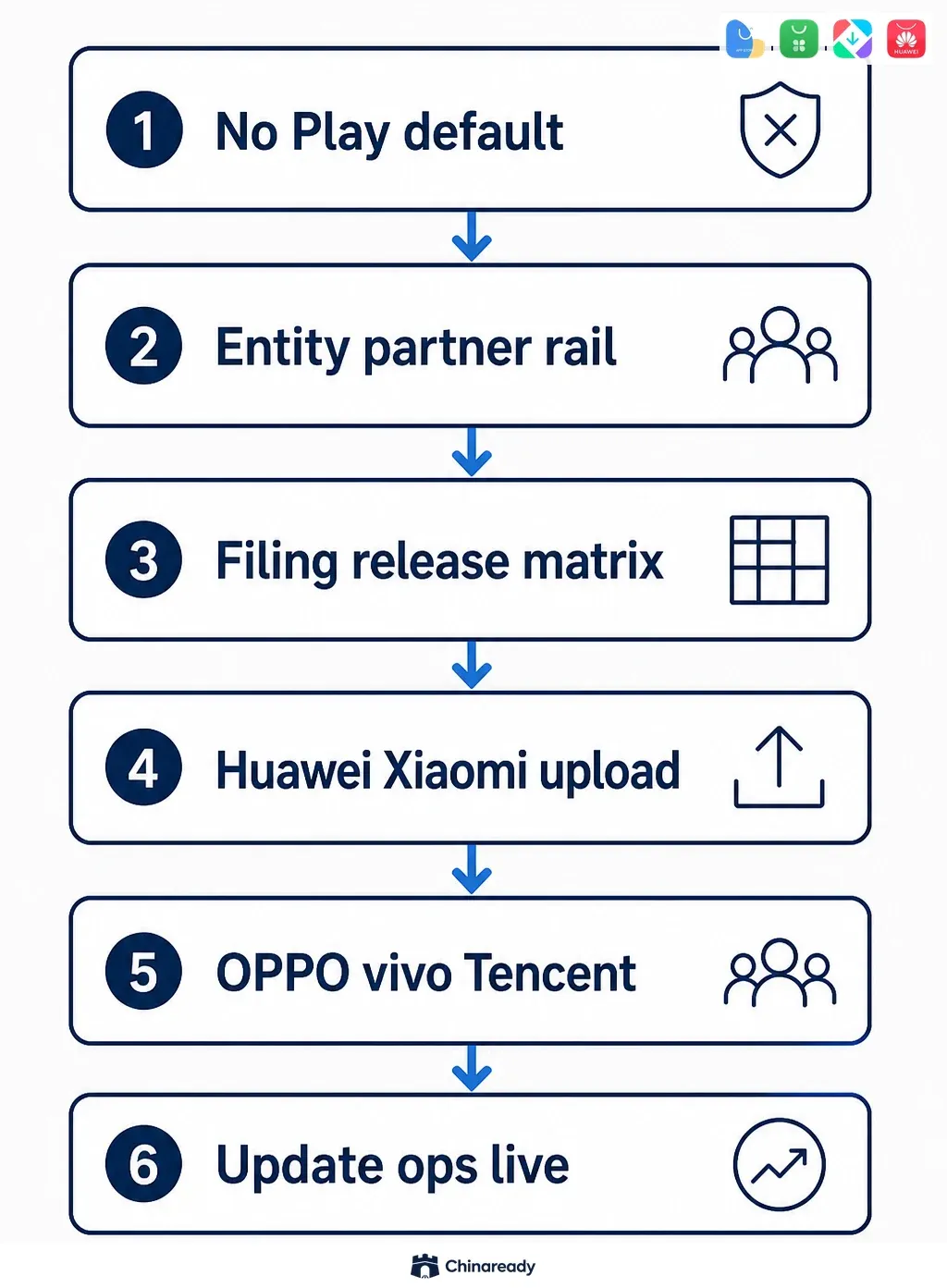
From release matrix to first-wave Android live
| Stage | Decision / outcome |
|---|---|
| 1. Confirm multi-store Android is in scope | No Play default for ordinary Mainland China users |
| 2. Lock first-wave Android shortlist | Usually Huawei AppGallery, Xiaomi GetApps, OPPO, vivo, Tencent MyApp (+ Honor when coverage needs it) |
| 3. Lock entity / partner rail | Who holds developer accounts, admin phones, and exit if the partnership ends |
| 4. Clear filings for the ship set | App filing and category licenses before multi-console batch |
| 5. Build the package matrix | One applicationId; clean core build + per-store channel config — not five codebases |
| 6. Submit first wave store-by-store | Huawei AppGallery upload → Xiaomi GetApps upload → OPPO / vivo app store China → Tencent app store publish — fix one channel before cloning |
| 7. Prove update + crash ops | Brand-aware measurement; removal response before expansion |
Direct entity vs partner rail (hard gate)
Necessity: wrong assumption here wastes weeks — either developer verification never starts, or you ship Android packages under an identity that cannot hold the accounts.
| Route | When it fits | What must already be true |
|---|---|---|
| Direct with Mainland China business license | You already operate a Chinese entity and can staff Mandarin console ops | License scope matches the offer; admin phones and signing ownership align |
| China landing partner / authorised publisher ops | No Mainland China entity, or no Mandarin multi-console Android capacity yet | Partner can hold or operate developer rails; exit and APK / keystore ownership are agreed |
OEM and MyApp Android developer surfaces are formal publish products (Huawei, Xiaomi, OPPO, vivo, Tencent MyApp). Still treat entity, filing, package matrix, and remittance for paid featuring as program gates — not a checklist that replaces Mainland China ops.
Package matrix that survives five Android consoles
Hard gate: one package name across all China Android stores — Huawei AppGallery, Xiaomi GetApps, OPPO, vivo, and Tencent MyApp share the same applicationId. Per-store *.huawei / *.oppo forks look like adaptation theater; they break update continuity, scatter filing references, and create install conflicts when users meet the same product under different identities.
What actually differs per console is the channel build, not the package identity:
| Matrix column | Why your process stalls |
|---|---|
Stable applicationId | Renaming per Android store orphans updates and doubles ops debt |
| Release signing for that package identity | Rotating keys without a continuity plan blocks store updates; do not invent a new package name to dodge keystore hygiene |
| Channel config only — store App ID, optional push/pay SDK, channel meta-data | Shipping every OEM SDK on day one multiplies rejection surface |
| Privacy / third-party SDK disclosure URL per store | A single global privacy page fails store-specific disclosure checks |
| Listing claims vs shipped capabilities | “Fully adapted” copy without integrated rails triggers false-advertising review — advertising law |
Engineering note (short): Keep a clean core module with product logic only. Use Gradle productFlavors (or equivalent CI inject) to stamp channel IDs, store keys, and optional OEM SDKs into each Android artifact — same applicationId, different buildConfig / manifest meta-data. Wire push or payment SDKs only when that store’s v1 job requires them; high-traffic stores get capability depth after the first-wave compliance pass, not before. Minimize permission sets to what the build actually uses. Automate channel packaging after one manual path clears review — scripts do not replace Mandarin console ops.
Same Android build, different review outcomes
Hard gate: passing one China Android console does not clear the others. Huawei AppGallery, Xiaomi GetApps, OPPO, vivo, and Tencent MyApp each run independent review mixes — different automation depth, human checks, and interpretation of privacy, ads, permissions, and security findings. Same versionName / binary family can be approved on one rail and rejected on another in the same week. Plan for variance; do not staff a “once approved, clone everywhere” release ritual.
| Rejection type | Fix scope |
|---|---|
| Cross-store — privacy gaps, permission abuse, filing / identity strings shared by all channel builds | Fix the core once, then re-cut every first-wave Android artifact |
| Store-specific — disclosure wording, ads UX, OEM SDK / login proof called out by one console | Change only that channel flavor; do not pollute other Android stores |
| Ambiguous rule — reviewer note without a clear engineering target | Get written console guidance before rewriting product code |
Before you burn engineering cycles on guesswork, run each store’s official pre-check / security scan where it exists, then reproduce on the rejecting console’s feedback — not a generic third-party report alone. Keep a per-store rejection log so OPPO ads findings are not “fixed” by editing the Huawei privacy URL. Full triage depth: China Android app-store rejection. This upload Guide only locks the fix-scope rule that protects your package matrix.
Why single-upload assumptions kill China Android programs
Play-only plan → near-zero Mainland China Android reach. Ordinary users do not get apps from Google Play as the default channel.
One unmanaged APK, five Android toggles → silent drift. Version codes, privacy URLs, and filing references diverge until a channel removes you.
Per-store package-name forks → update and install chaos. Five identities for one Android product is not a release matrix.
“Approved on Huawei → ship all Android stores” → false confidence. Independent review rails reject the same build for different reasons.
Filings after submit → rejection and removal loops. Compliance materials belong before a multi-console wave — mobile app filing.
Huawei-only success → false multi-store confidence. AppGallery live does not mean Xiaomi GetApps, OPPO, vivo, or MyApp are cleared.
Every-store day-one → ops collapse. Each Android console has its own review and update workflow; overhead grows faster than incremental installs.
Game rules on a utility checklist → months lost. Monetized games need ISBN / publisher rails — see publish a game in China.
Apple success → false Android confidence. iOS is one China App Store; Android is multi-console upload — Apple App Store in China.
What blocks product teams on China Android upload
- Creative-first store listing plans — Screenshot sets before developer accounts and filings exist.
- Assuming overseas login = publisher ready — Browsing a developer portal and a verified Chinese company publisher are different milestones.
- Skipping the package matrix — Channel config, signing continuity, and privacy URLs accumulate without an owner.
- Forking
applicationIdper Android store — Looks like localization; costs update path and filing coherence. - Treating one console approval as universal — Independent Android review rails reject the same version for different reasons.
- No Mandarin ops owner — Console appeals and review replies are not English-first.
- Cloning a rejected channel build everywhere — Fix shared issues globally; fix store-specific issues only on that flavor.
- Blind core rewrites on ambiguous rejections — Get written console guidance before you refactor product code.
- Expansion before update proof — Second-wave stores are guesswork without first-wave crash and review quality data.
- Confusing selection with upload — Android store shortlist is a prior decision; this Guide is the console-ops gate after that choice.
China landing partner for Android store upload
Most product teams exploring Mainland China entry need a China landing partner to open and verify Android developer accounts, clear filing adjacency, keep a unified-package channel matrix coherent across Huawei AppGallery / Xiaomi GetApps / OPPO / vivo / Tencent MyApp, triage Mandarin rejection loops without polluting other channels, and keep review cycles moving — not another longer Play Console migration playbook. Your team still owns product, applicationId, and store prioritization; the partner path makes China Android app store upload an executable program when those rails are not already in-house.
What we can offer?
China Android app store upload is a multi-console gate decision before “live on China Android.” Chinaready helps your product team clear the rails that make first-wave Android publish real in Mainland China:
- China Readiness Assessment — Map first-wave versus expansion Android stores, what entity or partner path fits, and which filing, unified-package matrix, and console gates sit on the critical path before a multi-store live date.
- China Access Acceleration — Keep APIs, auth, and critical deps reachable on Mainland China Android devices after store approval so installs become working products.
- China Product Hosting — Host China-critical services so Android store installs are not dead shells on first open.
- Mobile App Distribution — Execute Huawei AppGallery upload, Xiaomi GetApps upload, OPPO and vivo app store China submits, Tencent app store publish, and measured update ops across the first wave.
Contact us when you need a China Android release matrix and console owners before the first store submission.
Frequently asked questions
What is China Android app store upload?
China Android app store upload means submitting and maintaining your Android package through domestic handset OEM and major third-party developer consoles — typically Huawei AppGallery, Xiaomi GetApps, OPPO and vivo app stores, and Tencent MyApp — instead of Google Play. Each console has its own account, review path, and channel config — under one applicationId, not five forked package names.
Should each Android store get its own package name?
No. Keep one applicationId / package name across Huawei AppGallery, Xiaomi GetApps, OPPO, vivo, and Tencent MyApp. Differentiate with channel metadata, optional OEM SDKs, store listings, and a stable release signing key for that package identity. Per-store package-name forks break update continuity and multiply filing and ops debt.
How do we do a Huawei AppGallery upload?
Through Huawei’s AppGallery Connect / developer rails after entity or partner verification, app identity, and package materials match Huawei review rules. Treat AppGallery as one console in a China Android multi-store matrix — not a Play Console rename that covers Xiaomi, OPPO, vivo, or Tencent.
What about Xiaomi GetApps upload?
Xiaomi GetApps (and Xiaomi’s developer distribute docs) is a separate Android developer console with its own account, channel build, and review cycle. Clear Xiaomi verification and filing references for that build before you treat “live on Xiaomi” as done — still under the same applicationId as the rest of the first wave.
Why does the same version pass one Android store and fail another?
Each console runs its own review mix — automated scanners, human depth, and rule interpretation. Passing Huawei AppGallery does not mean Xiaomi GetApps, OPPO, vivo, or Tencent MyApp will accept the same Android build. Classify cross-store versus channel-only fixes, then follow the China Android app-store rejection Decision Map — do not assume “approved once, approved everywhere.”
Can product teams finish China Android app store upload without Mainland China ops?
Usually no. Multi-console verification, app filing readiness, Chinese metadata, a unified-package channel matrix, rejection triage, and update ops stall teams without Mainland China rails.