
China Android app-store rejection — same build, different review
China app store rejection is console-independent — the same Android build can pass one store and fail another. Mechanism, rule scale, and scanners differ; grade cross-store vs channel fixes before rewriting core.
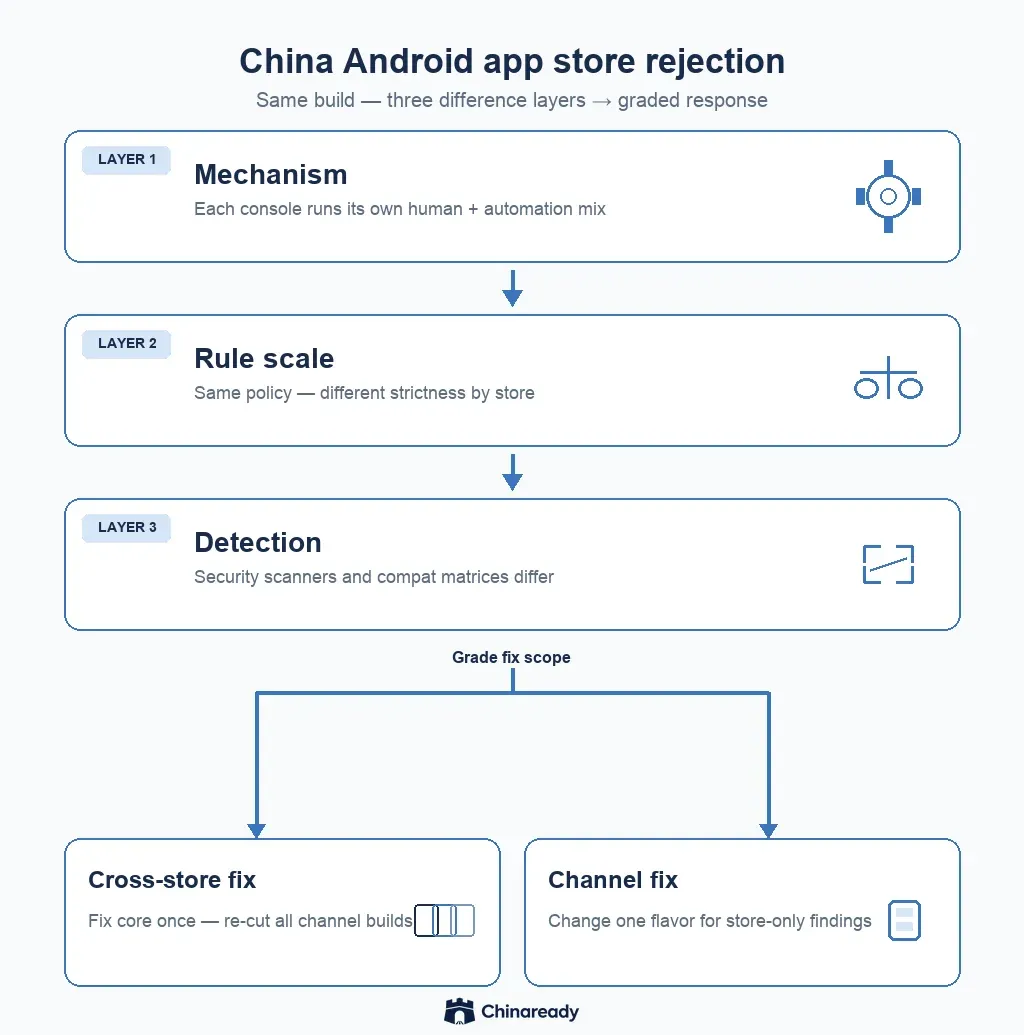
China app store rejection is not one verdict — it is five independent review rails. The same Android build can pass Huawei AppGallery and fail OPPO in the same week because each Mainland China console runs its own human-and-automation mix, applies privacy and ads rules at different strictness, and feeds different security scanners. Do not assume pass once, pass everywhere. Pair this Guide with China Android app-store upload for the package matrix.
Mechanism differences across Mainland China Android stores
Each domestic Android console is a separate review mechanism — not a mirror of Google Play or of its peers.
Huawei AppGallery and Xiaomi GetApps typically blend deeper human review on high-risk categories with automated security and compatibility passes. AppGallery rejection feedback often arrives with more narrative context; Xiaomi GetApps leans on automated security and compatibility testing plus a self-serve cloud test platform (云测平台) before human escalation.
OPPO and vivo consoles are often more automation-led on first pass — privacy, permission, and security engines flag issues before a human re-reads edge cases. OPPO publishers can run Privacy Security Detection (隐私安全检测) against upload-flow guidance; vivo offers the Application Security Detection Platform (应用安全检测平台) for APK upload scans.
Tencent MyApp (应用宝) sits in a third-party distribution lane with its own automation stack — historically including Tencent Cloud Legu (乐固) security detection (product documentation PDF) — rather than handset-OEM review alone. Treat MyApp as its own oem app store review family when logging rejections.
Timing adds variance: batch queues and peak submission windows can stretch review cycles on one console while another moves faster — there is no universal SLA across stores. When one Android store rejects your build in China, the same APK can still pass a sibling console days later — Monday’s outcome does not predict Tuesday’s.
Same policy, different review scale
National privacy and ads frameworks apply broadly, but how strictly each console interprets them differs — that is the core of china android store rejection variance.
| Policy area | Typical cross-store baseline | Where scale diverges (patterns) |
|---|---|---|
| Privacy policy & consent | Must exist; links and in-app disclosure expected | Granularity of permission rationale, SDK inventory depth, and “reject if missing” vs “fix on resubmit” |
| Ads & monetization UX | No deceptive placement; clear close affordances | Rewarded-ad skip visibility, interstitial frequency, and whether Western privacy regimes are cited as auto-fail |
| Permissions & background behavior | Sensitive permissions need justification | Wake frequency, auto-start, and overlay prompts — consoles weigh severity differently |
| Identity & filing strings | Developer entity must match console account | Store-specific proof of OEM login SDKs or channel attribution |
Reviewers often flag rewarded-ad skip affordances that feel too short or hard to find — treat that as a store-scale pattern until the rejecting console cites a written rule. Similarly, some consoles may treat incomplete GDPR or CCPA disclosure language as a hard privacy fail while others request a Mainland China–appropriate rewrite first — illustrative rejection patterns, not a single national rulebook.
An AppGallery rejection about disclosure wording is not automatically an OPPO ads patch. Grade whether the finding is shared across every channel build or isolated to one store’s interpretation scale before engineering starts.
Scanners and compatibility matrices
Beyond policy text, automated security engines and device compatibility matrices differ by console — the same APK can pass one scanner and fail another.
Xiaomi GetApps runs automated security and compatibility testing (documentation) and encourages self-serve cloud testing before submit. OPPO’s privacy security detection and vivo’s application security detection platform scan for permission abuse, risky SDK behavior, and packaging anomalies before listing. Tencent MyApp historically routed builds through Legu (乐固) security detection — a separate automation layer from handset OEM scans.
Compatibility checks also diverge: one console may require reproduction on store-named reference devices while another accepts emulator logs for the same crash signature. Teams often see frame-rate or animation jank flagged on mid-tier OEM hardware — treat device-specific compat notes as channel-scoped until the same finding appears on a second console. Harmony-oriented testing requests and mandatory official repacking claims surface in some rejection threads — log them as store-specific patterns unless written console guidance confirms a hard gate.
Run the official pre-check or security scan when the rejecting console offers one — generic third-party scanners miss store-specific rules and burn prepaid review cycles.
Rejection response: ledger, grade, pre-check
Turn variance into ops: log every rejection, grade fix scope, prefer official pre-checks, then re-cut only what the grade demands.
Keep a per-store rejection ledger — rejecting console, build fingerprint, reviewer note (screenshot or verbatim text), classification, fix owner, and resubmit outcome. Without it, an OPPO ads fix gets misapplied as a Huawei privacy edit on the next version.
| Grade | When to use it | Fix scope |
|---|---|---|
| Cross-store | Same privacy gap, permission abuse, or filing/identity string would fail every channel | Fix core once; re-cut all first-wave channel builds |
| Store-specific | Disclosure wording, ads UX, OEM SDK proof, or scanner finding named by one console only | Change that channel flavor only; do not pollute healthy stores |
| Ambiguous | Mandarin note with no clear engineering target | Get written console guidance before product rewrites |
Hard principle: shared findings → global fix; store-only findings → channel or local change. Resubmit the rejecting console first to prove the fix before cloning changes across the first wave.
Keep one applicationId across stores — rejection triage sits on the unified-package matrix in China Android app-store upload; do not invent per-store package names to dodge review feedback.
Most product teams exploring Mainland China entry need a China landing partner to read Mandarin rejection notes, run store pre-checks when offered, and keep cross-store vs channel fixes coherent — not another longer appeal template.
What we can offer?
China app store rejection work is a graded fix-scope decision before the next Android resubmit. Chinaready helps your product team turn multi-store variance into an executable ops loop in Mainland China:
- China Readiness Assessment — Map whether the rejection is cross-store or channel-specific, what entity or partner path can run Mandarin appeals, and which filing or claim gates sit on the critical path before resubmit.
- China Access Acceleration — Keep APIs, auth, and critical deps reachable on Mainland China Android devices so a review-approved build still becomes a working product.
- China Product Hosting — Host China-critical services so store-approved installs are not dead shells on first open.
- Mobile App Distribution — Execute channel-aware rebuilds, AppGallery and OEM resubmits, and update ops without turning one console’s rejection into a five-store fire drill.
Contact us when you need a rejection ledger and fix-scope owner before the next China Android resubmit.
Frequently asked questions
What is China app store rejection?
China app store rejection means a domestic Android console — Huawei AppGallery, Xiaomi GetApps, OPPO, vivo, Tencent MyApp, or peers — returns or refuses a submitted build. It is feedback from one review rail, not a single “China blocked” switch.
Why was our Android store rejected in China on one OEM but approved on another?
Consoles differ in automation depth, human checks, and how they interpret privacy, ads, permissions, and security findings. Treat multi-store variance as expected — then grade whether the finding is cross-store or channel-specific. Pair with China Android app-store upload for the package matrix.
How do we decide cross-store vs channel-specific fixes after OEM app store review?
Shared privacy, permission, or filing/identity issues → fix core once and re-cut channel builds. Store-only disclosure, ads UX, or OEM SDK proof → change that flavor only. Ambiguous Mandarin notes need written console guidance before product rewrites.
Does China Android store rejection mean we need a new package name?
Usually no. Keep one applicationId across stores. Rejection triage sits on the unified-package matrix in China Android app-store upload — do not invent per-store package names to dodge review feedback.
Can product teams clear China Android rejections without Mainland China ops?
Usually no. Mandarin console replies, official pre-checks, entity rails, and channel-aware rebuilds stall teams without Mainland China ops.