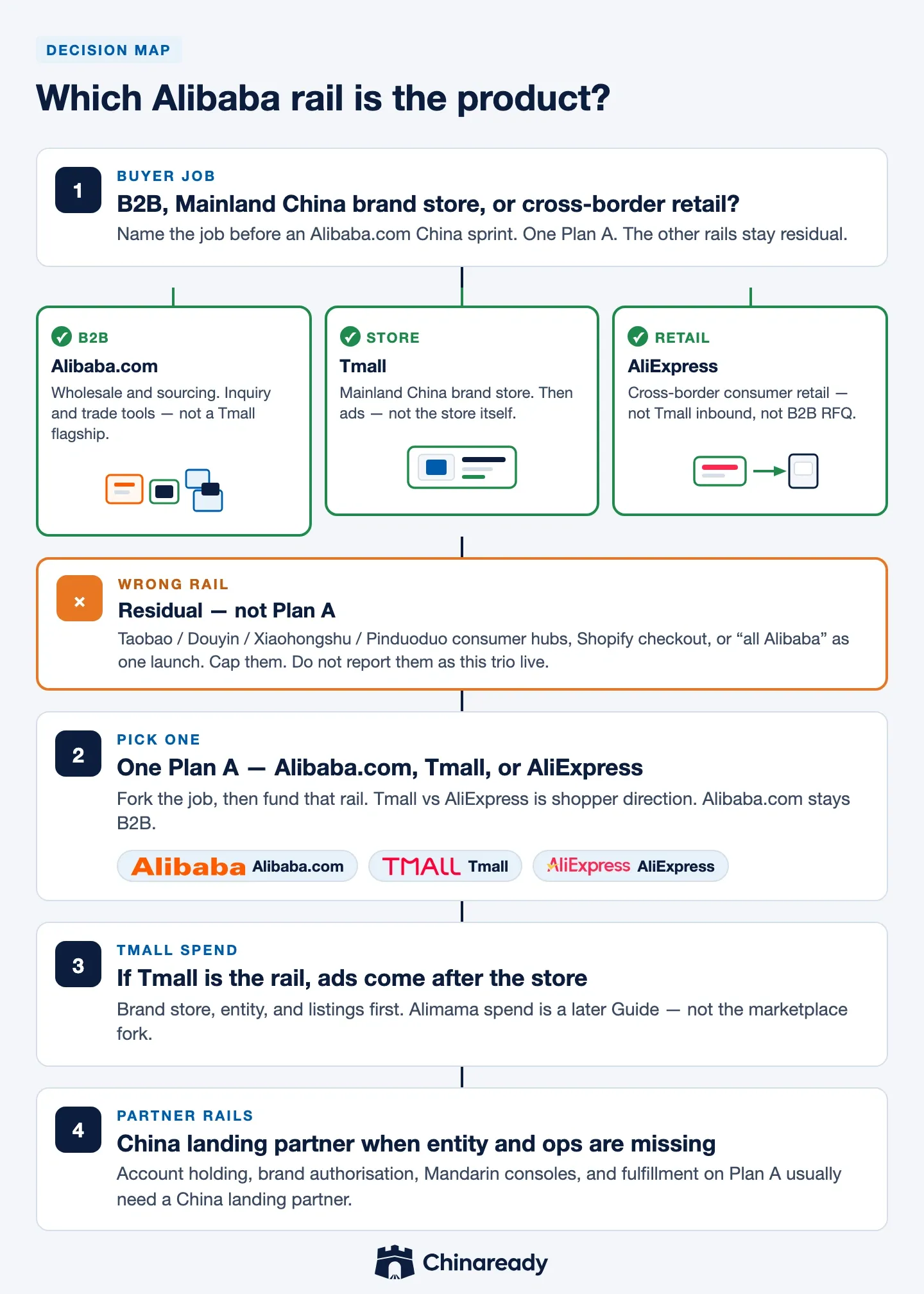
Alibaba.com China is a rail choice, not one marketplace SKU. Fork the job, then pick one Plan A: B2B wholesale on Alibaba.com, a Mainland China brand store on Tmall, or cross-border retail on AliExpress. Keep the other two residual. This is not a Tmall ads rewrite and not a Taobao consumer-hub clone. Shopify is not an Alibaba rail — remap that storefront on Shopify in China.
What Alibaba.com, Tmall, and AliExpress actually are
Hard names your commerce plan will use:
- Alibaba.com — Alibaba Group’s global B2B marketplace. Buyers source; suppliers list, inquire, and trade. Group description: Alibaba.com. Seller onboarding: How to start selling on Seller Central. English storefront and RFQ tools do not create a Tmall flagship.
- Tmall — Mainland China brand-store rail. Brands sell to shoppers in Mainland China on a flagship or authorised store. Group description: Tmall. Consumer entry: tmall.com. Tmall Global, if you use it, is still this rail — inbound to Mainland China shoppers — not AliExpress.
- AliExpress — Cross-border retail to consumers outside Mainland China. Group description: AliExpress. Consumer entry: aliexpress.com. A Choice-style retail program is still AliExpress, not a Tmall brand store.
- Tmall vs AliExpress — Shopper direction. Tmall = Mainland China brand retail. AliExpress = international consumer retail. Mixing them reports “we launched Alibaba” while the wrong buyer never converts.
- Not Taobao / Douyin / Xiaohongshu / Pinduoduo — Those consumer search-shop and content-commerce rails live on the China consumer platform map. Taobao seller ads are a different spend job: Taobao ads.
- Not Shopify — An independent Shopify checkout is not one of these three rails. Shopify in China is the storefront-reach fork.
- Common myth — “Open Alibaba.com and we are on Tmall.” B2B inquiry is not a Mainland China brand store. Twin myth: AliExpress listings as a Tmall flagship.
Vocabulary first. Next: what must be true before a rail is Plan A.
What must be true before you name a rail
Missing a named buyer job stops your product team before an “Alibaba for China” sprint is real work.
| Precondition | Why your process stalls |
|---|---|
| Buyer job locked — B2B wholesale vs Mainland China brand store vs cross-border retail | All three rails are staffed as one Alibaba.com China launch; none finish |
| One Plan A named — Alibaba.com, Tmall, or AliExpress | Residual rails crowd the critical path; ops cannot tell which console is live |
| Honest store class — B2B storefront ≠ Tmall flagship ≠ AliExpress retail | HQ reports “Alibaba is live” on the wrong buyer |
| Entity / partner path that can hold the chosen rail | Company verification and settlement commonly expect Chinese business-license or authorised-ops rails, especially on Tmall |
| Brand / IP pack when Tmall is Plan A — name, mark, authorisation | Store open waits on proof the platform expects — trademark in China |
| Fulfillment and settlement named for that rail | Listings without stock, logistics, or remittance are not a store |
| Owned web scoped only if needed beside the store | A China-reachable site is a separate job — website vs WeChat |
| Ads scoped after the rail if Tmall is Plan A | Alimama spend before a brand store burns prepaid balance — Tmall ads |
Product teams usually cannot treat “join Alibaba, then figure out Tmall vs AliExpress later” as the Mainland China plan. Naming the rail is the floor.
Which Alibaba platform is Plan A
| Stage | Decision / outcome |
|---|---|
| 1. Name the buyer job | B2B sourcing / wholesale, Mainland China brand retail, or cross-border consumer retail? |
| 2. Pick one Plan A | Alibaba.com (B2B) · Tmall (Mainland China brand store) · AliExpress (cross-border retail) |
| 3. Park the other two as residual | Cap them. Do not report residual listings as the China store |
| 4. If the job is none of these | Remap. Taobao / Douyin / Xiaohongshu / Pinduoduo → consumer platform map. Independent checkout → Shopify in China or a China-reachable owned storefront |
| 5. Lock entity, brand, and ops on Plan A | Who holds the account, trademark / authorisation, admin phones, fulfillment, and exit |
| 6. If Tmall is Plan A and you will spend | Open the brand store first, then Tmall ads. Taobao seller media is not a substitute: Taobao ads |
| 7. If a China-reachable web still sits beside the store | Treat that origin as its own fork — website vs WeChat |
Hard gate — one Plan A, two residual
Necessity: confusing these three jobs wastes the quarter — either you underfund the rail that actually holds the buyer, or you staff Tmall, AliExpress, and Alibaba.com as if they were one SKU.
| Job | Plan A | What must already be true |
|---|---|---|
| B2B wholesale / sourcing | Alibaba.com | Buyer is a business; inquiry and trade tools match the offer; Tmall flagship is not required for this job |
| Mainland China brand store | Tmall | Shoppers are in Mainland China; brand-store type, entity or partner, and IP pack are in motion |
| Cross-border retail | AliExpress | Shoppers are outside Mainland China; retail checkout — not B2B RFQ, not Tmall |
| Taobao / Douyin / Xiaohongshu / Pinduoduo consumer hub | Not this trio | Use the consumer platform map |
| Independent Shopify (or peer) checkout | Not this trio | Shopify in China |
| “All Alibaba platforms” as one launch | Myth as Plan A | One named rail; the rest residual |
Domestic wholesale on 1688 is a different B2B job from Alibaba.com. Do not treat a 1688 account as Alibaba.com China launched.
Confirm live merchant gates on the official entries above. This Guide does not reprint apply click-paths.
Why mixing rails kills the store plan
Alibaba.com treated as Tmall → no Mainland China brand store. B2B inquiry and Trade Assurance-class tools do not list a flagship for shoppers on Tmall.
Tmall vs AliExpress reversed → the wrong shopper. Tmall converts in Mainland China. AliExpress converts international retail. A Tmall Global inbound path is still Tmall; it is not AliExpress export retail.
Ads before the Tmall rail → spend with nowhere to convert. Tmall ads assume a brand store that can list, fulfill, and settle. Taobao ads assume a seller rail — not a Tmall flagship rename.
Shopify kept as the Alibaba plan → wrong storefront class. Shopify checkout is not Alibaba.com, Tmall, or AliExpress. Remap on Shopify in China.
Taobao consumer hub counted as this trio → wrong map. Search-shop and content-commerce order sits on the consumer platform map.
Trademark skipped on a Tmall Plan A → store open stalls. Brand proof is a gate, not a polish pass — trademark in China.
Owned web ignored or over-scoped → two products collide. If you still need a China-reachable site beside the store, that is a separate origin decision — website vs WeChat.
What stalls teams that treat Alibaba as one SKU
- Platform-name thinking — Product treats “Alibaba” as a geo toggle before which Alibaba platform is named.
- Alibaba.com as the China storefront — A B2B membership is reported as Tmall live.
- Tmall vs AliExpress as a price tier — Cheap vs premium, instead of shopper direction.
- Ads-first Tmall — Creative and Alimama booked before brand-store entry.
- Shopify-plus-Alibaba mashup — HQ Shopify admin plus a few AliExpress SKUs reported as Mainland China brand retail.
- Consumer-hub dump — Taobao, Douyin, Xiaohongshu, and Pinduoduo added because “China ecommerce,” without a Plan A on this trio.
- HQ laptop QA — Testers outside Mainland China never see Tmall shopper or AliExpress export reality, so the ticket never opens.
- No owner for the fork — The plan stalls because nobody owns Plan A vs residual — only “launch on Alibaba.”
What “fixed” means: One named rail is Plan A (Alibaba.com, Tmall, or AliExpress); the other two are capped residual if they exist; Tmall ads start only after Tmall is the rail; Taobao / Douyin / Xiaohongshu / Pinduoduo are not counted as this trio; Shopify is not counted as an Alibaba rail; trademark and entity sit on the Tmall path when that is Plan A; any owned web beside the store is a named separate job. “We have Alibaba” with three half-open consoles is not fixed.
China landing partner when the rail is the product
Most product teams exploring Mainland China entry need a China landing partner once they name the rail — to hold or operate the chosen Alibaba.com, Tmall, or AliExpress account path, clear entity and admin verification, assemble brand authorisation for a Tmall store, run Mandarin consoles, and stand up fulfillment and settlement that match that Plan A. Your team still owns catalog, pricing, and which rail wins the shortlist; the partner path makes that rail executable when those ops are not already in-house. Keeping residual listings on the other two platforms does not remove the need for that China landing partner on Plan A.
What we can offer?
Alibaba.com China work is a which-rail decision before any “open Alibaba and scale” sprint. Chinaready helps your product team pick one Plan A — Alibaba.com, Tmall, or AliExpress — and clear the entity, brand, and ops rails that make that store real:
- China Readiness Assessment — Decide which Alibaba platform is Plan A, which two stay residual, and which entity, trademark, fulfillment, and (if Tmall) ads gates sit on the critical path before a store date.
- China Access Acceleration — Keep any China-facing pages beside the store reachable from Mainland China vantage so brand and conversion paths do not die on an offshore-only site while the marketplace rail is opening.
- China Product Hosting — Place a China-reachable owned origin, when you still need one beside Tmall or Alibaba.com, where entity consistency and ICP adjacency stay coherent with the store offer.
- Mobile App Distribution — Align Mini Program or app sell-in with the chosen marketplace rail — not mistake a WebView of Alibaba.com for a Tmall brand store.
Contact us when you need one Alibaba rail named before you staff another “sell on Alibaba” sprint.