

China Negative List — investment vs product entry path
The Foreign Investment Negative List reshapes entity equity and category no-gos — VATS, ICP, and content licenses still gate product entry.
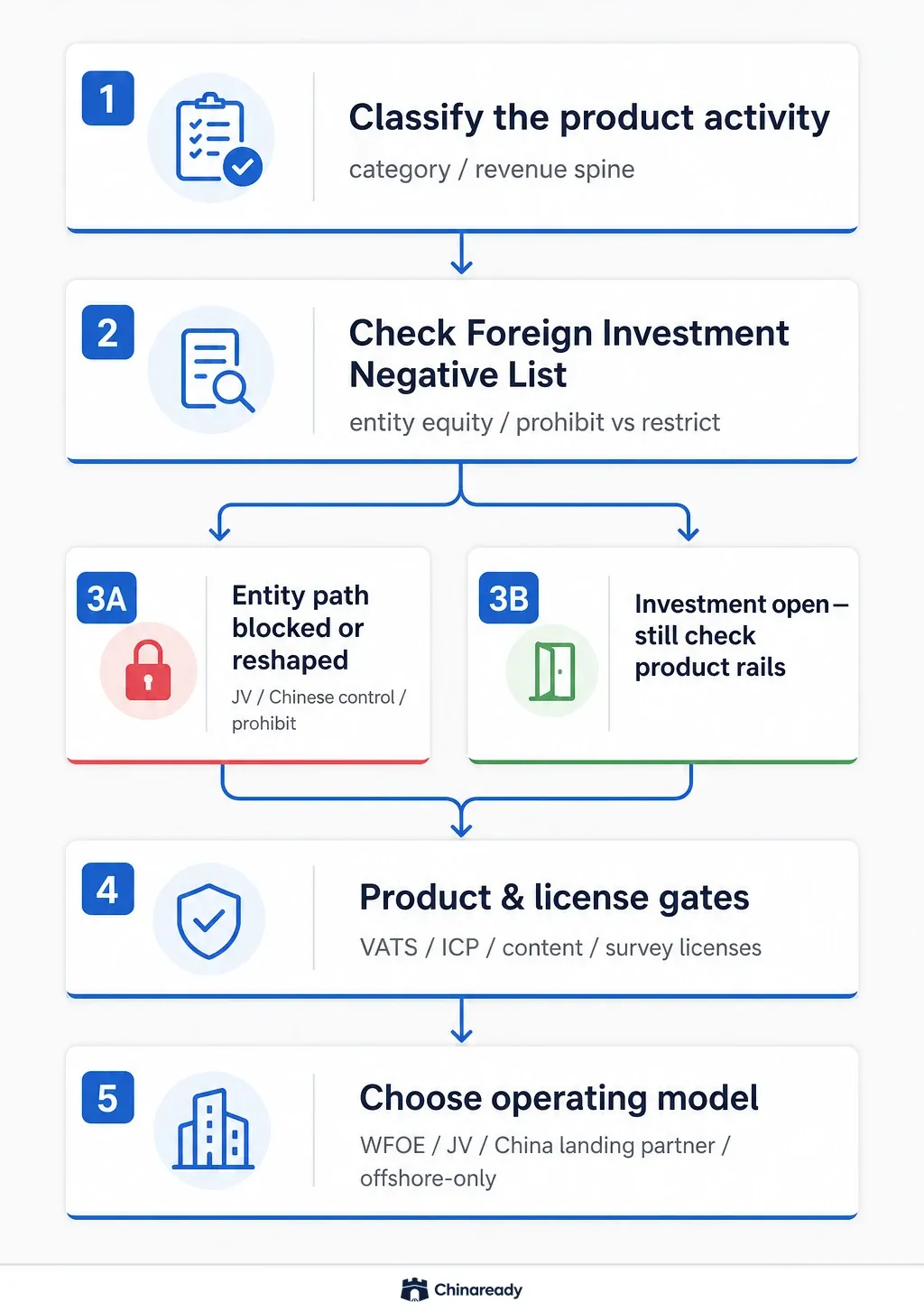
China’s Foreign Investment Negative List is an entity and category no-go map before it is a product launch checklist. Your product team classifies the China activity, checks whether the Special Administrative Measures (Negative List) for Foreign Investment Access (外商投资准入特别管理措施(负面清单)) prohibits or reshapes foreign equity, then still clears product and license rails — VATS, ICP, content, survey, and platform gates.
What the Foreign Investment Negative List is
Hard names your Mainland China entry plan will use:
- Foreign Investment Negative List (外商投资准入负面清单) — Officially the Special Administrative Measures (Negative List) for Foreign Investment Access (外商投资准入特别管理措施(负面清单)). The 2024 edition is NDRC / MOFCOM Decree No. 23, effective 1 November 2024, and replaces the 2021 edition (NDRC decree page; MOFCOM PDF).
- Negative-list logic — The list unifies equity and senior-management access measures. Fields outside the list follow domestic–foreign equal treatment; domestic and foreign investors still share the Market Access Negative List (市场准入负面清单) rules (Note 1 of the 2024 list).
- Foreign Investment Law (外商投资法) — National treatment plus negative-list management for foreign investment (NPC English text; SAMR Chinese text).
- 2024 headline change — National restrictive measures moved from 31 to 29; manufacturing foreign-investment access restrictions were cleared (NDRC Q&A). Digital and culture rows remain the product-team focus.
- Not a product-license catalogue — Note 8 keeps culture, finance, administrative approvals, qualifications, and national-security measures that are not listed as investment rows. Clearing investment access is not the same as holding VATS, ICP, or content permits.
- Common myth — “We are not on the Negative List, so China product entry is open.” Investment openness still leaves product rails, platform accounts, and Mandarin ops as separate gates.
Vocabulary first. Next: what must exist before entity tickets are real work.
What must exist before Negative List work is real
Missing any of these stops your product team before a durable Mainland China entity or publish plan — not before a slide titled “WFOE in Q3.”
| Precondition | Why your process stalls |
|---|---|
| Activity frozen — what users do, what you charge for, and which China category that maps to | Registry and MIIT classify behavior, not brand slogans |
| Primary vs secondary revenue spine | Multi-product stacks (software + marketplace + content) can trigger different list rows and licenses |
| Investment question named — WFOE, JV, Chinese-controlled holdco, or partner-operate | Wrong equity story fails registration or later diligence |
| Product rails inventory — ICP / VATS, content, survey, app filing, ads accounts | Teams that only clear investment still stall at publish |
| Chinese organizing path — subsidiary counsel track or China landing partner that can hold licenses and consoles | Overseas-only packs cannot finish many digital licenses |
| Mandarin ops owner for filings, supplements, and partner exit | Authority correspondence is not an English-first soft launch |
Chinese-language registries, sector regulators, and license display sit outside a global incorporation checklist. Free Trade Zone or CEPA preferential tracks exist in policy (Note 9) — treat them as counsel-led exceptions, not a default product plan.
From category check to operating model
| Stage | Decision / outcome |
|---|---|
| 1. Classify the China activity | Product job + revenue spine → candidate industry rows |
| 2. Read the Foreign Investment Negative List | Prohibit / equity or control / not listed for investment |
| 3. Separate investment vs product gates | Entity structure vs VATS, ICP, content, survey, platforms |
| 4. Choose operating model | WFOE (if open), JV / Chinese control, partner-operate, or offshore-only |
| 5. Sequence publish | Entity + licenses + hosting / filing + distribution on one calendar |
Digital-product rows on the 2024 national list (hard gate)
Necessity: these rows are the usual collision for apps, sites, and content products — wrong assumption here staffs the wrong entity or promises a WFOE that cannot hold the activity.
Source: 2024 Foreign Investment Negative List (MOFCOM PDF), items 12–16 and culture cluster; explanatory notes on gov.cn.
| List focus | What the 2024 list says (summary) | Product-entry implication |
|---|---|---|
| Telecom (item 12) | VATS foreign equity ≤50% within WTO-open services (exceptions include e-commerce, domestic multi-party communications, store-and-forward, call centers); basic telecom Chinese-controlled | Entity equity and VATS licensing are both gates — not substitutes |
| Internet content stack (item 13) | Prohibit investment in internet news, online publishing, online audiovisual, internet culture (except music), and internet public information publishing (WTO carve-outs as stated) | Foreign WFOE often cannot be the licensed operator; Chinese partner or Chinese-controlled structure is the usual path — product licenses such as Network Culture Business License and Broadcast and Television License still sit beside investment access |
| Market / social surveys (items 15–16) | Market surveys limited to JV (radio/TV ratings Chinese-controlled); social surveys prohibited | Research and data products need a separate FRSL / survey analysis — not “SaaS WFOE” by default |
| Culture / media cluster (items 23–29) | Prohibit investment in news orgs, publishing edit/produce, radio/TV, film production/distribution, and related culture entities | Streaming, publishing, and many media products are entity no-gos for foreign control even before license packing |
| Note 8 (unlisted measures) | Culture, finance, approvals, qualifications, national security outside the list still follow current rules | “Not on the list” ≠ “no license” |
This table is selective on purpose. Agriculture, mining, transport, education, and healthcare rows matter for those sectors; they are not the default shortlist for a SaaS or consumer-app launch.
Why “investment open” still fails product entry
Negative List cleared → VATS ignored. Item 12 caps equity; MIIT still issues commercial B25 / B21 and related codes. Partner-publish remains the common foreign path.
Content product on a “software WFOE.” Item 13 and culture rows prohibit foreign investment in several internet content classes. Relabeling as “tooling” does not survive category review when the live experience is news, AV, or culture ops.
Survey features bolted onto an analytics SaaS. Social surveys are prohibited for foreign investment; market surveys are JV-limited. Product questionnaires can become a second program — see the Foreign-Related Survey License Guide.
FTZ optimism without counsel. Note 9 allows more preferential measures in free-trade and special zones for eligible investors — it is not a blanket waiver of national digital licenses.
Offshore-only brand → Mainland China commerce promises. Staying outside investment access avoids list rows and also avoids the in-China commercial model sales assumed.
No Mandarin owner for SAMR / MIIT / partner packs. Filing supplements and license display become “China is slow” while the entity story was never finished.
Where Negative List plans stall
- Treating the list as the only compliance document — Note 8 and sector licenses sit beside investment rows.
- Promising a 100% foreign WFOE for VATS-heavy or content-heavy apps — Equity caps and prohibit rows reshape the entity before App Store tickets.
- Confusing Market Access Negative List with foreign-investment access — Both can apply; clearing one does not clear the other.
- Building marketplace or paid-info features after a “filing-only” entity plan — Commercial VATS appears late and forces rebuilds.
- Assuming a cloud vendor’s licenses cover your service layer — IDC/CDN vendor permits do not authorize your commercial app.
- Ignoring partner exit and license holding — Orphaned ICP / VATS / console ownership looks like a regulatory delay.
- Skipping live classification when features creep — Ads inventory, UGC, or survey modules can move you onto a new row mid-quarter.
China landing partner for investment-vs-product pathing
Most product teams exploring Mainland China entry need a China landing partner to turn Negative List classification into an executable entity and license program — Chinese registration or JV design when required, VATS / ICP / content adjacency, Mandarin regulator and platform packs, and a clear exit for license-holding rails — not another longer “read the 29 rows” playbook. Your team still owns product scope, category honesty, and commercial model; the partner path makes investment-versus-product sequencing real when those Mainland China rails are not already in-house.
What we can offer?
Negative List work is an investment-versus-product gate decision — entity no-gos and equity caps on one side, VATS / ICP / content rails on the other. Chinaready helps your product team clear the path that makes Mainland China entry executable:
- China Readiness Assessment — Map your activity to Foreign Investment Negative List rows versus product licenses (VATS, ICP, content, survey), and name whether WFOE, JV, partner-operate, or offshore-only is realistic before you promise an entity date.
- China Access Acceleration — Keep Mainland China user journeys reachable once the operating model and license gates are in scope — so “investment-cleared” and “customers can open the product” stay aligned.
- China Product Hosting — Place China-critical sites and APIs on Mainland China termination paths that support ICP filing and the commercial posture your entity plan can actually hold.
- Mobile App Distribution — Sequence store and Mini Program launch with the same entity and commercial-license evidence regulators and platforms expect — so App filing does not collide with a Negative List no-go.
Contact us when you need an investment-versus-product entry path before you staff a “WFOE first, licenses later” sprint.
Frequently asked questions
What is China’s Foreign Investment Negative List?
The Special Administrative Measures (Negative List) for Foreign Investment Access (外商投资准入特别管理措施(负面清单)) is the national list of equity, control, and prohibit measures for foreign investment access. Fields outside the list are managed under domestic–foreign equal treatment; domestic and foreign investors also remain subject to the Market Access Negative List (市场准入负面清单). The 2024 edition is jointly issued by NDRC and MOFCOM.
If our category is not on the Negative List, can we ship a China product freely?
No. Clearing foreign-investment access does not replace product rails such as basic ICP filing, commercial VATS (B25/B21), content or survey licenses, app filing, or platform account rules. Note 8 of the 2024 list also keeps culture, finance, approvals, qualifications, and national-security measures that are not written as list rows.
How does the Negative List affect Value-Added Telecommunications Services (VATS)?
Item 12 of the 2024 national list caps foreign equity in value-added telecom at 50% for services within China’s WTO commitments (with listed exceptions such as e-commerce, domestic multi-party communications, store-and-forward, and call centers) and requires Chinese control for basic telecom. Separate MIIT licensing still applies — see the VATS Guide.
Are internet news, publishing, audiovisual, and culture apps blocked for foreign investment?
Item 13 prohibits foreign investment in internet news information services, online publishing services, online audiovisual program services, internet culture operations (except music), and internet public information publishing services — subject to the WTO-commitment carve-out stated in the list. Product teams still need the matching operating licenses even when the operating entity is Chinese-held.
What is the difference between the Foreign Investment Negative List and the Market Access Negative List?
The Foreign Investment Negative List governs foreign-investment access (equity, control, prohibit). The Market Access Negative List applies to domestic and foreign investors alike for market-access administration. Being “off” the foreign-investment list does not waive market-access or sector licenses.
Can product teams finish Negative List analysis without Mainland China ops?
Usually no. Category classification, entity structuring, MIIT and content licensing, and Mandarin registry or partner rails stall teams without Mainland China ops.