

Broadcast and Television License — AV streaming product gate
Broadcast and television program production and network audiovisual permits gate Mainland China AV and streaming models — not NCBL, publication, or VATS substitutes. Map the product model first; most teams need a China landing partner.
“Broadcast and Television License” is not one stamp for every Mainland China video feature. Product teams usually face two National Radio and Television Administration (国家广播电视总局) (NRTA) gates: the Broadcast and Television Program Production and Operation License (广播电视节目制作经营许可证) when you produce or operate broadcast and television programs, and the License for Dissemination of Audio-Visual Programs through Information Network (信息网络传播视听节目许可证) when you run internet audiovisual services or IPTV / dedicated-network style distribution. Sibling content and telecom permits — Network Culture Business License, Publication License, VATS — stay separate. Classify the product model first. Most global teams need a China landing partner.
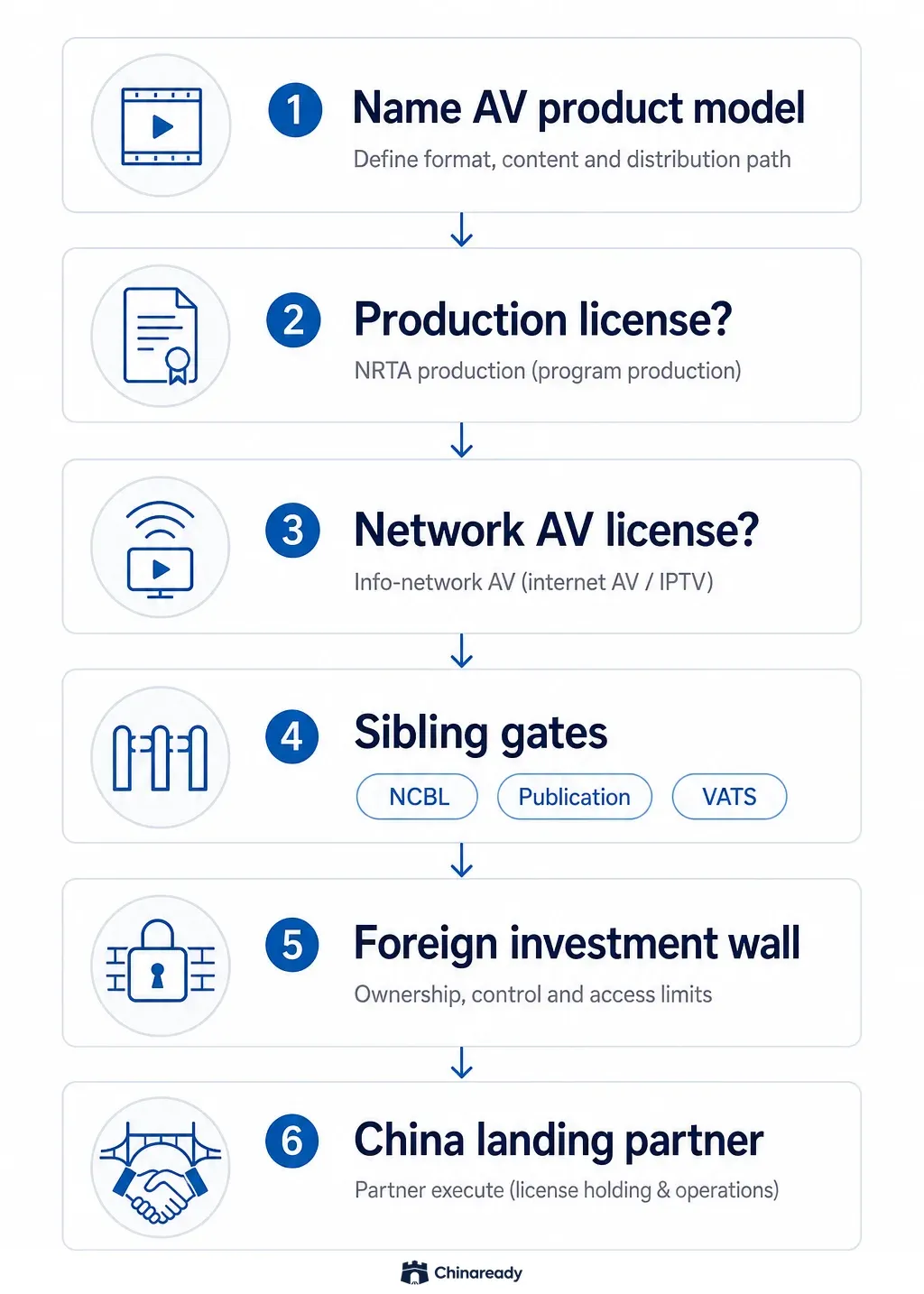
What broadcast and audiovisual permits cover
Hard names your Mainland China AV / streaming plan will use:
- Broadcast and Television Program Production and Operation License (广播电视节目制作经营许可证) — Required to establish a broadcast and television program production operating institution or to engage in broadcast and television program production and operation activities. Rule text: Provisions on the Administration of Radio and Television Program Production and Operation (NRTA order lineage; 2025 revision published on a provincial NRTA open-government page). NRTA service guide: establishment of a broadcast and television program production operating unit.
- License for Dissemination of Audio-Visual Programs through Information Network (信息网络传播视听节目许可证) — The permit (or, where rules allow, filing) to engage in internet audiovisual program services, and the same license family for dedicated-network / directed audiovisual services such as IPTV, dedicated-network mobile TV, and internet TV. Primary rule texts: Provisions on the Administration of Internet Audiovisual Program Services; Provisions on the Administration of Dedicated Network and Directed Dissemination of Audiovisual Program Services (NRTA page). NRTA service guide: issuance of the information-network audiovisual license.
- NRTA is the industry authority — Policy and approval sit with NRTA and provincial radio and television administrations — not with a cloud vendor’s ICP footer (nrta.gov.cn).
- Production license can sit under network AV categories — Under the internet audiovisual rules, certain service types (for example hosting / interview / reporting audiovisual services, and self-produced network drama / film-style services) also require holding the Broadcast and Television Program Production and Operation License — production clearance is not a substitute for the network audiovisual license, and the reverse is also false.
- Not NCBL, publication, or VATS — For-profit internet culture platforms → Network Culture Business License. Publication distribution / internet publishing → Publication License. Commercial information / marketplace telecom patterns → VATS for digital products. Map siblings when the stack overlaps.
- Foreign equity is a hard wall — The 2024 Foreign Investment Negative List prohibits foreign investment in online audiovisual program services (item 13 content cluster) and in broadcast and television program production operating companies (culture cluster). Internet audiovisual applicants are further constrained to state-owned or state-controlled units under the internet audiovisual rules. Pair with China Negative List.
Vocabulary first. Next: what must exist before an AV license path is real work.
What must exist before an AV license path is real
Missing any of these stops your product team before a provincial or NRTA pack is honest work — not before a feature roadmap slide titled “China streaming in Q3.”
| Precondition | Why your process stalls |
|---|---|
| Product model named — program production / internet AV platform / IPTV or dedicated-network distribution / ordinary SaaS with incidental video | Wrong permit chase; months spent on a track that never applied |
| Content objects named — self-produced shows, UGC upload, licensed catalog, IPTV channel pack, utility help video | Reviewers and partners cannot map scope; counsel cannot pick the gate |
| Operating entity model — Chinese licensee / state-controlled AV operator vs “global HQ alone” | Foreign-investment and ownership rules make solo WFOE paths unavailable for these activities |
| Sibling stack inventory — NCBL / publication / ICP / VATS / app filing already listed | Clearing one NRTA permit without telecom or culture adjacency creates launch collisions |
| China-reachable legal & ops owners — Mandarin-capable contacts for provincial packs and content duties | Silent stalls when authorities or partners cannot reach anyone |
| Partner RACI — who holds which license, who owns content review, who answers takedowns | Verbal “we have a Chinese media partner” fails on the first removal event |
Replace “we need a Broadcast License” with “product model locked; production vs network AV assigned; sibling stack named; Chinese operating vehicle chosen.”
From product model to production vs network AV gate
| Stage | Decision / outcome |
|---|---|
| 1. Name the Mainland China product model | Program production / internet AV service / IPTV or dedicated-network distribution / out-of-scope utility video |
| 2. Map production activity | Broadcast and Television Program Production and Operation License path when you produce or operate broadcast and television programs under a Chinese production entity |
| 3. Map network audiovisual dissemination | Information-network audiovisual license path when you provide internet AV services or dedicated-network / IPTV-style services to the public |
| 4. Check category prerequisites | Some internet AV categories also require the production license — do not treat one permit as covering both jobs |
| 5. Keep sibling gates honest | NCBL / publication / VATS / ICP / app filing on the same calendar when behavior overlaps |
| 6. Lock foreign-investment reality | Partner-operate or Chinese-controlled structure when Negative List prohibit rows apply — Negative List Guide |
| 7. Lock China landing partner | Contracted entity that already holds or can lawfully pursue the needed NRTA permits and content ops |
Quick forks product teams misuse
- Utility SaaS with help or marketing clips — Often not an NRTA audiovisual-platform trigger. Still check hosting / ICP / commercial VATS.
- Producing shows, series, or program catalogs for Mainland China broadcast / AV markets — Plan the Broadcast and Television Program Production and Operation License under a Chinese production entity.
- Public internet streaming / video platform / UGC upload AV — Plan the information-network audiovisual license track; ownership and category bars are severe.
- IPTV, dedicated-network mobile TV, or internet TV distribution — Still the information-network audiovisual license family under dedicated-network rules — not a production-license-only story.
- Interactive culture / performance / game-adjacent community — May need Network Culture Business License analysis in addition to NRTA gates when culture operating activity is present.
- Monetized game title — Do not substitute broadcast language for the game ISBN path when the real product is a game.
This sequence is phase decisions, not a console click-path. After network audiovisual approval, related telecom / ICP procedures still apply under the internet audiovisual rules — schedule them with counsel when the operating model is commercial.
Why production, network AV, and sibling licenses are not interchangeable
Production license without network AV clearance → public streaming still fails. The production permit authorizes program production and operation activity. Public internet or dedicated-network audiovisual dissemination is a separate NRTA license family. Shipping a “we produce content” certificate into an app-store diligence pack does not clear audiovisual dissemination.
Network AV without production where the category requires it → incomplete category pack. Certain internet AV service types expressly require holding the Broadcast and Television Program Production and Operation License as well. Clearing only the dissemination license leaves the category prerequisite open.
Treating NCBL as an NRTA substitute → wrong ministry, wrong evidence. Culture-admin internet culture permits answer a different question from NRTA production and audiovisual dissemination. Map both when the product is a commercial culture + video platform — see Network Culture Business License.
Publication credentials skipped when publishing is the job → entity mismatch. When the real activity is publication distribution or internet publishing, NPPA tracks matter — pair with China Publication License instead of stuffing every media product into “broadcast license.”
NRTA cleared, VATS / ICP ignored → host and telecom gates still fail. Internet audiovisual rules expect related telecom licensing or filing after NRTA approval. Commercial information or marketplace patterns still need VATS analysis.
Foreign HQ as applicant → no valid filing vehicle. Online audiovisual services and broadcast program production companies sit behind Foreign Investment Negative List prohibit rows (item 13 content cluster and culture-cluster production companies). Most product teams need a China landing partner that already holds (or can lawfully pursue) the right permit and content-review ops — Negative List Guide.
Global feature rename → false “we’re only SaaS.” Live catalog streaming, UGC video upload, IPTV-style channel packs, or self-produced network series can pull the product into NRTA territory even when the global brand calls the SKU “community media” or “engagement video.”
What blocks product teams on this license map
- Assuming every video UI needs a Broadcast License — Ordinary productivity apps with incidental clips are a different map; force-fitting wastes months.
- Assuming one NRTA permit covers production and public dissemination — Production and information-network audiovisual are different jobs.
- Ignoring state-owned / state-controlled and Negative List walls — Ownership constraints are part of the product plan, not a late legal footnote.
- Confusing IPTV / dedicated-network models with “just another CDN path” — Dedicated-network rules still require the information-network audiovisual license family.
- Using NCBL or publication language as a broadcast shortcut — Sibling ministries do not issue interchangeable stamps.
- No Chinese entity or Mandarin ops rail — Provincial preliminary review and ongoing content duties expect a local operating posture.
- Missing license display / renewal owners — Network audiovisual licenses carry validity, renewal, and on-interface marking duties under the internet audiovisual rules.
- Copy alone cannot finish it — Entity design, Mandarin packs, and partner commercial terms require Mainland China counsel and a landing partner; this Guide stops at the decision map.
When you need a China landing partner for AV licenses
Most product teams exploring Mainland China entry need a China landing partner to classify the AV product model against NRTA production vs network audiovisual rules, sequence sibling NCBL / publication / VATS gates, and execute under a Chinese organizing entity that can lawfully hold the activity. Your team still owns product scope and monetization decisions; the partner path makes broadcast and audiovisual rails executable when they are not already in-house.
What we can offer?
Broadcast and audiovisual permits are a product-model gate: production license vs network audiovisual dissemination vs sibling culture / publication / VATS stack — then a Chinese operating vehicle. Chinaready maps that line before your team promises a Mainland China AV or streaming launch:
- China Readiness Assessment — Name whether your China property is program production, internet audiovisual service, IPTV / dedicated-network distribution, or outside NRTA tracks — and which foreign-equity / partner model is realistic.
- China Access Acceleration — Sequence partner selection, NRTA / provincial packs, and parallel ICP / VATS / culture / publication work so license clocks match a shippable product scope.
- China Product Hosting — Place China-critical AV properties on Mainland China–operable hosting and domain postures that can support ICP filing and the telecom adjacency internet audiovisual rules expect.
- Mobile App Distribution — Align store enablement with the same audiovisual / content evidence channels ask for, so app filing and NRTA gates do not collide at submission.
Contact us when you need the AV product model and partner path named before you market a Mainland China streaming or IPTV-style launch.
References
- Provisions on the Administration of Radio and Television Program Production and Operation — NRTA order text (2025 revision republication); Broadcast and Television Program Production and Operation License
- NRTA — establishment of a broadcast and television program production operating unit (service guide 27039) — application path and materials overview
- Provisions on the Administration of Internet Audiovisual Program Services — gov.cn republication; information-network audiovisual license
- Provisions on the Administration of Dedicated Network and Directed Dissemination of Audiovisual Program Services — State Council Gazette; IPTV / dedicated-network / internet TV license family (NRTA page)
- NRTA — issuance of the information-network audiovisual license (service guide 27045) — approval clocks and provincial preliminary review
- National Radio and Television Administration — industry portal
- 2024 Foreign Investment Negative List — item 13 online audiovisual; culture-cluster broadcast program production prohibit
- China Negative List — investment vs product entry — Chinaready guide
- Network Culture Business License — Chinaready guide
- China Publication License — Chinaready guide
- China VATS licenses for digital products — Chinaready guide
Frequently asked questions
What is China’s Broadcast and Television Program Production License?
The Broadcast and Television Program Production and Operation License (广播电视节目制作经营许可证) is the National Radio and Television Administration (NRTA) permit required to establish a broadcast and television program production operating institution or to engage in broadcast and television program production and operation activities under the Provisions on the Administration of Radio and Television Program Production and Operation.
Do streaming apps also need a network audiovisual license?
Often yes when the Mainland China model is internet audiovisual program service or dedicated-network / IPTV-style distribution. Those tracks use the License for Dissemination of Audio-Visual Programs through Information Network (信息网络传播视听节目许可证) under internet audiovisual and dedicated-network rules — not the production license alone.
How is this different from the Network Culture Business License?
The Network Culture Business License sits under culture administration for for-profit internet culture activities. Broadcast / audiovisual permits sit under NRTA for program production and network audiovisual dissemination. A product can need one, both, or neither — classify behavior first. See the Network Culture Business License Guide.
Can a foreign-owned company hold these licenses?
Foreign investment in online audiovisual program services and in broadcast and television program production operating companies is prohibited on the Foreign Investment Negative List. Internet audiovisual applicants are also constrained to state-owned or state-controlled units under the internet audiovisual rules. Most global product teams operate through a Chinese partner or Chinese-controlled structure.
Is a Broadcast and Television License the same as a publication permit or VATS?
No. Publication permits are NPPA tracks for publication distribution or internet publishing. VATS licenses are MIIT telecom/internet service permits. Broadcast / audiovisual permits answer NRTA production and audiovisual dissemination questions — keep them on the same plan when the product stack overlaps.
Can product teams finish this without Mainland China ops?
No. Product-model classification, foreign-investment walls, provincial-to-central approval clocks, and sibling content / telecom licenses stall teams without Mainland China counsel and a landing partner.