Most writing on AWS China region differences is a catalog check: a service is listed or it is not. That method misses where migrations actually fail — on load-test day when nothing launches, or in month three when the event bus throttles at 4% of the traffic it was sized for. Catalog presence says nothing about versions, sub-features, rate limits, or price.
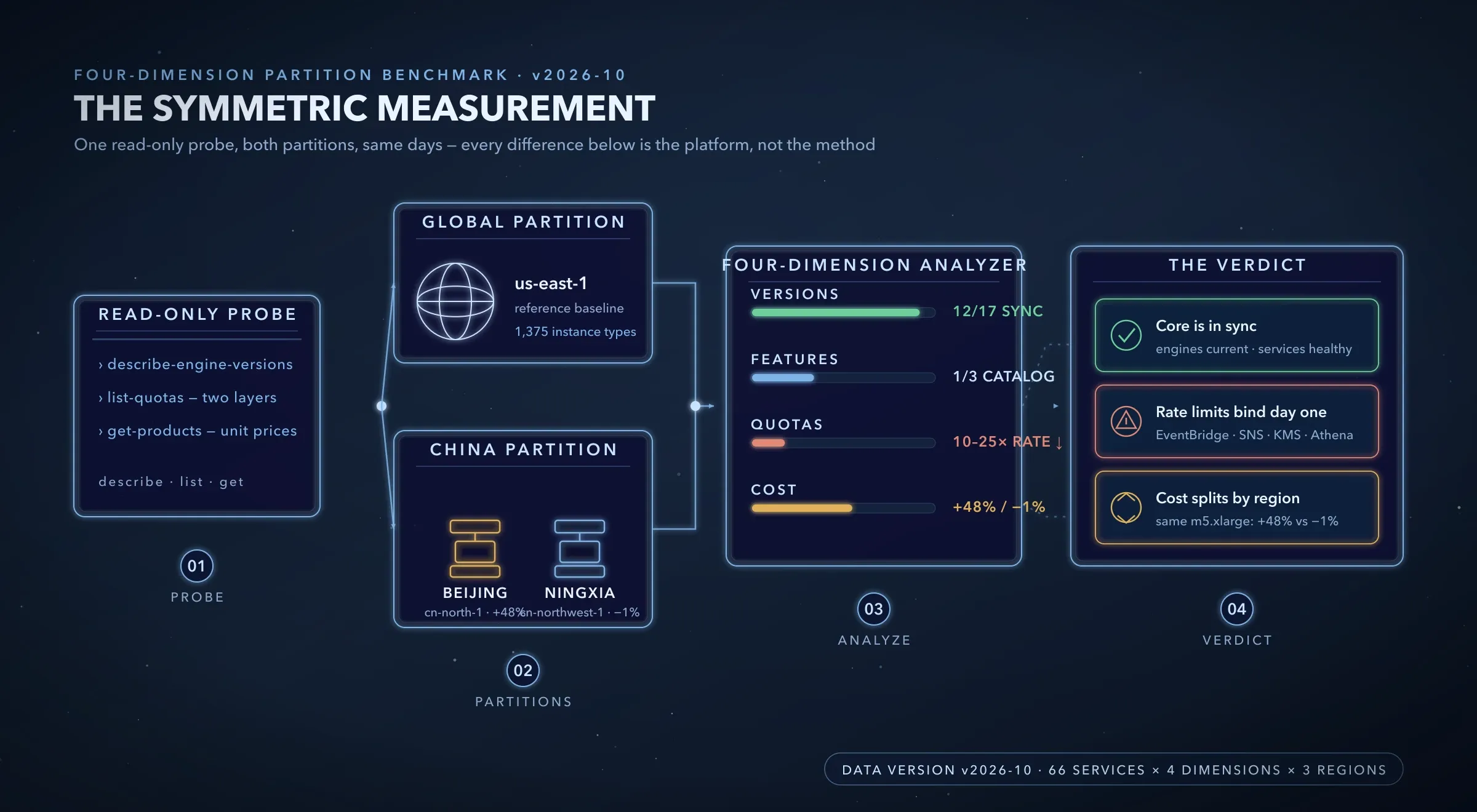
This article reports a different measurement. Two brand-new AWS accounts — one in the China partition (Beijing cn-north-1, Ningxia cn-northwest-1), one in the global partition (us-east-1) — were measured against each other across 66 services and four dimensions. Because both accounts were empty on day one, every number here is a cold-start baseline: the defaults a new product team inherits at AWS China, with no account history and no negotiated limits.
The four dimensions, per service, always the same:
| Dimension | The question | Why a product team cares |
|---|
| Versions | Are engine / runtime / cluster versions in sync? | Migration scripts and feature assumptions break on version skew |
| Features | Is the service deployed, and are sub-features present? | You discover mid-build that you have to roll your own |
| Quotas | Do default limits match global? | The limit you hit is usually a quota, not a missing service |
| Cost | What does the same unit cost? | Budget math done with us-east-1 numbers is wrong twice |
Two scope notes. First, this is not a catalog comparison; accounts, operators, and catalog gaps are covered in our AWS China orientation guide. Second, AI services are out of scope for the per-service matrix: in a separate measurement campaign, AWS China Bedrock availability resolved to a simple fact — no endpoint for Bedrock or any managed AI API in either China region, leaving SageMaker self-build, with a 2021-generation A10G accelerator ceiling, as the only path.
Official AWS sources, for cross-checking anything below:
These are the authoritative references; this article’s numbers are independent measurements taken at a point in time.
How we tested
The method — we call it a four-dimension partition benchmark — is symmetric measurement: every number below was produced by calling the same read-only AWS API, with the same commands, against both partitions on the same days, so any difference in these tables can only come from the platform, never from the measurement. The principle is falsifiability: each table names the API behind it and every open question we could not resolve is published rather than smoothed over, so your team can re-run the commands against your own accounts and check us.
- When: October 11–12, 2026, in six batches, all commands re-runnable.
- Accounts: One fresh China-partition account, one fresh global account. Account identifiers are excluded from this article. “Fresh” matters: applied quotas carry account history, so every quota number below is the default layer — the factory setting a new team inherits.
- Method: Read-only API calls only — describe / list / get. Zero resources created, zero spend. Service-quotas values read from both API layers (see field note below). Engine versions from
describe-*-engine-versions. Endpoint existence verified per service by calling a minimal read API and classifying the response; “not deployed” below always means the endpoint does not exist in public DNS or rejects the call as unsupported — never a guess.
- Pricing: Read from the Price List API (EC2 per instance type; managed services pulled as full regional catalogs and matched client-side). One structural finding: RDS and Aurora compute SKUs are absent from the Pricing API for the China partition — for those, and only those, you must price from the official AWS China price list; the blind-spot table in the Cost insight is the complete list of verified gaps. Everything else in this article is API-sourced.
- All prices are shown in USD; China list prices were billed in CNY and converted at ≈7.1 CNY/USD.
Field note: read quotas in two layers, or you will misread them
Our first pass concluded that the Lambda concurrency quota “does not exist” in China: GetServiceQuota returned NoSuchResource while the console showed 1,000. The resolution: applied-value and default-value are two different APIs, and a quota that was never initialized is invisible to the applied layer — GetAWSDefaultServiceQuota returned 1,000 cleanly. This is not China-specific; any fresh account behaves this way. Every quota claim in this article survived the two-layer read.
Key numbers at a glance
For readers with thirty seconds — and for anyone quoting this benchmark — five numbers carry most of the weight. Each links to the section that measures it.
| Number | What it measures |
|---|
| 25× | EventBridge and SNS default throughput vs global — 750 vs 18,750 TPS invocations, 120 vs 3,000 TPS topic operations (Quotas insight) |
| 10× | KMS symmetric crypto, 10k vs 100k TPS, and Athena concurrent queries, 20 vs 200 (Quotas insight) |
| +48% / −1% | The same m5.xlarge on-demand hour in Beijing and Ningxia, against us-east-1’s $0.192 (Cost insight) |
| +153% | ALB LCU-hour in Beijing; Ningxia prices the identical unit at parity (Cost insight) |
| 66 + 10 | Service surfaces measured in full plus surfaces absent in both regions — the closed ledger behind every claim above (The matrix) |
The matrix: 66 services, four dimensions, three regions
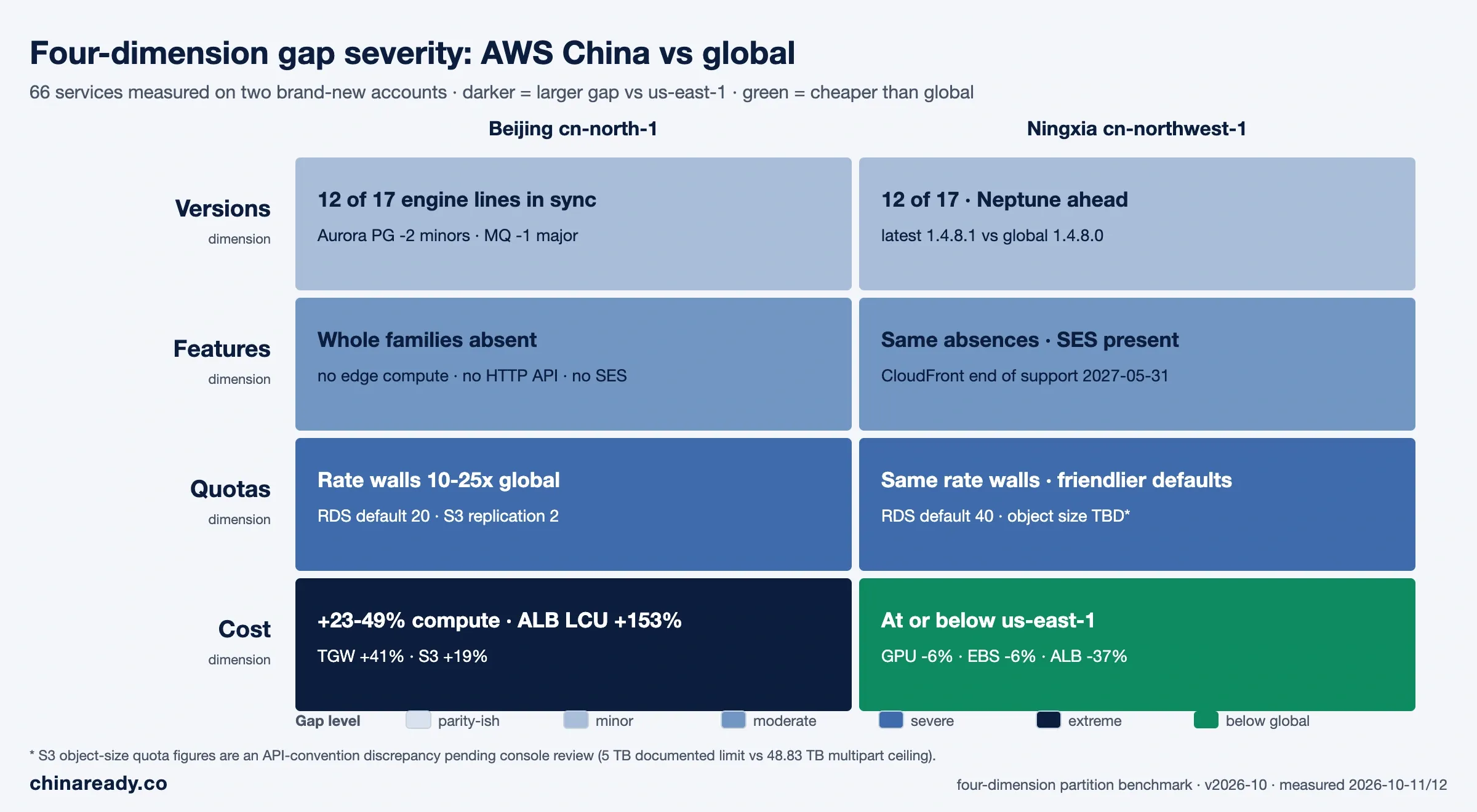
Each service gets the same four-row table. The Gap column is the verdict; the three region columns are the evidence. “Parity” means all three regions returned the same answer. Ten further service surfaces have no endpoint in either China region; they are consolidated in the closing table of this section, so the ledger closes at 66 measured plus 10 absent. One convention on Cost rows: a number is API-measured on both sides, three dashes mean the unit was simply not captured by this benchmark, and the only verified API absence — RDS and Aurora compute — points to the blind-spot table in the Cost insight.
Compute and runtime
EC2 — one-third the catalog, no 7th generation, three GPU chips
| Dimension | us-east-1 | Beijing | Ningxia | Gap |
|---|
| Versions | Current generations (m7i / c7i / r7i / p6 present) | No 7th-gen families | Same as Beijing | 7th-generation instance families absent in China |
| Features | 1,375 types / 146 accelerator types | 432 / 33 | 461 / 40 | ~1/3 breadth; GPU: 13 chips vs 3 (T4, A10G, Inferentia); within-family sizes never shrink — what’s missing is whole families |
| Quotas | Catalog 1,775 items; vCPU default 5 | 1,614 items (1,526 not adjustable) | 1,613 items | Defaults match; 94% of Beijing catalog items are not adjustable |
| Cost | m5.xlarge $0.192/hr | $0.285 (+48%) | $0.191 (−1%) | Beijing +23–49%; Ningxia at or below us-east-1, GPU −6% |
EKS — service healthy; quota self-service not integrated
| Dimension | us-east-1 | Beijing | Ningxia | Gap |
|---|
| Versions | 1.32–1.37 (7 versions) | Same, latest 1.37 | Same | Fully in sync, Auto Mode available |
| Features | Full cluster + addon APIs | Works; list-addons returns NotFound | Works | Core is there; addon management surface has a gap |
| Quotas | 12 self-service quota items | Not integrated into Service Quotas (NoSuchResource) | Same | The one genuine partition-level quota integration gap — the service itself is healthy |
| Cost | Control plane $0.10/hr; Fargate $0.0405/vCPU-hr | Control plane $0.097; Fargate $0.051 (+26%) | Same | Control plane at parity; Fargate +26% |
ECS / Fargate — API parity; the difference is quota management
| Dimension | us-east-1 | Beijing | Ningxia | Gap |
|---|
| Versions | n/a | n/a | n/a | — |
| Features | describe/list all available | Works | Works | Parity |
| Quotas | 62 items (default layer) | 62 items, identical values | 62 items | Default layer identical — measured, not assumed |
| Cost | Fargate vCPU/GB billing | — | — | Priced in the compute bill (EKS Fargate SKU) |
Lambda — durable-execution rates halved
| Dimension | us-east-1 | Beijing | Ningxia | Gap |
|---|
| Versions | Runtimes not measurable read-only (no standalone API) | n/a | n/a | Flagged honestly, not guessed |
| Features | Works | Works | Works | Parity |
| Quotas | 75 items | 33 items; durable-execution rates halved (6,000→3,000 TPS family) | 33 items | Item count 44%; the newest feature ships with half the throttle |
| Cost | $0.0000167/GB-s | $0.00002/GB-s | Same | Compute price at parity across all three regions |
Auto Scaling — full parity
| Dimension | us-east-1 | Beijing | Ningxia | Gap |
|---|
| Versions | n/a | n/a | n/a | — |
| Features | Works | Works | Works | Parity |
| Quotas | 9 items, all identical | 9 | 9 | Identical values |
| Cost | Billed with EC2 | Same | Same | — |
Batch — full parity
| Dimension | us-east-1 | Beijing | Ningxia | Gap |
|---|
| Versions | n/a | n/a | n/a | — |
| Features | Works | Works | Works | Parity |
| Quotas | 15 items (all not adjustable) | 15, identical | 15 | Identical |
| Cost | Billed via Fargate/EC2 | Same | Same | — |
Elastic Beanstalk — works everywhere; quota plane absent in China
| Dimension | us-east-1 | Beijing | Ningxia | Gap |
|---|
| Versions | Platform branches API available | Same | Same | Depth comparison deferred (API granularity is coarse) |
| Features | Works | Works | Works | Parity |
| Quotas | 5 items | Not integrated | Not integrated | Quota self-service absent |
| Cost | Billed via EC2/ELB | Same | Same | — |
Messaging and streaming
SQS — parity
| Dimension | us-east-1 | Beijing | Ningxia | Gap |
|---|
| Versions | n/a | n/a | n/a | — |
| Features | Works | Works | Works | Parity |
| Quotas | Integrated | Integrated | Integrated | No differing values measured |
| Cost | Per-request | — | — | — |
SNS — transaction rates at one twenty-fifth of global
| Dimension | us-east-1 | Beijing | Ningxia | Gap |
|---|
| Versions | n/a | n/a | n/a | — |
| Features | Works | Works | Works | Parity |
| Quotas | Topic ops at 3,000 TPS | 120 TPS across the board | 120 TPS | 25× throttle — fan-out-heavy designs must re-rate |
| Cost | Per-request | — | — | — |
EventBridge — invocation and PutEvents rates at one twenty-fifth
| Dimension | us-east-1 | Beijing | Ningxia | Gap |
|---|
| Versions | n/a | n/a | n/a | — |
| Features | Works | Works | Works | Parity |
| Quotas | 21 items; invocations 18,750 TPS / PutEvents 10,000 TPS | 8 items; 750 / 400 TPS | Same | 25× throttle on the event backbone — event-driven capacity plans must be re-derived, not ported |
| Cost | Per-event | — | — | — |
Step Functions — parity
| Dimension | us-east-1 | Beijing | Ningxia | Gap |
|---|
| Versions | n/a | n/a | n/a | — |
| Features | Works | Works | Works | Parity |
| Quotas | Integrated | Integrated | Integrated | No differing values |
| Cost | Per transition | — | — | — |
MSK (Kafka) — 36 versions, fully in sync
| Dimension | us-east-1 | Beijing | Ningxia | Gap |
|---|
| Versions | 36 versions (4.2.x KRaft) | 36, same | 36, same | Fully in sync |
| Features | Works | Works | Works | Parity |
| Quotas | 7 items | 7, identical | 7 | Identical |
| Cost | Per broker | — | — | — |
Amazon MQ — the dataset’s only major-version gap
| Dimension | us-east-1 | Beijing | Ningxia | Gap |
|---|
| Versions | RabbitMQ 4.3 / ActiveMQ 5.19 | RabbitMQ 4.2 / ActiveMQ 5.18 | Same | Both brokers one major version behind |
| Features | Works | Works | Works | Parity |
| Quotas | 17 items | 17 (15 not adjustable) | 17 | No differing values |
| Cost | Per broker + instance | — | — | — |
Kinesis (Streams + Firehose) — parity
| Dimension | us-east-1 | Beijing | Ningxia | Gap |
|---|
| Versions | n/a | n/a | n/a | — |
| Features | Streams/Firehose APIs work | Works | Works | Parity |
| Quotas | Integrated | Integrated | Integrated | No differing values |
| Cost | Per shard/PUT | — | — | — |
AppSync — API parity; quota plane absent
| Dimension | us-east-1 | Beijing | Ningxia | Gap |
|---|
| Versions | n/a | n/a | n/a | — |
| Features | Works | Works | Works | Parity |
| Quotas | In catalog | Not integrated | Not integrated | Quota self-service absent |
| Cost | Per request | — | — | — |
API Gateway — REST works; HTTP API does not exist
| Dimension | us-east-1 | Beijing | Ningxia | Gap |
|---|
| Versions | n/a | n/a | n/a | — |
| Features | REST + HTTP APIs | REST works; HTTP API (v2) endpoint not deployed | Same | Architectures must use REST v1 — cheaper-to-run HTTP APIs are not an option in China |
| Quotas | 51 items | Not integrated | Not integrated | Quota self-service absent |
| Cost | Per request | — | — | — |
AppConfig — parity
| Dimension | us-east-1 | Beijing | Ningxia | Gap |
|---|
| Versions | n/a | n/a | n/a | — |
| Features | Works | Works | Works | Parity |
| Quotas | Not listed | Not listed | Not listed | — |
| Cost | Per configuration update | — | — | — |
Cloud Map — parity
| Dimension | us-east-1 | Beijing | Ningxia | Gap |
|---|
| Versions | n/a | n/a | n/a | — |
| Features | Works | Works | Works | Parity |
| Quotas | Integrated | Integrated | Integrated | No differing values |
| Cost | Per endpoint | — | — | — |
Systems Manager (incl. Parameter Store) — parity
| Dimension | us-east-1 | Beijing | Ningxia | Gap |
|---|
| Versions | n/a | n/a | n/a | — |
| Features | Works | Works | Works | Parity |
| Quotas | In ssm catalog | Integrated | Integrated | No differing values |
| Cost | Standard parameters free | Same | Same | — |
Data layer
RDS MySQL — versions in sync; Beijing and Ningxia quotas diverge
| Dimension | us-east-1 | Beijing | Ningxia | Gap |
|---|
| Versions | 22 versions, latest 8.4.11 | 22, same | 22, same | Fully in sync |
| Features | Works | Works | Works | Parity |
| Quotas | DB instances 40; parameter groups 50 | DB instances 20; parameter groups 20 | 40; 50 | Beijing 20 vs Ningxia 40 — an intra-China asymmetry, not a partition one |
| Cost | db.m5.large / db.r5.xlarge baselines captured | Not in Pricing API — blind-spot list | Same | Official China price list |
RDS PostgreSQL — latest in sync; 11 fewer historical versions
| Dimension | us-east-1 | Beijing | Ningxia | Gap |
|---|
| Versions | 56 versions, latest 18.6 | 45, latest in sync | 45 | Latest matches; fewer rollback targets |
| Features | Works | Works | Works | Parity |
| Quotas | As RDS family | 20/20 | 40/50 | Same Beijing asymmetry |
| Cost | Baselines captured | Not in Pricing API — blind-spot list | Same | Official China price list |
RDS MariaDB — fully in sync
| Dimension | us-east-1 | Beijing | Ningxia | Gap |
|---|
| Versions | 27 versions, 12.3.3 | 27, same | 27 | Fully in sync |
| Features | Works | Works | Works | Parity |
| Quotas | Family values | Family asymmetry | Family values | As above |
| Cost | — | Not in Pricing API — blind-spot list | Same | Official China price list |
Aurora MySQL — latest in sync
| Dimension | us-east-1 | Beijing | Ningxia | Gap |
|---|
| Versions | 35 versions | 33, latest in sync | 33 | Latest matches |
| Features | Works | Works | Works | Parity |
| Quotas | Family values | Family asymmetry | Family values | As above |
| Cost | Aurora baselines captured | Not in Pricing API — blind-spot list | Same | Official China price list |
Aurora PostgreSQL — two minor versions behind
| Dimension | us-east-1 | Beijing | Ningxia | Gap |
|---|
| Versions | 46 versions, 18.6 | 40, 18.4 | 40, 18.4 | 2 minor versions behind — the only Aurora line that lags |
| Features | Works | Works | Works | Parity |
| Quotas | Family values | Family asymmetry | Family values | As above |
| Cost | Aurora baselines captured | Not in Pricing API — blind-spot list | Same | Official China price list |
DynamoDB — full parity, measured twice
| Dimension | us-east-1 | Beijing | Ningxia | Gap |
|---|
| Versions | n/a | n/a | n/a | — |
| Features | Works | Works | Works | Parity; global tables do not replicate across partitions |
| Quotas | 13 items; account 80k / table 40k CU | 13, identical values | 13 | Fully identical |
| Cost | Per WCU/RCU | — | — | — |
DocumentDB — engines in sync; instance classes trimmed
| Dimension | us-east-1 | Beijing | Ningxia | Gap |
|---|
| Versions | 8 versions (8.0.2) | 8, same | 8 | Fully in sync |
| Features | 39 instance classes | 33 (r4-generation missing, r5 intact) | 27 | 85% / 69% breadth |
| Quotas | 10 items | 10, identical | 10 | Identical |
| Cost | Per instance | — | — | — |
ElastiCache — engines in sync (including Valkey); Ningxia trims history
| Dimension | us-east-1 | Beijing | Ningxia | Gap |
|---|
| Versions | redis 6 (7.1) / valkey 6 (9.1) / memcached 11 | Same | memcached 7 | Latest all in sync; Ningxia drops 4 historical memcached versions |
| Features | 236 purchasable SKUs | 167 (~70%) | 167 | SKU breadth 70% |
| Quotas | 12 items | 12, identical | 12 | Identical |
| Cost | cache.r5.large $0.216/hr | $0.235 (+9%) | $0.213 (−1%) | Near parity; Ningxia effectively at us-east-1 |
MemoryDB — fully in sync
| Dimension | us-east-1 | Beijing | Ningxia | Gap |
|---|
| Versions | redis 3 (7.1) / valkey 2 (7.3) | Same | Same | Fully in sync |
| Features | Works | Works | Works | Parity |
| Quotas | 8 items | 8, identical | 8 | Identical |
| Cost | Per node | — | — | — |
Neptune — the only engine ahead of global
| Dimension | us-east-1 | Beijing | Ningxia | Gap |
|---|
| Versions | 28 versions, latest 1.4.8.0 | 30, latest 1.4.8.1 | 30, 1.4.8.1 | Both China regions ahead of us-east-1 — the dataset’s only inversion |
| Features | Works | Works | Works | Parity |
| Quotas | 13 items | 13, identical | 13 | Identical |
| Cost | Per instance | — | — | — |
OpenSearch — engines in sync; the serverless variant is absent
| Dimension | us-east-1 | Beijing | Ningxia | Gap |
|---|
| Versions | 36 versions | 36 | 36 | Fully in sync |
| Features | Includes OpenSearch Serverless | Serverless endpoint not deployed | Same | Managed-serverless search is not an option in China |
| Quotas | 5 items (es) | 5, identical | 5 | Identical |
| Cost | Per instance | — | — | — |
Redshift — works; version API too coarse to compare fairly
| Dimension | us-east-1 | Beijing | Ningxia | Gap |
|---|
| Versions | cluster-versions API returns majors only | Same | Same | Granularity flagged rather than forced |
| Features | Works | Works | Works | Parity |
| Quotas | Integrated | Integrated | Integrated | No differing values |
| Cost | Per node | — | — | — |
DAX — works; a quota-catalog oddity worth recording
| Dimension | us-east-1 | Beijing | Ningxia | Gap |
|---|
| Versions | n/a | n/a | n/a | — |
| Features | Works | Works | Works | Parity |
| Quotas | In catalog | No catalog entry | In catalog | Catalog asymmetry — availability is unaffected |
| Cost | Per node | — | — | — |
Storage and backup
S3 (incl. S3 Tables) — parity, except Beijing’s object-size ceiling
| Dimension | us-east-1 | Beijing | Ningxia | Gap |
|---|
| Versions | n/a | n/a | n/a | — |
| Features | Works; S3 Tables available | Works; Tables API reachable (functional check pending) | Works | Parity |
| Quotas | Object size quota 48.83 TB; replication destinations 28 | Object size quota 5 TB; replication destinations 2 | 48.83 TB; 2 | Object-size figures are an API-convention discrepancy, not a confirmed gap — 5 TB matches the documented global single-object limit, 48.83 TB matches the 10,000-part × 5 GiB multipart ceiling; console review pending. Replication fan-out capped at 2 |
| Cost | Standard $0.023/GB-Mo | $0.027 (+19%) | $0.025 (+8%) | Modest premium |
EBS — parity, and gp3 is cheaper in Ningxia
| Dimension | us-east-1 | Beijing | Ningxia | Gap |
|---|
| Versions | n/a | n/a | n/a | — |
| Features | Works | Works | Works | Parity; per-volume concurrent snapshots 5 (not adjustable) in all three |
| Quotas | Under EC2 catalog | Same | Same | Small numbers identical |
| Cost | gp3 $0.08/GB-Mo | $0.084 (+5%) | $0.075 (−6%) | Full volume-type ladder extracted |
EFS — works; quota plane absent in China
| Dimension | us-east-1 | Beijing | Ningxia | Gap |
|---|
| Versions | n/a | n/a | n/a | — |
| Features | Works | Works | Works | Parity |
| Quotas | 23 items | Not integrated | Not integrated | Quota self-service absent |
| Cost | Per GB | — | — | — |
FSx — works; OpenZFS capacity quota quartered
| Dimension | us-east-1 | Beijing | Ningxia | Gap |
|---|
| Versions | n/a | n/a | n/a | — |
| Features | Works | Works | Works | Parity |
| Quotas | 30 items; OpenZFS SSD 262 TB | 25 items; 65 TB | 25 | OpenZFS capacity at 1/4 |
| Cost | Per GB/throughput | — | — | — |
AWS Backup — parity
| Dimension | us-east-1 | Beijing | Ningxia | Gap |
|---|
| Versions | n/a | n/a | n/a | — |
| Features | Works | Works | Works | Parity |
| Quotas | 12 items | 9, identical values | 9 | 3 fewer items; values match |
| Cost | Per backed-up volume | — | — | — |
Network and edge
VPC / ELB — Beijing LCU premium on the ingress line
| Dimension | us-east-1 | Beijing | Ningxia | Gap |
|---|
| Versions | n/a | n/a | n/a | — |
| Features | ALB/NLB work | Works | Works | Parity |
| Quotas | 31 items | 27 (5 not adjustable) | 27 | No material differences |
| Cost | ALB $0.0225/hr + $0.004/LCU-hr | ALB $0.022 (≈parity) + LCU $0.01 (+153%) | ALB $0.014 (−37%) + LCU ≈parity | Beijing’s LCU premium is the single biggest ingress cost gap; Ningxia wins both lines |
Transit Gateway — works; attachment premium 41%
| Dimension | us-east-1 | Beijing | Ningxia | Gap |
|---|
| Versions | n/a | n/a | n/a | — |
| Features | Works | Works (API verified) | Works | Parity |
| Quotas | Under VPC catalog | No separate items | No separate items | Flagged for review |
| Cost | Attachment $0.05/hr + data $0.02/GB | Attachment $0.07 (+41%); data ≈parity | Same | Cross-region mesh costs more per attachment |
PrivateLink — catalog breadth, not price, is the gap
| Dimension | us-east-1 | Beijing | Ningxia | Gap |
|---|
| Versions | n/a | n/a | n/a | — |
| Features | 633 endpoint services (incl. third-party SaaS) | 180 | 181 | ~29% catalog breadth — private connectivity to SaaS partners is where the catalog thins out |
| Quotas | Under VPC catalog | Same | Same | Not separately probed |
| Cost | Interface endpoint $0.02/hr + $0.01/GB | $0.016 + $0.00986 | $0.012 + $0.00986 | Prices slightly below us-east-1 |
CloudFront — distributions work; no edge compute; Ningxia end of support 2027-05-31
| Dimension | us-east-1 | Beijing | Ningxia | Gap |
|---|
| Versions | n/a | n/a | n/a | — |
| Features | Functions / KV stores / realtime logs available | All three: “not supported in this region” | Same, plus published end of support: 2027-05-31 | Lambda@Edge unavailable by dependency; Ningxia carries a retirement date |
| Quotas | 98 items | 98 (43 not adjustable) | No catalog entry | Items match; catalog asymmetry recorded |
| Cost | Per traffic | — | — | — |
Route 53 — zones and health checks in; traffic policy and registration out
| Dimension | us-east-1 | Beijing | Ningxia | Gap |
|---|
| Versions | n/a | n/a | n/a | — |
| Features | Full incl. traffic policies + domain registration | Zones + health checks; traffic policies invalid; no domain registration | Same | Third-party registrar + ICP filing is the path |
| Quotas | 500 hosted zones (catalog entry Beijing only) | Integrated | No catalog entry | Catalog asymmetry |
| Cost | Per zone/query | — | — | — |
Direct Connect — parity
| Dimension | us-east-1 | Beijing | Ningxia | Gap |
|---|
| Versions | n/a | n/a | n/a | — |
| Features | Works | Works | Works | Parity |
| Quotas | 16 items (all not adjustable) | 16, identical | 16 | Identical |
| Cost | Per port/transfer | — | — | — |
Identity and security
IAM — parity
| Dimension | us-east-1 | Beijing | Ningxia | Gap |
|---|
| Versions | n/a | n/a | n/a | — |
| Features | Works | Works | Works | Parity |
| Quotas | 23 items | 23 (catalog entry Beijing only) | No catalog entry | Values identical |
| Cost | Free | Free | Free | — |
Organizations — fully usable inside China; no bridge to your global org
| Dimension | us-east-1 | Beijing | Ningxia | Gap |
|---|
| Versions | n/a | n/a | n/a | — |
| Features | Works | Works (SCPs verified in the earlier campaign) | Works | Build parallel, don’t extend: the two orgs are disjoint |
| Quotas | 20 items | 0 items listed (integrated but empty on a fresh account) | No catalog entry | Empty catalog ≠ unavailable |
| Cost | Free | Free | Free | — |
IAM Identity Center — parity within the partition
| Dimension | us-east-1 | Beijing | Ningxia | Gap |
|---|
| Versions | n/a | n/a | n/a | — |
| Features | Works | Works (instances + permission sets verified) | Works | Parity |
| Quotas | Not listed | Not listed | Not listed | — |
| Cost | Per user | Same | Same | — |
KMS — request rates at one tenth
| Dimension | us-east-1 | Beijing | Ningxia | Gap |
|---|
| Versions | n/a | n/a | n/a | — |
| Features | Works | Works | Works | Parity |
| Quotas | Symmetric crypto 100k TPS; RSA keypair gen 20/4/1 | 10k TPS; 1/0.5/0.1 | Same | 10× on symmetric, 20× on RSA generation — envelope-encryption-heavy designs need a caching layer |
| Cost | Per key/request | — | — | — |
Secrets Manager — parity
| Dimension | us-east-1 | Beijing | Ningxia | Gap |
|---|
| Versions | n/a | n/a | n/a | — |
| Features | Works | Works | Works | Parity |
| Quotas | Integrated | Integrated | Integrated | No differing values |
| Cost | Per secret/version | — | — | — |
ACM — parity
| Dimension | us-east-1 | Beijing | Ningxia | Gap |
|---|
| Versions | n/a | n/a | n/a | — |
| Features | Works | Works | Works | Parity |
| Quotas | Not listed | Not listed | Not listed | — |
| Cost | Public certs free | Same | Same | — |
WAF (v2) — service parity; quota plane absent
| Dimension | us-east-1 | Beijing | Ningxia | Gap |
|---|
| Versions | n/a | n/a | n/a | — |
| Features | Works | Works | Works | Parity |
| Quotas | In catalog | Not integrated | Not integrated | Quota self-service absent |
| Cost | Per rule/request | — | — | — |
GuardDuty — parity
| Dimension | us-east-1 | Beijing | Ningxia | Gap |
|---|
| Versions | n/a | n/a | n/a | — |
| Features | Works | Works | Works | Parity |
| Quotas | Integrated | Integrated | Integrated | No differing values |
| Cost | Per volume/ingested log | — | — | — |
CloudTrail — parity
| Dimension | us-east-1 | Beijing | Ningxia | Gap |
|---|
| Versions | n/a | n/a | n/a | — |
| Features | Works | Works | Works | Parity |
| Quotas | Integrated | Integrated | Integrated | No differing values |
| Cost | Free tier + per-event | Same | Same | — |
AWS Config — parity
| Dimension | us-east-1 | Beijing | Ningxia | Gap |
|---|
| Versions | n/a | n/a | n/a | — |
| Features | Works | Works | Works | Parity |
| Quotas | Integrated | Integrated | Integrated | No differing values |
| Cost | Per configuration item | — | — | — |
| Dimension | us-east-1 | Beijing | Ningxia | Gap |
|---|
| Versions | n/a | n/a | n/a | — |
| Features | Works | Works | Works | Parity |
| Quotas | Not listed | Not listed | Not listed | — |
| Cost | Free (resources billed) | Same | Same | — |
ECR — parity
| Dimension | us-east-1 | Beijing | Ningxia | Gap |
|---|
| Versions | n/a | n/a | n/a | — |
| Features | Works | Works | Works | Parity |
| Quotas | 23 items | 22, values identical | 22 | 1 fewer item |
| Cost | Per storage/transfer | — | — | — |
CodePipeline — parity (and its quota plane IS integrated — an earlier draft of our notes said otherwise; corrected against measured data)
| Dimension | us-east-1 | Beijing | Ningxia | Gap |
|---|
| Versions | n/a | n/a | n/a | — |
| Features | Works | Works | Works | Parity |
| Quotas | 29 items | 29 (20 not adjustable) | 29 | Identical |
| Cost | Per pipeline | — | — | — |
CodeBuild — works; quota plane absent, which makes CI concurrency opaque
| Dimension | us-east-1 | Beijing | Ningxia | Gap |
|---|
| Versions | n/a | n/a | n/a | — |
| Features | Works | Works | Works | Parity |
| Quotas | 38 items | Not integrated | Not integrated | You cannot read your build-concurrency ceiling from the API |
| Cost | Per build minute | — | — | — |
CodeDeploy — works; fleet sizes halved
| Dimension | us-east-1 | Beijing | Ningxia | Gap |
|---|
| Versions | n/a | n/a | n/a | — |
| Features | Works | Works | Works | Parity |
| Quotas | 2,000 instances per deployment; 3,000 concurrent | 1,000 / 1,000 | Same | Large fleets deploy in batches |
| Cost | Per deployment | Free | Free | — |
Observability
CloudWatch — core parity; RUM out, query throttles lower
| Dimension | us-east-1 | Beijing | Ningxia | Gap |
|---|
| Versions | n/a | n/a | n/a | — |
| Features | Metrics / logs / Synthetics / SLO / RUM | First four work; RUM not offered | Same | Front-end monitoring needs a third party |
| Quotas | 69 log items; StartQuery 10 TPS | 55 items; 6 TPS | Same | Log-query throttle 10→6 |
| Cost | Per metric/log volume | — | — | — |
X-Ray — parity
| Dimension | us-east-1 | Beijing | Ningxia | Gap |
|---|
| Versions | n/a | n/a | n/a | — |
| Features | Works | Works | Works | Parity |
| Quotas | Integrated | Integrated | Integrated | No differing values |
| Cost | Per trace | — | — | — |
Analytics
Athena — concurrent queries one tenth of global
| Dimension | us-east-1 | Beijing | Ningxia | Gap |
|---|
| Versions | n/a | n/a | n/a | — |
| Features | Works | Works | Works | Parity |
| Quotas | 30 items; active DML queries 200 | 5 items; 20 | 20 | 10× fewer concurrent queries — dashboards queue |
| Cost | Per data scanned | — | — | — |
Glue — parity
| Dimension | us-east-1 | Beijing | Ningxia | Gap |
|---|
| Versions | n/a | n/a | n/a | — |
| Features | Works | Works | Works | Parity |
| Quotas | Integrated | Integrated | Integrated | No differing values |
| Cost | Per DPU-hour | — | — | — |
EMR — works; release-catalog comparison deferred
| Dimension | us-east-1 | Beijing | Ningxia | Gap |
|---|
| Versions | 100 release labels measured | 100 | 100 | Count truncation suspected — flagged, not claimed |
| Features | Works | Works | Works | Parity |
| Quotas | Integrated | Integrated | Integrated | No differing values |
| Cost | EC2 rates in API; EMR surcharge not | Same | Same | Partially computable |
QuickSight — API reachable; fresh account not subscribed
| Dimension | us-east-1 | Beijing | Ningxia | Gap |
|---|
| Versions | n/a | n/a | n/a | — |
| Features | Works | API reachable (account-level “not subscribed” response is a fresh-account state, not absence) | Same | Subscribe and go |
| Quotas | In catalog | Catalog entry (Beijing only) | No catalog entry | Catalog asymmetry unexplained — flagged |
| Cost | Per user/session | — | — | — |
SaaS-critical services
SES — deployed in Ningxia only; a region-selection factor
| Dimension | us-east-1 | Beijing | Ningxia | Gap |
|---|
| Versions | n/a | n/a | n/a | — |
| Features | Works (production) | No endpoint | Works — API live, sandbox 200 emails/day measured | Email-reliant SaaS has exactly one China region option |
| Quotas | In catalog | No catalog entry | Catalog entry | Catalog matches deployment |
| Cost | Per email | — | — | — |
| Dimension | us-east-1 | Beijing | Ningxia | Gap |
|---|
| Versions | 5 engine versions | 2 | 2 | Match your source engine against the short list before planning |
| Features | Works | Works | Works | Parity |
| Quotas | 21 items | 16 | 16 | No material differences |
| Cost | Per replication instance | — | — | — |
Not deployed in either China region
These endpoints do not exist in Beijing or Ningxia. The replacement path is the actionable content:
| Service | Category | Replacement path |
|---|
| App Runner | App platform | ECS/Fargate + ALB |
| Amplify Hosting | App platform | S3 + CloudFront or third-party |
| Pinpoint | Engagement | Domestic SMS/push vendors |
| AppFlow | Data integration | Custom ETL |
| CodeArtifact | DevTools | Self-hosted Nexus/Artifactory with in-country mirroring |
| Global Accelerator | Network | CloudFront / third-party CDN for anycast needs |
| Cognito User Pools | Identity | Self-built auth or third-party IdP (identity-pool endpoint exists in Beijing — flagged for review) |
| CloudWatch Evidently | Observability | Third-party A/B tooling (also retiring globally) |
| Incident Manager | Observability | SSM + custom incident tooling |
| Cloud Shell | Tooling | Local CLI / CI runners |
Dimension insights
Versions: sync is the norm, and the exceptions fit on one line
Of the 17 engine lines with a comparable version axis, 12 match the latest version in both China regions — including EKS (1.37, with Auto Mode), MSK (36 Kafka versions), and the entire open-source database line, down to Valkey 9.1, an engine that first shipped in 2024. The “China database versions lag” folklore is not supported by measurement.
The exceptions, in full: Aurora PostgreSQL is two minors behind (18.4 vs 18.6); Amazon MQ is the only major-version gap — both RabbitMQ (4.2 vs 4.3) and ActiveMQ (5.18 vs 5.19); Neptune is ahead in both China regions (1.4.8.1 vs 1.4.8.0), the dataset’s only inversion; ElastiCache memcached drops four historical versions in Ningxia. If your workload is version-sensitive, your entire pre-migration version audit is these four lines.
Features: whole families are missing, not thinned
Feature gaps in the China partition are structural absences, not degradation. EC2 has 432–461 instance types against 1,375 — but within any family that exists, every size matches global exactly (g4dn 7/7, g5 8/8). The same pattern repeats at every layer: OpenSearch exists, OpenSearch Serverless does not; API Gateway REST exists, HTTP API does not; CloudFront distributions exist, the entire edge-compute plane (Functions, KV stores, realtime logs, and Lambda@Edge by dependency) does not.
AWS China GPU instances warrant specific attention in architecture reviews: three accelerator chips (T4, A10G, Inferentia) against thirteen in us-east-1, including the 2026-generation B200/B300, and the 7th-generation CPU families (m7i/c7i/r7i) have not landed. Performance-generation-sensitive workloads face a hard ceiling. On the AI stack, the scope note from the introduction applies: no Bedrock, no managed AI APIs, SageMaker self-build with an A10G ceiling.
Quotas: rate limits, not resource limits
This dimension produced the numbers most likely to change a migration plan. Resource-class quotas (vCPUs, DB instances, tables) are mostly partition-consistent at the default layer — but the rate-class quotas run 10–25× below global: EventBridge invocations at 750 vs 18,750 TPS, SNS topic operations at 120 vs 3,000 TPS, KMS symmetric crypto at 10k vs 100k TPS, Athena concurrent queries at 20 vs 200. These limits bind CI/CD pipelines, event backbones, and BI dashboards on launch day, not at scale.
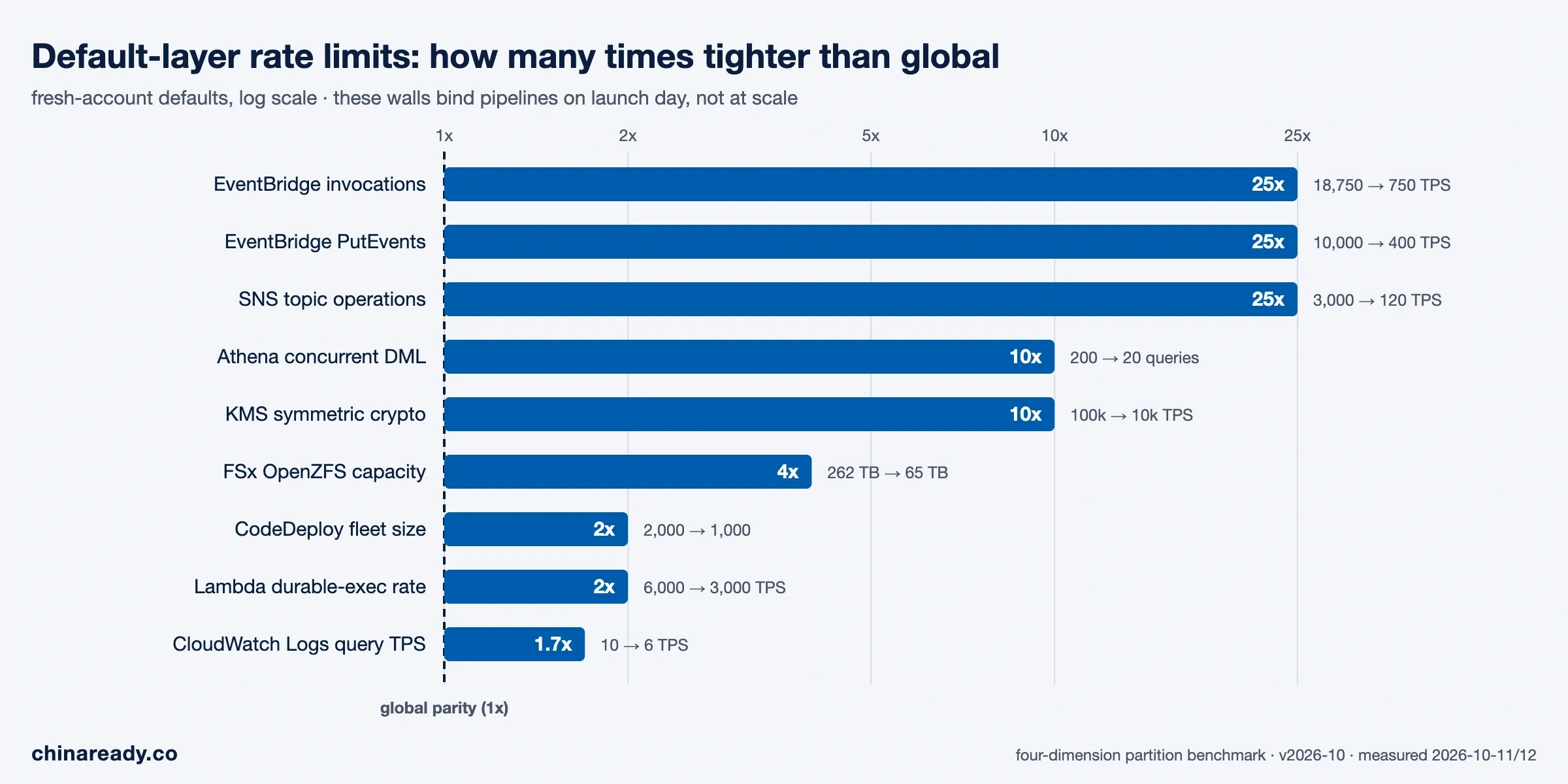
Three structural findings around them:
- The quota management plane is itself gapped. Global exposes 320 services through self-service quotas; China exposes 119/111 — and the missing set includes EKS, API Gateway, CodeBuild, WAF, and EFS. For those, the ceiling is real but unreadable from the API.
- “Not adjustable” is the default posture. 94% of Beijing’s EC2 quota items carry no increase path. You design around them; you don’t file tickets.
- Intra-China asymmetry is real and material. RDS instances default to 20 in Beijing vs 40 in Ningxia; the S3 object-size quota is reported under two conventions (5 TB vs 48.83 TB — pending verification); SES exists only in Ningxia. “Which China region” is a first-order architecture decision, not a footnote.
Cost: Beijing premium, Ningxia discount
AWS China pricing divides cleanly by region (CNY list prices converted at ≈7.1). Beijing runs +23–49% over us-east-1 on compute (m6i.xlarge +49%, c6i +23%), adds a 153% premium on ALB LCU-hours, and charges +41% for Transit Gateway attachments. Ningxia, meanwhile, prices at or below us-east-1 almost across the board: m5.xlarge −1%, GPU g5.12xlarge −6%, EBS gp3 −6%, ALB −37%, Lambda at exact parity, ElastiCache at parity. Public IPv4 addresses are cheaper in both (−7%).
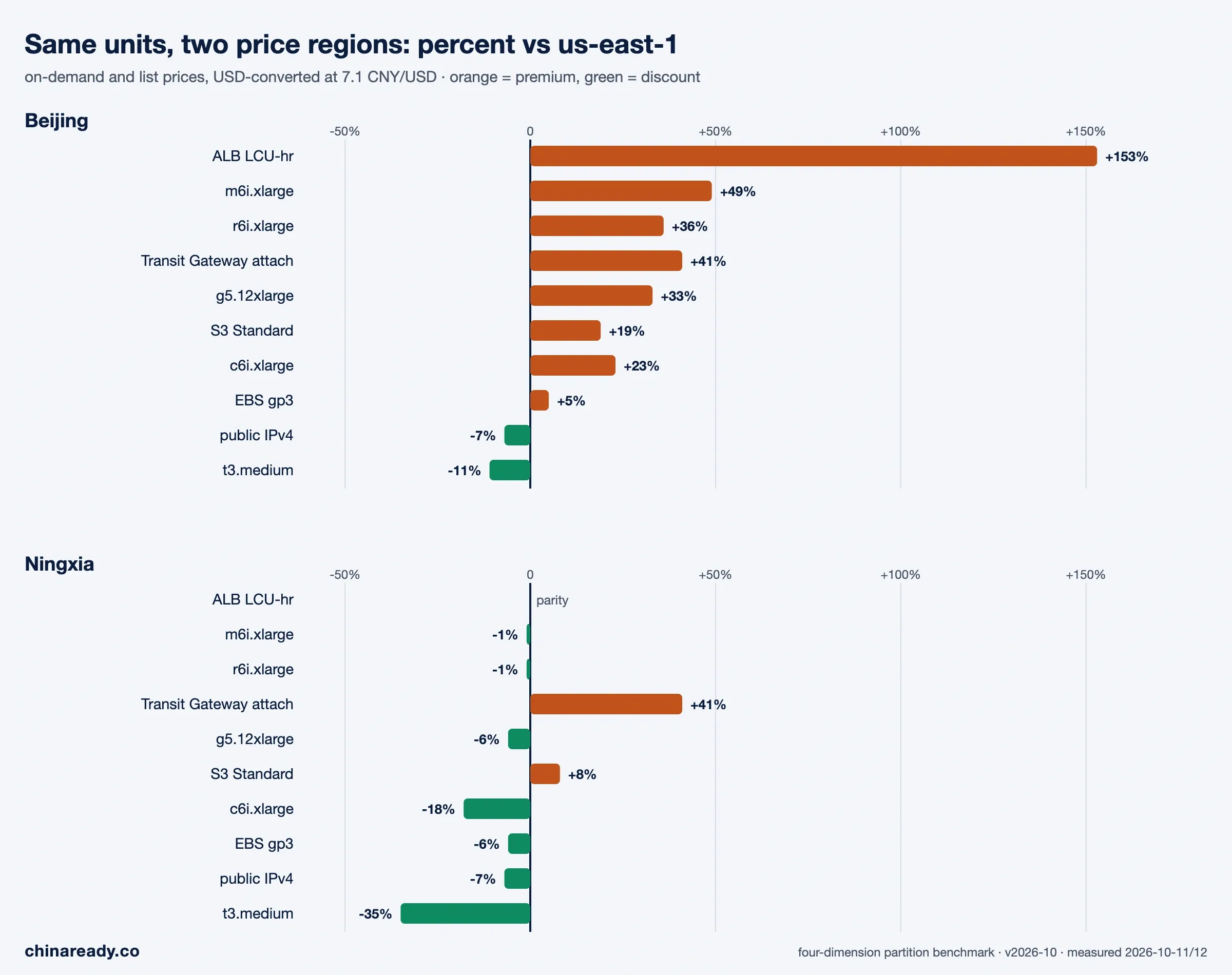
For budget modeling: EC2, EBS, S3, ALB, ElastiCache, Lambda, EKS, TGW, and PrivateLink are all API-priced for China and captured throughout this article. The Cost rows elsewhere in the matrix that carry dashes were simply not captured by this benchmark — not claimed absent. What the China Pricing API genuinely lacks is a short list:
The Pricing API blind-spot list
| Surface | Status in the China Pricing API | Where to price it |
|---|
| RDS compute — MySQL, PostgreSQL, MariaDB | Verified absent. The China catalog carries storage and license SKUs but no instance billing rows | Official AWS China price list |
| Aurora compute — MySQL, PostgreSQL | Verified absent. Same catalog gap | Official AWS China price list |
| NAT Gateway | SKU not located in the catalog pull — open item, listed in “What we could not pin down” | Official AWS China price list |
| Every other priced line in this article | Present and automatable. S3, ELB, ElastiCache, the VPC family, EKS, Lambda, and EBS (under the AmazonEC2 service code) were all read via full-catalog pulls with client-side SKU matching | Pricing API |
Two practical notes for FinOps automation. The catalog pull must be location-based — server-side usagetype filters silently return nothing for China regions — and EBS hides under the AmazonEC2 service code with CNN1-/CNW1-prefixed usagetypes. Once those two conventions are handled, everything in the bottom row scripts cleanly; the database lines do not, as of data version v2026-10.
The compute bill: EC2 and EKS
Every line measured at Linux / shared tenancy / on-demand, shown in USD (China CNY list prices converted at ≈7.1).
| Compute line item | us-east-1 | Beijing | Ningxia |
|---|
| EC2 t3.medium (burstable) | $0.0416 | $0.037 (−11%) | $0.027 (−35%) |
| EC2 t4g.medium (Graviton burstable) | $0.0336 | $0.029 (−15%) | $0.021 (−38%) |
| EC2 m5.xlarge (general) | $0.192 | $0.285 (+48%) | $0.191 (−1%) |
| EC2 m6i.xlarge (general) | $0.192 | $0.285 (+49%) | $0.191 (−1%) |
| EC2 m7i.xlarge (general) | $0.202 | not offered | not offered |
| EC2 c6i.xlarge (compute) | $0.170 | $0.208 (+23%) | $0.139 (−18%) |
| EC2 c7i.xlarge (compute) | $0.179 | not offered | not offered |
| EC2 r6i.xlarge (memory) | $0.252 | $0.343 (+36%) | $0.249 (−1%) |
| EC2 r7i.xlarge (memory) | $0.265 | not offered | not offered |
| EC2 g4dn.xlarge (1× T4) | $0.526 | $0.736 (+40%) | $0.523 (−1%) |
| EC2 g5.12xlarge (4× A10G) | $5.672 | $7.56 (+33%) | $5.32 (−6%) |
| EKS control plane (per cluster) | $0.10/hr | $0.097 (≈parity) | $0.097 (≈parity) |
| EKS Fargate (per vCPU-hr) | $0.0405 | $0.051 (+26%) | $0.051 (+26%) |
Note the inversion: standard families carry a Beijing premium of +23–49%, but burstable t3/t4g run 11–38% below us-east-1 in both China regions, making small dev/test workloads among the few things genuinely cheaper in China. The 7th-generation rows express the generation gap from the features section as money.
The database bill: managed vs self-hosted
Managed database pricing splits into what the API exposes and what it doesn’t. RDS and Aurora compute SKUs are the one blind spot — us-east-1 baselines below are API-measured; China prices for those four rows must come from the official China price pages or the Amazon Pricing Calculator (China region) for interactive estimates. Everything else is measured.
| Database line item | us-east-1 | Beijing | Ningxia |
|---|
| RDS MySQL db.m5.large (Single-AZ) | $0.171/hr | official price pages | official price pages |
| RDS MySQL db.r5.xlarge (Single-AZ) | $0.480/hr | official price pages | official price pages |
| Aurora MySQL db.r5.xlarge | $0.580/hr | official price pages | official price pages |
| Aurora PostgreSQL db.r5.xlarge | $0.754/hr | official price pages | official price pages |
| ElastiCache Redis cache.r5.large | $0.216/hr | $0.235 (+9%) | $0.213 (−1%) |
| Self-hosted MySQL/PostgreSQL on r6i.xlarge | $0.252/hr | $0.343 (+36%) | $0.249 (−1%) |
| Self-hosted Redis/Kafka node on m6i.xlarge | $0.192/hr | $0.285 (+49%) | $0.191 (−1%) |
The self-hosted rows quantify the fallback where a managed price is not API-readable: the floor is an EC2 node that prices exactly. In Ningxia that floor sits at −1% vs us-east-1.
The storage bill: S3 classes and EBS volume types
S3 storage classes (GB-month; the 2026 price catalog renames Standard to “General Purpose” and Glacier tiers to “Archive” — old names shown for readability):
| S3 storage class | us-east-1 | Beijing | Ningxia |
|---|
| Standard (General Purpose) | $0.023 | $0.027 (+19%) | $0.025 (+8%) |
| Standard-IA (Infrequent Access) | $0.0125 | $0.019 (+51%) | $0.015 (+16%) |
| Glacier Instant Retrieval | $0.0040 | $0.00465 (+18%) | $0.00423 (+6%) |
| Glacier Flexible Retrieval | $0.0036 | $0.00423 (+18%) | $0.0038 (+6%) |
| Reduced Redundancy | $0.024 | $0.024 (−1%) | $0.024 (−1%) |
EBS volume types (GB-month, full ladder):
| EBS volume type | us-east-1 | Beijing | Ningxia |
|---|
| gp3 (general SSD) | $0.080 | $0.084 (+5%) | $0.075 (−6%) |
| gp2 (legacy general SSD) | $0.100 | $0.105 (+5%) | $0.094 (−6%) |
| io1 / io2 (provisioned IOPS) | $0.125 | $0.121 (−3%) | $0.108 (−14%) |
| st1 (throughput HDD) | $0.045 | $0.047 (+5%) | $0.042 (−6%) |
| sc1 (cold HDD) | $0.015 | $0.016 (+5%) | $0.014 (−6%) |
The storage pattern is consistent: Beijing carries roughly +5% on block storage and +8–51% on object storage by class, while Ningxia lands at or below us-east-1 on every row; provisioned-IOPS SSD is 14% cheaper there. Archive classes carry a +6–18% premium over us-east-1 — modest, but log-retention and backup-heavy SaaS should still re-run the math before porting a retention policy.
One claim withdrawn during review: an earlier draft flagged the Beijing g5 ladder as inverted because g5.12xlarge (4× A10G, $7.55) lists above g5.16xlarge (1× A10G, $5.46). Sorting by GPU count shows this mirrors the global structure exactly — us-east-1 prices the same pair at $5.67 vs $4.10. The ladder is GPU-count-driven; there is no anomaly.
Four conclusions from 66 services
Read across the four dimensions and four structural conclusions emerge:
1. The catalog was never the problem. Of the 76 service surfaces a complex SaaS would touch, 66 are deployed, healthy, and measured below, and 10 have no endpoint in either region; on the version axis, 12 of 17 engine lines match global’s latest in both regions. A team that stops at “is it listed?” predicts failure where measurement shows parity, and misses it where it actually occurs.
2. The gaps are in rate and management planes. The gaps that bite are EventBridge at 4% of global TPS, KMS at 10%, Athena at 10%, quota APIs that cannot answer for EKS and CodeBuild, and an edge-compute plane that doesn’t exist. None of these appear in a catalog; they appear in production.
3. Beijing and Ningxia are different products. The intra-China asymmetries (RDS 20 vs 40, SES Ningxia-only, S3 replication destinations 2 vs 28, ALB LCU +153% vs −0%, EBS +5% vs −6%) mean region selection is an architecture decision with quota, cost, and feature consequences — made once, at the start. For cost-sensitive, latency-tolerant workloads the data says Ningxia; for anything needing SES or lower latency to North China, Beijing — with its premium — is the only option.
4. A fresh account is a known quantity. Because this baseline was measured on day-zero accounts, a new product team can read every default above as their own starting position — and the two-layer quota method in our field note tells them how to keep reading it correctly as they grow.
Decision rules, condensed:
| Your workload | The measured answer |
|---|
| Data-layer lift-and-shift | Migrate — 12/17 engine lines at the latest in both regions; check Aurora PG (−2 minors) and MQ (−1 major) |
| Event-driven / high-fanout | Re-rate the backbone: EventBridge and SNS at 1/25th global TPS |
| CI/CD at fleet scale | CodeBuild quotas unreadable; CodeDeploy 1,000 instances per deployment |
| BI-heavy | Athena 20 concurrent queries; budget for queues or caching |
| Crypto-heavy | KMS 10k TPS symmetric; cache envelope keys |
| Edge-dependent | No Functions/Lambda@Edge; Ningxia CloudFront retires 2027-05-31 |
| Email-sending SaaS | Ningxia or nothing |
| Cost-optimized | Ningxia, by the numbers |
What we could not pin down
Published, not hidden. Status vocabulary: verified (double-checked), needs-console-review (API evidence is strong but the console must confirm), inconclusive (this method cannot resolve it).
| # | Item | Status |
|---|
| 1 | SES Ningxia “deployed” verdict (API 200 + sandbox quota; contradicts common belief) | needs-console-review |
| 2 | Cognito identity-pool asymmetry (Beijing yes, Ningxia no endpoint) | needs-console-review |
| 3 | S3 object-size quota convention: 5 TB (Beijing) vs 48.83 TB (Ningxia, us-east-1) under one quota name | needs-console-review |
| 4 | RDS default instances Beijing 20 vs Ningxia 40 | needs-console-review |
| 5 | Lambda runtimes (no standalone read-only API) | inconclusive |
| 6 | EMR release-catalog counts (possible pagination truncation) | inconclusive |
| 7 | NAT Gateway price SKU not located in the VPC catalog | inconclusive |
| 8 | ElastiCache cache.m5.large absent from China catalog (m6g likely substitute) | needs-console-review |
| 9 | PrivateLink / TGW quota codes not separately listed | needs-console-review |
Appendix: reproduce every table
The claim “all commands re-runnable” should be checkable, not trusted. Every command below is read-only (describe / list / get), costs nothing, and produces rows in this article. China-region calls need a China-partition profile; us-east-1 calls need a global one.
Command list (click to expand)
# Quota catalog coverage — the 320 vs 119/111 table
aws service-quotas list-services --region cn-north-1

# Default-layer quotas per service — the layer every quota number here uses
aws service-quotas list-aws-default-service-quotas --service-code ec2 --region cn-north-1

# Two-layer quota read — the field-note method (applied vs default)
aws service-quotas get-service-quota --service-code lambda --quota-code L-B99A9384 --region cn-north-1
aws service-quotas get-aws-default-service-quota --service-code lambda --quota-code L-B99A9384 --region cn-north-1

# Engine versions — the version tables
aws eks describe-cluster-versions --region cn-north-1
aws rds describe-db-engine-versions --engine aurora-postgresql --region cn-north-1
aws elasticache describe-cache-engine-versions --region cn-northwest-1
aws kafka list-kafka-versions --region cn-north-1
aws mq describe-broker-engine-types --region cn-north-1
aws opensearch list-versions --region cn-north-1

# Compute breadth and GPU inventory
aws ec2 describe-instance-type-offerings --region cn-north-1
aws ec2 describe-instance-types --instance-types g5.12xlarge --region cn-north-1   # GpuInfo

# Feature presence — one minimal read probe per service
aws sqs list-queues --region cn-north-1
aws apigatewayv2 get-apis --region cn-north-1          # HTTP API: fails in China regions, by design of the probe
aws sesv2 get-account --region cn-northwest-1          # SES: Ningxia responds, Beijing has no endpoint

# Prices — Price List API, always queried via the us-east-1 pricing endpoint
aws pricing get-products --service-code AmazonEC2 \
  --filters 'Type=TERM_MATCH,Field=regionCode,Value=cn-north-1' 'Type=TERM_MATCH,Field=instanceType,Value=m5.xlarge'
aws pricing get-products --service-code awselb \
  --filters 'Type=TERM_MATCH,Field=location,Value=China (Beijing)'   # full catalog pull; match SKUs client-side
Notes: quota names and engine version lists are joined across the three regions on identical keys, and the dataset’s source_api column names the exact call behind every row. RDS and Aurora China prices cannot be produced this way — that is the documented API blind spot.
Data version, citation, and requesting a test
Data version: v2026-10 (measured 2026-10-11/12). No fixed re-test cadence is promised — most of these measurements are one-shot by design. Re-measurements and extensions increment the version and land in the changelog.
Download the dataset. Every quantitative row in this article — quota values, engine versions, probe statuses, and unit prices, 224 rows with the source API named on each — is exportable as machine-readable data:
- JSON (
aws-china-partition-benchmark-v2026-10.json, ~60 KB)
- CSV (long format: service, dimension, metric, region columns, source API)
Both carry the same metadata block as this article (method, dates, conventions, withdrawn claims) and are served under CC BY 4.0 with attribution to Chinaready.
Changelog
v2026-10 — 2026-10-12 — Initial release: 66 services × 4 dimensions × 3 regions; quota catalog diff (320/119/111); per-service default-layer quota alignment; unit prices for 10+ cost lines; RDS/Aurora identified as the Pricing API blind spot for China.
Cite this dataset
Chinaready. "AWS China vs Global: Partition Differences Measured Across 66 Services."
Chinaready Insights, four-dimension partition benchmark, data version v2026-10, 2026-10-12.
https://chinaready.co/insights/aws-china-partition-benchmark/
<cite>Chinaready. <a href="https://chinaready.co/insights/aws-china-partition-benchmark/">AWS China vs Global: Partition Differences Measured Across 66 Services</a>. Chinaready Insights, four-dimension partition benchmark, data version v2026-10, 2026-10-12.</cite>
Attribution, trademarks, and disclaimer
Disclaimer. The measurements and conclusions in this article are an independent, user-side evaluation conducted by Chinaready. They do not represent the official position of Amazon Web Services, Inc. or the operators of the AWS China regions — this is a customer’s benchmark, not an AWS test. All AWS product names and trademarks are the property of AWS. For authoritative answers on AWS products, pricing, or quotas, use the official sources listed at the top of this article or contact AWS China through its official channels.
Attribution and copyright. The dataset downloads (JSON and CSV) are licensed under CC BY 4.0 with attribution to Chinaready. The article text is © 2026 Chinaready; quote or excerpt it with a link to this page.
Request a test
This dataset covers what a migration review needs, not everything. If a service, region pair, or dimension you care about is missing or stale, request a test. Two ways in:
- Use the contact form — tell us what you need measured and why it matters to your architecture.
- Email [email protected] with your test request.
Selected requests get measured and folded into the next data version with a changelog entry. Requests that map to a real architecture question tend to get picked first.
Where to go next