
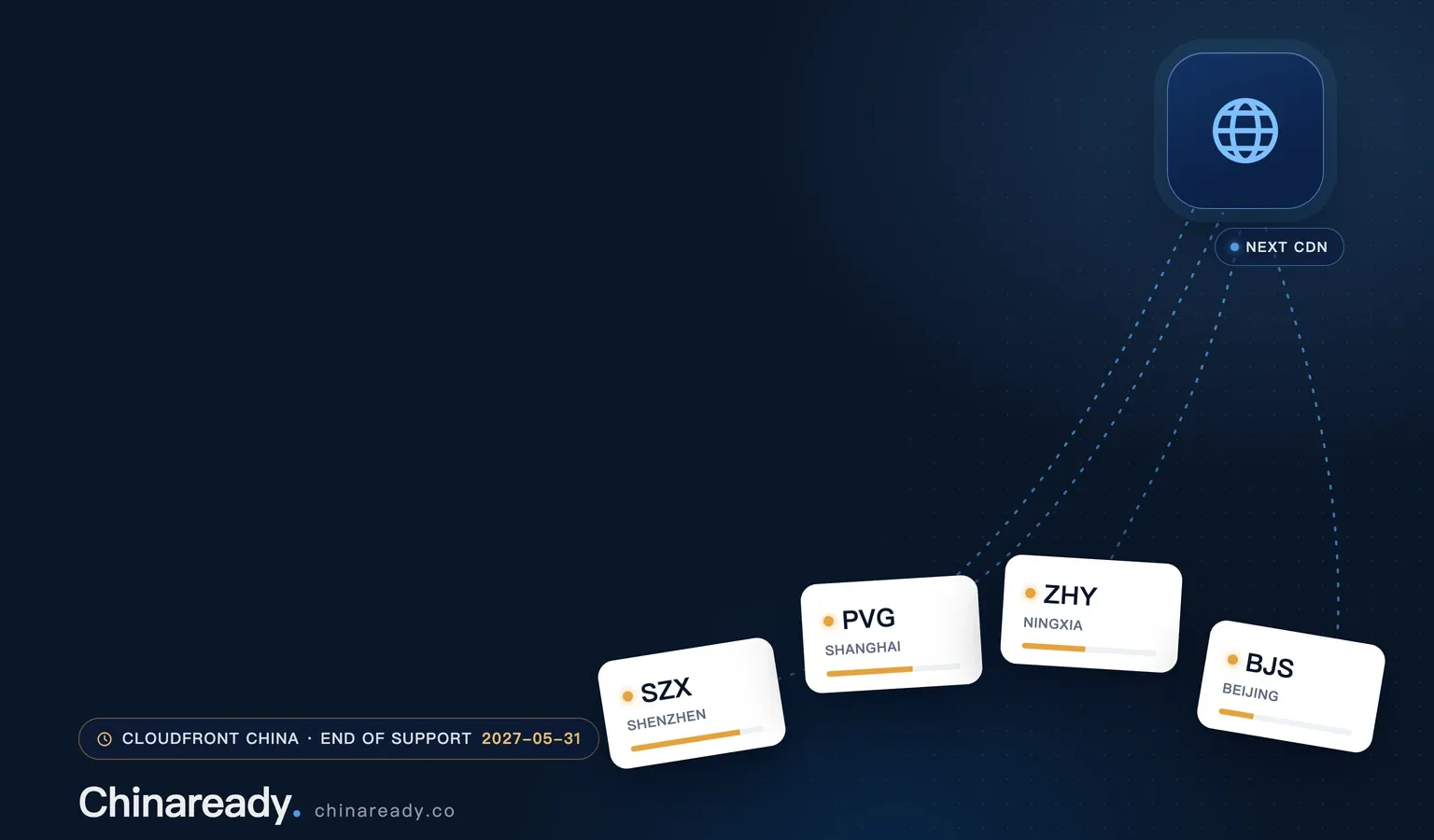
AWS will discontinue Amazon CloudFront in the AWS China (Ningxia) region on May 31, 2027. The four mainland Points of Presence — Shenzhen (SZX), Shanghai (PVG), Ningxia (ZHY), and Beijing (BJS) — will be decommissioned, and after that date AWS accounts can no longer access CloudFront in the China (Ningxia) region at all. The on-ramp is already closed: new distribution creation ended September 30, 2026, and AWS accepts no new CloudFront China customers after that date. If CloudFront China is in your delivery path, you have one cutover to plan between now and May 2027 — this post maps the dates, what breaks, and where teams in your position actually land.
Video companion
This migration map is also a short video — the first episode of the China Cloud updates handbook series on YouTube, with the slide deck published alongside it.
What is actually being switched off
The service being retired is CloudFront as offered inside the AWS China regions: configured through the China (Ningxia) region, with edge locations in Beijing, Shanghai, Zhongwei (Ningxia), and Shenzhen connected by private network to the Beijing region (operated by Sinnet) and the Ningxia region (operated by NWCD). It is the same separate-cloud arrangement that shapes every AWS China service — separate accounts, separate billing, a separate operational surface, and ICP-filed domains. CloudFront China was never a checkbox on a global distribution; it was a China-side deployment you ran in parallel, and it is that parallel deployment that now has an end date.
The two dates that matter
| Date | What happens |
|---|---|
| September 30, 2026 | Last day for new distribution creation; AWS accepts no new CloudFront China customers after this date. Already in effect as of this writing. |
| May 31, 2027 | Support ends. All four PoPs — Shenzhen (SZX), Shanghai (PVG), Ningxia (ZHY), Beijing (BJS) — are decommissioned, and AWS accounts can no longer access CloudFront in the China (Ningxia) region. |
For existing users that is roughly eight months of runway from publication — enough time to migrate properly, and not enough to treat this as next year’s problem. Certificates, DNS TTLs, cache warm-up, and monitoring all behave better when the cutover is planned rather than forced.
What keeps working
Three boundaries contain the blast radius:
- Global CloudFront is unaffected. The discontinuation covers the China (Ningxia) region service, not the global one. Global distributions keep answering requests from mainland users — from PoPs outside the mainland, typically Hong Kong and Asia-Pacific, with the cross-border variability that has always been part of that path. A global CDN without in-mainland PoPs is a different product for China users; the Cloudflare China handbook covers the same physics.
- The AWS China regions keep running. Beijing (Sinnet) and Ningxia (NWCD) continue to operate EC2, S3, and the rest of the China service catalog. This is a service exit, not a region exit.
- Your obligations travel, not disappear. Whatever replaces CloudFront China still serves mainland traffic under the same rulebook — ICP-filed domains, a licensed CDN provider, real-name accounts.
Where AWS points you
AWS routes the migration through AWS Marketplace China, where the official migration guide lists alternate CDN solutions. Two are called out:
- Cloudsway — Cloud Distribution. Dynamic and static acceleration with 2,800+ self-built nodes across 200+ cooperative operators and 90+ countries and regions; full-link HTTPS with WAF, DDoS, and bot protection; a self-service console with training/production dual environments and one-click rollback.
- BaishanCloud — CDN. A global edge-cloud architecture with 1,500+ self-built nodes worldwide; download acceleration, full-site acceleration (dynamic + static hybrid), and on-demand video acceleration with intelligent scheduling and security protection.
Buying the replacement inside Marketplace China keeps procurement, billing, and support inside your existing AWS China relationship — which is the point of the routing. Treat it as a convenience shortlist, not a ceiling on the market.
AWS’s own migration path is six steps: identify your active CloudFront distributions in the China regions, select an alternative provider from AWS Marketplace China, configure the new CDN with your origin settings, update DNS records to point to the new provider, verify traffic is flowing, and delete the CloudFront distributions in China. Mechanically complete. Operationally, it skips the half that decides whether step three works at all.
The half the checklist skips: the filing
Any CDN serving mainland traffic from in-mainland nodes requires the accelerated domain to hold an ICP filing, and the CDN provider itself operates under a content-distribution-network business license. CloudFront China ran on the same rulebook — an AWS China account, real-name verification, an ICP-filed domain. Your replacement keeps those obligations, transferred to a new provider relationship:
- Confirm the filing with the new provider. Providers check the accelerated domain’s ICP status at onboarding and suspend acceleration on domains that fall out of compliance.
- Know what moves the filing and what doesn’t. The filing travels with hosting, not with DNS. A CDN swap alone normally does not change it; a hosting move does.
- Set up the account under the right legal entity. Real-name registration and invoicing follow the entity that owns the filing.
- Re-upload certificates. TLS certificates live in the new provider’s console, served from its edges.
None of this is hard for a team that has already filed once. It is only hard when it is discovered in week seven of an eight-month window.
The mainland CDN landscape you are choosing from
Past Marketplace China, the mainland CDN market is a concentrated set of cloud majors plus independent specialists. Reported shares vary by analyst and methodology, so treat the numbers as direction, not truth.
Cloud majors:
| Provider | Reported position | Where it wins |
|---|---|---|
| Alibaba Cloud CDN | ~31% reported share; 3,200+ global nodes; deepest cloud + CDN integration | E-commerce, VOD, high concurrency, full-stack Alibaba customers |
| Tencent Cloud CDN | ~21–22% reported share; strong audio/video and gaming ecosystem, live streaming and weak-network optimization | Game distribution, live streaming, short video, RTC, WeChat-ecosystem products |
| Huawei Cloud CDN | Government, finance, hybrid-cloud, and security compliance strength | Government, SOEs, financial services, industrial internet, domestic-substitution programs |
| Baidu AI Cloud CDN | Price-competitive; solid static/dynamic separation; storage + CDN bundles | Domestic site acceleration, VOD, small and mid-size developer projects |
| Carrier CDNs (China Mobile, China Telecom, China Unicom) | Backbone-network resources; inherent government and enterprise credibility | Government, education, healthcare, central-SOE, private-network projects |
Independent and specialist providers:
| Provider | Reported position | Best fit |
|---|---|---|
| Wangsu Science & Technology | Largest independent CDN; ~12–19% reported share; 2,800+ global nodes; strong security + acceleration | Finance, government, cross-border, multi-cloud and vendor-neutral deployments |
| BaishanCloud | Edge security and edge computing; deep emerging-market overseas footprint; also an AWS Marketplace China pick | Overseas expansion, short video, online education, edge compute |
| Qiniu / Upyun | Storage + CDN + multimedia processing in one platform; developer-friendly | Audio/video, image processing, small and mid-size apps, creators |
| Xingyu CDN (Wangxin Cloud) | Large PCDN node network; volume throughput | High-bandwidth video, download, live streaming |
| 263 | Cross-border CDN and overseas live streaming, including short-drama delivery | Overseas live streaming, short drama, cross-border enterprise links |
Matching a provider to your situation
- Your stack is already on a Chinese cloud. Take that vendor’s CDN — one account, one bill, integrated logging. For most teams this is Alibaba Cloud or Tencent Cloud.
- Video, live streaming, games. Tencent Cloud is the default first call, with Alibaba Cloud as the benchmark bid.
- Regulated, government, financial. Huawei Cloud, Wangsu, or a carrier CDN. Compliance posture and account teams matter more here than PoP counts.
- Serving China and the world from one edge. Compare Alibaba Cloud, Tencent Cloud, Wangsu, BaishanCloud, and 263 on overseas node maps, cross-border compliance, and measured link quality. This is the profile most CloudFront China users actually fit.
- Cost-sensitive or small. Qiniu, Upyun, and Baidu AI Cloud price friendlier at the floor.
Whatever shortlist you draw, buy on evidence rather than share: measure mainland and overseas PoP latency from your actual user provinces, cache hit ratio on your real object mix, dynamic acceleration on your API paths, DDoS and WAF behavior, log delivery, and the pricing model — traffic, bandwidth, or requests — against your traffic shape.
A cutover plan that survives contact with China
- Inventory now. List every distribution in the China (Ningxia) region: origins, alternate domain names, certificates, cache behaviors, TTLs, WAF rules, log destinations. China-region configuration does not export to global CloudFront; capture it while you can still read it.
- Pick the landing zone. Marketplace China (Cloudsway, BaishanCloud) keeps everything inside the AWS China relationship. Direct vendor accounts open the wider field above.
- Clear the paperwork in parallel. ICP status with the new provider, real-name account setup under the right entity, certificate upload. File these as workstreams, not afterthoughts.
- Mirror, then shadow-run. Reproduce cache behaviors and header handling on the new provider, then run both CDNs in parallel on staging hostnames and compare from mainland probes — full-page fetches through the real user path, not just synthetic pings.
- Cut DNS with a low TTL. Drop TTLs days in advance, switch, and watch hit ratio and error rates from mainland monitoring across peak hours, not just a quiet Tuesday.
- Decommission on purpose. Delete the China distributions once traffic and the rollback window are done — before May 31, 2027, not in the incident review after it.
If CloudFront China was load-bearing for you
A forced CDN swap is also a forced re-test of the whole China delivery chain. Origins that were fine behind CloudFront’s PoPs should be re-measured from the new provider’s edges, and anything still crossing the border re-checked from actual mainland networks. Chinaready’s free full-page diagnostics run exactly that class of test from Mainland China vantage points, and the China Readiness Assessment maps the rest of the stack — APIs, fonts, auth, media, analytics — that a CDN change touches but does not fix. For the narrower class of frontend library and font delivery, our Frontend CDN and GFonts utilities on launchready.cn remain available and unaffected by this shutdown.
Sources
The sources doing the heaviest lifting in this piece:
- AWS China — Amazon CloudFront end-of-support notice (dates, PoPs, account access)
- AWS China — CloudFront migration guide (Marketplace China alternates and the six-step path)
Market-share figures in the landscape tables are analyst and channel estimates that vary by methodology and quarter; treat them as directional. Node counts are vendor-reported. Test shortlisted providers against your own traffic before committing.
Trademark notice. Amazon Web Services, AWS, CloudFront, and AWS Marketplace are trademarks of Amazon.com, Inc. or its affiliates. Alibaba Cloud, Tencent Cloud, Huawei Cloud, Baidu AI Cloud, Wangsu, BaishanCloud, Qiniu, Upyun, Xingyu, and 263 are trademarks of their respective owners. This article is independent editorial analysis published by Chinaready; it is not commissioned by, endorsed by, or affiliated with Amazon or any CDN provider named. Brand names and PoP codes are used for identification purposes only.