Tmall ads in China — brand-store gates before spend
Tmall ads China are a brand-store and Alimama program — flagship rails, entity access, creative review, and measurement — not a Taobao seller rename.
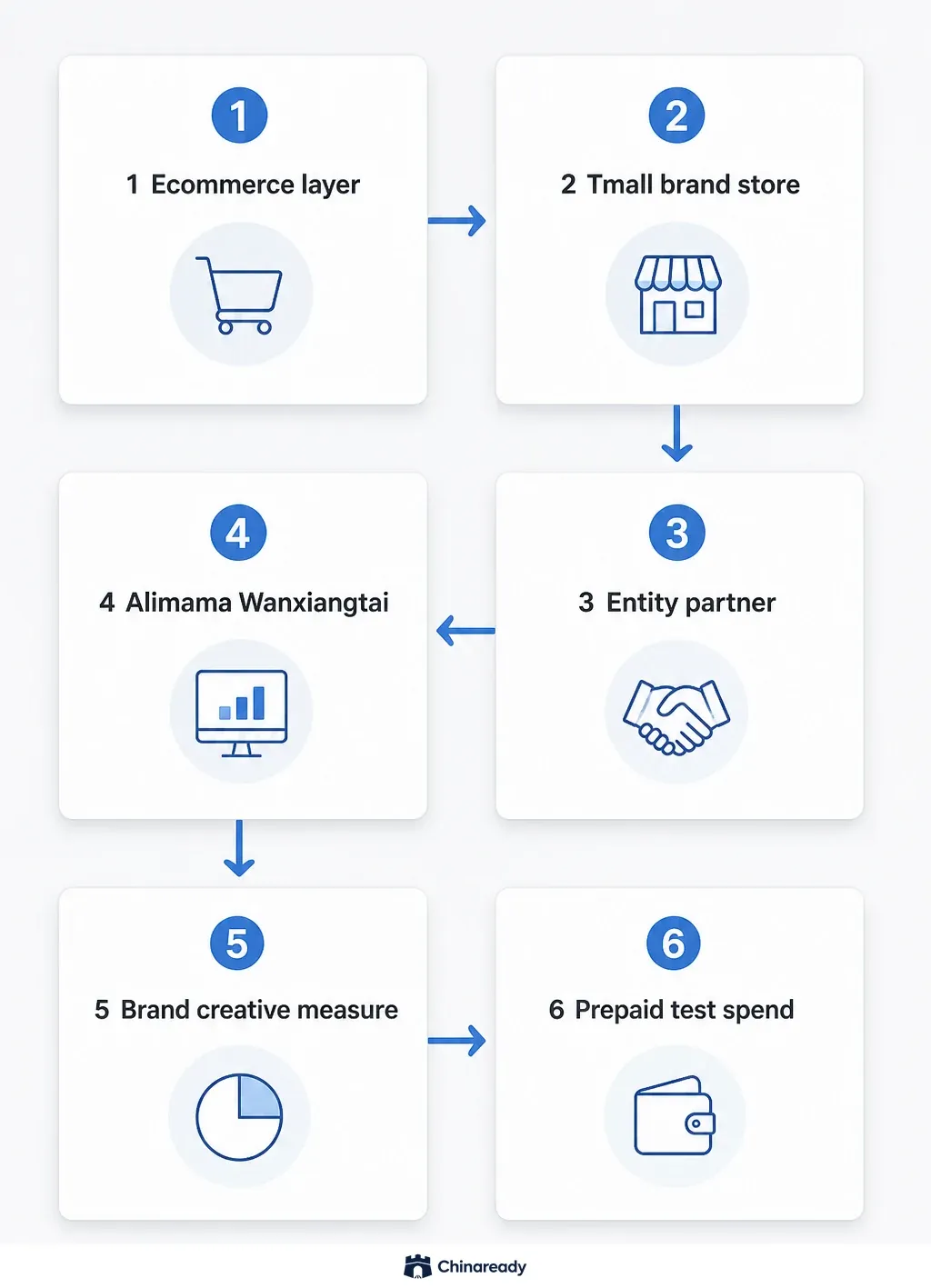
Tmall ads China are a brand-store and Alimama program before they are a sponsored-listing creative sprint. Your product team clears a Tmall flagship or authorised brand-store rail, Chinese entity or partner access, Alimama (阿里妈妈) / Wanxiangtai (万相台) account and qualification gates, creative and claim review, and a commerce measurement path — then prepaid test spend makes sense. Tmall advertising and brand store ads China only become fundable after those rails exist. This is not a substitute for the China ads goal–channel map; it is the ecommerce-media gate after you choose that layer.
What Tmall ads are on Alimama
Hard names your Mainland China brand ecommerce media plan will use:
- Tmall ads / Tmall advertising / Tmall China ads — Paid placements bought to influence shoppers already close to purchase on Tmall (天猫) — search, recommendation, and related commerce inventory that convert back into Tmall brand-store paths. Official consumer entry: tmall.com.
- Brand store ads China — Spend that assumes a Tmall flagship or authorised brand store can list, fulfill, and settle. Without that store type, “Tmall media” is usually the wrong sequence.
- Alimama (阿里妈妈) — Alibaba’s digital marketing platform that opens brand and merchant advertiser rails across the Taobao / Tmall ecosystem. Official entries: alimama.com · one.alimama.com · ad.alimama.com.
- Wanxiangtai (万相台) — Merchant / brand advertising workbench many operators use for unified campaign delivery. Console access does not invent a brand store.
- Not a Taobao seller rename — Marketplace seller rails and Tmall brand-store rails are different ops commitments. Peer Decision Map: Taobao ads. Retail peer: JD ads.
- Not the ads hub taxonomy — Goal–channel selection still comes first. Tmall sits in the e-commerce media row beside Taobao and JD when store ops already exist — see the ads goal–channel map. Social peers (Douyin ads, Xiaohongshu ads) are different conversion rails.
- Common myth — “Open brand ads like Amazon Sponsored Brands, skip flagship onboarding.” Without brand proof, store type, and China-ready product pages, review and conversion fail before creative quality matters.
Vocabulary first. Next: what must exist before campaign build is real work.
What must exist before Tmall spend
Missing any of these stops your product team before durable Tmall / Alimama spend — not before a brand moodboard.
| Precondition | Why your process stalls |
|---|---|
| Layer choice locked — Tmall / ecommerce media for this Mainland China job (not “rename Meta / Google ads”) | Wrong layer wastes brand-store onboarding; remap via the ads goal–channel map first |
| Tmall brand-store path — flagship or authorised brand store aligned to the SKUs you will promote | Ads without brand listings, price, and fulfillment burn prepaid balance |
| Brand authorisation / IP pack ready for the categories you sell | Store open stalls without trademark and brand proof the platform expects |
| Chinese organizing path — subsidiary or landing partner that can hold / operate brand-store and advertiser rails | Company verification and settlement commonly expect Chinese business-license rails |
| Admin identity that can finish contact verification — reachable Chinese mobile path | SMS and person checks fail on overseas-only admins |
| Industry / category qualifications ready if the category is regulated | Account open ≠ category approved to advertise |
| Simplified Chinese creative + claim pack | Absolute claims and English-only assets fail review — advertising law Guide |
| China-working measurement path — GMV, order, and attribution views your ops can read | Spend without Mainland China-readable commerce data is not a learning plan |
| Prepaid / settlement path | Campaigns do not go live on empty balance or unclear remittance |
Product teams usually cannot treat “upload English brand creatives → pick Tmall → scale” as the China plan. Brand store, entity, creative, and measurement gates are the floor.
From brand store to first Alimama spend
| Stage | Decision / outcome |
|---|---|
| 1. Confirm Tmall ecommerce media is the right layer | On-platform brand GMV / retail conversion — not a WeChat or Douyin substitute |
| 2. Lock brand-store commercial path | Who owns the flagship / authorised store, SKUs, pricing, and fulfillment |
| 3. Lock entity / partner rail | Who holds brand-store and Alimama admin phones and exit if the partnership ends |
| 4. Open and verify brand store + Alimama / Wanxiangtai | Store ops ready; advertiser account verified; Chinese phone path preferred |
| 5. Clear qualifications + creative | Category docs, brand proof, Simplified Chinese assets, claim pack, product links that convert |
| 6. Prove measurement | Commerce events / reports your team can act on from Mainland China vantage |
| 7. Fund and launch a controlled test | Prepaid top-up → format matched to goal → platform review → learn, then scale |
Direct entity vs partner rail (hard gate)
Necessity: wrong assumption here wastes weeks — either brand-store verification never starts, or you produce creatives under an entity that cannot hold the account.
| Route | When it fits | What must already be true |
|---|---|---|
| Direct with Mainland China business license | You already operate a Chinese entity and Tmall-facing brand offer under that entity | License scope and brand rights match the offer; admin phones and settlement align |
| China landing partner / authorised brand ops | No Mainland China entity, or no Mandarin brand-store + ads ops capacity yet | Partner can hold or operate the store and advertiser rails; exit and brand-asset ownership are agreed |
Alimama surfaces are formal commercial products (alimama.com, one.alimama.com, ad.alimama.com). Platform rule hubs such as rule.tmall.com document merchant expectations — still treat entity, brand proof, qualification, and remittance as program gates, not a checklist that replaces Mainland China ops.
Why store-skip assumptions kill Tmall campaigns
No Tmall brand-store path → ads with nowhere to convert. Sponsored discovery without live brand SKUs, stock, and fulfillment is not a GMV plan.
Treating Tmall as Taobao seller ads → wrong store type. Brand proof and flagship ops are different commitments — see Taobao ads.
No Chinese license / partner path → no durable company verification. Creative production queues while Alimama never clears.
Account open without category or brand certificates → vertical blocked. Health, food, finance, education, and similar categories sit in review limbo.
English global creatives → review and CTR both fail. Localisation is a gate, not a polish pass after spend — pair with China advertising law.
Treating Tmall as the whole China media plan → wrong stack. Goal–channel selection still comes first; Douyin / Xiaohongshu / WeChat / Taobao / JD remain separate jobs when the conversion surface differs — Douyin ads, Xiaohongshu ads, Taobao ads, JD ads.
Blind optimization → wasted prepaid balance. Commerce measurement that your team cannot read from Mainland China makes “learning budget” guesswork; design the measurement path before you raise spend.
What blocks product teams on Tmall ads
- Creative-first plans — Brand teams book banner or video production before brand-store entry, entity, and qualifications exist.
- Assuming overseas login = advertiser ready — Platform browsing and verified Chinese brand advertiser are different milestones.
- Skipping brand and category packs — Trademark / authorisation and regulated-category certificates block store and spend.
- China advertising-law claim risk — Absolute claims, unlabeled ads, and restricted-category rules sit beside platform review.
- No Mandarin ops owner — Alimama / Wanxiangtai consoles, appeals, and review replies are not English-first.
- No prepaid / remittance path — Learning budgets stall on settlement, not on creative quality.
- Measurement after scale — Raising budget before Mainland China-readable commerce events exist burns prepaid balance without a decision.
- Mixing Tmall ads with social ecommerce work — Alimama buys retail attention toward Tmall conversion; Douyin / Xiaohongshu shop paths are separate product programs when conversion must close there.
China landing partner for Tmall / Alimama
Most product teams exploring Mainland China entry need a China landing partner to clear Chinese entity or account-holding rails, Tmall brand-store setup adjacency, Alimama / Wanxiangtai verification, brand and industry documents, Mandarin console ops, creative review norms, prepaid settlement, and commerce measurement that works in Mainland China — not another longer Amazon Sponsored Brands playbook. Your team still owns offer, assortment, and measurement goals; the partner path makes Tmall advertising an executable spend program when those rails are not already in-house.
What we can offer?
Tmall ads work is a brand-store and entity gate decision before Alimama scale. Chinaready helps your product team clear the rails that make Tmall ecommerce media real in Mainland China:
- China Readiness Assessment — Map whether Tmall / Alimama is the right ecommerce-media layer versus Taobao, JD, Douyin, or Xiaohongshu, what entity or partner path fits, and which brand-store, qualification, creative, and measurement gates sit on the critical path before a learning budget date.
- China Access Acceleration — Keep China-facing product and conversion paths reachable and fast from Mainland China vantage so review-approved creatives do not die on offshore-only pages when traffic leaves the app.
- China Product Hosting — Place China-critical pages and APIs where entity consistency, ICP where required, and any off-Tmall landings stay coherent with the brand offer.
- Mobile App Distribution — Align Tmall retail media with app-store or Mini Program paths when the click is meant to install or convert in-app — not mistake sponsored listings for a substitute store launch.
Contact us when you need a Tmall brand-store and Alimama measurement path before you staff a global retail-media “China geo” sprint.
Frequently asked questions
What are Tmall ads in China?
Tmall ads China are paid ecommerce placements bought mainly through Alimama (阿里妈妈) surfaces — often Wanxiangtai (万相台) and related brand tools — to influence shoppers on Tmall brand-store paths. They are retail media for on-platform brand GMV, not a generic social-feed buy and not a lightweight Taobao seller rename.
What is Tmall advertising versus brand store ads China?
Tmall advertising is the paid media program on Tmall inventory and brand destinations. Brand store ads China usually means that spend assumes a Tmall flagship or authorised brand-store rail already exists — listings, brand proof, and ops — before prepaid balance is useful.
Do we need a Tmall store before Tmall China ads?
For ordinary on-platform brand GMV goals, yes in practice. Alimama spend toward Tmall conversion assumes a brand store that can list, price, fulfill, and settle. Paid media without that rail burns budget; remap awareness-only jobs via the China ads goal–channel map first.
Can overseas teams open Tmall ads without a Chinese company?
Brand-store open, account verification, and settlement commonly expect Chinese business-license paths, brand authorisation packs, Chinese mobile contact verification, and category qualifications. Teams without that entity usually operate through a China landing partner or authorised brand / agency rail.
How do Tmall ads differ from Taobao or JD ads?
Tmall sits on brand-store / flagship rails with stricter brand and category gates. Taobao ads usually follow marketplace seller paths. JD ads run through Jingzhuntong on JD. Pick the layer that matches the store type you can actually operate.
Can product teams finish Tmall ads without Mainland China ops?
Usually no. Brand-store entry, Chinese entity or partner rails, Mandarin Alimama ops, creative and claim review, prepaid settlement, and Mainland China-readable measurement stall teams without Mainland China ops.