
China mobile app filing — clear it before store launch
Mainland China apps need MIIT App filing before store publish — after an ICP-filed domain. Domain and site filing first, then entity, package identity, and provincial approval.
China’s mobile App filing (移动应用程序备案) is the Ministry of Industry and Information Technology (MIIT) registration for apps that provide internet information services in Mainland China. Since 2023, new store publishes generally need a filing number first. App filing also depends on a domain that already has ICP filing — a mandatory Mainland China internet-governance prerequisite, whether or not the app talks to a backend. Foreign teams almost always need a Chinese organizing entity, aligned package identity, and privacy materials that match the live app — not an overseas-only console account.
Pre-request phase — ICP-filed Mainland China domain first
App filing is not a free-standing form. It depends on a domain that has already completed ICP filing. That requirement holds whether or not the app needs or depends on a backend service.
- Register a Mainland China domain for the product (a dedicated China domain for the app property — not an overseas-only marketing site assumed to “count”).
- Complete website ICP filing for that domain on Mainland China–terminated hosting, following the same sequence as our ICP Guides: China ICP and PSB filing — sequence before go-live and ICP filing in China — domain DNS to Mainland China IPs.
- Keep the domain reachable after filing — even if the app has no API. A one-page app introduction is enough, as long as it stays live, the footer displays the ICP filing number, and the domain’s ICP filing stays compliant (entity, contacts, and hosting posture match the filed record).
- If the app has a backend, file the backend / API host under ICP first, then proceed to App filing. Backend ICP → App filing is the correct work path; do not reverse it for a store deadline.
Only after this pre-request phase should you continue with the five App-filing stages below.
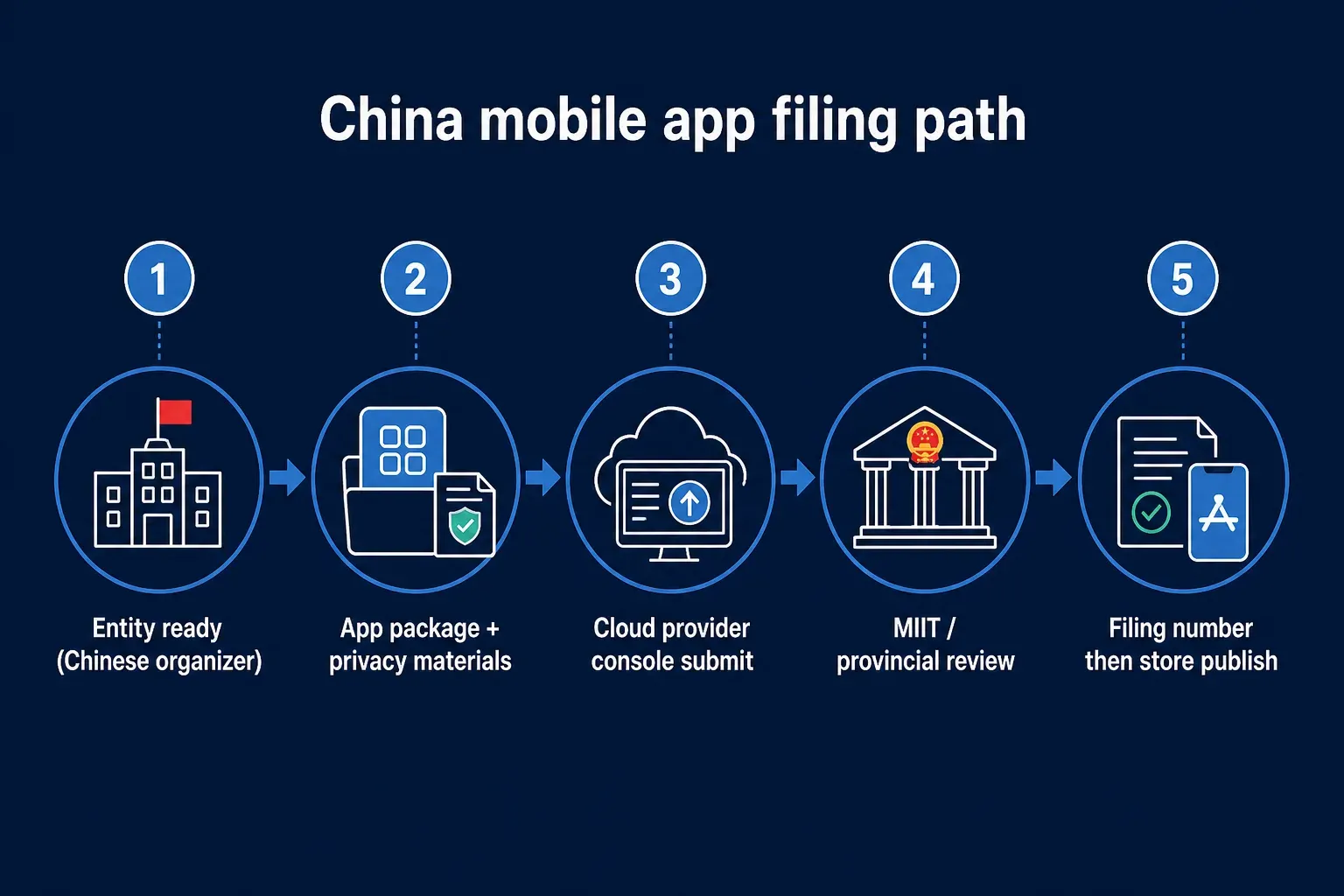
Critical path (five stages)
Treat App filing as a publish gate, not a post-ship cleanup.
- Entity and contacts ready — Chinese business license (or accepted organizer certificate), Chinese mobile numbers, and people who can complete facial / SMS verification.
- App identity locked — Package name / bundle ID, app name, icon, category, and service description that match what stores will receive.
- Submit via access provider — Most teams open the order in a Mainland China cloud console (Alibaba Cloud, Tencent Cloud, AWS China, Azure China, and similar) bound to the organizing entity and hosting product.
- MIIT SMS + provincial review — Designated contacts complete verification; provincial communications administration decides.
- Display filing number and publish — Show the App filing number in-app (Settings / About or equivalent); then proceed to OEM / third-party store submission with the same identity.
| Stage | What “done” looks like | Typical timing |
|---|---|---|
| Pre-request | Mainland China domain live with ICP filing; footer shows filing number; backend host filed if the app has one | Usually weeks (blocks App filing until done) |
| Prep | Entity, package ID, privacy policy, and category aligned | Days to weeks |
| Provider pre-review | Console advances; no open document defects | ~1–2 business days |
| Province | Filing number issued | Often multi-week end-to-end |
| Publish | Stores accept the filed identity | Store-specific |
Documents and materials foreign teams usually prepare
Exact fields vary by provider and province, but expect:
- Organizing-entity certificate and responsible-person IDs
- App name, package name / bundle ID, version, and icon
- Service description and content category matching live screenshots
- Privacy policy URL and personal-information processing explanation (collect what you declare)
- Pre-approvals for regulated categories (news, healthcare, finance, education, publishing, games, and similar)
- Authorization letters when the submitter is not the legal representative
App filing itself is generally not a large MIIT fee. Budget instead for entity or partner setup, Mainland China hosting alignment, privacy engineering, and store account work. From a complete package, plan weeks; one wrong package name or unreachable SMS phone can still miss a marketing date.
How App filing sits next to other gates
| Gate | Covers | Same as App filing? |
|---|---|---|
| Website ICP filing | Mainland China–hosted sites / domains | No — separate form, and a prerequisite for App filing |
| App filing | Mobile internet information service apps | This guide |
| Commercial ICP license (B25) / other VATS | Commercial information or marketplace patterns | No — product-trigger licenses |
| PSB filing | Security registration after go-live | No — usually within 30 days of launch |
| Store review | Huawei, OPPO, vivo, Xiaomi, Apple China, and others | No — distribution layer |
Build a one-page inventory before you file: package names, privacy policy URLs, payment features, webview domains, API hostnames, and whether those hosts are Mainland China–filed. Filing the APK while leaving an unfilled Mainland China API host is a classic “console green, production red” failure.
App filing form fields and notes
Provider consoles ask for the same family of fields. Extract and freeze them with engineering before you open the order — package name, signing fingerprints, and SDK declarations are where foreign teams most often bounce. Field names and notes below follow Huawei Cloud’s public prep guide App filing preparation and notes (updated 2025-05-27); other Mainland China cloud providers use equivalent forms. Province rules may still add materials.
App basic information
| Field | What to prepare |
|---|---|
| App name | Name shown under the icon after install; unique under the same organizer |
| App icon | Home-screen graphic; keep under the provider size limit (≤100 KB) |
| App service content | Category (life services, entertainment, dining, etc.). If no exact match, pick the closest and describe the real use in remarks |
| Domain (or subdomain) | Domains used by the app — file each level you use, up to four levels (deeper hostnames file at the fourth level) |
| Associated provider IP | Usually auto-filled from the verified resource; IP↔domain can be one-to-many or many-to-one |
App characteristic information — extract with developers
This block is package identity and SDK posture. Wrong values force change filings and store resubmits.
| Field | What to prepare |
|---|---|
| Whether you provide SDK services | Yes if your product, beyond its own app, ships an SDK other apps can call |
| Whether you use SDK services | Public SDKs you embed (payment, location, login, analytics, etc.) and their vendors; put unlisted vendors in remarks |
| SDK vendor / SDK type names | Required when you use third-party SDKs; leave blank only if you use none |
| Platform | Android, iOS, HarmonyOS, Linux, and similar — one filing can cover multiple platforms; each platform needs its own characteristic set. Add/remove platforms later via change filing |
| Package name / Bundle ID | Unique Android package name or iOS Bundle ID |
| Public key | Signing-certificate public key used to verify the app’s digital signature |
| Signature MD5 (certificate fingerprint) | MD5 fingerprint of the signing certificate, not an arbitrary APK hash |
If the same app ships with different characteristic sets for different distribution channels, file multiple package-name / public-key / fingerprint rows. Pull these from the signing keystore and CI — do not invent placeholders for a marketing deadline.
Other materials often attached in the same form
| Material | When it applies |
|---|---|
| ICP responsible-person authorization | When the internet-information-service responsible person is not the legal representative |
| Domain certificate | Often required within a recent window (Huawei Cloud guide: issued within three months) |
| Pre-approval documents | When the app category or the organizer’s business scope hits regulated keywords (news, healthcare, finance, education, publishing, games, and similar) |
Source checklist: https://support.huaweicloud.com/prepare-icp/icp_02_0049.html.
App service content categories
Pick the category that matches what the live app actually does — not the softest label on the list. A wrong service type can get the filing rejected, or force you to supply extra product / operating qualifications (pre-approvals and related business licenses) before the province will pass the order. If no exact match exists, choose the closest category and describe the real use in the internet-information remarks field.
| Category | Sub-items |
|---|---|
| Life services | Utility bill payment; recruitment; tools; housekeeping; wedding services; real estate; maternity and infant; sharing services; beauty; bathing / wellness; pets; legal consulting; notarization; electronic certification; auctions; patent / trademark agency; parent-child / forensic appraisal; accounting firms; tax agent firms; public seal engraving; company-transfer information services; general financial services; PR / promotion / market research; network agency; enterprise management; exhibition services; overseas emigration; photography / printing; quality inspection; machinery repair; business registration agency; other |
| Dining | Ordering; food delivery; other |
| Leisure and entertainment | Welfare lottery; games; song-and-dance venues / KTV and similar entertainment; gyms / yoga / dance / body-shaping studios; board games / arcades / internet cafés; social networking; online books; video; music / radio / audiobooks; cultural venues; sports; amusement parks / carnivals; cinemas / live performances |
| Travel services | Scenic-area services; travel agencies; tourism management entities; tourist tax refund; OTA (online travel agency); accommodation; outbound travel; other |
| Transportation | Train / high-speed rail; aviation; bus / metro; ride-hailing / taxi; bicycle; coach; shipping; navigation; fuel; expressways; other |
| Automotive services | Repair and maintenance; auto parts and accessories; vehicle sales / used-car sales; designated driving; car rental; parking; charging; ETC; roadside assistance; connected vehicles (IoV) |
| Education | Children’s education; training institutions; schools; other |
| Warehousing and postal services | Express delivery; logistics; warehousing; parcel lockers; other |
| Medical services | Hospitals; medical devices; pharmaceuticals; health care / nursing; blood / stem-cell services; clinical trials |
| Government services | Current-affairs / political information; government service halls; traffic and transport; household registration; public security (including national security) and firefighting; entry-exit and border control; judicial / notarization; discipline inspection and audit; finance (treasury); civil affairs; housing security; Party / Youth League / organizations; culture, sports, education and research; human resources and social security; environmental protection and greening; water resources / water affairs; meteorology and geology; market regulation; medical and health administration; land and planning / construction; quality and technical supervision; food regulation; press, publishing and radio/TV; tax and finance administration; finance (regulatory); intellectual property; letters and visits (petition); public utilities; customs and ports; postal administration; inspection and quarantine; commerce and trade; agriculture, forestry, animal husbandry and marine; social sciences, archives and cultural relics; work safety and emergency management; science and technology innovation; statistics; economic development and reform; tobacco; cyberspace administration; industry and information technology; energy; rural revitalization; ethnic and religious affairs; credit; public welfare |
| Financial industry | Insurance; banking; trust; public funds; private funds; securities / futures; non-financial-institution proprietary microloans; financing guarantees; commercial factoring; auto finance / financial leasing; credit reporting; NEEQ information platforms; stock information platforms (Hong Kong / US); stock information platforms; foreign-currency exchange; physical gold trading; consumer finance; merchant acquiring services; regional equity trading markets |
| Information transmission, software and IT services | Audio/video equipment; telecom services; multi-party communications; software development; online promotion |
| Wholesale and retail | Retail and wholesale; self-operated selling; department stores / shopping malls |
| Security | Security software; antivirus software; assistive security software; anti-adware / anti-malware utilities; encryption software; other |
| Industrial internet software | Industrial R&D and design; production management; other |
| Other | Religious information; consulting plaza |
Source catalog: https://support.huaweicloud.com/prepare-icp/zh-cn_topic_0000002049126804.html.
China-specific failure points
Opening App filing before the domain ICP pre-request
App filing is not free-standing. Without a Mainland China domain that already has ICP filing — kept reachable, with the ICP number in the footer even on a one-page intro — the App order cannot complete correctly. An overseas-only marketing site does not satisfy the pre-request. Conversely, finishing website ICP does not replace App filing: stores still ask for the App filing number as a publish gate.
Filing the app before the backend host
If the product has APIs or Mainland China–terminated backends, backend / host ICP first, then App filing is the correct path. Filing the APK while an unfilled API hostname remains in production is a classic “console green, production red” failure — the same inventory gap called out under other gates above.
Soft-label service category
Picking “tools” or another soft catalog row while the live app is education, medical, finance, news, games, or another regulated vertical invites rejection or a demand for extra product / operating qualifications and pre-approvals. Use the service-content catalog in this guide; when no exact match exists, choose the closest category and describe the real use in remarks — do not hide the product under a generic label.
Placeholder or drifted characteristic information
Public key, signature MD5, and package name / Bundle ID must come from the signing certificate and CI, not invented placeholders. Changing package name, rotating signing keys, or shipping a different fingerprint after filing forces change filings and store resubmits. If Android, iOS, and HarmonyOS (or channel-specific builds) use different identities, file separate characteristic rows per platform / distribution set before you submit.
SDK and privacy declarations that disagree with the binary
The form asks whether you provide or use SDKs and which vendors / types. Omitting payment, login, location, or analytics SDKs — or declaring a privacy policy that denies collection the binary performs — creates provider or provincial bounce-backs and later store enforcement. Freeze the SDK list against the filing screenshot set.
Letting the ICP-filed domain go dark after the App order
Even with no backend, the filed domain must stay normally reachable and the footer ICP display must remain compliant with the filed entity and hosting posture. Taking down the one-pager, pointing DNS offshore, or leaving a stale filing number after entity changes re-opens compliance risk after the App number is issued.
Foreign parent as sole organizer
Overseas HQ rarely appears alone as the organizing entity. Subsidiary, branch (where accepted), or publish partner — plus Chinese SMS / facial-verification contacts — must be decided before you open the order. Unclear ownership of the developer account and phones looks like “MIIT is slow” but is a credential gap.
SMS and facial verification clocks
Missed MIIT SMS windows and unavailable Chinese administrators force resubmission. Assign a Mainland China business-hours owner for the full provincial review window.
Store accounts that disagree with the filing
OEM / Apple China developer accounts, legal entity names, App filing organizer, and the filed package identity must tell one story. Mismatches surface as store reject reasons that look unrelated to MIIT.
What we can offer?
Mobile App filing is a sequenced publish gate: ICP-filed Mainland China domain (and backend host when you have one) first, then entity / package identity, provider submit, provincial App filing, and store accounts that tell one story. Chinaready’s four services map onto that line:
- China Readiness Assessment — Name the domain ICP → App filing → store order for your product, including whether a one-page intro host is enough or a backend host must be filed first.
- China Access Acceleration — Keep the filed domain and Mainland China user journeys reachable while App filing and store review are in flight — so “filed” and “customers can open it” stay aligned.
- China Product Hosting — Place the intro site and any API hosts on Mainland China termination paths that support ICP filing, instead of assuming an overseas CDN can stand in for the pre-request phase.
- Mobile App Distribution — Sequence Chinese Android stores / Apple China store submit with the same App filing identity and privacy evidence, so package drift and organizer mismatches do not appear as surprise store rejects.
Contact us when you need that sequence before you open an App filing order.
Frequently asked questions
Is mobile app filing required in China?
Yes for apps that provide internet information services in Mainland China. Since 2023, new apps distributed through Mainland China app stores generally need an MIIT App filing number before publication — including iOS / Apple App Store China, Android OEM stores, and HarmonyOS when they ship as such services. Store review sits on top of MIIT filing.
Does App filing require website ICP filing first?
Yes. They are separate MIIT registrations, and App filing depends on a Mainland China domain that already has ICP filing. Keep that domain reachable (a one-page app intro with the ICP number in the footer is enough if you have no API). If the app has a backend, complete ICP for the API / host first, then App filing.
Can a foreign company file an app alone?
Usually no. Filing runs under a Chinese organizing entity with Chinese contacts for identity and SMS verification — typically a subsidiary or a publish / landing partner. Overseas HQ rarely appears alone as organizer.
What characteristic information must developers extract before filing?
Per platform — package name or Bundle ID, signing-certificate public key, signature MD5 (certificate fingerprint), whether you provide or embed SDKs (and vendor / type names), and the platforms you ship. Pull values from the keystore and CI; wrong fingerprints force change filings. Multiple distribution identities need multiple characteristic rows.
What happens if we pick the wrong App service category?
The province may reject the order, or require extra product / operating qualifications and pre-approvals before approval. Match the live product — not the softest label — and use remarks when no exact catalog match exists.
How long does China mobile app filing take?
Budget weeks for the pre-request domain ICP first (it blocks App filing). After a complete App package, provider pre-review is often about one to two business days; provincial review adds the bulk. Missed SMS, wrong category, privacy/SDK mismatches, or bad package fingerprints extend the calendar.