

Baidu Maps China — stack vs residual Google
Baidu Maps China is the remap stack when indoor, mall, or POI breadth is the job after the Google Maps China fork. Keep Google Maps only for residual jobs. Mandarin consoles still stall teams.
Baidu Maps China is the product map stack when indoor, mall, or POI-heavy journeys are the named job — not the automatic default after Google Maps fails. After the Google Maps China fork, Amap is the usual start; Tencent Maps fits WeChat-adjacent location. Residual Google Maps jobs can stay supplementary for audiences who still live on Google surfaces.
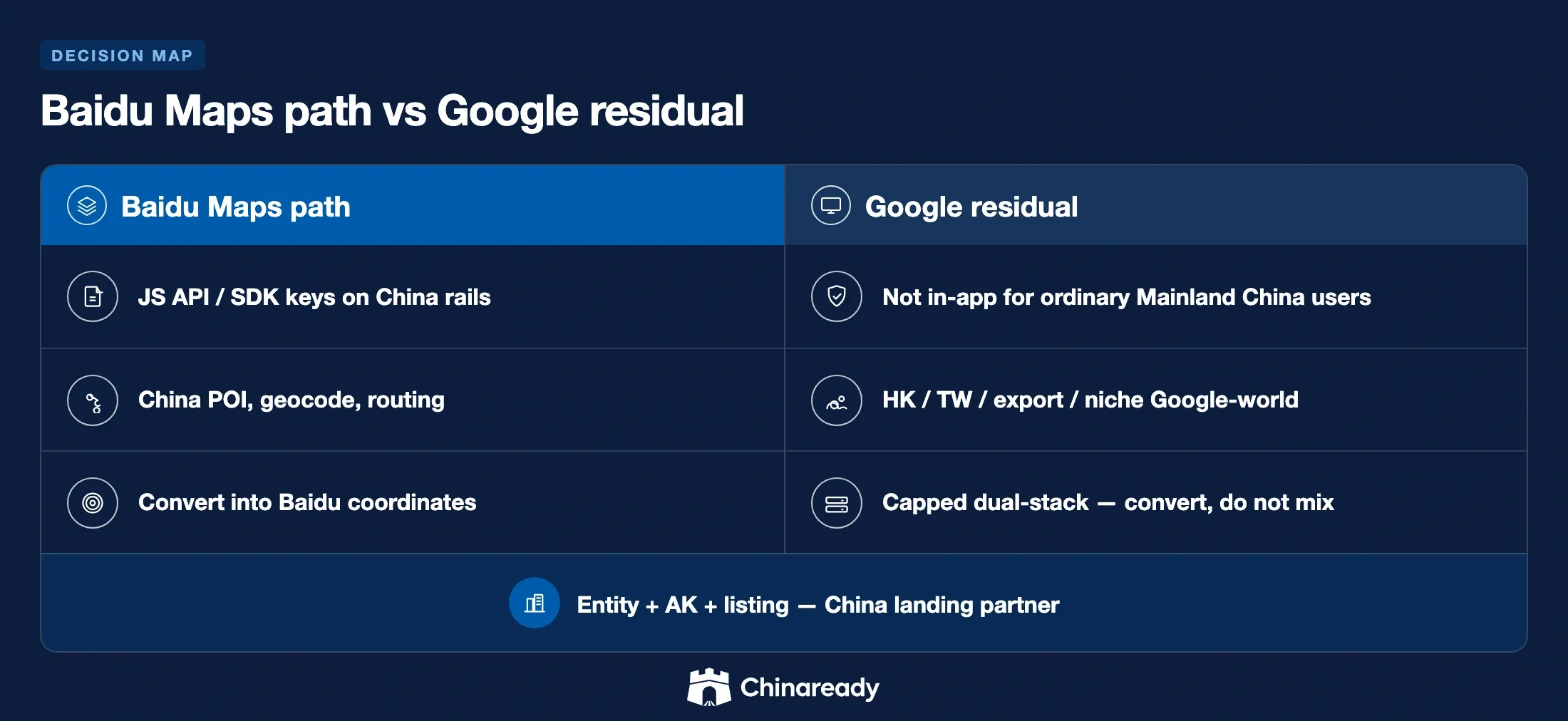
What Baidu Maps means for a China map stack
Hard names your map program will use:
- Baidu Maps — A China-native maps product for consumers and for developers. Product maps go through Baidu Maps Open Platform (also lbs.baidu.com): map display, POI search, geocoding, routing, and Android / iOS / HarmonyOS SDKs plus JavaScript APIs. This Guide is the product stack — not a tourist app list.
- AK (service key) — You need a Baidu account, developer certification, then an AK before JS API, Web Service, or SDK calls work. Official get-key notes: JSAPI account and key. AK type must match the surface (browser AK for JS API; Android / iOS SDK types for native).
- JS API vs SDK — Web embeds use JavaScript API (JSAPI 4.0 overview). Native apps use the matching SDK. One leftover Google Maps JavaScript or Android SDK does not become a China web or in-app map.
- Coordinates — Baidu Maps is not a drop-in WGS-style pin layer. Official coordinate conversion turns non-Baidu inputs (GPS-style, and other China map coordinates) into Baidu map coordinates before you draw or geocode. Unconverted points look like “the SDK is wrong.”
- Google residual — Google Maps Platform remains a real product for residual jobs. Data coverage tables are not the same as reliable tiles and APIs for ordinary Mainland China users on local networks. Landscape labels the SKU on Google Maps Platform alternatives.
- Common myth — “Keep Google Maps in the China build and add Baidu later.” Dual unconverted stacks are two products. Treat Baidu as primary only when that job is named; do not skip the Google Maps China shortlist.
Vocabulary first. Next: what must be true before Baidu Maps keys are real work.
What must exist before Baidu Maps keys
Missing any of these stops your product team before AK tickets are useful engineering — not after a Google Maps sprint is already on the board.
| Precondition | Why your process stalls |
|---|---|
| Audience job locked — ordinary Mainland China in-app / web map vs residual Google-world users | Wrong job keeps Google as Plan A or picks the wrong China map product for the fork |
| China map product named for the job — Amap as usual start; Baidu Maps API / SDK when indoor, mall, or POI is the chosen stack | “Maps somewhere in China” does not pick JS API vs Android / iOS SDK or AK type |
| Coordinate policy written — what you store, what you convert, what you draw | Mixed WGS-style and Baidu points shift pins; geocoding and POI disagree |
| Baidu developer path named — who holds the Baidu account, who certifies, who owns AKs | English-first teams stall on Mandarin consoles and certification, not on map widgets |
| Surface list frozen — web JS API, native SDK, or both | Browser AKs do not unlock native SDKs; native keys do not embed a web map |
| China landing partner or in-house China ops for entity, keys, and listing | Most global teams cannot finish developer rails and store listing from an overseas console alone |
Baidu Maps English developer surfaces are not a full substitute for the Chinese Open Platform. Plan Mandarin ops (or a partner who already has them). iOS-only residual display is a different Landscape question — Apple MapKit — not a reason to keep Google Maps as the China in-app map.
Baidu Maps vs Google — product stack choices
Stages are decisions. Not console click-paths.
| Stage | Decision / outcome |
|---|---|
| 1. Name the map job | Ordinary Mainland China user journeys, or only residual Google-world audiences? |
| 2. If Mainland China in-app / web map | Follow the Google Maps China fork: Amap as usual start; Baidu Maps China when indoor, mall, or POI is the named job; Tencent Maps for WeChat-adjacent location — not Google Maps as the China widget |
| 3. Pick Baidu surface | JS API for web; Android / iOS SDK for native; match AK type |
| 4. Lock coordinate remap | Convert into Baidu coordinates before draw / geocode / POI; do not mix raw GPS-style points |
| 5. If a residual Google job remains | Keep Google Maps Platform as a capped line (Hong Kong / Taiwan / export / niche) — not the China GTM map |
| 6. Clear China developer rails | Account, certification, AKs, package / bundle binding, listing evidence — with a China landing partner when those rails are missing |
Hard gate — primary vs residual
Necessity: confusing these two jobs wastes the quarter — either you ship a Google map ordinary Mainland China users cannot complete, or you fund two unconverted stacks.
| Job | Map stack | What must already be true |
|---|---|---|
| Ordinary Mainland China in-app / web map | Amap as usual start after the fork; Baidu Maps API / SDK when indoor, mall, or POI is the named job | China map product chosen; Open Platform path in motion when Baidu is selected; AK type matches surface; coordinates convert when using Baidu |
| Hong Kong / Taiwan / export / English-first / niche Google-world | Google Maps may remain residual | Geo and measurement match that audience; do not read residual traffic as Mainland China map success |
| “One SDK worldwide, including China” | Myth as a China map plan | China-native tiles, POI, and developer rails are a separate product |
Baidu Maps vs Google is a role split, not a feature bake-off. Landscape’s Google Maps Platform page is the SKU availability lookup — this Guide is the stack choice after that lookup.
Why leftover Google tiles block the China map path
Google Maps in the China binary ≠ Mainland China map. Tiles and APIs that depend on Google hosts are typically not a reliable in-app or web map for ordinary Mainland China users on local networks. Coverage rows in Google’s tables do not restore that journey.
Unconverted coordinates ≠ “SDK bug.” Baidu’s conversion service exists because GPS-style and other China map coordinates are not Baidu map coordinates. Mixing them produces shifted pins, broken geocodes, and POI misses.
Browser AK ≠ native SDK. JS API and Android / iOS SDKs are different AK types. Shipping a web key into a store build (or the reverse) fails at the first honest review.
English backlog ≠ Open Platform access. Baidu Maps English help text, if you find any, does not replace Chinese-first certification, console, and quota ops.
Keeping Google “just in case” ≠ dual-stack design. Two map products need two coordinate policies, two key programs, and two test vantage points. An unowned leftover Google layer is how China QA files “map blank” while global QA still passes.
iOS MapKit residual ≠ Google Maps residual. Apple’s system map is a separate Landscape question. Do not treat MapKit availability as permission to keep Google Maps as the China stack.
What stalls English-first map programs
- Baidu Maps English expectation — Teams search for a full English Open Platform and stall when docs and consoles are Chinese-first (
Content-Languageon official get-key pages is Chinese). The stall is language and certification, not missing POI. - AK-type mix-ups — JS API keys used as if they were SDK keys; SDK keys pasted into a script tag.
- Coordinate debt — Global lat/lng stored as if they were Baidu points; reverse geocodes disagree with the basemap.
- Entity / certification freeze — Personal vs enterprise developer certification sits with legal while engineering demos a key from a personal account.
- Listing evidence mismatch — Store screenshots still show a Google map the China reviewer cannot complete.
- Residual Google reported as “China working” — Hong Kong or export traffic is read as Mainland China map success.
- No Mandarin ops owner — Quota, AK rotation, and package binding have no owner on the China side.
China landing partner for map keys
Most product teams exploring Mainland China entry need a China landing partner for SDK keys, entity, and listing — Baidu account and developer certification, AK types that match JS API vs native SDK, Mandarin Open Platform ops, and store evidence that shows a China-completable map. Your team still owns map UX, coordinate policy, and which residual Google jobs (if any) stay in scope; the partner path makes the Baidu Maps China stack executable when those rails are not already in-house.
What we can offer?
Baidu Maps China work is a named-job remap choice after the Google Maps China fork — not a default for every Mainland China map. Chinaready helps your product team name the right China map stack (Amap, Baidu when indoor/mall/POI is the job, Tencent when WeChat-adjacent) and keep Google only where it still belongs:
- China Readiness Assessment — Name Baidu Maps vs residual Google, which surfaces need JS API vs SDK, and which entity / AK / coordinate gates sit on the critical path before a China map date the board can trust.
- China Access Acceleration — Keep China-facing map pages, APIs, and SDK traffic reachable from Mainland China vantage so the Baidu stack is testable — not only a screenshot from an overseas VPN.
- China Product Hosting — Place China-critical map backends and landings where Mainland China users and reviewers can finish store-locator, routing, and POI journeys.
- Mobile App Distribution — Align Android / iOS map SDK keys, package binding, and listing evidence with a China-completable Baidu map — not a Google widget the reviewer cannot load.
Contact us when you need that stack choice before the next China app sprint ships another Google Maps key.
Frequently asked questions
Should our China product keep Google Maps as the in-app map?
Not for ordinary Mainland China users on local networks. Remap via the Google Maps China fork. Use Baidu Maps China when indoor, mall, or POI breadth is the named job; otherwise Amap is the usual start. Keep Google Maps only for residual jobs such as Hong Kong / Taiwan, export, or niche users who still live on Google surfaces.
Is there a Baidu Maps English developer console?
Official Baidu Maps Open Platform docs and consoles are Chinese-first. English-first product teams usually stall on developer certification, AK types, and Mandarin console ops — not on missing map features. Plan Mandarin ops or a China landing partner; do not wait for a full English console.
When does Baidu Maps vs Google still keep Google in the stack?
Keep Google Maps as a capped residual line when the audience still uses Google surfaces outside ordinary Mainland China reach. Do not run two unconverted coordinate systems as one China map. See Google Maps Platform docs for the residual product, and Baidu Maps Open Platform when Baidu is the chosen China-facing stack for indoor, mall, or POI breadth.
Do we need a China landing partner for Baidu Maps keys?
Most product teams need a China landing partner for SDK keys, entity, and listing. Baidu Maps Open Platform expects a Baidu account, developer certification, and an AK matched to JS API versus Android or iOS SDK — rails most global teams do not already hold.
Why do pins jump when we mix Google and Baidu coordinates?
Baidu Maps uses its own coordinate path. Official coordinate conversion turns non-Baidu inputs (including GPS-style coordinates) into Baidu map coordinates before JS API, Web Service, or SDK calls. Mixing unconverted WGS-style points with BD-09 data shifts markers.
Insights
Other similar insights
Part of the Third-party dependencies cluster — every guide in the cluster, one page.