

China PSB filing — when police filing blocks go-live
After ICP, Public Security Bureau (PSB) network-security filing can block go-live or keep-live. Map the 30-day clock, footer display, and China landing-partner path for product teams.
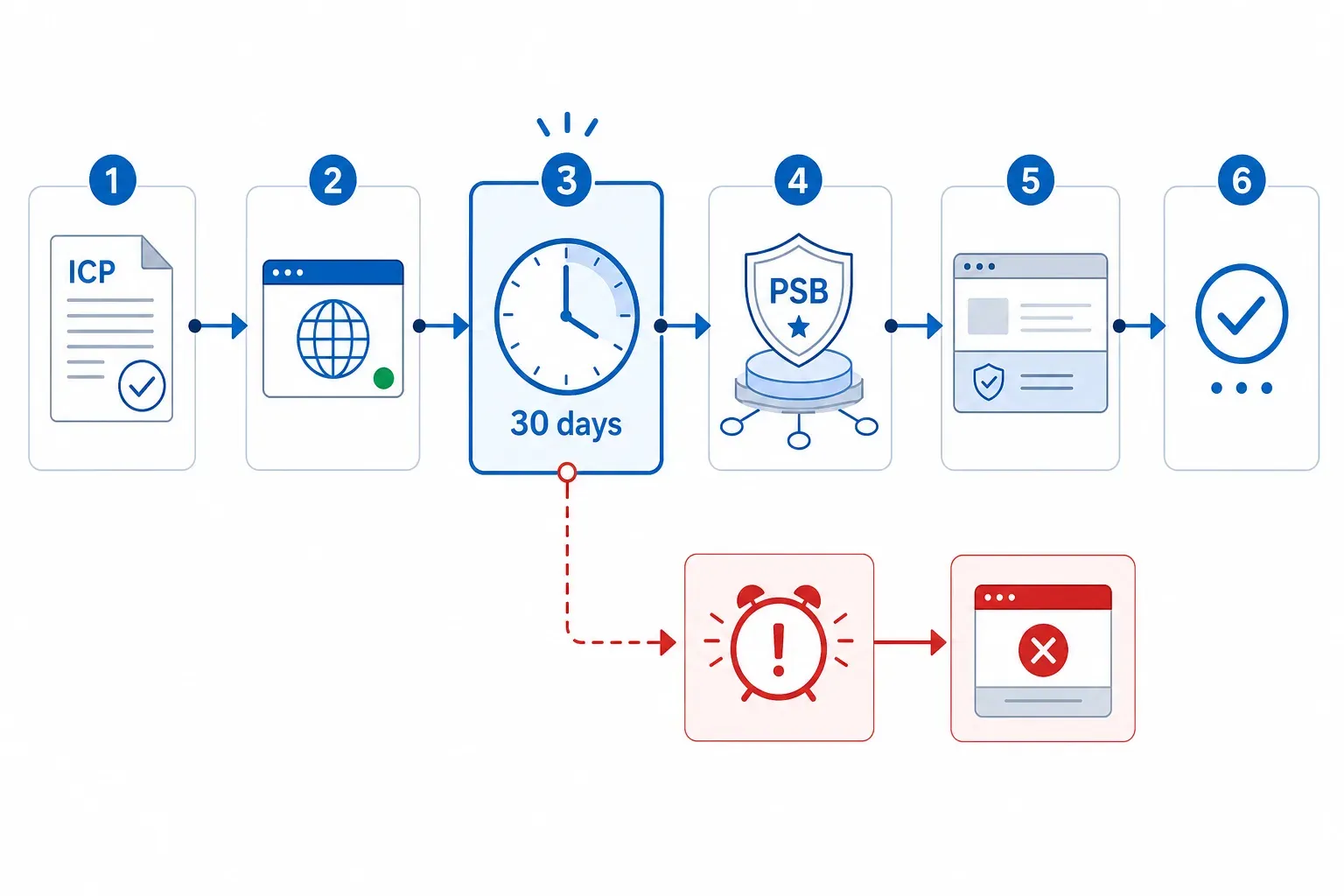
After ICP filing, Public Security Bureau (PSB) network-security filing is what keeps a Mainland China–hosted property lawfully live. ICP clears the usual pre-live hosting gate; PSB filing — 公安联网备案 — registers the same site or app with public security after you go live, on a ~30-day clock. Miss that window and enforcement can suspend or take the property offline — so PSB can still block go-live as a program even when the console work happens after launch day.
For the ICP-then-PSB sequence, see China ICP and PSB filing — sequence before go-live. For how you obtain ICP via domain DNS → Mainland China IPs, see ICP filing in China — obtain via domain DNS path.
What China PSB filing means
Hard names your go-live program will use:
- PSB filing / 公安联网备案 — Public Security Bureau network-security registration for a website or app served from Mainland China. Portal: beian.mps.gov.cn.
- Not ICP — ICP (MIIT) answers who may host and publish on Mainland China infrastructure. PSB answers who is accountable to public security for the live property — security contact, logs and duties, harmful-content reporting posture.
- Trigger — Mainland China hosting for a public site or app, plus an approved ICP filing number. Offshore-only origins usually do not create a PSB website filing duty.
- Clock — Complete PSB filing within about 30 days of going live on the Mainland China network after ICP approval. Treat the window as operational, not optional.
- Display — After approval, show the PSB filing number (and linked badge where required) in the footer / in-app location next to the ICP number.
- Common myth — “ICP done means launch is finished.” ICP gets you live; unfinished PSB puts keep-live at risk and can undo the launch.
Vocabulary first. Next: what must exist before the PSB portal work is real.
What must be true before PSB work starts
Missing any of these stops your product team before a honest PSB submission — usually after engineering already thinks “we launched.”
| Precondition | Why your process stalls |
|---|---|
| Approved ICP filing number for the same domain / app property | PSB packs require the MIIT record; reverse order fails |
| Property actually live on Mainland China hosting (public URL / app reachable for review) | Empty shells and “coming soon” pages often fail local verification |
| China organizing entity or partner path | Portal and local net-security review expect a Mainland China filing story |
| Security contact with Mainland China–reachable phone and ID | PSB is a security registration, not a marketing contact list |
| Aligned domain, ICP name, screenshots, and access-provider data | Mismatch with the ICP pack triggers resubmission inside the 30-day window |
| Owner for the 30-day clock on the product calendar | Launch week without a PSB owner is how the window expires |
Chinese-language portal steps, SMS verification, and provincial net-security review are part of this floor. Overseas-only ops usually cannot finish PSB from English cloud docs alone.
From ICP approval to PSB keep-live
| Stage | Decision / outcome |
|---|---|
| 1. ICP approved | You have a filing number and may proceed toward public Mainland China hosting publish |
| 2. Go live | Site or app opens on the Mainland China network — PSB clock starts |
| 3. Assemble PSB pack | Entity proof, ICP number, domain / IP / access-provider fields, IDs, live screenshots |
| 4. File on the national platform | Submit via beian.mps.gov.cn (local net-security review follows) |
| 5. Display | Place PSB number / badge with ICP in the footer or required in-app surface |
| 6. Keep live | Maintain contacts and file changes when domain, hosting, or operator data changes |
Cloud providers help with ICP consoles; PSB is typically your organizing entity’s work on the public-security platform — not a checkbox inside the MIIT order. Provider sync options (where offered) still leave you accountable for a complete, on-time PSB record.
Why missing PSB undoes a “successful” launch
ICP without a live date → clock never managed. Teams that treat PSB as “someday after ICP email” discover the 30 days started when traffic and the public URL went up.
Live without a security contact → pack incomplete. Marketing site owners abroad cannot satisfy Mainland China verification when the portal asks for a reachable network-security officer.
Footer shows ICP only → incomplete public compliance signal. Buyers and reviewers look for both numbers; missing PSB is a red flag even before enforcement letters.
App and web filed separately in ICP, PSB forgotten on one surface → partial keep-live. Each public Mainland China property in scope needs its own honest PSB story.
MLPS confused with website PSB → wrong program. Graded system assessment is not the 30-day website/app police filing — see China MLPS.
What blocks product teams on PSB
- Calling launch “done” at ICP approval — keep-live still depends on PSB inside the clock.
- No Mainland China entity or partner path — portal and review expect one.
- Placeholder sites filed under ICP then rebuilt after go-live without updating PSB data.
- Overseas-only security contacts that never answer SMS or local calls.
- Assuming the cloud ticket includes PSB — ICP helpdesk ≠ public-security filing completion.
- Skipping display after approval — the number must appear where users and reviewers look.
- Ignoring change filings when domain, IP, or operator identity shifts after launch.
When you need a China landing partner for PSB
Most product teams exploring Mainland China hosting need a China landing partner to own the ICP → go-live → 30-day PSB → footer display chain — entity path, Chinese-language portal work, security-contact rails, and resubmission when local review rejects a pack. Your team still owns product scope and launch date; the partner path makes the police-filing clock executable when those rails are not already in-house.
What we can offer?
PSB filing is the post-ICP keep-live gate on Mainland China hosting — 30-day clock, public-security registration, footer display. Chinaready helps your product team sequence that clock with hosting and launch:
- China Readiness Assessment — Map whether your plan triggers Mainland China hosting, ICP, and the PSB keep-live clock — and who owns the 30-day window before launch marketing locks.
- China Access Acceleration — Keep critical admin and verification paths reachable while the live property and PSB pack are under review.
- China Product Hosting — Place China-critical workloads on a Mainland China–operable stack where ICP approval, go-live, and PSB filing describe one coherent publish path.
- Mobile App Distribution — Align app publish gates with website ICP/PSB so web and app keep-live stories do not diverge after store or hosting cutover.
Contact us when you need a PSB keep-live read tied to your Mainland China hosting and ICP plan — without treating police filing as optional post-launch homework.
Frequently asked questions
What is China PSB filing?
Public Security Bureau (PSB) filing — 公安联网备案 — is network-security registration with public security for a website or app hosted in Mainland China. It records the operator and security contacts after ICP filing, usually on the National Internet Security Management Service Platform (beian.mps.gov.cn).
Does PSB filing block go-live the same way ICP does?
ICP filing is the usual pre-live hosting gate. PSB filing is the post-launch keep-live gate — complete it within about 30 days of going live on the Mainland China network. Miss the clock and enforcement can suspend or take the property offline, so treat PSB as part of the go-live program, not optional paperwork after marketing launch.
When does the 30-day PSB clock start?
In standard practice the clock runs from when the site or app is live on the Mainland China network after ICP approval — not from the day you open a cloud account. Plan the PSB pack before launch so the window is not spent hunting IDs and screenshots.
Is PSB the same as ICP or MLPS?
No. ICP is the MIIT hosting / traffic registration. PSB website filing is public-security network registration for the live property. MLPS is a graded cybersecurity assessment for systems you operate — a different program and clock. Sequence context: the ICP and PSB sequence Guide; MLPS has its own Guide.
Do offshore-only products need PSB filing?
Usually no — PSB filing tracks Mainland China hosting for the public property. Offshore hosting can still face performance and reachability issues in Mainland China; those are separate from the PSB obligation.
Can product teams finish PSB filing without Mainland China ops?
Usually no. You need an approved ICP number, a live Mainland China property, a China organizing entity or partner path, Mainland China–reachable security contacts, and Chinese-language portal work.