

China’s AIGC filing — full filing vs registration
Mainland China generative AI needs CAC AIGC tracks — full filing (大模型备案) or registration (大模型登记) on a filed model; algorithm filing is separate. Plan months, not a launch-week form.
China’s AIGC filing is the practical umbrella for Cyberspace Administration of China (CAC) generative AI service rules in Mainland China. If you own, fine-tune, or independently deploy the model, plan full filing (大模型备案). If you only call a China-filed large model via API, you may use application registration (大模型登记) and receive a launch number (上线编号). Algorithm filing (算法备案) is often a parallel track. Treat the whole path as a months-long workstream, not a launch-week form.
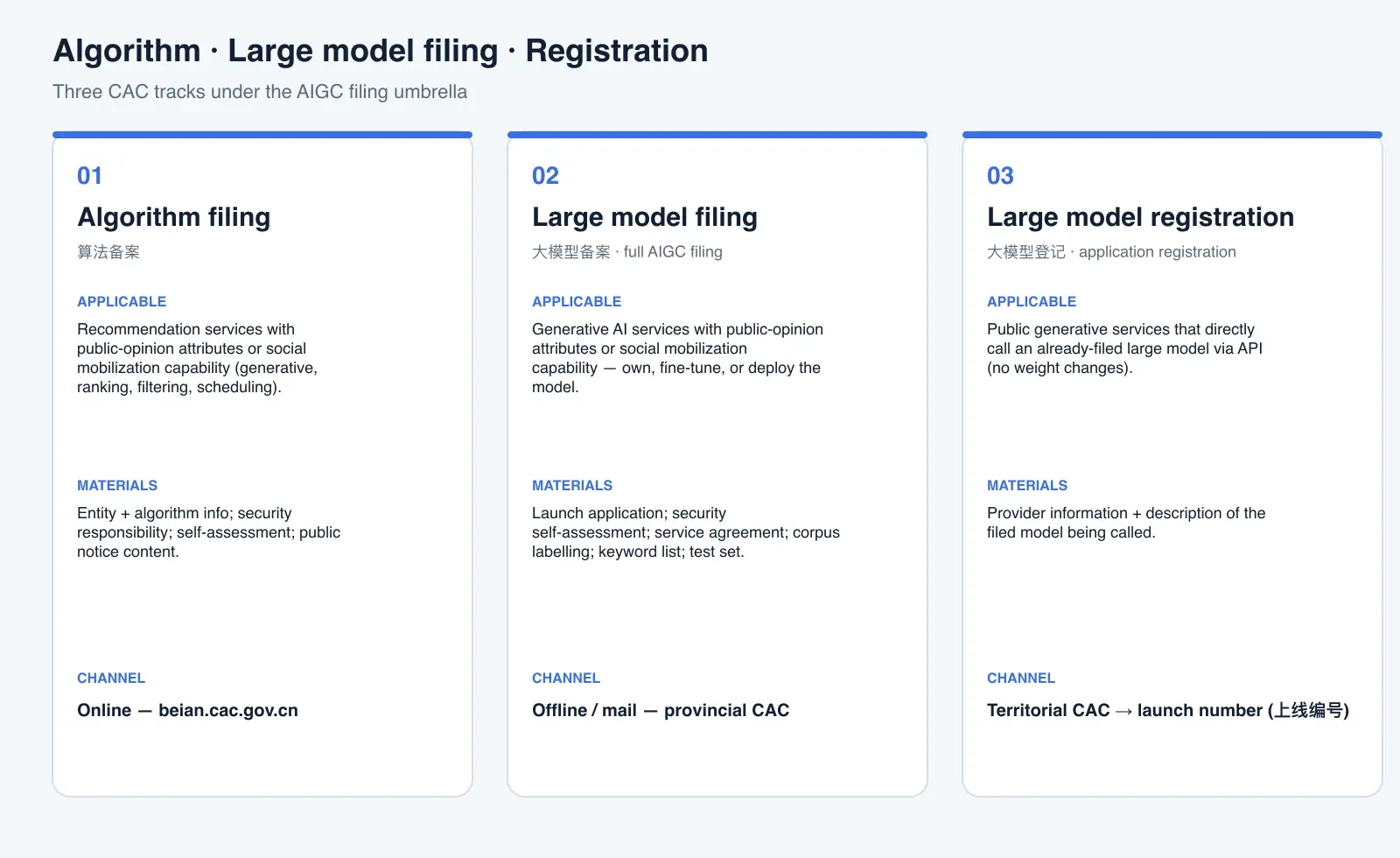
Critical path: which route applies?
The Interim Measures for the Management of Generative Artificial Intelligence Services (effective 15 August 2023) apply when a service uses generative AI to provide text, images, audio, video, or similar content to the public in Mainland China — including APIs, not only consumer chatbots. Industry briefings and CAC practice also frame generative and recommendation services that carry public-opinion attributes (舆论属性) or social mobilization capability (社会动员能力) as in-scope for the filing tracks below. Use both lenses when you scope the product; do not assume a private beta label removes a public endpoint.
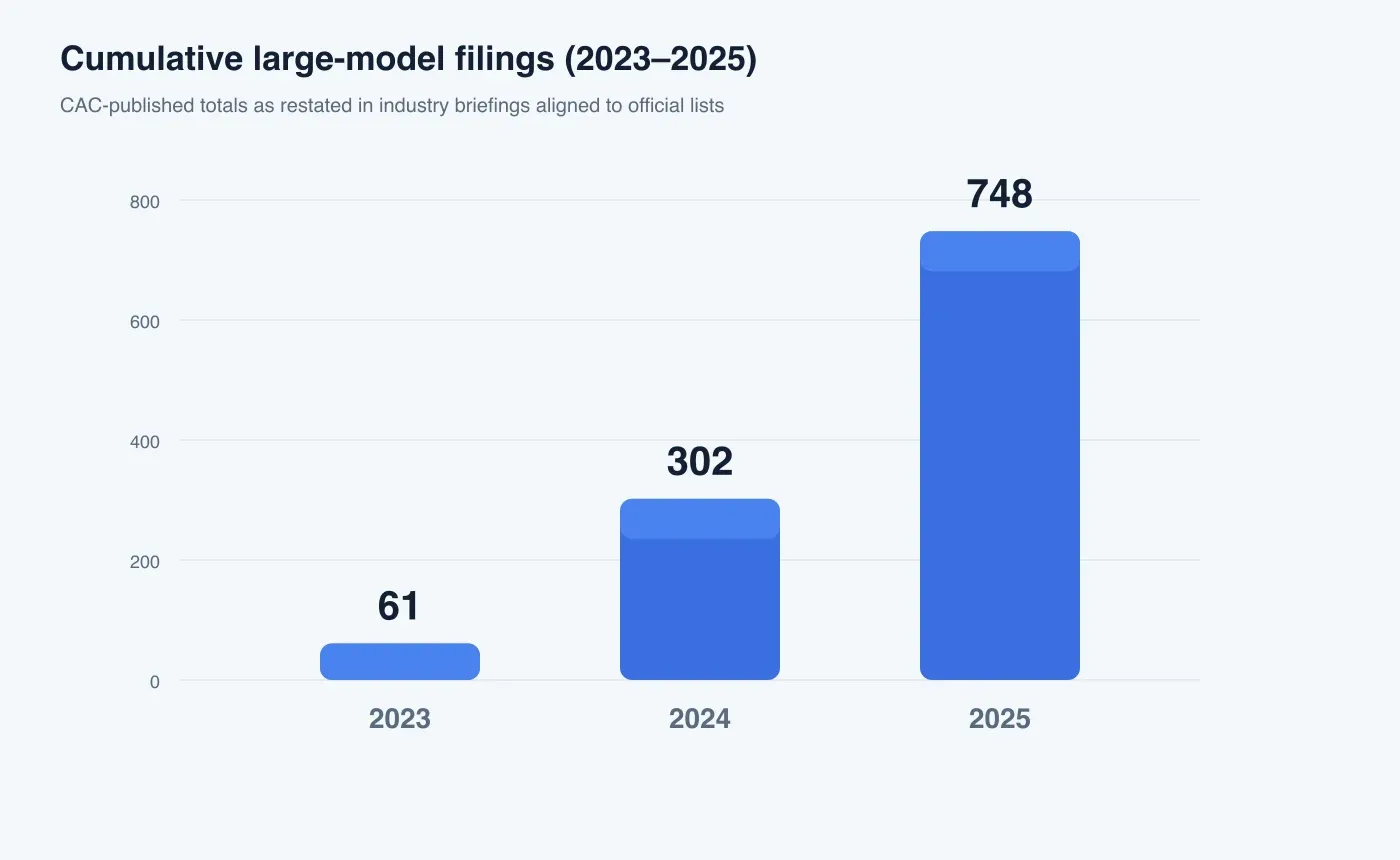
Scale: cumulative large-model filings
CAC-published cumulative large-model filings, as restated in industry briefings aligned to official lists, grew from 61 (2023) to 302 (2024) to 748 (2025). That curve is why “we will file later” is a poor launch plan: the registry is crowded, reviewers expect live controls, and registration still depends on calling a listed China-filed model.
Which track: algorithm, full filing, or registration?
| Product structure | Likely requirement (AIGC umbrella) |
|---|---|
| You developed your own foundation model | Full filing (大模型备案) |
| You independently deploy an open-source model | Full filing |
| You fine-tune or change model weights | Full filing |
| You operate a proprietary model in China | Full filing |
| Your app calls a China-filed model via API (no weight changes) | Registration (大模型登记) → launch number |
| Prompt templates or RAG over a filed model | Often registration — confirm with local CAC |
| China-facing product calls an unfiled overseas model | Simplified registration usually unavailable |
| Recommendation / ranking / generative algorithms with public-opinion or social-mobilization attributes | Algorithm filing (算法备案) — often in addition to model track |
| Genuine internal-only employee use | Generally outside AIGC filing |
Treat the official CAC list as the source of truth for which China model you can call for registration — not a vendor marketing page.
Common application scenarios
Large-model filing or registration shows up across product surfaces, not only general chatbots:
- Natural language processing (assistants, translation, text analysis)
- Software engineering (coding assistants, test generation)
- Digital marketing (copy and creative generation)
- Medical technology (assistive tooling — expect sector overlays)
- Financial services (customer and risk-facing generative tools)
- Multimodal applications (text + image / audio / video)
- Media and entertainment (content generation, digital humans)
Full-filing sequence (two-tier review)
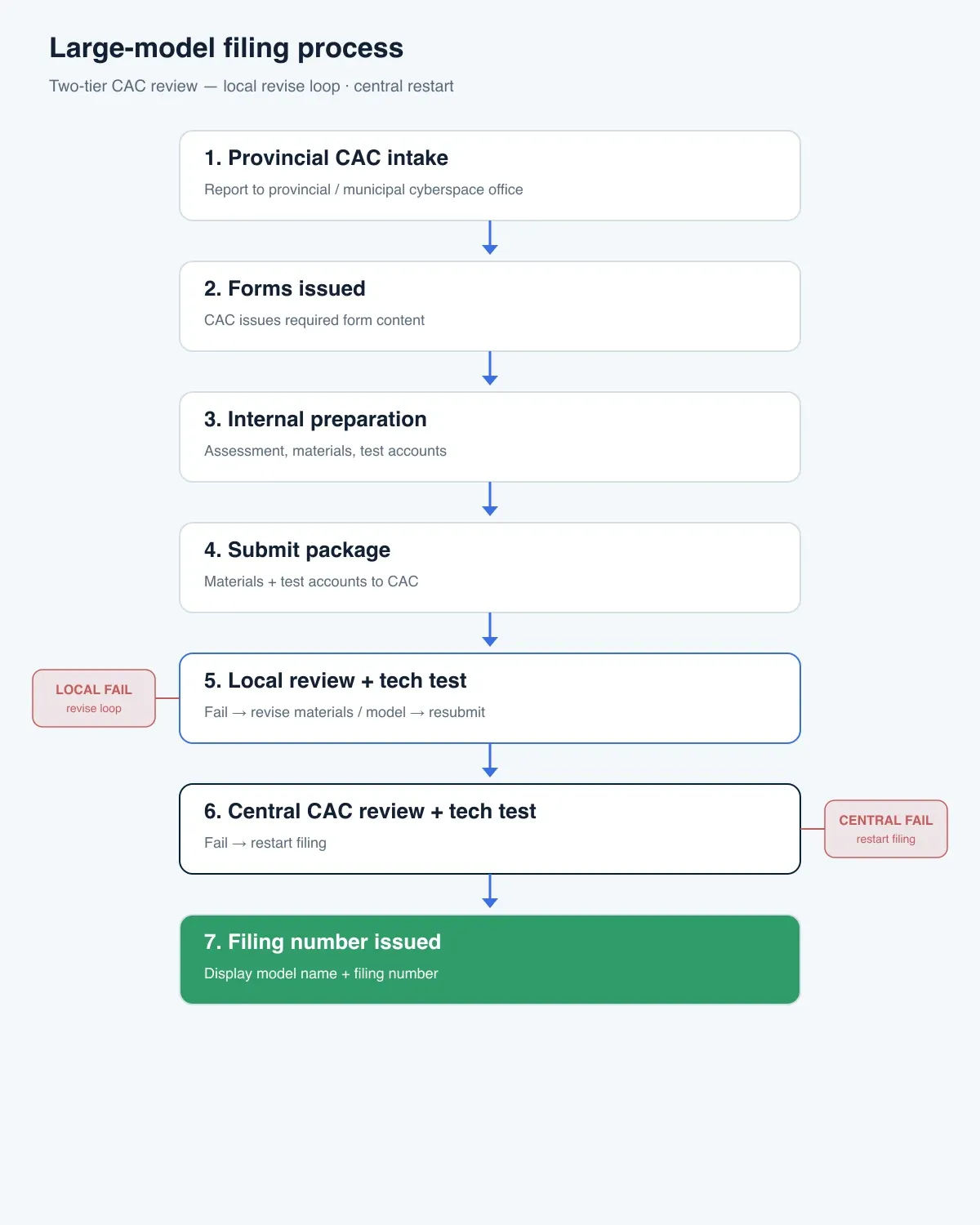
- Provincial intake — The enterprise providing generative AI services reports to the cyberspace administration of its province, autonomous region, or municipality (省 / 自治区 / 直辖市网信办).
- Forms issued — The CAC office issues the required form content and package expectations.
- Internal preparation — Run internal assessment, write materials, and prepare test accounts reviewers can use.
- Submit — Deliver material attachments and test accounts to the CAC office.
- Local review + technical testing — Territorial CAC reviews materials and tests the live service. On fail: revise materials or adjust model capability, then resubmit (loop).
- Central review + technical testing — Central CAC reviews materials and tests again. On fail: restart filing (unlike the local revise loop).
- Filing number issued — Display model name and filing number; keep change procedures after go-live.
Registration follows territorial CAC submission for services that directly call an already-filed large model; approval yields a launch number (上线编号), not a substitute for full filing when you own or fine-tune weights.
Channels and packages
Algorithm filing (算法备案) — Online submission via the CAC portal https://beian.cac.gov.cn/. Typical package themes include entity and algorithm information, implementation of algorithm security entity responsibility (落实算法安全主体责任情况), algorithm security self-assessment (算法安全自评估报告), and content to be publicized (拟公示内容). Applies when algorithm recommendation services carry public-opinion attributes or social mobilization capability (including generative/synthetic, personalized push, ranking, retrieval/filtering, scheduling/decision technologies).
Large-model filing / full AIGC filing (大模型备案) — Typically offline or mail to the provincial CAC (local rules vary). Common package pieces include:
- Generative AI (large language model) launch filing application form (生成式人工智能(大语言模型)上线备案申请表)
- Security self-assessment report (安全自评估报告)
- Model service agreement (模型服务协议)
- Corpus labelling rules (语料标注规则)
- Keyword interception list (关键词拦截列表)
- Evaluation and test question set (评估测试题集)
Also expect applicant/service, model architecture/version, training-data provenance, user-facing China-ready terms, and a stable test environment.
Large-model registration (大模型登记) — Submit provider information and a description of the already-filed model you call to the territorial CAC. On approval, a launch number (上线编号) is issued.
Parallel tracks still on the calendar
AIGC work does not replace Internet Content Provider (ICP) filing, commercial ICP / other VATS licenses, mobile app filing, Public Security Bureau (PSB) filing, classified cybersecurity protection, or sector approvals. Schedule those beside the model track.
Labelling is part of the same launch story. Since 1 September 2025, Measures for Labelling AI-Generated and Synthetic Content and GB 45438-2025 require explicit labels users can see or hear and implicit metadata labels for traceability. Labels must survive download/export where required. Filing without labelling readiness is incomplete product work.
China-specific failure points
Overseas unfiled model + China UI
Connecting a Mainland China–facing product to an unfiled overseas model blocks the light registration path. Full filing then needs deep technical evidence and cooperation from the model owner — often unavailable on a launch deadline. Prefer a China-filed foundation model for the China application layer unless you have budget and time for full filing.
Entity and internet licenses not scheduled in parallel
Finishing large-model filing or registration does not authorize hosting or store distribution. Foreign teams that “finish AIGC first” still stall on ICP, app filing, and PSB. Put those workstreams on the same calendar.
Single-track mistake
Algorithm filing and large-model filing/registration are separate channels and packages. Completing one does not close the other. Public generative services often need both (双备案) — and confusing registration with full filing leaves the wrong certificate on the wall.
Safety docs that do not match the live product
Local technical testing uses your test accounts. If the security self-assessment describes filters, refusals, keyword lists, or logging the live environment lacks, expect revise-and-resubmit loops. Written compliance without shipped controls is a schedule killer.
Central rejection means restart
Failing local review usually means fix materials or capabilities and resubmit. Failing central review typically means restart filing. Build schedule buffer for the worst branch, not only the happy path.
Post-approval drift and evidence gaps
After filing or registration you must keep filters, labels, complaint channels, and change filings current. Display the model name and filing number or launch number; treat it as an operating certificate. Full filing also expects training-data provenance many overseas teams never documented for regulators. If the model was trained abroad, gather that evidence early — or choose a filed China model and registration. Cross-border prompt and personal-information flows that stream every Mainland China user request to an overseas inference cluster may pass a demo and still fail compliance review.
Chinaready difference
Chinaready maps generative AI launches as a stack problem: which model can legally serve Mainland China users, which Chinese entity applies, and how AIGC (备案/登记), algorithm filing, ICP, and app workstreams share one calendar. We favor evidence-based route selection — full filing versus registration on a filed model — before engineering locks an overseas inference path that China cannot register. Contact Chinaready when your AI product needs that route decision early.
Frequently asked questions
What is China’s AIGC filing?
AIGC filing is Chinaready’s umbrella English term for CAC generative AI service compliance in Mainland China. Full filing maps to large-model filing (大模型备案). Application registration maps to large-model registration (大模型登记) when you call an already-filed model. Algorithm filing (算法备案) is related but separate.
Do I need full filing or only application registration?
Full filing if you own, fine-tune, independently deploy, or operate the generative model. Registration is often available when your product directly calls a China-filed large model via API without changing weights — subject to territorial CAC review, which issues a launch number (上线编号).
Is AIGC filing the same as algorithm filing?
No. Algorithm filing (互联网信息服务算法备案) runs online at beian.cac.gov.cn for recommendation algorithms with public-opinion attributes or social mobilization capability. Large-model filing is typically submitted offline or by mail to the provincial CAC. Many public generative services need both tracks.
Does AIGC filing replace ICP or app filing?
No. Completing large-model filing or registration does not authorize internet hosting or app distribution on its own. You may still need ICP filing, commercial licenses, mobile app filing, PSB filing, and sector approvals.
How long does AIGC filing take, and what are the review stages?
There is no guaranteed national SLA. Full filing is a months-long product workstream. Provincial intake is followed by local material review and technical testing (revise and resubmit if you fail), then central CAC review and technical testing (failure typically means restart filing), then a filing number.